Gabriela Gómez-Ochoa, Patricia Ortega-Chasi, Martha Cobos-Cali, Omar Alvarado-Cando, Karla Andrade-Castro (2023). Validation of affective images of the IAPS set in children. In: Neuroergonomics and Cognitive Engineering. AHFE Open Access, vol. 102, pp. 122–130. https://doi.org/10.54941/ahfe1003012
Emotions, in the field of Neuropsychology, are a topic of contemporary relevance due to the impact they have on a person's development. At the brain level, emotions arise from the activation of brain circuits in response to stimuli. Treatments have focused on traditional psychological intervention, which today, thanks to technological advances, includes the use of technology, so it is necessary to have available material that has been validated and standardized in the area where it is to be used, which is the subject of this study. The validation of 16 affective images from the International Affective Picture System (IAPS) set was carried out with the participation of 223 children between 6 and 8 years of age from a private, co-educational educational institution in Cuenca, Ecuador applying validation processes followed in other countries, adjusted to our context. The children's emotional responses were similar to those of the original test according to the statistical tests applied.
At the brain level, emotions arise from the activation of brain circuits in response to stimuli, which activate one of the human body’s primary moti- vational systems: the appetitive or defensive system, generating approach or avoidance behavior. Activation demands the intervention of 3 levels of response: physiological, motor, and cognitive, the latter comprising 3 dimen- sions: valence (pleasant–unpleasant), arousal (activated–calm) and control or dominance of the person over the emotional response (Bradley, 2009; Brad- ley et al., 2001; Lang, 1995). If the stimulus is positive, the appetitive system is activated, producing a feeling of security and stability; on the other hand, if the stimulus is negative, the defensive system is activated, generating a state of fear, insecurity, and avoidance. The emotional environments in the two cases are different, the second being more complex and affecting learning and levels of attention, since the individual’s thoughts are concentrated on how to solve or escape from the problem at hand, i.e., they remain in a state
Validation of Affective Images of the IAPS Set in Children 123
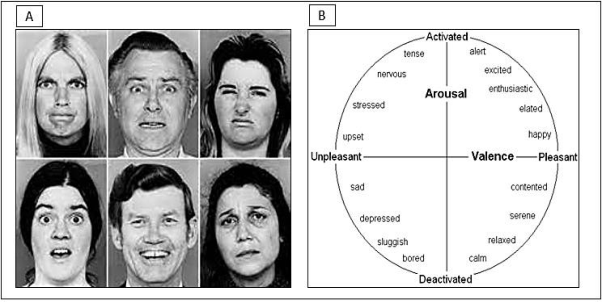
of constant alert in the face of situations that could be adverse (Fredrickson, 1998). Emotions are classified as discrete and dimensional. Those that correspond to the first classification are commonly called basic emotions and are six in number: anger, disgust, fear, happiness, sadness and surprise (Ekman, 1972). Dimensional emotions are classified according to their location in a space that is determined by two axes: arousal (intensity of emotions) and valence (appraisal of emotions) (Kragel and Labar, 2013). The latter is used in the field of psychology for self- report assessment.
In childhood, emotions develop from an early age. Observation, to be able to recognize and discriminate the expressions of the nearby adult, evolves into the ability to recognize and understand emotions, leading to self-awareness and self- understanding, that are strengthened along with the social spaces in which they are performed. The more a child’s social circle expands to include peers and adults in addition to their parents, the more they establish an under- standing of their own emotions and those of others and strengthen emotional bonds (Thompson, 2001; Loeches et al., 2004; Maguire et al. 2016). From this, the importance of emotionally stable childhoods arises, since experie- nces, coupled with personality and life background, will lead individuals to express their emotions in a unique way in the different environments in which they develop (Thompson, 2001).
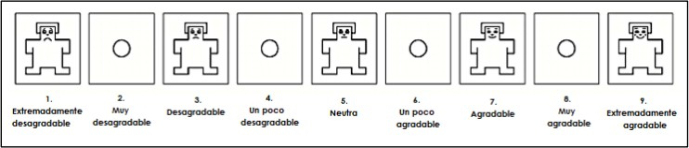
In the field of research, the evaluation of emotions is relevant and complex as it demands ethical, methodological, and instrumental processes that are in line with current needs. Images are an appropriate instrument for the eva- luation process; existing scientific studies carried out with affective images include those using the International Affective Picture System (IAPS) deve- loped by Lang et al. (2008), which is restricted and requires the signing of confidentiality protocols to access the 1195 color photographs. These pictu- res of objects, people, landscapes and everyday life are categorized according to the three dimensions: valence, arousal and dominance and are assessed by self-report using the Self-Assessment Manikin (SAM), which is a pictographic scale with values 1 to 9 that can be selected for analysis (Lang and Bradley, 1994).
Figure 1: Classification of emotions. A. Ekman’s discrete emotions, 1972. B. Represen- tation of Russell’s circumplex model (Trimmer et al., 2013).
METHODOLOGY
The validation of the 16 images of the IAPS set was developed in a quanti- tative and inferential study that made use of statistical values to determine the validity of the images used and to undertake a comparison between the original test and the study test.
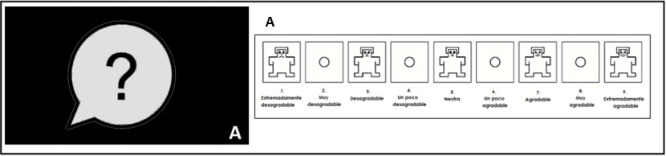
Instruments For validation, a digital presentation was prepared containing the script of the study presentation, 2 DEMO images, 16 study images on black back- grounds with appropriate labelling (lettering for demo images and numbers for study images), as well as the SAM scale. The 2 DEMO images were used to give instructions on how to carry out the activity, with no time limit for their execution. Each study image was projected for 6.5 seconds, of which 0.5 seconds were accompanied by a sound element to alert the child to the image already on the screen, and followed by a black screen for 15 seconds, which was the time allowed to record the assessment on the registration sheet using the SAM.
Complementing the digital presentation, the registration sheet included the Self-Assessment Manikin or SAM with a Likert scale from 1 to 9 in accorda- nce with the original study. The registration sheet was placed in a booklet, which included a cover sheet with identification data: code, group, date and name of the image set, followed by 18 sheets with the SAM pictograms (2 for the DEMO images and 16 for the study images).
Population and Sample The study population consisted of 343 students between 6 and 8 years of age from a private, co-educational school in the city of Cuenca, Ecuador, who were sent informed consent forms to be signed by their legal representatives, leaving a sample, following return of the forms, of 223 boys and girls.
Figure 2: SAM self-assessment manikin (Lang and Bradley, 1994).Table 1. Study sample (own elaboration).
Table available in the original PDF paper.
Sample n Children 117 Girls 106 Total 223
Validation of Affective Images of the IAPS Set in Children 125
Procedure Access to the Study Group In order to carry out the study, it was necessary to engage in dialogue with the authorities of the institution where it was to be carried out to obtain a letter of authorization. It was also necessary to present the necessary documenta- tion to the Human Research Committee of the University of Azuay (CISH UDA) to get permission to carry out the research, which included consent and informed consent forms addressing ethical issues such as: confidentia- lity, the right to anonymity, voluntariness, return of results, and the right to withdraw from the study.
Selection of Images To obtain images of the set, the intervention of the director of the Neurosci- ences Group of the University of Azuay was required, who carried out the due process with the Center for the Study of Emotion and Attention of the National Institute of Mental Health of the United States (NIMH). Having obtained access to the images, the 18 images for the study were randomly selected, from subsets of images with valences of 1–4 and with valences of 6–9, leaving aside the images with a neutral valence of 5 due to the origin of the study. In addition, exclusion criteria were established with respect to explicit sexual content and depictions of extreme violence due to the age of the participants; instead, the images immediately above in the list of valence measurements were chosen.
Due to the importance of the valence hierarchy, we chose to assess this dimension (Bradley, 2009; Bradley, Codispoti, Cuthbert and Lang, 2001; Lang, 1995).
Image Evaluation For the evaluation, a pilot phase was carried out to identify relevant issues with children of a similar age group and with similar characteristics to the sample; the results of this process determined the form of presentation of the booklet.
For the evaluation, groups of 8–11 students were assembled in the morning in a comfortable and well-lit room. A person trained in the assessment process with the children was available for support.
The screening began with the presentation of the study, the assent was read out and the process was explained using the DEMO images and the booklet.
Figure 3: Example of screen projection and evaluation in the self-assessment manikin (own elaboration).
When observing the projected image, the children had to indicate whether they found it pleasant or unpleasant using the SAM scales by marking the corresponding box in the booklet with an X.
After the demonstration with the DEMO images, the study images were evaluated.
Statistics Following the assessment by the 223 students, the data obtained were tabulated in three tables: overall (all participants), male and female, as was done in the original test. The data were processed using the R tool, from which descriptive data were obtained, as well as mean and stan- dard deviation values for comparison using chi- square. A comparative analysis between the study test and the original test was conducted using Spearman’s test, and coefficient of coincidence values were calculated as percentages.
RESULTS
The data obtained from the affective imagery assessment are presented below.
Image Validation Validation of the 16 images of the IAPS set is realized in the three tables showing overall, male and female mean and standard deviation values.
Note: Application of the study to all female students using the images from the IAPS set.
Comparison To determine the level of coincidence or not between the original test and the study test, data analysis was carried out using chi-square (χ2).
The values of the study test set were compared with the values of the study test set with an alpha value of 0.01. The p-values obtained from the comparison are greater than the alpha value, suggesting significant overlap.
The results of application of Spearman’s test using the mean values of the 16 images indicate a positive correlation in all three tables (overall, males and females) with proportions greater than 75%.
Validation of Affective Images of the IAPS Set in Children 129
General 0.8565124 81.25 Males 0.8617647 75 Females 0.8167773 87.50
DISCUSSION
Overall, the values obtained support the validation of the valence dimension of the 16 images from to the International Affective Picture System (IAPS) examined in the study for the evaluation of emotional response.
In the comparison, the obtained rho values of 0.8565124 (overall), 0.8617647 (males), and 0.8167773 (females) attest to the similarity of this validation study in Latin America with the original US study, despite the diffe- rences of age and culture. This suggests that the valence dimension of emoti- onal response is associated with neurobiological aspects, more than cultural or learning aspects (Gantiva et al., 2011; Gantiva et al., 2019; Mina et al., 2017; Silva et al., 2011).
CONCLUSION
The study results in the validation of 16 images from the IAPS set for studies of emotional responses in children.
The comparison undertaken suggests that the results of the study test are similar to those of the original test in all three tables: overall, male and female.
The data obtained provide a basis for future evaluations of emotional response using images that have been validated in our environment. As indi- cated at the beginning, it is intended to carry out these evaluations, in addition to the traditional way, by applying technological tools such as Eye Tracking and Virtual Reality, which are the main objectives of the research group.
It is recommended that more images be validated in order to expand the bank of visual material for research and/or therapeutic work in the area of psychology and neuropsychology.
REFERENCES
Bradley, M. (2009). Natural Selective Attention: Orienting and Emotion. Psychophysiology, 46(1), 1–11. doi:10.1111/j.1469–8986.2008.00702.x Bradley, M., Codispoti, M., Cuthbert, B., y Lang, P. (2001). Emotion andmotiva-
tion I: Defensive and appetitive reactions in picture processing. Emotion, 1(3), 276–298. doi:10.1037/1528- Bradley, M., y Lang, P. (1994). Measuring emotion: The self-assessment manikin and the semantic differential. Journal of Behavior Therapy and Experimental Psychiatry, 25(1), 49–59.https://doi.org/10.1016/0005-7916(94)90063-9 Ekman, P. (1972). Universal and cultural differences in facial expression of emo-
tion. En J. R. (Ed.), Nebraska symposium on motivation, 1971 (pp. 207–283). Nebraska University. Fredrickson, B. L. (1998). What good are positive emotions? Review of General Psychology, 2(3), 300–319. Kragel, P., y Labar, K. (2013). Multivariate Pattern ClassificationReveals Autono-
mic and Experiential Representations of Discrete Emotions. Author Manuscript, 13(4), 681–690. doi:10.1037/a0031820 Lang, P. (1995). The emotion probe. Studies of motivation and attention. American Psychologist, 50(5), 372–385. doi:10.1037/0003-066X.50.5.372 Lang, P., y Bradley, M. (1997). International Affective Picture System (IAPS): Technical Manual and Affective Ratings. https://www2.unifesp.br/ dpsicobio/adap/instructions.pdf Lang, P., Bradley, M., y Cuthbert, B. (2008). International Affective Picture System
(IAPS): Affective ratings of pictures and instruction manual (Technical Report A-8). University of Florida, Center for Research in Psychophysiology. Loeches, A., Carvajal, F., Serrano, J., y Fernández, S. (2004). Neuropsicología de la percepción y la expresión facial de emociones. Anales de Psicología, 2(20), 241–259.https://www.um.es/analesps/v20/v20_2/06-20_2.pdf Maguire, L., Niens, U., McCann, M., y Connolly, P. (2016). Emotional development
among early school-age children: gender differences in the role of problem beha- viours. Educational Psychology: An International Journal of Experimental Edu- cational Psychology, 36(8), 1408-1428. doi:10.1080/01443410.2015.1034090. Thompson, R. (2001). Infancy and Childhood: Emotional Development. En N. Smelser, & P. Baltes, International Encyclopedia of the Social & Behavioral Sciences (pp.7382–7387). Pergamon. Trimmer, P., Paul, E., Mendl, M., McNamara, J., y Houston, A. (2013). On the
Evolution and Optimality of Mood States. Behavioral Sciences, 3(3), 501– 521. doi:10.3390/bs3030501.
LISTED IN THE AHFE DIGITAL BOOKSTORE CATALOGUE
Explore the complete digital volume
Neuroergonomics and Cognitive Engineering
Read this individual research paper free through the original publisher, or explore the full digital proceedings book.
ISBN 978-1-958651-78-0
Explore this ISBN in the AHFE Bookstore ↗Listed in the July 2026 bookstore catalogue; search by ISBN to confirm current availability · Digital book purchase optional