Andrea Giorgi, Vincenzo Ronca, Alessia Vozzi, Pietro Aricò, Gianluca Borghini, Luca Tamborra, Ilaria Simonetti, Simone Sportiello, Marco Petrelli, Rodrigo Varga, Marteyn Van Gasteren, Fabio Babiloni, Gianluca Di Flumeri (2023). Multimodal characterization of mental fatigue on professional drivers. In: Neuroergonomics and Cognitive Engineering. AHFE Open Access, vol. 102, pp. 93–102. https://doi.org/10.54941/ahfe1003009
A non-adequate psychophysical condition represents a major factor in causing car accidents. In particular, 20% of car crashes are caused by mental fatigue and drowsiness, with dramatic consequences and fatalities. Nowadays strategies to reduce the risks while driving. The on-board systems equipping current vehicles are not able to intervene before the sudden onset of drowsy episodes and are affected by a poor accuracy resulting in several events’ misclassifications (i.e., false positive) causing drivers’ mistrust of technology.Being able to recognise in advance the occurrences of fatigue and drowsiness episodes would dramatically increase road safety and reduce car crashes. This is extremely relevant especially for professional drivers who drive for prolonged periods leading to an increase of risks due to not-proper psychophysical conditions. Even if professional drivers are trained to prevent, recognise, and minimize the effect of fatiguing, it must be considered that often the driver becomes conscious of drowsiness and mental fatigue onset too late, that is when it is already driving in a not-safe condition. The aim of this study was to adopt a multimodal approach to characterize the initial phases of fatigued mental state while driving, to develop an effective and timely detecting methodology. Ten volunteer professional drivers have been recruited to take part in an experimental protocol, performed in a car simulator. The experiment took place in the afternoon to increase the chance of eliciting mental fatigue and it consisted in driving for 45 minutes in a monotonous city-like environment. Before performing the monotonous driving task, participants were asked to drive for 15 minutes in a high-difficulty track race to induce fatigue, increasing the probability of a not-adequate psychophysical condition during the following monotonous driving task. Aiming at developing a neurophysiological model for mental fatigue characterization, a multimodal neurophysiological assessment was performed collecting the Electroencephalographic (EEG) and Electroculographic (EOG) signals. In parallel, behavioural assessment was performed through a secondary reaction task to detect eventual variation of performance from individual normal levels because of an altered psychophysical condition. Subjective measures were collected as well for the self-assessment of both fatigue and drowsiness state and task perception (high vs low demand). Behavioural and subjective measures have been so employed to (i) validate the experimental design; and to (ii) support and validate the employment of neurophysiological measures for characterizing the mental fatigue.
The World Health Organization (WHO) reported more than one million dea- ths related to road accidents (Global Status Report on Road Safety, 2018). This relevant aspect also reflects in an economic loss, costing 3% of countries gross domestic product (Global Status Report on Road Safety, 2018). Human factors play a crucial role in more than 70% of car accidents and it is now largely recognized as the main causes in more than 50% of them. For this rea- son, and thanks to the advance of technology and measuring systems, in the recent years a consistent research effort was focused on the drivers’ mental state (Pauzié, 2008; Frontiers, 2023). In this regard, several parameters can be considered to monitor drivers’ state. These include Eyeblink Rate (EBR) (Baby Shamini et al., 2022; Rahman et al., 2015), Heart Rate (HR) (Fujiwara et al., 2019; Sensors, 2023), Electroencephalography (EEG) (Houshmand et al., 2021; Simon et al., 2011) and driving parameters (PMC, 2023).
The present study aims at recognising the initial phase of fatigued driving by mean of a multimodal approach. While driving in a simulated environ- ment, professional drivers’ mental state was assessed by computing EEG and EOG related parameters. In parallel, a behavioural assessment was performed to objectively quantify the level of fatigue. Subjective reports were collected to validate the neurophysiological and behavioural measures. Results demon- strated the sensitivity of a previously developed Mental Drowsiness index (Frontiers, 2023) in detecting mental fatigue before this was measurable using other parameters such as EBR and behavioural performance.
MATERIALS AND METHODS
Participants and Experimental Setup Ten (10) professional drivers (10 male, 29.8 years old ± 4.2), with normal or corrected-to-normal vision were recruited to take part in the study. The experiment was conducted following the principles outlined in the Decla- ration of Helsinki of 1975, as revised in 2008, and it was approved by the Sapienza University of Rome and Roma Tre Ethical Committee. Experiments took place in the afternoon to ease a higher level of mental fatigue.
Experimental Protocol After an initial training phase, the neurophysiological activity in resting state was collected. Participants were asked to sit and close their eyes for one minute (EC condition). Then they were instructed to look at the main monitor for one minute without performing any task (EO condition, EO1). Subsequently, participants were provided with questionnaires (described below).
Then, participants had to drive in two simulated environments, a challen- ging and a monotonous one, in fixed order, according to what suggested by scientific literature (Thiffault and Bergeron, 2003; Garcia et al., 2010). The first simulation consisted in a 15-minute driving task in a high-demanding circuit. This task was performed to highly engage participants to increase the chance of fatigue episodes in the following monotonous driving task. After
Multimodal Characterization of Mental Fatigue on Professional Drivers 95
the Circuit another Eyes Open condition (EO2) was performed along with the questionnaire phase. The monotonous driving task consisted in a 45- minute driving in an easy and repetitive path without traffic. A speed limit of 40 km/h was set. A secondary task (Blanco et al., 2006), (Collet et al., 2009) was introduced in this monotonous driving task. This consisted in the presentation of a fake engine-failure alarm both acoustically and visually. Par- ticipants had to address the issue by pushing a button on the steering wheel. Reaction time needed push the button was took as performance of the secon- dary task. When this second driving task was completed, a last Open Eyes condition (EO3) and questionnaire phase was performed. A scheme depicting the entire experimental protocol is given below (Figure 1).
Subjective Assessment Along the experiment three questionnaires were provided. Karolinska Slee- piness Scale (KKS) (Kaida et al., 2006) and Chalder Fatigue Scale (Chalder) (Cella and Chalder, 2010) were presented at the arrival and after each driving task for fatigue rating. The Driver Activity Load Index (DALI) (Pauzié, 2008) was presented after each driving session. Below a description.
Karolinska Sleepiness Scale KSS asks participants to rate their state of sleepiness on a scale from 1 to 9 (Shahid et al., 2012). This scale measures the subjective level of sleepiness at a particular time during the day and therefore it is sensitive to fluctuations.
Chalder Fatigue Scale Chalder questionnaire asks participants to answer several questions on a scale from 0 to 3 (Cella and Chalder, 2010). In the original form, Chalder questions refer to two different dimensions called “physical symptoms” and “mental symptoms. Given the focus of this study (i.e., mental fatigue) only the que- stions related to this dimension were used (questions from 9 to 14 of the original questionnaire).
Driver Activity Load Index (DALI) DALI questionnaire (Pauzié, 2008) is designed to investigate the resources needed to perform a driving task. It is a modified version of the widely used NASA-TLX (Alaimo et al., 2020). In the implementation adopted for this study, the unweighted version of the test was used (rating of each dimension from 0 to 10).
Figure 1: Flow and phases of the experimental protocol.
Figure available in the original PDF paper.
Behavioural Assessment During the Monotonous condition participants were presented with 9 alarms at fixed intervals of around 5 minutes (all the intervals were different to avoid any anticipation). The assumption was that if the participant is impaired by any not proper-to-drive mental state the performance in this task would decrease.
Neurophysiological Assessment Electroencephalographic Signal EEG signal was collected using Mindtooth device (developed and validated during Mindtooth Project, GA 950998). It consists of 8 Ag/AgCl water-based electrodes placed according to the International 10–20 system (AFz, AF3, AF4, AF7, AF8, Pz, P3 and P4) plus a ground and reference electrodes pla- ced on mastoids. Data was collected with a sample frequency of 125 Hz. First, a fifth-order Butterworth filter was used to band-pass filter the EEG signal in the frequency range of 2–30 Hz. The Reblinca method (Flumeri et al., 2016) was used to identify the blink artifacts, rectified using the ocular component calculated using a multi-channel Wiener Filter (MWF). Epochs of 1 s were used to segment EEG data and if an amplitude greater than 80 (V) was found that epoch was marked as artifact (threshold criterion). The Glo- bal Field Power (GFP) for the EEG frequency band of interest Alpha, 10 Hz, was determined from the artefact-free EEG. The Individual Alpha Frequency (IAF) value was used to define this band in accordance with it (Klimesch, 2012). Participants were instructed to keep their eyes closed for a minute because the alpha peak is mostly noticeable during rest settings. The IAF value was then calculated specifically for each participant using such a criterion. Consequently, the EEG Alpha band was defined as Alpha = (IAF + 1): (IAF -1) Hz. Individual Alpha band over the parietal sites was used to compute a Mental Drowsiness Index (MDrow), as described in Ronca et al.(2021).
Electrooculographic Signal The electrooculographic (EOG) signal was derived from EEG data. The ver- tical EOG pattern was estimated by analysing the EEG AFz channel. This analysis was based on the application of a customized version of the Rebli- nca method (Di Flumeri et al., 2016) to isolate and identify the eyeblinks. The Eyeblinks Rate (EBR) parameter was then estimated for each minute during the monotonous driving task.
Statistical Analysis Normal distribution of the continuous variables (Reaction Times -RT- during secondary task, Alpha Power (EEG Feature), MDrow and EBR) was checked with Shapiro-Wilk Test. If confirmed, parametric test was performed, otherw- ise non-parametric test was used. For questionnaires, being non-continuous variables, non-parametric test was adopted. Authors refers to the experimen- tal conditions as: “Arrival” (data collected at participants’ arrival), “Circuit” (data about the first driving task in the circuit) and “Monotonous” (data
Multimodal Characterization of Mental Fatigue on Professional Drivers 97
about the second driving task in the monotonous environment). OE conditi- ons will be referred as: “EO1” (OE collected at participants’ arrival), “EO2” (OE collected just after the Circuit driving task) and “EO3” (OE collected just after the Monotonous driving task). RT, EEG Feature, MDrow and EBR data measured during the monotonous driving task were divided into three segments of 15 minutes each and averaged (1
, 2
and 3
segments).
RESULTS
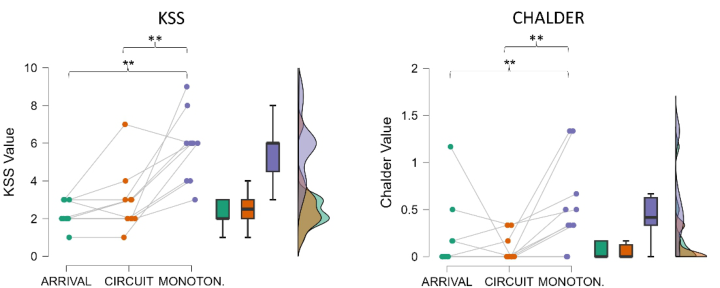
Subjective Assessment Statistical analysis of KSS and Chalder showed significant increases in both questionnaires with Friedman test resulting in p < 0.001 for KSS and p = 0.007 for Chalder (Figure 2). Post-hoc analysis showed higher level of perceived fatigue after the Monotonous driving task compared to both Circuit and Arrival ones.
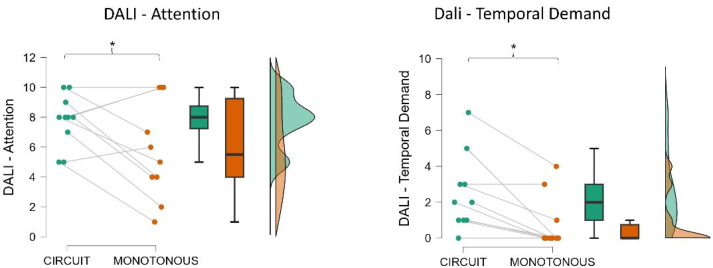
DALI analysis resulted in a not significant difference (p > 0.05). Investi- gating each dimensions significance was found for the dimensions Attention (p = 0.05, Figure) and Temporal Demand (p < 0.05), higher in Circuit task than in Monotonous one (Figure).
Behavioural Assessment Performance of secondary task were analysed with Friedman Test, but no significant variation was found (p > 0.05 Errore. L’origine riferimento non è stata trovata).
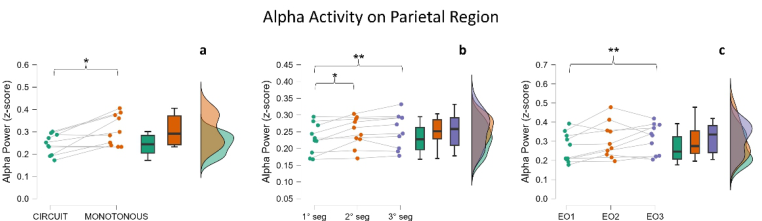
Neurophysiological Assessment Electroencephalographic Signal The MDrow Index is based on the increased EEG Alpha activity on parietal region (Frontiers, 2023). Sensitivity of this feature was then tested as a first step. T-test showed increased Alpha activity during the Monotonous condi- tion compared to the Circuit one (p = 0.02, Errore. L’origine riferimento non
Figure 2: Value and distribution of KSS and Chalder questionnaires value. Monotonous driving task induced higher level of perceived mental fatigue compared to both circuit and participants’ arrival (p < 0.01).Figure 3: Analysis of single dimensions of DALI showed a significant increase in terms of both Attention and Temporal Demand needed to perform the Circuit driving task (p < 0.05).Figure 4: Alpha activity on parietal region. Monotonous condition induced higher level of Alpha compared to Circuit one (p<0.05, a). Along the Monotonous condition, in the last 30 minutes (2◦and 3◦segments) Alpha activity was higher than the first 15 minutes (1◦segment), with p<0.05 (b). Assessment of EEG Feature while participants were not driving (OA conditions, c) revealed and increased Alpha just after the Monotonous condition compared to the activity collected at participants’ arrival (p < 0.01).
è stata trovata.a). Sensitivity along the Monotonous condition was then tested and the Alpha activity of the three segments revealed a significant increase (p = 0.002, Errore. L’origine riferimento non è stata trovata.b) with activity in the second and third segments higher than the first one (Bonferroni, p < 0.05 and p < 0.01 respectively). Alpha activity while participants were not driving was higher after the Monotonous condition (EO3) compared to the moment of arrival (EO1) (Bonferroni, p < 0.01, Errore. L’origine riferimento non è stata trovata).
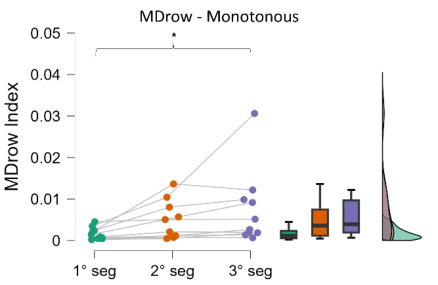
Once the sensitivity of the EEG Feature was confirmed, analysis on the MDrow Index was performed. The Index during the three segments was com- pared (ANOVA, p = 0.03, Errore. L’origine riferimento non è stata trovata.) and post-hoc test revealed higher level of fatigue in the last segment of the Monotonous task compared to the first one (p < 0.03).
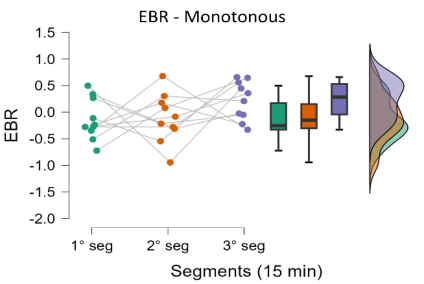
Electrooculographic Signal Eyeblink activity was analysed along the three segments of the Monotonous condition and no differences were found (ANOVA, p = 0.2, Figure 3).
Multimodal Characterization of Mental Fatigue on Professional Drivers 99
Figure 5: MDrow Index value during the Monotonous condition. Participants showed higher mental fatigue in the last segment compared to the first one (p<0.03).Figure 6: EBR during Monotonous condition. No significant difference was found betw- een the segments of the task (p>0.05) even if a tendency toward an increase is visible (3◦seg).
DISCUSSION
In this paper, two simulated driving tasks were adopted to induce mental fatigue. Participants were professional drivers working for delivery services in Rome and recruited to perform the experiment in the afternoon of the working day. Afternoon period, together with post-working shift hour, is the most affected by fatigue (PMC, 2023; Liu et al., 2016). The aim of this paper is indeed to apply a multimodal approach to detect the initial phase of fati- gue episodes. Prevention could be achieved only if it is possible to intervene before the effect of the mental fatigue are manifested in the driving behavi- our. Questionnaires, behavioural and neurophysiological measure provided both a subjective and objective evaluation of the drivers’ mental state. Par- ticipants perceived an increase of fatigue after driving in the Monotonous conditions compared to their arrival (Figure 2). They performed two driving tasks, the first one was a high-demanding task and the second one was a monotonous one. The choice to adopt these two tasks in this sequence was made because literature reports that moving to high-demanding activity to a
low-demanding one increases the occurrences of fatigue (Thiffault and Ber- geron, 2003; Fu et al., 2016). The activity load was then tested with DALI questionnaire. No significant difference was found in term of averaged load index of the two tasks (Errore. L’origine riferimento non è stata trovata.) but the analysis of the single dimensions of the DALI (Figure) revealed higher level of Attention and Temporal Demand for the Circuit driving task. A decrease of performance in the secondary task was expected with emerging fatigued mental state (Blanco et al., 2006; Collet et al., 2009). As showed, this decre- ase was not detected in this experiment (Errore. L’origine riferimento non è stata trovata.). Looking at the solely performance, it could be argued that the protocol did not induce a fatigued mental state.
An EEG based index, the MDrow Index (Frontiers, 2023), was adopted to detect mental fatigue. This index is based on the increased activity in Alpha band on parietal region. The first step was then to verify such an increase of Alpha activity during the Monotonous condition. The Alpha activity resul- ted higher in the Monotonous condition compared to Circuit one (Errore. L’origine riferimento non è stata trovata.a). Moreover, this EEG Feature resul- ted to be higher along the second and third segment of the Monotonous task compared to the first one (Errore. L’origine riferimento non è stata trovata.b). If the increased Alpha represented a proxy of a fatigued mental state, it should have been observed also shortly after the driving tasks. Analysis was per- formed on resting state data collected at participants’ arrival (EO1), after the Circuit (EO2) and after the Monotonous conditions (EO3). After the Monotonous driving task participants showed higher value of Alpha activity (Errore. L’origine riferimento non è stata trovata.c). These findings validated the reliability of the EEG feature underlying the MDrow index which was then computed. The value of this index at the end of the Monotonous dri- ving task resulted higher than the beginning, confirming what emerged from subjective reports. Correlates of mental fatigued in the eyeblink behaviour were investigated. Literature reports an increase of Eyeblink rate (EBR) when a fatigued mental state is experienced (Ko et al., 2020). EBR analysis resul- ted in a not significant increase during the monotonous condition (Figure 3). As for RT, this finding alone could be interpreted as sign of a not fatigued mental state. But considering together all the results, the picture could be dif- ferent: participants felt fatigued at the end of the experiment and as showed by MDrow analysis, they exhibited the cortical correlates of a fatigued men- tal state. Under this light, RT and EBR results could indicate that the mental fatigue experienced along the experimental session was not yet visible at beh- avioural level. Here, performance in the secondary task represented the time drivers needed to react to a sudden event which in a real context could be represented any sudden event while driving. On the other hand, EBR is one of the measures implemented in the on-board safety systems. EBR seemed not to be sensitive to an initial fatigued mental state and therefore not reliable in preventing fatigue-related car accidents. In this view, MDrow appeared to be only measure adopted in this study capable of recognising the occurrence of fatigue episodes before these episodes became evident at behavioural level, both with RT and EBR.
Multimodal Characterization of Mental Fatigue on Professional Drivers 101
This study proved the feasibility and reliability of detecting a fatigued mental state by using a simulated driving protocol. It also showed that it is possible to detect the early EEG correlates of these episodes before they become visible at other levels, such as reaction time and eyeblink behavi- our. This could improve work safety among professional drivers. Further implementation should include an increased pool of people as well as investi- gating how long it takes for symptoms associated with mental fatigue to show up in behaviour and EBR measures using a longer version of the monoto- nous driving task. Finally, future experiments will consider also information coming from other neurophysiological signals such as Electrodemal Activity and Heart Rate.
AKNOWLEDGMENTS This research was funded by European Commission through the Horizon 2020 Framework Programme projects “FITDRIVE: Monitoring devices for overall FITness of Drivers” (GA n. 953432); Authors want to thank all the FITDRIVE consortium members for their precious work.
REFERENCES
‘Frontiers | EEG-Based Index for Timely Detecting User’s Drowsiness Occurrence in Automotive Applications’. https://www.frontiersin.org/articles/10.3389/fnhum .2022.866118/full (accessed Feb. 09, 2023). ‘Global status report on road safety 2018’. https://www.who.int/publications-detail-
redirect/9789241565684 (accessed Feb. 13, 2023). ‘Online Detection of Driver Fatigue Using Steering Wheel Angles for Real Driving Conditions - PMC’. https://www.ncbi.nlm.nih.gov/pmc/articles/PMC5375781/ (accessed Feb. 09, 2023). ‘Sensors | Free Full-Text | Detection of Driver Drowsiness Using Wavelet Analy-
sis of Heart Rate Variability and a Support Vector Machine Classifier’. https://www.mdpi.com/1424-8220/13/12/16494 (accessed Feb. 13, 2023). A. Alaimo, A. Esposito, C. Orlando, and A. Simoncini, ‘Aircraft Pilots Workload Analysis: Heart Rate Variability Objective Measures and NASA-Task Load Index Subjective Evaluation’, Aerospace, vol. 7, no. 9, Art. no. 9, Sep. 2020, doi: 10.3390/aerospace7090137. A. Pauzié, ‘A method to assess the driver mental workload: The driving activity
load index (DALI)’, IET Intelligent Transport Systems, vol. 2, no. 4, pp. 315–322, Dec. 2008, doi: 10.1049/iet-its:20080023. A. Rahman, M. Sirshar, and A. Khan, ‘Real time drowsiness detection using eye blink monitoring’, in 2015 National Software Engineering Conference (NSEC), Dec. 2015, pp. 1–7. doi:10.1109/NSEC.2015.7396336. A. Shahid, K. Wilkinson, S. Marcu, and C. M. Shapiro, ‘Karolinska Sleepiness
Scale (KSS)’, in STOP, THAT and One Hundred Other Sleep Scales, A. Shahid, K. Wilkinson, S. Marcu, and C. M. Shapiro, Eds. New York, NY: Springer, 2012, pp. 209–210. doi: 10.1007/978-1-4419-9893-4_47. C. Collet, A. Clarion, M. Morel, A. Chapon, and C. Petit, ‘Physiological and behavioural changes associated to the management of secondary tasks while dri- ving’, Applied Ergonomics, vol. 40, no. 6, pp. 1041–1046, Nov. 2009, doi: 10.1016/j.apergo.2009.01.007.
G. Di Flumeri, P. Arico, G. Borghini, A. Colosimo, and F. Babiloni, ‘A new regressionbased method for the eye blinks artifacts correction in the EEG signal, without using any EOG channel’, Annu Int Conf IEEE Eng Med Biol Soc, vol. 2016, pp. 3187–3190, Aug. 2016, doi: 10.1109/EMBC.2016.7591406. I. Garcia, S. Bronte, L. M. Bergasa, N. Hernandez, B. Delgado, and M. Sevillano,
‘Vision-based drowsiness detector for a realistic driving simulator’, 13th Inter- national IEEE Conference on Intelligent Transportation Systems, pp. 887–894, Sep. 2010, doi: 10.1109/ITSC.2010.5625097. K. Fujiwara et al., ‘Heart Rate Variability-Based Driver Drowsiness Detection and Its Validation With EEG’, IEEE Transactions on Biomedical Engineering, vol. 66, no. 6, pp. 1769–1778, Jun. 2019, doi: 10.1109/TBME.2018.2879346. K. Kaida et al., ‘Validation of the Karolinska sleepiness scale against performance
and EEG variables’, Clin Neurophysiol, vol. 117, no. 7, pp. 1574–1581, Jul. 2006, doi:10.1016/j.clinph.2006.03.011. L.-W. Ko, O. Komarov, W.-K. Lai, W.-G. Liang, and T.-P. Jung, ‘Eyeblink recognition improves fatigue prediction from single-channel forehead EEG in a realistic sustained attention task’, J. Neural Eng., vol. 17, no. 3, p. 036015, Jun. 2020, doi: 10.1088/1741-2552/ab909f. M. Blanco, W. J. Biever, J. P. Gallagher, and T. A. Dingus, ‘The impact of
secondary task cognitive processing demand on driving performance’, Acci- dent Analysis & Prevention, vol. 38, no. 5, pp. 895–906, Sep. 2006, doi: 10.1016/j.aap.2006.02.015. M. Cella and T. Chalder, ‘Measuring fatigue in clinical and community settings’, Journal of Psychosomatic Research, vol. 69, no. 1, pp. 17–22, Jul. 2010, doi: 10.1016/j.jpsychores.2009.10.007. M. Simon et al., ‘EEG alpha spindle measures as indicators of driver fatigue under
real traffic conditions’, Clinical Neurophysiology, vol. 122, no. 6, pp. 1168–1178, Jun.2011, doi: 10.1016/j.clinph.2010.10.044. P. Baby Shamini, M. Vinodhini, B. Keerthana, S. Lakshna, and K. R. Meenatchi, ‘Driver Drowsiness Detection based on Monitoring of Eye Blink Rate’, in 2022 4th International Conference on Smart Systems and Inventive Technology (ICSSIT), Jan. 2022, pp. 1595–1599. doi: 10.1109/ICSSIT53264.2022.9716304. P. Thiffault and J. Bergeron, ‘Monotony of road environment and driver fatigue: A
simulator study’, Accident Analysis and Prevention, vol. 35, pp. 381–391, 2003, doi: 10.1016/S0001-4575(02)00014-3. R. Fu, H. Wang, and W. Zhao, ‘Dynamic driver fatigue detection using hidden Markov model in real driving condition’, Expert Systems with Applications, vol. 63, pp. 397–411, Nov. 2016, doi: 10.1016/j.eswa.2016.06.042. S. Houshmand, R. Kazemi, and H. Salmanzadeh, ‘A novel convolutional neural
network method for subject-independent driver drowsiness detection based on single-channel data and EEG alpha spindles’, Proc Inst Mech Eng H, vol. 235, no. 9, pp. 1069–1078, Sep. 2021, doi: 10.1177/09544119211017813. W. Klimesch, ‘Alpha-band oscillations, attention, and controlled access to stored information’, Trends in Cognitive Sciences, vol. 16, no. 12, pp. 606–617, Dec. 2012, doi: 10.1016/j.tics.2012.10.007. Y.-T. Liu, Y.-Y. Lin, S.-L. Wu, C.-H. Chuang, and C.-T. Lin, ‘Brain Dynamics in Pre-
dicting Driving Fatigue Using a Recurrent Self-Evolving Fuzzy Neural Network’, IEEE Trans Neural Netw Learn Syst, vol. 27, no. 2, pp. 347–360, Feb. 2016, doi: 10.1109/TNNLS.2015.2496330.
LISTED IN THE AHFE DIGITAL BOOKSTORE CATALOGUE
Explore the complete digital volume
Neuroergonomics and Cognitive Engineering
Read this individual research paper free through the original publisher, or explore the full digital proceedings book.
ISBN 978-1-958651-78-0
Explore this ISBN in the AHFE Bookstore ↗Listed in the July 2026 bookstore catalogue; search by ISBN to confirm current availability · Digital book purchase optional