Eusébio Conceição, João Gomes, Maria Manuela Lúcio, Domingos Viegas, Teresa Viegas (2022). Heat Transfer in a Pine Tree Trunk. In: Human Interaction & Emerging Technologies (IHIET 2022): Artificial Intelligence & Future Applications. AHFE Open Access, vol. 68, pp. 544–550. https://doi.org/10.54941/ahfe1002775
This article presents a numerical study on the heat and mass transfer in a pine trunk under the effect of a forest fire. The numerical model of the pine trunk is based on energy balance integral and differential equations. The virtual trunk geometry was developed using grid generation. The radiation heat exchanges are evaluated between the pine trunk and the plan surface of the front fire. These radiative exchanges are evaluated using view factors considering the grid generation in the tree and front fire. A fire front propagation at a constant fire spread rate of 0.01 m/s and a flame temperature of 500ºC were considered in this study. The field temperature evolution in the external surface and inside the pine trunk was obtained considering wind speed fluctuations with three different frequencies. In general, pine trunk temperatures increase with decreasing frequency of wind speed fluctuations.
The primary influences upon how fires move through the forests are humi- dity, topography, wind and temperature (Toši´c et al. 2019). The hotter the air temperature, the lower the relative humidity, and the lower the humi- dity, the drier the air is, so dry fuel ignites and burns more easily. The slope of the landscape is also important: fires burn much faster uphill than down (Eftekharian et al., 2019). This is because the radiation and convection a fire creates preheat the unburned fuel ahead of the flame front, and this is done more effectively upslope than down. Wind speed is the environmental vari- able that has the most significant effect on the spread of fires (Beer, 1991; Cruz and Alexander, 2019).
Wind can influence fire behavior by moving moist air away from fuels, causing them to dry out faster. It carries burning embers that have been lifted aloft by convection air and starting spot fires ahead of the perimeter. It bends the convection column, which promotes pre heating of unburned fuels in front of the fire. It brings a continuous supply of oxygen to the fire. Cruz et al. (2020) claim wind speed has an overwhelmingly dominant effect on the spread rate of wildfires when fuels are dry and the wind is strong.
The environmental wind fluctuates in both direction and speed, with incre- ased instability of the air implying greater fluctuations (Beer, 1991). Articles
on models of wildfire spread (Nelson, 2002), simulations of spread and beh- avior of two real fires (Jahdi et al., 2014), and fire spreads with varying wind strengths (Song and Lee, 2017) reveal important aspects for the study of the behavior of forest fires in the face of fluctuations in wind speed.
In this numerical study it is used a thermal response numerical model to evaluate the temperature evolution inside a pine trunk during a forest fire. This numerical model is based on the human body geometry, applied on the human thermal response numerical model (Conceição et al., 2010a; Conceição and Lúcio, 2016).
The purpose of this numerical study, using a grid generation model, is to get the field temperature evolution in the pine trunk in the presence of a forest fire for wind speeds with different fluctuation frequencies. Here, the forest fire is characterized by a front fire.
NUMERICAL MODELS The differential energy equations and the grid are utilized by the numerical model to evaluate the thermal behavior inside the pine trunk (made up of bark and cambium). The model considers energy balance equations at the boundary between the tree and the environment as follows:
Heat conduction with the interior of the tree;
Heat convection (natural, forced and mixed) between the tree surface and the air environment;
Radiation between the tree surface and the surrounding surfaces (fire front, fuel bed and sky).
The radiation heat exchanges are evaluated between the pine trunk and the plan surface of the front fire. These radiative exchanges are evaluated using view factors considering the grid generation in the tree and front fire. In the radiative exchanges determination, it is utilized a procedure similar to heat exchanges between surfaces of building spaces. This procedure is applied in the thermal response model of buildings (Conceição et al., 2010b; Conceição and Lúcio, 2010) and vehicle cabins (Conceição et al., 2000). A finite differe- nces implicit model is used in the assessment of the temperature distribution inside the pine trunk.
The pine trunk surface shape was developed by a numerical grid generation model using the finite differences method. This grid generation takes into account the conversion of a physical space into a computation space done by two Poisson’s type elliptic partial differential equations.
METHODOLOGY
The results of the numerical simulation are referred to the field temperature evolution in a pine trunk obtained considering wind speeds with three diffe- rent frequency fluctuations: A, 0.01 Hz; B, 0.005 Hz; and C, 0.0025 Hz. The fire front moves at a constant fire spread rate of 0.01 m/s from a distance of 4 m upstream of the pine trunk. The pine trunk has a height of 0.5 m and an external diameter of 0.4 m. The fire front has a tilt angle of 45°, 1 m wide,
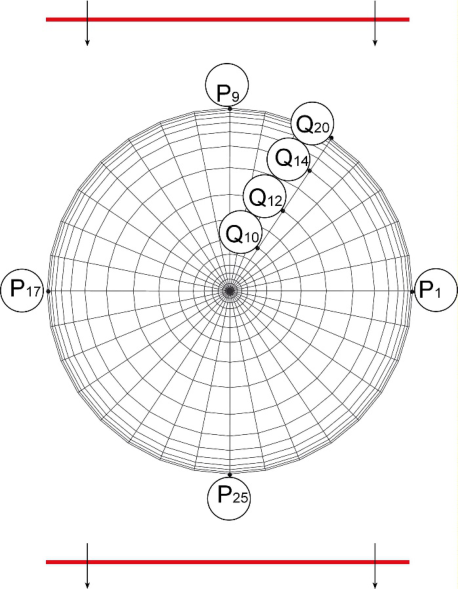
Figure 1: Location of 33 P-points on the external surface of the pine trunk and of 20 Q-points inside the pine trunk. The red line denotes the moving fire front.
2 m high and an average flame temperature of 500°C. As environmental con- ditions, there is an average wind speed of 5 m/s, an air temperature of 20°C and a relative humidity of 50% near the trunk. The temperature distribu- tion was obtained at 33 points (P) equidistant distributed along the external surface (bark) of the pine trunk in a plane located at a height of 0.5 m and at 20 points (Q) distributed along the radius of the pine trunk, as shown in Figure 1.
RESULTS AND DISCUSSION
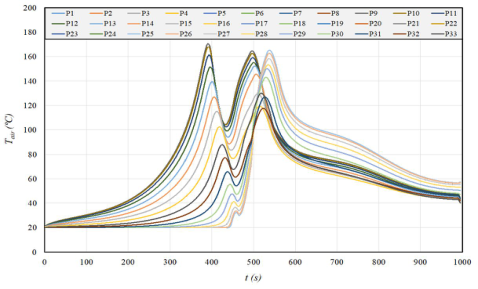
The evolution of the temperature distribution in the outer surface (points P1 to P33) of the pine trunk is shown for the three frequency fluctuations of the wind speed in, respectively, Figures 2a), 2b) and 2c). During its movement, the upstream side of the trunk is primarily affected by the fire. Due to the inclination of the fire front, points located on the surface of the upstream side of the trunk reach the highest temperatures. However, as the frequency of wind speed fluctuation decreases, the temperature amplitudes at the sur- face points of the trunk downstream increase significantly. It is found that fluctuations in trunk surface temperatures are due to fluctuations in wind speed.
Heat Transfer in a Pine Tree Trunk 547
(a)
(b)
(c)
Figure 2: Evolution of the temperature distribution in the outer surface of the pine trunk for the three frequencies of wind speed fluctuations: a) 0.01 Hz; b) 0.005 Hz; c) 0.0025 Hz.
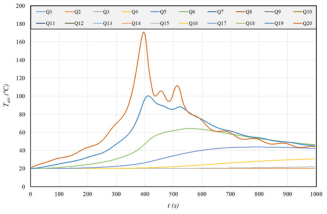
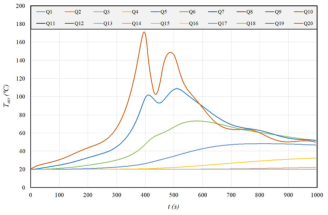
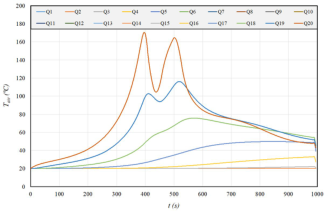
The evolution of the temperature distribution in the points Q1-Q20 loca- ted on the lines of the pine trunk radius, containing the points P9 and P25 (see Figure 1), for the three frequencies of wind speed fluctuations is shown in Figures 3, 4 and 5, respectively.
Considering the thermal response inside the pine trunk, in general, the temperatures on the upstream sides of the rings are higher than those on the
(a) (b)
Figure 3: For a frequency of 0.01 Hz of wind speed fluctuation, evolution of the tempe- rature distribution in the points Q1-Q20 located on the trunk radius containing: a) P9; b) P25.
(a) (b)
Figure 4: For a frequency of 0.005 Hz of wind speed fluctuation, evolution of the tem- perature distribution in the points Q1-Q20 located on the trunk radius containing: a) P9; b) P25.
(a) (b)
Figure 5: For a frequency of 0.0025 Hz of wind speed fluctuation, evolution of the tem- perature distribution in the points Q1-Q20 located on the trunk radius containing: a) P9; b) P25.
upstream side. It is also verified that the temperature variation occurs only in the four outermost rings and, in particular, in the outermost one (note that point Q20 is the point on the trunk bark). On the upstream side, the temperatures in the outer rings increase with decreasing frequency of wind
Heat Transfer in a Pine Tree Trunk 549
speed fluctuations. On the downstream side, the temperatures in the outer rings increase with decreasing frequency of wind speed fluctuations. On the downstream side the highest temperatures in the outer rings occur for the lowest frequency of wind speed fluctuations and the lowest temperatures in these rings occur for the intermediate frequency of wind speed fluctuations.
CONCLUSION
This article presented a numerical study on the thermal response of a pine trunk under the effect of a forest fire. The distribution of temperatures in the surface and inside the pine trunk was then obtained. The study was carried out considering wind speeds fluctuations for three different frequencies.
On the outer surface (bark) of the pine trunk and, in general, inside the pine trunk the temperature increases with decreasing frequency of wind speed fluctuations. Temperatures are higher at points on the upstream side than on the downstream side of the pine trunk due to the inclination of the flame during the displacement of the fire front. The outermost ring of the trunk is the one that experiences the greatest increase in temperature during the passage of the fire front.
ACKNOWLEDGMENT
The authors would like to acknowledge the support of the project reference PCIF/MPG/0108/2017, funded by the Portuguese Foundation of Science and Technology (FCT).
REFERENCES
Beer, T. (1991). The interaction of wind and fire. Boundary-Layer Meteorology 54, 287–308. Conceição, E., Silva, M., André, J., Viegas, D. (2000). Thermal behaviour simulation
of the passenger compartment of vehicles. International Journal of Vehicle Design 24(4), 372–387. Conceição, E., Rosa, S., Custódio, A., Andrade, R., Meira, M., Lúcio, M.
(2010a). Study of airflow around occupants seated in desks equipped with upper and lower air terminal devices for slightly warm environments. HVAC&R Research 16(4), 401-412. Conceição, E., Nunes, A., Gomes, J., Lúcio, M. (2010b). Application of a school building thermal response numerical model in the evolution of the adaptive ther- mal comfort level in the Mediterranean environment. International Journal of Ventilation 9(3), 287–304. Conceição, E., Lúcio, M. (2010). Numerical study of the influence of opaque exter-
nal trees with pyramidal shape in the thermal behaviour of a school building in summer conditions. Indoor and Built Environment 19, 657–667. Conceição, E., Lúcio, M. (2016). Numerical simulation of the application of solar radiant systems, internal airflow and occupants’ presence in the improvement of comfort in winter conditions. Buildings 6(3), 38. Cruz, M., Alexander, M. (2019). The 10% wind speed rule of thumb for estimating
a wildfire’s forward rate of spread in forests and shrublands. Annals of Forest Science 76, 44.
Cruz, M., Alexander, M., Fernandes, P., Kilinc, M., Sil, A. (2020). Evaluating the 10% wind speed rule of thumb for estimating a wildfire’s forward rate of spread against an extensive independent set of observations. Environmental Modelling and Software 13, 104818. Eftekharian, E. Ghodrat, M., He, Y., Ong, R., Kwok, K., Zhao, M., Samali, B. (2019).
Investigation of terrain slope effects on wind enhancement by a line source fire. Case Studies in Thermal Engineering 14, 100467. Jahdi, R., Darvishsefat, A., Etemad, V., Mostafavi, M. (2014). Wind effect on wildfire and simulation of its spread (Case study: Siahkal Forest in Northern Iran). Journal of Agricultural Science and Technology 16, 1109–1121. Nelson, R. (2002). An effective wind speed for models of fire spread. International
Journal of Wildland Fire 11, 153–161. Song, H., Lee, S. (2017). Effects of wind and tree density on forest fire patterns in a mixed-tree species forest. Forest Science and Technology 13(1), 9–16. Toši´c, I., Mladjan, D., Gavrilov, M., Živanovi´c, S., Radakovi´c, M., Putnikovi´c, S.,
Petrovi´c, P., Mistridželovi´c, I., Markovi´c, S. (2019). Potential influence of meteo- rological variables on forest fire risk in Serbia during the period 2000–2017. Open Geosciences 11, 414–425.
Read this individual research paper free through the original publisher, or explore the full digital proceedings book.
ISBN 978-1-958651-44-5
Explore this ISBN in the AHFE Bookstore ↗Listed in the July 2026 bookstore catalogue; search by ISBN to confirm current availability · Digital book purchase optional