Shujun Ban, Maria Rita Ferrara (2022). Promoting a teaching platform for "Traditional Skills + Virtual Reality Technology”. In: Human Factors in Virtual Environments and Game Design. AHFE Open Access, vol. 50, pp. 117–124. https://doi.org/10.54941/ahfe1002068
VR (Virtual reality) technology has been applied to teaching/learning in many contexts. Our interest focuses on the application of VR in design studies, allowing students to experience craft, (technical aspects, tools and methods), providing advanced means and methods for learning, and enabling the recovery and renewal of crafting and making. VR technology is used to simulate the space environment and technological process in the production process. Students will be brought into the simulated environment through different sensing devices, so that they can operate the objects in the virtual world by themselves, so as to enhance their feelings, deepen their understanding of the traditional technology, and better learn and create. Through survey sections we can achieve an understanding of students experience of VR for craft, and the enhancement of the teaching effect in a product design course. Finally, we can increase the inheritance and development of traditional skills among young people and in the future.
What we want to do is storytelling: crafters need to show their stories to much more people, especially to the young generation. There are lots of good stories about them and their skills all over the world. We, design teachers and craft- skill fans want to record and transfer these stories to our students and the new generation. In the past, we told what we heard, which could barely bring youngster’s interest. By VR, a high technology, the younger generation can immerse themselves in “real people and their real stories” and “experience” the stories. After they are interested in craft skills, they will actively learn and inherit them.
Imagine the whole project is a well-programming performance. The design students are our audience who prefer to immerse themselves into the show and interact with the main characters, who are the crafters with their skills as the show stories. How could we, as the director, organize and demonstrate this show to tell a good story? We need excellent lights, stage properties, stage design, monitoring, all of which will be prepared and arranged well to be a final perfect stage. Here, virtual reality technology is the stage.
We will explain this project by showing the stage: Virtual Reality (VR); the story: Craft Skills (CS); and the audience: Product Design education (PD). Then by analyzing the relationships of VR and CS, CS and PD, VR and PD, we will clearly understand why the director performs this big show.
PRODUCT DESIGN EDUCATION: PD Now let us look at the show’s key audience: students and the state of their available product design education.
The current teaching situation in most design universities is: when we start a new design course, the teacher will prepare the presentation, including the theoretical introduction and relevant design examples. In class, the teacher explains the slides then gives some assignments. After, the students will com- plete the design tasks: from the design research and analysis to the precise design direction; then they begin to design: brainstorming, using sketches or rough models to express their design ideas, group discussing, debating on the sketches, and finally coming to the design scheme to be deepen; then 3D software is used to model the final design in the form of computer renderings.
This process completes a design task. Sometimes the solid model will be further carried out, using mud, foamed plastic, cardboard, wood and other materials, producing and grinding out the final design presented by the physical scale or scale model.
During the design process of teaching and learning, the students see, draw and design primarily visual expression. The human-computer interaction, all the details, and the effect of material texture bringing the sense of touch can only rely on the imagination.
CRAFT SKILLS: CS As for the script of our performance, the craft skills (CS), mainly traditional handicraft, we can see its current situation of inheritance is in an awkward position.
Traditional handicraft carries the memory of cultures of different coun- tries, usually for thousands of years. However, with the development of The Times, traditional handicrafts are gradually marginalized. The craft industry is declining historically and economically as the number of inheritors dwind- les, and the younger generation’s lifestyle loses interest in traditional products (Shibata & Miyakawa, 2003).
VIRTUAL REALITY: VR VR is often described as a technology set that enables the audience to expe- rience a world beyond reality. The core is that virtual reality is a human experience. This technology is the purposeful use of human information pro- cessing systems – to mimic how we make sense of the world around us. As Harry Houdini describes: “What the eyes see, and the ears hear, the mind believes.” Computer algorithms simulate the virtual world, the display simu- lates the senses we are presented with, and our mind puts the pieces together to create the experience. If VR is well done, experiencing it can make users
Promoting a Teaching Platform for “Traditional Skills + Virtual Reality Technology” 119
believe they have a physical location, or a sense of presence, in the virtual world (Berg & Vance, 2017).
VR is being actively used in many industries to support making decisions and innovation (Berg & Vance, 2017). Virtual Reality allows people to make decisions about their environment in an increasingly natural way. Specifically, it is used to create believable environments where we can effectively decide about realities that do not yet exist and predict future outcomes.
Studying human-product interactions is also a bright spot for VR, especi- ally when physical prototypes are unavailable. Viewing and interacting with objects on a real scale seems to be one of the biggest revelations VR offers. Many participants spoke of finding great value in seeing life-size objects in the context of their intended environment (Berg & Vance, 2017).
Since 2010, over 4 billion dollars has been invested in VR start- ups (Benner & Wingfifield, 2016), expecting VR to revolutionize the entertainment, gaming, and education industries (Blascovich & Bailen- son, 2011; Standen & Brown, 2006; Taylor & Disinger, 1997). The mainstream media’s attention to VR and investments from major tech companies like Apple, Facebook, Google, Microsoft, and Samsung por- tend that VR will be used in many applications, including learning (Makransky & Lilleholt, 2018).
CS+PD With the popularity of handicrafts globally, various countries have paid more attention to the spread and development of national handicrafts. However, the current situation of design teaching is that when students accept design proposition in class, they can only learn about intangible cultural heritage by collecting relevant information from desk research (e.g., through websites), so it is almost impossible for them to grasp the essence of traditional handicraft and make innovation from it.
At this time, we (as teachers or directors) need a solid stage for directing good stories to our audience so that they can get close to and understand these stories.
VR+CS In recent years, many experts, scholars and even colleges worldwide have tried to display and interact handicrafts with VR technology and produced many fruitful “performance stories”. In the article “Reviving the past: cul- tural heritage meets virtual reality”, the authors declared that the immersive Virtual Reality (VR) systems, as the development of new interactive technolo- gies, has inevitably impacted the more traditional sciences and arts (Gaitatzes, Christopoulos & Roussou, 2001).
In 2004, a team of Japanese experts proposed a user-friendly three- dimensional CG presentation system for the typical Japanese crafting indu- stry based on the high-speed network’s agent and virtual reality functions. This system lets users interactively retrieve the required accessories and put these Japanese traditional interior designs into more creative and original
120 Ban and Ferrara
houses, hotels, and other buildings in real-time (Ishida et al., 2004). In 2006, Ishida et al. proposed the method of sharing space that enabled collabora- tive work in the virtual traditional crafting system based on the high-speed network (JGN2). They built a presentation system that deals with human sensitivity in a Virtual Reality environment. They proposed three different presentation systems of the Internet and SGI versions. The system allows users to retrieve more traditional handicrafts from the unified data of tra- ditional handicrafts across Japan (Ishida et al., 2006). In 2016, Iyobe and Misaki proposed and evaluated a mobile virtual traditional crafting presen- tation system consisting of the Content Browsing Mobile Application and the content management web application. The former provided information about the traditional craft and a high immersion feeling. The latter managed the traditional craft information and the traditional technique information treated by the Content Browsing Mobile Application. This research evalu- ated the necessity, effectiveness, operability, functionality, and readability of the mobile virtual traditional crafting presentation system (Iyobe et al., 2016).
More recently, Bosworth and Lakshmi (2018) witnessed a revolution in storytelling by analysing pioneering work across industries and the use of immersive technologies – Virtual Reality, Augmented Reality and Mixed Reality – to tell compelling stories.
These researches proved that VR still has many opportunities and poten- tialities to tell craft skills stories in bridging new media and giving form to classic stories (Bucher, 2017).
VR+PD Design education based on VR technology has been studied and promoted for many years. The technology used in education meets the expectations of today’s newest generation of students. Virtual Reality technology can also provide a platform for effective virtual labs in distance learning cour- ses (Abulrub, Attridge & Williams, 2011). The increasing development of VR technologies has matured enough to expand into more multidisciplinary areas (Gaitatzes, Christopoulos & Roussou, 2001). VR technology as a tool for education and training has the advantages of being safe, economical and controllable. In addition, Virtual Reality environments significantly enhance the learning experience as they provide a sense of reality and interactivity for learners. Much work presented shows that virtual reality technology can significantly improve the productivity of teaching and training, allowing users to apply theoretical knowledge to practical industrial problems. In addi- tion, it fosters creativity and innovation, communication, problem-solving, teamwork and business skills (Abulrub, Attridge & Williams, 2011).
Related to the application advantages of VR in the product design process, in the first stage of research and user analysis, it is possible to build a virtual environment for users, where designers can observe, record, measure, analyse users’ perspectives. In a project at WMG, the University of Warwick, the experts found that 3D VR technology enabled students to understand how to define requirements earlier in the New Product Introduction (NPI) process,
Promoting a Teaching Platform for “Traditional Skills + Virtual Reality Technology” 121
thus reducing the risk of losing profits or making products that do not meet customer expectations (Abulrub, Attridge & Williams, 2011).
During the second step of the design process, designers can adapt and repeatedly adjust according to the applying environment by VR tech- nology. Using animation to simulate product features can help to pre- dict future functional challenges. The study of ergonomics can be better understood through interactions between real people and virtual models (Berg & Vance, 2017).
In the verification phase of design, with advances in virtual techno- logy environments, designers can reduce physical prototypes by performing validation tasks early in the concept phase of the digital model.
In the future, a better understanding of 3D digital prototyping in the manu- facturing process will increase confidence in making decisions during the NPI process (Abulrub, Attridge & Williams, 2011). Virtual Reality provides a sui- table environment for design review, helping to reduce development time and cost and improving the quality and availability of new products.
VR+CS+PD The above six points (PD, CS, VR; CS+PD, VR+CS, VR+PD) fully describe the three keywords of this research project (VR, CS and PD) and the significance of their two-two addition. Based on the retrieval analysis and demonstration of these reasons, we carry out a combination experiment of these three to use VR as the stage to perfectly present CS stories for PD stu- dents, which is VR+CS+PD. In conclusion, the advantages of the project are:
- Interactivity: Virtual Reality technology can be integrated into Product Design teaching to simulate real-time learning, making, and creating craft products. It allows students to follow a “real life” demonstration and get immediate feedback at each step. Depending on the programming, they can even interact with a VR artisan. - Immersion: The real scene reproduction and real-time operation of VR will make it easy for students to immerse themselves in the learning and design process as if they were in an immersive handmade workshop, taught by the craftsman hand in hand. - Imagination: Virtual Reality technology can reduce the step of creating new product, make full use of computer software technology to perfect the product CMF (Color, Materials, Finish), choose the most suitable material and simulate the product in the environment, test and analysis. - Interdisciplinary: Immersive facilities VR enable people with different design goals to communicate in a shared experience across disciplines (Berg & Vance, 2017).
According to the three keywords of the VR+CS+PD project, we condu- cted an extensive search in academic index platforms (e.g. Scopus, cnki.net), and the results showed that there is a lack of literature more suitable for pro- duct design education. Only one paper is suitable for design students and
122 Ban and Ferrara
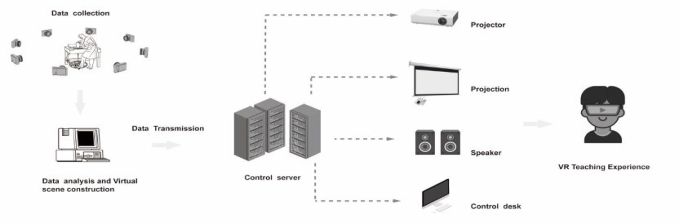
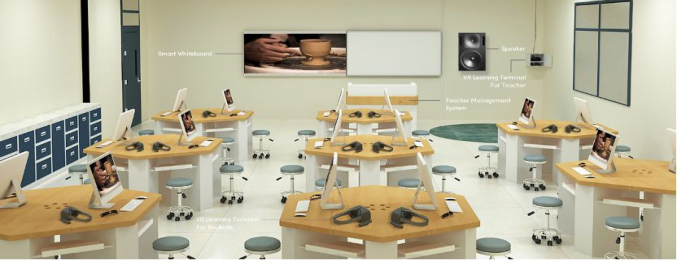
Figure 1: The process of VR+CS+PD project.Figure 2: Design classroom of VR+PD+CS project.
handicraft learning, but only 3D printing technology is mainly applied in the research.
To sum up, the data mentioned above shows that the VR+CS+PD project is original in the world at present, and the practical experiment to come is original too. This research must have groundbreaking and unique value and significance.
As shown in Figure 1, we will collect graphic and video data of a handi- craft skill, to revert its process, to build the data model and the interactive operation according to the requirements of the director (teacher), to complete database construction and data transformation, to generate the VR model. After that, by using VR output terminal equipments, students can immersive experience the arts of the craft in the virtual environment and innovate new creations in the process according to the director’s design in advance.
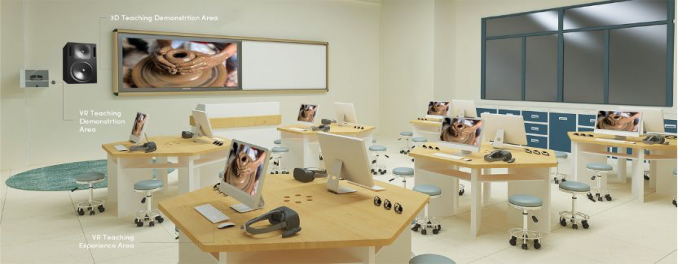
The plan of the design classroom is as in Figures 2 and 3. Virtual reality facilities utilize one or more of the following: a single large projection screen, multiple connected projection screens, stereo-capable monitors with desktop tracking, and head-mounted displays (HMDs). With the help of VR:
- It is possible to experience presented craft from all viewpoints. - It is possible to receive a presentation with a feeling near actual size. - It is possible to check the details.
Promoting a Teaching Platform for “Traditional Skills + Virtual Reality Technology” 123
Figure 3: Design classroom of VR+PD+CS project.
- It is possible to receive the presentation accompanied by the high feeling of hand-making (Shibata & Miyakawa, 2003). - It is possible to interest students strongly with craft skills. - It is possible to make craft skills and traditional craft skills much more popular than ever. - It is possible to innovate craft skills and develop a handicraft economy to promote the cultural heritage of all countries.
REFERENCES
Abulrub, A.G., Attridge, A.N. and Williams, M.A. (2011). ‘Virtual reality in engineering education: The future of creative learning’, in 2011 IEEE Global Engineering Education Conference (EDUCON). 2011 IEEE Global Engineering Education Conference (EDUCON), pp. 751–757. Berg, L.P. and Vance, J.M. (2017). ‘Industry use of virtual reality in product design
and manufacturing: a survey’, Virtual Reality, 21(1), pp. 1–17. Bosworth, M. and Lakshmi, S. (2018) Crafting Stories for Virtual Reality. Routledge. Bucher, J. (2017) Storytelling for Virtual Reality: Methods and Principles for Crafting Immersive Narratives. Taylor & Francis. Gaitatzes, A., Christopoulos, D. and Roussou, M. (2001). ‘Reviving the past: cultural
heritage meets virtual reality’, in Proceedings of the 2001 conference on Virtual reality, archeology, and cultural heritage. New York, NY, USA: Association for Computing Machinery (VAST ‘01), pp. 103–110. Ishida, T. et al. (2004). ‘Extended virtual traditional Japanese crafting system on CAVE’, in 18th International Conference on Advanced Information Networking and Applications, 2004. AINA 2004. 18th International Conference on Advanced Information Networking and Applications, 2004. AINA 2004., pp. 6–9 Ishida, T. et al. (2006). ‘Method of sharing virtual traditional crafting system based
on high-speed network’, in 20th International Conference on Advanced Infor- mation Networking and Applications - Volume 1 (AINA’06). 20th International Conference on Advanced Information Networking and Applications - Volume 1 (AINA’06), p. 5 Iyobe, M. et al. (2016). ‘Development of a mobile virtual traditional crafting presentation system using augmented reality technology’, International Journal of Space-Based and Situated Computing, 6(4), pp. 239–251.
124 Ban and Ferrara
Lee, E.A.-L. and Wong, K.W. (2008). ‘A Review of Using Virtual Reality for Learning’, in Pan, Z. et al. (eds) Transactions on Edutainment I. Berlin, Heidelberg: Springer (Lecture Notes in Computer Science), pp. 231–241. Makransky, G. and Lilleholt, L. (2018). ‘A structural equation modeling investiga-
tion of the emotional value of immersive virtual reality in education’, Educational Technology Research and Development, 66(5), pp. 1141–1164. Shibata, Y. and Miyakawa, A. (2003). ‘Kansei Information Processing and Virtual Reality Techniques for Japanese Traditional Crafting Presentation’, Multimedia Tools and Applications, 20(1), pp. 83–91. Taylor, G. L., & Disinger, J. F. (1997). The potential role of virtual reality in
environmental education. The Journal of Environmental Education, 28(3), 38–43.
LISTED IN THE AHFE DIGITAL BOOKSTORE CATALOGUE
Explore the complete digital volume
Human Factors in Virtual Environments and Game Design
Read this individual research paper free through the original publisher, or explore the full digital proceedings book.
ISBN 978-1-958651-26-1
Explore this ISBN in the AHFE Bookstore ↗Listed in the July 2026 bookstore catalogue; search by ISBN to confirm current availability · Digital book purchase optional