Wen-Chi Chen, Chih-Fu Wu (2023). Rehabilitation behavior intention of upper extremity stroke patients by IMVT. In: Human Factors in Virtual Environments and Game Design. AHFE Open Access, vol. 96, pp. 83–92. https://doi.org/10.54941/ahfe1003870
In recent years, studies have shown that mirror therapy can improve the rehabilitation effect of upper extremity stroke patients. On the other hand, with the advancement of virtual reality technology, relevant rehabilitation medical researchers have widely introduced virtual reality technology into the rehabilitation medical system. This pilot study investigates the effect of the integration of mirror therapy and virtual reality technology (IMVT) with somatosensory game elements on upper extremity stroke patients. Based on research ethics, patients with upper extremity stroke were first consulted about their willingness to participate in the experiment, and the experiment was carried out with the patients’ consents. In this preliminary study, a total of 38 upper limb stroke patients were willing to participate in this ethical research investigation. Thirty-eight patients included 21 males and 17 females, with an average age of 53.8 and 55.4, respectively, are shown a demonstration video, made by the physical health personnel, of how to operate the equipment integrating mirror therapy and virtual reality before participating the experiment. The upper limb stroke patients who agreed to participate in the experiment after browsing the video are given a questionnaire survey on the rehabilitation behavior intention of the patients. The questionnaire used in this research is based on the literature survey of extending the unified theory of acceptance and use of technology II(UTAUT2) proposed by Venkatesh et al. (2012), and the questionnaire items are selected through interviews with rehabilitation medical experts from accredited institutions. The content of the questionnaire included five exogenous variables, namely, "performance expectation", "effort expectation", "social influence", "hedonic motivation" and "game setting", one endogenous variable of "behavioral intention" as well as twenty indicators. The statistical tool PLS-smart was used to perform PLS-SEM (Structural Equation Modeling) analysis on the data. The analysis results found that "hedonic motivation" has a significant impact on "behavior intention" in the SEM model. According to patient interviews and SEM analysis, it can be inferred that the increase in content of hedonic motivation can improve patients’ rehabilitation behavior intentions. In contrast, since upper limb stroke patients still question this novel rehabilitation method, performance expectations, effort expectations, social influence, as well as, game setting, are insignificant in behavioral intention.
According to a December 9, 2020, report by the World Health Organiza- tion, stroke ranks second among the top ten causes of death, accounting for approximately 11% of deaths. Impairments caused by stroke include disturbance of consciousness, physical impairment (strength, large range of motion, and coordination), cognitive impairment (memory, language, and perception), visual impairment, emotional problems, and urinary disorders (Riddoch et al., 1995) which affects life quality and level of autonomy of individuals (Turolla et al., 2013).
In recent years, various emerging upper limb movement rehabilitation tre- atments have been developed. These treatments include constraint-induced movement therapy, electrical stimulation, machine-assisted therapy (Robot- aided therapy) and bilateral movement therapy (Oujamaa, Relave, Froger, Mottet, & Pelissier, 2009) etc. Mirror therapy (MT) is also one of the newer rehabilitation treatments in the past decade. MT was originally developed in the affected arm by Altschuler (Altschuler et al., 2008) as a possible way to help stroke survivors regain motor function. The mechanism by which MT improves motor function may be related to use-dependent cortical reorganization (Sathian et al., 2000).
At the same time, many scholars and therapists engaged in research rela- ted to medical rehabilitation in the world are integrating virtual reality (VR), augmented reality (AR), and mixed reality technology as the theore- tical basis and apply it to treatments for stroke patients. Researchers use a “User-Centered” approach to consider the utility, sensational, and immersive aspects of the treatment. They further utilize the interactive modes and strate- gies provided by the human-machine interface to carry out the development of various new rehabilitation treatments and rehabilitation technologies. In a recent randomized controlled study, VR using a 3D motion tracking system to adapt complex motor tasks in an augmented environment and a high- resolution screen displaying the virtual scene has been found to help improve upper extremity motor function after stroke (Kiper et al. 2018; Turolla et al., 2013). However, most existing VR-based rehabilitation focuses on training the proximal upper extremity, while studies on its effectiveness on the distal upper extremity are limited (Shin et al., 2016).
As a theoretical framework to analyse and present our results, we used the UTAUT2 (Unified Theory of Acceptance and Use of Technology 2) tech- nology acceptance model, devised by Venkatesh (Venkatesh et al., 2012). We believe this model provides a suitable framework for our findings. It is widely used, well understood, and is itself heavily empirically studied by numerous researchers.
Furthermore, due to the diversity of VR technology, the content of reha- bilitation games for stroke patients must consider that the operation process conforms to ethical norms. A video combining MT and VR was made for the researchers to operate in advance. Upper limb stroke patients were invited to conduct questionnaire surveys after watching the video recorded by the rese- archers. Before watching the film, the patients agreed to the test under the conditions where they were physically and psychologically comfortable and
Rehabilitation Behavior Intention of Upper Extremity Stroke Patients by IMVT 85
normal, and the test process was carried out in accordance with the research ethics.
Based on the above background, the purpose of this study is to explore the use of UTAUT2 framework and objective questionnaire to evaluate the beha- vior intention of IMVT in patients with upper extremity stroke. We will have a better understanding of the degree of intention of upper limb stroke patients to IMVT and the acceptance of other factors from the research. In addi- tion, this study will also provide researchers with a more in-depth research direction on IMVT and immersive rehabilitation games.
METHOD
This study consists of three parts: 1) Researchers edited rehabilitation videos integrating mirror therapy and virtual reality technology (IMVT). The con- tent of the video is in line with Brunnstrom’s research and is suitable for operation on patients with upper extremity stroke. 2) In order to comply with research ethics, the researchers simulated the operation of IMVT in pati- ents with upper extremity stroke and shot a demonstration video at the same time. The research team used the UTAUT2 framework design questionnaire to assess the intention of upper limb stroke patients to use this innovative rehabilitation game. 3) Upper extremity stroke patients watched the IMVT demonstration video and filled out the questionnaire to evaluate the intention of upper extremity stroke patients to use the rehabilitation game.
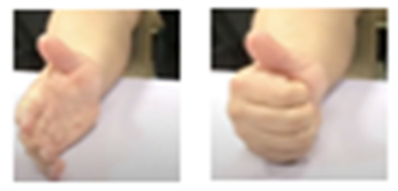
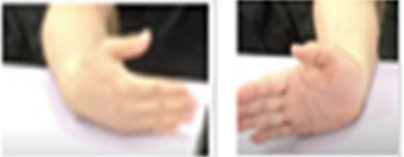
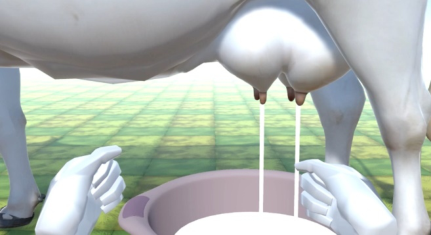
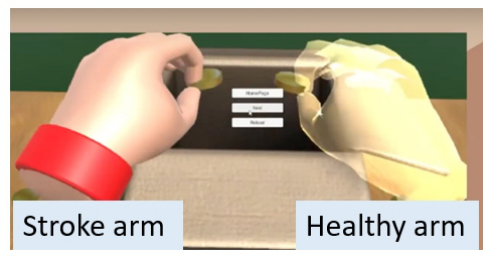
IMVT rehabilitation videos editing Based on the characteristics of Brunnstrom (Shah SK, 1984) patients with upper extremity stroke and the Brunnstrom stages 1 and 2 of the mirror training task, the researchers designed the scene of packaging milk bottles with the hand action game tasks of “fist open and clench” and “wrist bent and straight”in the milking scene, as shown in Figure 1, 2. Each game is set to 3 minutes per cycle, and 2 cycles are played each round, a total of 6 minutes per round of game, as shown in Figure 3. The completed IMVT movie screen is shown in Figure 4.
Researchers simulated the operation of IMVT as patients and shot a demonstration video After setting up the scene of the rehabilitation game for upper extremity stroke patients, the researchers began to shoot virtual reality videos. Through
Figure 1: “Fist open and clench”.Figure 2: “Wrist bent and straight”.Figure 3: The milking scene.Figure 4: The completed IMVT movie screen.
the virtual reality video, the healthy arm of the upper limb stroke patient will appear on the screen of the VR glasses. According to the principle of mirror therapy, the stroke side arm will also appear in the VR video, as shown in Figure 5. Upper extremity stroke patients can see their healthy and diseased arms on the screen of VR glasses. The mirror used in traditional mirror the- rapy is replaced by a program that automatically generates a stroke patient’s stroked arm embedded in a VR video. The IMVT video not only replaces the function of the mirror but also provides interesting rehabilitation games for upper limb stroke patients.
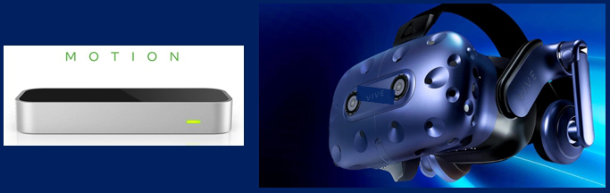
In order to comply with the research ethics, the researchers performed a simulation operation on IMVT in advance. This pre-test is helpful to understand whether IMVT will cause distress or harm to upper limb stroke patients, which is beneficial to subsequent research. The main equipment to operate IMVT includes human motion detection controller, virtual reality
Rehabilitation Behavior Intention of Upper Extremity Stroke Patients by IMVT 87
Figure 5: The stroke side arm appears in the VR video.
glasses and a personal computer for serial data transmission, as shown in Figure 6.
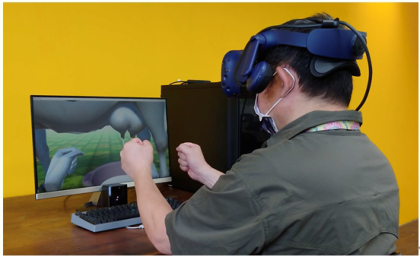
After the researcher wears VR glasses, the human body motion detection controller will detect the person’s healthy arm and at the same time, the per- son’s healthy arm and stroke arm will appear on the screen of the VR glasses. The researchers began to operate the rehabilitation game of milking, and the virtual stroke arm that appeared on the screen would also synchronize with the milking action. The situation of researchers operating IMVT is shown in Figure 7. Another group of researchers began filming people operating the IMVT and documenting the shortcomings of the IMVT that could be improved, such as height-adjustable chairs to accommodate stroke patients of different heights and genders.
Real upper extremity stroke patients watched the demonstration video of researchers operating IMVT and filled out the questionnaire.
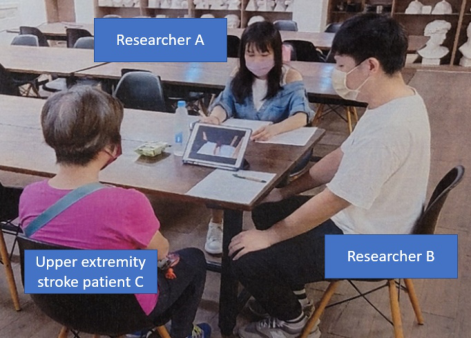
In the last step, we invited 38 upper extremity stroke patients, including 21 males and 17 females with an average age of 53.8, to participate in the IMVT experiment. During the experimental period when patients with upper extre- mity stroke filled out the questionnaire, in order to comply with the research ethics, two researchers accompanied the whole process of the interview to pay attention to the psychological feelings and physiological changes of the patients. The researchers actively asked the patients every 10 minutes whether they had symptoms of rapid heartbeat, dizziness and nausea. If they had the above symptoms, they would stop the interview immediately. If they did not,
Figure 6: Human motion detection controller and Virtual reality glasses.Figure 7: The situation of researchers operating IMVT.Figure 8: The interview status of upper extremity stroke patients.
the questionnaire interview would continue. The interview status of upper extremity stroke patients is shown in Figure 8.
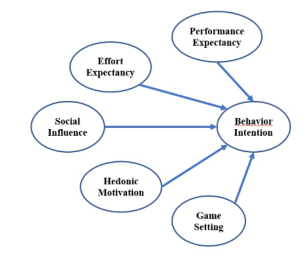
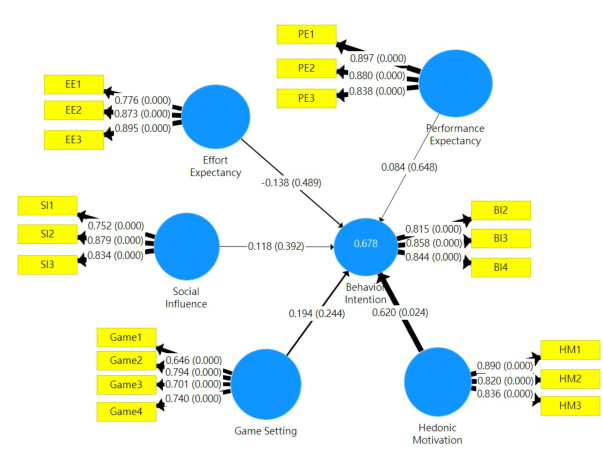
ANALYSIS This study uses PLS-SEM (partial least squares structural equation modeling) to analyse the causal model among latent variables. The structural diagram of the behavior intention of upper extremity stroke patients to IMVT esta- blished by PLS-SEM (partial least squares structural equation modeling) is shown in Figure 9. The statistical tool used in this research is SmartPLS, which has the advantages of being able to deal with multiple dependent and independent variables, collinearity issues, regression modeling under severe multicollinearity conditions, and the ability to simultaneously handle reflective indicator and formative indicators are suitable for small samples, allowing regression modeling when the number of samples is less than the number of variables.
Regarding the validity of the questionnaire, the construct validity used in this study includes convergent validity and discriminant validity (Fornell and
Rehabilitation Behavior Intention of Upper Extremity Stroke Patients by IMVT 89
Figure 9: The structural diagram of the behavioral intention of upper extremity stroke patients to IMVT.
Larcker, 1981). The analysis of convergent validity adopts composite reliabi- lity (CR) of latent variables, the recommended value is above 0.6 and the AVE (Average Variance Extracted) value of latent variables; the suggested value of AVE is above 0.5. The results showed that the AVE values of all factors were greater than 0.5 and the CR values were greater than 0.6. In contrast, the values of Cronbach’s α coefficients for evaluating Internal Consistency Reli- ability are all greater than or equal to 0.7, indicating that the questionnaire meets the internal consistency validity. The CR and AVE values of each latent variable in this study model are above the recommended value, indicating that this study has good convergent validity, as shown in Table 1.
In addition, the factor loadings related to each factor must be greater than the factor loadings of other factors, indicating good convergent validity and discriminant validity. The results of Cross loading of behavior intentions towards IMVT in patients with upper extremity stroke are shown in Table 2.
Figure 10 presents the PLS-SEM path analysis diagram of 6 factors (BI, PE, EE, HM, SI, GS) and 19 indicators. The analysis results show that in the SEM model, “hedonic motivation” has a significant impact on “behavio- ral intention”. The path coefficient of “hedonic motivation” to “behavioral intention” is 0.620 and the P value is 0.024 less than 0.05. As for the other four latent exogenous variables “performance expectation”, “effort expecta- tion”, “social influence” and “game setting”, they had no significant impact on “behavioral intention”.
Table 1. Reliability and validity of the questionnaire on behavioral intentions towards IMVT in patients with upper extremity stroke.
Figure 10: The PLS-SEM path analysis diagram of 5 factors (BI, PE, EE, HM, SI, GS) and 19 indicators.
CONCLUSION
Based on interviews with upper extremity stroke patients, the researchers understand that patients still have doubts about the innovative approach to
Rehabilitation Behavior Intention of Upper Extremity Stroke Patients by IMVT 91
IMVT rehabilitation. Therefore, the three exogenous latent variables “per- formance expectation”, “effort expectation” and “social influence” have no significant impact on “behavioral intention”. As for “game setting”, there is no significant effect on “behavioral intention”, since patients can only bro- wse the demonstration video of researchers operating IMVT, and they cannot change the setting of the rehabilitation game. Nevertheless, upper extremity stroke patients are highly interested and are positively aware of the recreati- onal effects of the innovative IMVT and thus having a significant impact on “hedonic motivation”.
Because the game content of the IMVT movie needs to be suitable for every upper limb stroke patient with different degrees of injuries, researchers and rehabilitation therapists are performing follow-up studies that can edit reh- abilitation game videos according to patients’ different needs for “hedonic motivation”. Furthermore, in order to eliminate the doubts of upper extre- mity stroke patients about the content and operation of IMVT rehabilitation games, researchers can conduct in-depth research on the psychological and physical discomfort symptoms caused by operating VR. The research team believes that IMVT is an efficient and recreational rehabilitation method for upper extremity stroke patients in the near future.
ACKNOWLEDGMENT
I would like to thank Professor Chih-Fu Wu, and Yang Chu-Jun for their valuable suggestions on the paper and the Ministry of Science and Technology for providing funding.
Funding: The study was financially supported by MOST 111-2410-H- 036-002-MY2.
REFERENCES
Altschuler EL, Hu J. Mirror therapy in a patient with a fractured wrist and no active wrist extension. Scand J Plast Reconstr Surg Hand Surg 2008; 42: 110–111. Fornell, C, Larcker, DF. Evaluating structural equation models with unobservable
variables and measurement error. J Mark Res 1981; 18 (1): 39–50. https://www.who.int/news-room/fact-sheets/detail/the-top-10-causes-of-death. Kiper P, Szczudlik A, Agostini M et al. (2018) Virtual reality for upper limb rehabilitation in subacute and chronic stroke: a randomized controlled trial. Arch Phys Med Rehabil 99:834–842. Oujamaa, L., Relave, I., Froger, J., Mottet, D., & Pelissier, J. Y. (2009). Rehabi-
litation of arm function after stroke: Literature review. Annals of Physical and Rehabilitation Medicine, 52 (3), 269–293. Riddoch, M. J., Humphreys, G. W., Bateman, A., 1995. Stroke: Stroke Issues in Recovery and Rehabilitation. Physiotherapy. 81(11), 689–694. doi: https://doi.or g/10.1016/S0031- 9406(05)66623-0. Sathian K, Greenspan AI, Wolf SL. Doing it with mirrors: a case study of a novel
approach to neurorehabilitation. Neurorehabil Neural Repair 2000; 14: 73–76. Shah SK. Reliability of the Original Brunnstrom Recovery Scale following hemiplegia. Aust Occup Ther J 1984; 31: 144–51.
Shin JH, Kim MY, Lee JY et al. (2016) Efects of virtual reality-based rehabilitation on distal upper extremity function and health-related quality of life: a single-blinded, randomized controlled trial. J NeuroEng Rehabil 13(1):17. Turolla, A., Dam, M., Ventura, L., Tonin, P., Agostini, M., Zucconi, C., Kiper, P.,
Cagnin, A., Piron, L., 2013. Virtual reality for the rehabilitation of the upper limb motor function after stroke: a prospective controlled trial. J. Neuroeng. Rehabil. 10, 85. doi: 10.1186/1743-0003-10-85. Venkatesh V, Thong JYL, Xu X. Consumer acceptance and use of information technology: extending the unifed theory of acceptance and use of technology. MIS Quart. 2012.
LISTED IN THE AHFE DIGITAL BOOKSTORE CATALOGUE
Explore the complete digital volume
Human Factors in Virtual Environments and Game Design
Read this individual research paper free through the original publisher, or explore the full digital proceedings book.
ISBN 978-1-958651-72-8
Explore this ISBN in the AHFE Bookstore ↗Listed in the July 2026 bookstore catalogue; search by ISBN to confirm current availability · Digital book purchase optional