Byungjoon Kim, Jinkun Lee, Emma Kloth (2022). Application of Virtual Reality to Instructions of Manual Lifting Analysis. In: Human Factors in Virtual Environments and Game Design. AHFE Open Access, vol. 50, pp. 84–91. https://doi.org/10.54941/ahfe1002064
Application of virtual and augmented reality has been popular in various areas such as education, entertainment, training, communication, design, therapy, and more. In education, particularly, virtual reality (VR) has been widely used by researchers or educators to create interactive instructions for interesting problem in alternatively real-like environments. Educators have recognized the potentials of VR to educational instructions in traditional classrooms where the environment of instructions would be limited to two-dimensional space and third-person’s view to a problem. Application of VR can allow students to be placed themselves into a virtual environment of interest with more immersive perception of problem conditions and application of instructions. In the literature, a considerable number of studies have applied digitalization technologies including virtual and augmented reality in design of process of workstations, manufacturing workplaces, and maintenance activities. In general, most of studies evaluated potentials of application of virtual reality from the perspective of fidelity, usability, and cost, but not from the perspective of effectiveness of instructions. In traditional instructions of manual lifting analysis, workplace or task conditions for manual lifting are usually given by statements, sometimes with pictorial descriptions. From the perspective of learners who need to investigate and analyze lifting tasks, it would be necessary to convert two-dimensional descriptions of task conditions into three-dimensional spaces for better understanding of tasks. However, the conversion would be limited with individual’s capability of imaginary perception. Providing virtual task environment for lifting task conditions to learners would be very helpful to understand underlying conditions for lifting task. The objective of this study was to design a teaching aid to improve instructions in virtual reality environments and to compare effectiveness of instructions between traditional instructions and virtual reality instructions. One exemplary lifting task published by Centers for Disease Control and Prevention was designed by using the Unity software. This example may be used by other educators to develop their own virtual instructions for different task analyses.
Learning outcomes in engineering education have relied on effectiveness of teaching instructions for discipline. However, since styles of instructions vary from one instructor to another instructor even for the same subject, student’s learning outcome may be dependent upon instruction approach (Michael 2006). Since engineering education has been predominantly descriptive tra- ditionally, opportunities for students to learn materials based on their own learning styles have been low. Teaching styles in higher education, howe- ver, has been consistently challenged and been changed to student-oriented instructions of which students are encouraged to actively engage with the learning material by analyzing the concepts taught by the instructor and understanding the discipline rather than passively accepting the instructed material without comprehending (Christie and de Graaff, 2017; Hernandez- de-Menendez et al. 2019). It is called an active learning teaching style that many studies (Michael, 2006; Koh et al. 2008; Sisk, 2011; Freeman et al. 2014; Betihavas et al. 2016) has shown a significant impact on student learning.
Application of Virtual Reality to Instructions of Manual Lifting Analysis 85
Virtual Reality (VR) has been emerged as an active learning teaching style for students to learn materials with driven engagement and motivation to learn through high levels of interactivity with VR programs (Brewer et al. 2012; Stepan et al. 2017; Harrington et al. 2018). A number of studies (Tera- nishi and Yamagishi, 2018; Makransky et al. 2019; Maresky et al. 2019) have evaluated interactive VR programs as learning tools in terms of long- term retention and revision of concepts as well as engagement with teaching materials and enjoyment of learning activity. The studies have concluded that a simple introduction of VR program to a class material can’t create the active learning teaching style as being expected. Rather, the VR program can turn back to a passive learning style if the user is constrained to interact with con- trol activities. Although the levels of control and immersion capabilities of the program are still important, student learning can be improved by a moti- vation to learn while enjoying and engaging with a learning tool (Jang, 2008; Kahu et al. 2017). Several studies (Brewer et al. 2012; Chessa et al. 2016; Stepan et al. 2017; Harrington et al. 2018) have reported that VR programs with immersion capabilities can make a learner keep the levels of engage- ment and enjoyment high during the use of programs. When implementing VR tools into curricula, interactivity with the tools should be also considered to improve visual-spatial conception of the topic.
Continuous improvements in affordability and accessibility of VR tech- nologies have allowed teaching in higher education to utilize the potential practicability of VR as an education tool. A variety of tools using VR tech- nology have been developed in the fields of studies such as biology (Borrel and Fourches, 2017; Goddard et al. 2018; O’Connor et al. 2018; Maresky et al. 2019), medical training (Cha et al. 2016; Parkhomenko et al. 2018; Pulijala et al. 2018), computer engineering (Teranish and Yamagishi, 2018), enginee- ring education (Abulrub et al. 2011), geology (Reynolds et al. 2005; Woods et al. 2016). Although the degree of effect of VR as an education tool on student learning outcomes will be different from one curriculum to the other, it may be also significantly relied on the design and delivery methods of VR program. When VR program is interceded with conventional teaching mate- rials, student can get help to not only revision of discipline previously studied but also long-term retention of knowledge learned from a course (Marsh et al. 2008). Therefore, learning experience for students may be improved by VR program along with other teaching materials.
In traditional instructions of manual lifting analysis, workplace or task conditions for manual lifting are usually given by statements, sometimes with pictorial descriptions. From the perspective of learners who need to investigate and analyze lifting tasks, it would be necessary to convert two- dimensional descriptions of task conditions into three-dimensional spaces for better understanding of tasks. However, the conversion would be limited with individual’s capability of imaginary perception. Providing virtual task environment for lifting task conditions to learners would be very helpful to understand underlying conditions for lifting task. The objective of this study was to design a teaching aid to improve instructions in virtual reality envi- ronments and to compare effectiveness of instructions between traditional
instructions and virtual reality instructions. One exemplary lifting task publi- shed by Centers for Disease Control and Prevention was designed by using the Unity software (Unity). This example may be used by other educators to develop their own virtual instructions for different task analyses.
METHODS
Lifting Equation National Institute for Occupational Safety & Health (NIOSH) has provided methods and guidelines to reduce low back pain and injuries, which is one of the leading occupational health and safety issues caused by a lifting task. The lifting task is defined as an activity that requires the operator to grasp an object manually with two hands and to move the object vertically or hori- zontally without any mechanical assistance. As a guideline for assessing the risk of low back disorders associated with manual lifting task, a lifting equ- ation has been developed and revised to calculate a recommended weight limit (RWL) by considering lifting conditions for task. The lifting equation (Walters et al. 2021) is based on several factors of the lifting condition. The factors are initial location of the object for lifting, target location of the object to be placed, moving distance of the object, rotation of body, frequency of lif- ting, and coupling condition of the object. The lifting equation is summarized as follows:
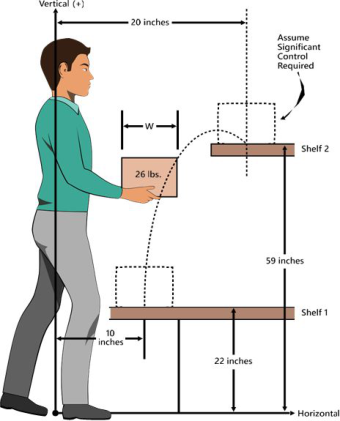
Selection of Lifting Task One of the lifting task examples from Applications Manual for the Revised NIOSH Lifting Equation (Walters et al. 2021) was selected to build a virtual program. That example was called a package inspection task that requires a worker to inspect compact containers for damage on a lower shelf and lift them using two hands to an upper shelf in front of the worker. The task was needed to be repeated at 3 times per minute and lasts 45 minutes. The worker was supposed to perform the task under three assumptions about working conditions. The first assumption was that the worker was not able to step forward when placing the container on the upper shelf due to the lower shelf configuration. Secondly, the worker was needed to control movement, so- called significant control, when placing the object at the destination on the upper shelf. Thirdly, the container did not have a coupling. Figure 1 shows the detail information of lifting conditions.
Virtual Reality Program The selected package inspection task will be transformed from the 2D descri- ption into a 3D virtual environment using the Unity software. Unity is a virtual reality development platform with a lot of applications for games,
Application of Virtual Reality to Instructions of Manual Lifting Analysis 87
Figure 1: Lifting conditions for package inspection task (Adapted from Walters et al. 2021).Figure 2: 3D virtual development.
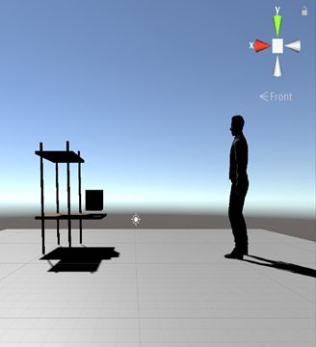
which uses a hierarchy to connect multiple models within a scene. Within Unity, assets are coded properties that can be assigned to selected models in the hierarchy to simulate complex physical properties to make a model more realistic. An asset, for instance a color, can be simply assigned to a box to make it look with different colors depending on its status. There is also an asset for a movement of model such as a C# coding asset that can be assigned to a humanoid model to pick up a box from its initial location. There are also assets that can assigned to keep the models from falling through the ground or floor of the scene and make them move through space. Figure 2 shows the early stages of the 3D virtual development. On the right of Figure 2, a humanoid model has a coding asset to pick up and put down a box from the
same level by pressing ‘pick up or put down’ button as a toggle key, as well as to give the box by pressing ‘give box’ button to trigger a giving action. In particular, the humanoid model holds coding properties assigned to its arms and legs to simulate various detailed human joint movement. In the code, the box is labeled as an item below the humanoid model based on the hiera- rchy so that the box would move based on the activation of the humanoid model. On the left, is a scene designed to have the lifting conditions shown in Figure 1. That humanoid model can simulate picking up the box, but the box would not move the humanoid model according to the hierarchy. The completed VR program will be used to instruct students how to assess the lifting equation. The effect of instruction using the VR will be evaluated by comparing student’s learning outcomes to traditional instructions with 2D description.
Statistical Analysis Two different assessments of learning outcomes (subjective and objective measure) will be collected from three different instructions such as traditio- nal instruction with 2D description of lifting task, instruction with 3D virtual program, and a combined instruction with 3D virtual program and conventi- onal PowerPoint presentation. The subjective measure will be a survey using Likert’s 5 scale questionnaires about student’s conception of the given lifting task requirements, amount of effort for analyzing lifting equation, and effe- ctiveness of teaching instruction. The objective measure will be assessed by grading student’s answer for lifting equation. A simple descriptive statistic comparison between teaching instruction methods will be applied to the sub- jective measure. For the objective measure, analysis of variance will be used to find an effect of difference between the instruction methods.
DISCUSSION
It is expected for students to improve the learning outcome by utilizing a VR program with 3D interactive control for examining lifting task environment. However, it will be difficult for general educators to develop a 3D VR pro- gram because of complexity of Unity application. In addition, it is not easy to find an exemplary VR program for uniquely customized activities. If educa- tors intend to develop a VR program but are non-professional programmers with limited experience of computer programming C# scripting, they may face a hardship for creating VR programs. The example in this study is solely based on animations with minimum C# scripting. This study may help inte- rested educators get some thoughts on VR program instruction development for manual lifting tasks.
CONCLUSION
In this study, the teaching outcome based on interactive VR instruction was hypothesized to be improved by student’s active involvement into conception of a given problem. A development of VR program for manual lifting task assessment using the Unity platform was elaborated in this study. Although a
Application of Virtual Reality to Instructions of Manual Lifting Analysis 89
considerable number of VR examples and videos can be found in the internet, few VR examples for manual lifting tasks are available to evaluate potential low back injury risks at particular working environment. This study can be an example for other educators in engineering educations who will want to develop VR instruction methods to enhance traditional teaching approach. When the development of the VR program is completed in the near future, the effect of the VR program compared to a traditional teaching method will be analyzed to validate the hypothesis.
ACKNOWLEDGMENT
The authors thank Unity for their generous grant allowing to use the software for academic research purposes.
REFERENCES
Abulrub, Abdul-Hadi. Attridge, Alex and Williams, Mark. (2011). Virtual Reality in Engineering Education: The Future of Creative Learning, INTERNATIONAL JOURNAL OF EMERGING TECHNOLOGIES IN LEARNING Volume 6 No. 4. Betihavas, Vasikili. Bridgman, Heather. Kornhaber, Rachel and Cross, Merylin.
(2016). The evidence for ‘flipping out’: A systematic review of the flipped classroom in nursing education, NURSE EDUCATION TODAY Volume 38. Borrel, Alexandre and Fourches, Denis. (2017). RealityConvert: a tool for preparing 3D models of biochemical structures for augmented and virtual reality, BIOINFORMATICS Volume 33 No. 23. Brewer, Danielle. Wilson, Timothy. Eagleson, Roy and de Ribaupierre, Sandrine.
(2012). Evaluation of neuroanatomical training using a 3D visual reality model, STUDIES IN HEALTH TECHNOLOGY AND INFORMATICS Volume 173. Cha, Young-Woon. Dou, Mingsong. Chabra, Rohan. Menozzi, Federico. State, Andrei. Wallen, Eric and Fuchs, Henry. (2016). Immersive Learning Experi- ence for Surgical Procedures, STUDIES IN HEALTH TECHNOLOGY AND INFORMATICS Volume 220. Chessa, Manuela. Maiello, Guido. Borsari, Alessia and Bex, Peter. (2016). The
Perceptual Quality of the Oculus Rift for Immersive Virtual Reality, HUMAN- COMPUTER INTERACTION Volume 34. Christie, Michael and de Graaff, Erik. (2017). The philosophical and pedagogical underpinnings of Active Learning in Engineering Education, EUROPEAN JOUR- NAL OF ENGINEERING EDUCATION Volume 42. https://doi.org/10.1080/ 03043797.2016.1254160 Freeman, Scott. Eddy, Sarah. McDonough, Miles. Smith, Michelle. Okoroafor, Nna-
dozie. Jordt, Hannah and Wenderoth, Mary. (2014). Active learning increases student performance in science, engineering, and mathematics, PROCEEDINGS OF THE NATIONAL ACADEMY OF SCIENCE OF THE UNITED STATES OF AMERICA Volume 111, No. 23. Goddard, Thomas. Brilliant, Alan. Skillman, Thomas. Vergenz, Steven. Tyrwhitt- Drake, James. Meng, Elaine and Ferrin, Thomas. (2018) Molecular Visualization on the Holodeck, JOURNAL OF MOLECULAR BIOLOGY Volume 430 No. 21. Harrington, Cuan. Kavanagh, Dara. Quinlan, John. Ryan, Donncha. Dicker, Patrick.
O’Keeffe, Dara. Traynor, Oscar and Tierney, Sean. (2018). Development and eva- luation of a trauma decision-making simulator in Oculus virtual reality, THE AMERICAN JOURNAL OF SURGERY Volume 215 No. 1.
Hernandez-de-Menendez, Marcela. Guevara, Antonio. Martinez, Juan. Alcantara, Diana and Morales-Menendez, Ruben. (2019). Active learning in engineering education. A review of fundamentals, best practices and experiences, INTERNA- TIONAL JOURNAL ON INTERACTIVE DESIGN AND MANUFACTURING Volume 13 No. 23. Jang, Hyungshim. (2008). Supporting students’ motivation, engagement, and lear-
ning during an uninteresting activity, JOURNAL OF EDUCATIONAL PSYCHO- LOGY Volume 100 No. 4. Kahu, Ella. Nelson, Karen and Picton, Catherin. (2017). Student interest as a key driver of engagement for first year students, STUDENT SUCCESS Volume 8 No. 2. Koh, Gerald. C-H. Khoo, Hoon. Wong, Mee and Koh, David. (2008). The effe-
cts of problem-based learning during medical school on physician competency: a systematic review, CMAJ Volume 178 No. 1. Makransky, Guido. Terkildsen, Thomas and Mayer, Richard. (2019). Adding immersive virtual reality to a science lab simulation cause more presence but less learning, LEARNING & INSTRUCTION Volume 60. Marsh, Karen. Giffin, Bruce and Lowrie, Dobald. (2008). Medical Student Reten-
tion of Embryonic Development: Impact of the Dimensions Added by Multimedia Tutorials, ANATOMICAL SCIENCES EDUCATION Volume 1 No. 6. Maresky, H.S. Oikonomou, A. Ali, I. Ditkofsky, N. Pakkal, M and Ballyk, B. (2019).
Virtual reality and cardiac anatomy: Exploring immersive three-dimensional cardiac imaging, CLINICAL ANATOMY Volume 32, No. 2. Michael, Joel. (2006). Where’s the evidence that active learning works?, ADVANCES IN PHYSIOLOGY EDUCATION Volume 30. https://doi.org/10.1152/advan.00053.2006 O’Connor, Michael. Deeks, Helen. Dawn, Edward. Metatla, Oussama. Roudaut, Anne. Sutton, Matthew. Thomas, Lisa. Glowacki, Becca. Sage, Rebecca. Tew, Philip. Wannacott, Mark. Bates, Phil. Mulholland, Adrian and Glowacki, David. (2018). Sampling molecular conformations and dynamics in a multiuser virtual reality framework, SCIENCE ADVANCES Volume 4 No. 6. Parkhomenko, Egor. O’Leary, Mitchell. Safiullah, Shoaib. Walia, Sartaaj. Owyong,
Michael. Lin, Cyrus. James, Ryan. Okhunov, Zhamshid. Patel, Roshan. Kaler, Kamaljot. Landman, Jaime and Clayman, Ralph. (2018). Pilot Assessment of Immersive Virtual Reality Renal Models as an Educational and Preoperative Plan- ning Tool for Percutaneous Nephrolithotomy, JOURNAL OF ENDOUROLOGY Volume 33 No. 4. Pulijala, Yeshwanth. Ma, Minhua. Pears, Matthew. Peebles, David and Ayoub, Ashraf. (2018). Effectiveness of Immersive Virtual Reality in Surgical Training- A Randomized Control Trial, INTERNATIONAL JOURNAL OF ORAL AND MAXILLOFACIAL SURGERY Volume 76 No. 5. Reynolds, S.J., Johnson, J.K., Piburn, M.D., Leedy, D.E., Coyan, J., Busch, M.M.
(2005) “Visualization in Undergraduate Geology Courses”, in: Visualization in Science Education. Models and Modeling in Science Education, Gilbert, John. (Ed.). pp. 253–266 Sisk, Rebecca. (2011). Team-Based Learning: Systematic Research Review, JOUR- NAL OF NURSING EDUCATION Volume 50 No. 12. Stepan, Katelyn. Zeiger, Joshua. Hanchuk, Stephanie. Del Signore, Anthony. Shriva-
stava, Raj. Govindaraj, Satish and Iloreta, Alfred. (2017). Immersive virtual reality as a teaching tool for neuroanatomy, INTERNATIONAL FORUM OF ALLERGY & RHINOLOGY Volume 7, No.10.
Application of Virtual Reality to Instructions of Manual Lifting Analysis 91
Teranishi, Shogo and Yamagishi, Yoshio. (2018). Educational Effects of a Virtual Reality Simulation System for Constructing Self-Build PCs, JOURNAL OF EDUCATIONAL MULTIMEDIA AND HYPERMEDIA Volume 27 No. 3. Unity, https://www.unity.com Walters, Thomas. Putz-Anderson, Vern and Garg, Arun. (2021) Applications manual
for the revised NIOSH lifting equation, Cincinnati, OH: US Department of Health and Human Services, Center for Disease Control and Prevention, National Insti- tute for Occupational Safety and Health, DHHS(NIOSH) publication No. 94–110 (Revised 9/2021) Woods, Terri. Reed, Sarah. Hsi, Sherry and Woods, John. (2016). Pilot Study Using the Augmented Reality Sandbox to Teach Topographic Maps and Surficial Proces- ses in Introductory Geology Labs, JOURNAL OF GEOSCIENCE EDUCATION Volume 64 No. 3.
LISTED IN THE AHFE DIGITAL BOOKSTORE CATALOGUE
Explore the complete digital volume
Human Factors in Virtual Environments and Game Design
Read this individual research paper free through the original publisher, or explore the full digital proceedings book.
ISBN 978-1-958651-26-1
Explore this ISBN in the AHFE Bookstore ↗Listed in the July 2026 bookstore catalogue; search by ISBN to confirm current availability · Digital book purchase optional