Cai Xin (2022). Chinese Characters Factory - Design of children's Chinese character construction enlightenment game based on augmented reality technology. In: Human Factors in Virtual Environments and Game Design. AHFE Open Access, vol. 50, pp. 110–116. https://doi.org/10.54941/ahfe1002067
China's "13th Five-Year Plan" points out that the development of the industry should adapt to the development trend of multi-media technology. Nowadays, augmented reality and virtual reality technologies have gradually penetrated into our daily life and have had a significant impact in many aspects. Since ancient times, there have been many important educational ideas in China. With the development of the Internet, there is a particular focus on the importance of Chinese characters. In recent years, the application of AR design and related research in various fields of children's education has also developed rapidly, at the same time, the unique interactive, immersive and imaginative characteristics of AR technology have greatly improved the enthusiasm and initiative of learning because they conform to children's figurative thinking. Therefore, in this environment, it is meaningful to explore how to effectively create a sought after AR children's Chinese character construction enlightenment game.【Methods】: This paper introduces augmented reality technology into the field of children's Chinese character education through technical research to create a design method of virtual-real interaction.This paper discovers the characteristics of children's language education, as well as the Chinese character root method through theoretical research, and finds the fit in children's cognitive development and the character root method. The author attempts to design a suitable set of diagrams to tap into the similarities between word-making thinking and product thinking.This paper finds the AR teaching format through market research. It weakens the one-way indoctrination process of product knowledge information and gives play to children's subjective initiative. The content is intuitive and can be used to perceive information through visual, tactile and auditory senses in a comprehensive manner.【Result】: “Chinese Characters Factory” is developed based on the Unity 3D, with ARkit as an augmented reality technology solution, run on the IOS platform. Users have access to game experience with iPad. The whole design practice is divided into three systems: Chinese character experiment system, mapping collection system and entertainment interactive system. The Chinese Character Experiment System was inspired by chemical experiments. Chinese characters are formed by the combination of character roots and graphemes with corresponding character formation methods. It identifies the Chinese character card images in the physical environment according to the image tracking technology of ARkit, being able to superpose Chinese character models. In addition, mapping collection system and entertainment interactive system are used to solve children's Chinese character literacy, novel and entertaining growth education.【Conclusion】: Children's educational products with augmented reality technology are important and innovative for the development of children's minds. It is highly interactive and rich in teaching content presentation, so it can mobilize children's all-round perception of information, which greatly stimulates children's learning interest in the learning process and brings a brand-new experience to teaching.Based on the characteristics of Chinese characters, "Chinese character Factory" is a Chinese character AR game that fits the characteristics of language education and the cognitive development of preschool children. It applies the advantages of augmented reality technology to help children learn and memorize Chinese characters in a gamified way by experimenting with synthetic Chinese characters, bringing children a vivid and interesting Chinese character learning experience. At the same time, "Chinese character test" is ready to be put on the App store.At present, the application of educational products based on augmented reality technology on the market is still in the primary stage. In the future, we still need to explore the application of augmented reality technology in education.
At the beginning of the 13th Five-Year Plan, the government further adju- sted the fertility policy and fully liberalized the birth of two children. From ancient times to the present, Chinese always have an ideology that emph- asizes education, and the influence of the traditional concept that parents want their children to become excellent has made children’s early educa- tion being more and more emphasized. Studies have found that the age of 3-6 is a critical period for developing preschoolers’ reading skills, and “lite- racy” is an important part of children’s ability to read on their own (Hou, Yuanqi, 2017). Nowadays, there is a common phenomenon in Chinese cha- racter education in China, which is to simply pursue the speed and quantity of children’s literacy while neglecting the most essential goals (e.g., developing children’s thinking and phonological skills, understanding of Chinese culture, etc.). Therefore, the educational concepts of “phonetic engraving”, “shape engraving”, and “scene engraving” (Hou Yuanqi, 2017) have emerged.
Chinese Character Factory—A Design of Children’s Chinese Character Construction 111
The application of AR technology to children’s education is a positive attempt and an important exploration of a new way to teach children Chi- nese characters, which can build a new learning environment, cultivate good habits of active learning, and transform children from a passive learner to an active learner who loves learning.
APPLICATION OF AUGMENTED REALITY TECHNOLOGY AND THE DEVELOPMENTAL CHARACTERISTICS OF CHILDREN’S VISUAL PERCEPTION Augmented Reality Technology in the Field of Education
Augmented Reality (AR) is a technology that seamlessly integrates the real world with the virtual world, and the core content of AR technology is instant interaction and presentation of three-dimensional effects (Zhao Yanqin, 2016). With the help of mobile devices, users can immerse in an environ- ment that combines virtual and reality, and they can feel the multi-sensory experience of seeing, hearing, speaking, touching and thinking.
In recent years, AR technology has been widely used in children’s educa- tion, including AR Doodle series, Journey to the West series, Chinese Year for Chinese Children series, and Chinese Character Adventure series. In teaching applications, Li Tie Meng’s team from Beijing University of Posts and Tele- communications developed AR literacy system for kindergarten children to learn Chinese characters and English (Li Tie Meng, 2015), and Cai Su’s team from Beijing Normal University developed “Happy Word Remembering” software (HE J, REN J, ZHU G, et al, 2014), etc.
Different from traditional education products for children, AR education products weaken the one-way infusion process of knowledge and informa- tion, and add interactive parts to stimulate children’s subjective initiative. The teaching content will be presented in various ways such as text, pictu- res, sound, film, animation, etc. Children can intuitively perceive information through visual, auditory and tactile senses in all aspects. At the same time, AR technology can provide a rich interactive experience of learning, adding to the fun and interactivity of learning and improving children’s learning initiative (Cai, Su, Wang, Peiwen, Yang, et al., 2019).
Developmental Characteristics of Children’s Visual Perception and Cognitive Ability Early childhood is a period of rapid development of word cognition and a very effective period of word learning (Mason.J.M, 1980). At present, resea- rch on children’s word awareness generally adopts the “three stages” theory, which are the overall shape processing stage, the local composition rule pro- cessing stage, and the orthographic rule processing stage (Li, D., 2016). In early period, children only have a pictorial impression of Chinese characters, and they see no difference between words and pictures. And with the develo- pment of recognization, children can gradually distinguish between words and pictures and gradually grasp the Chinese character recognition rules. According to the findings of Zhao, Jing, and Li, Rev. of children aged 3 to
112 Cai
6 years old, children aged 2 to 4 years old are in the embryonic state of Chi- nese character recognition, children aged 5 years old can already distinguish Chinese characters from pictures, and at the age of 6 years old, they already have a good ability to discriminate Chinese characters (Zhao, Jing, and Li, Rev. 2014).
According to Piaget’s theory of cognitive development stages, preschoolers at the preoperational stage, a stage in which children can establish symbols to represent external things, have a strong imitation ability, and are able to use the representation of objective things to think, but unable to think abstractly. In terms of thinking characteristics, preschoolers are predominantly concrete- image oriented, and intuitive and visual things are more attractive to their attention. Children in this age group have developed a great deal of ability to apply symbolic representations and can train their thinking ability with the help of some products that contain realistic interactive three-dimensional games (Li, Xiaojing, Zhang, Yimin, 2018).
AR GAME DESIGN FOR CHILDREN BASED ON AUGMENTED REALITY Design Strategy Layer
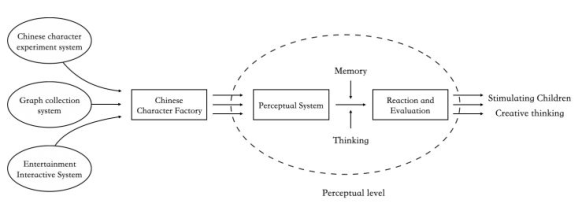
“Chinese Character Factory” is based on augmented reality technology and consists of three main systems: the Chinese character experiment system, the medal collection system and the entertainment interaction system, with a view to stimulating children’s perceptual system through the combination of these three systems, enabling them to memorize Chinese characters while developing the creative thinking of experimenting with all things, and acting on the reaction and evaluation to use the incentive mechanism of the game to stimulate children’s creative thinking (as shown in Figure 1).
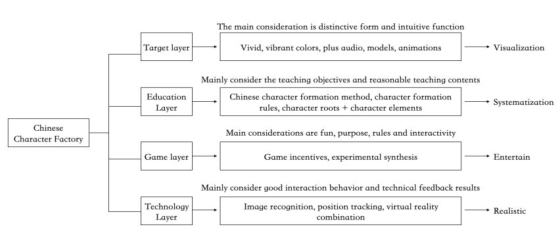
Design Framework Layer The design of augmented reality game products not only needs to balance the educational nature of learning content and the entertainment nature of interactive games, but also needs to fit the cognitive developmental chara- cteristics of preschool children. Based on relevant educational game theories and preschool children’s cognitive development theories, Tian Yuan et al. from Huazhong University of Science and Technology proposed a hierarchi- cal element design strategy model for mobile augmented reality educational games with four levels plus a unifying principle (Tian Yuan, Zhou Mi, Xia Dan, et al., 2019). This paper continues the framework of this design strategy model and improves it by combining the educational principles of chil- dren’s literacy with new technological capabilities, and completes the design and development of Chinese Character Factory, an AR literacy game for preschool children (as shown in Figure 2).
(1) Object layer: The main consideration is to establish the intuitive function and attractive form, which needs to meet the cognitive demand characteristics of children.
Chinese Character Factory—A Design of Children’s Chinese Character Construction 113
Figure 1: Game Design Strategy Map (Self-drawn).Figure 2: Design framework model (Self-drawn).
In order to strengthen children’s observation and memory, the whole Chi- nese character card deck design extracts the main three natural colors brown, blue and green, and derives a small amount of auxiliary colors outward, wea- kens the background elements with low saturation and high brightness colors, so that the visual center of gravity focuses on the main process; moreover, various content presentation methods such as audio, model and animation are added. For example, when the camera recognizes the Chinese character “马”, a 3D model of a horse will appear, and children can clip the model through the Chinese character clip to make the audio sound of “Ma~”; and if “马” and “虫” are clamped into the synthesizing machine at the same time, click on the start button, there will be an animation of the synthesis of the machine, and the successful synthesis will issue a victory audio and synthesize the new 3D model “蚂” and the card “蚂”. Preschool children’s sensory and perceptual development is relatively rapid, unconscious attention dominates, and is largely influenced by visual images and concrete and vivid external environment (Zhang, 2014), and this level leads children to active learning with distinctive forms and intuitive functions.
(2) Educational layer: It meets the teaching objectives and develops reasonable and professional teaching contents.
“Chinese Character Factory” takes the teaching requirements of the “Gui- delines for Children’s Learning and Development between the ages of 3 and 6” as the teaching objectives of the literacy game. 500 commonly used chara- cters for children are used as the source of Chinese learning in the game, and they are classified into animal, family, nature and life categories according
114 Cai
to the classification of Chinese characters in Tang Han’s book “Chinese Character Code”.
The whole design revolves around the concept of “experiment”. Through research, it’s found that the thinking of Chinese character creation is very similar to the synthesis process of chemical experiments, and the elemental law of “character root + character element” matches extremely well with “chemical element + chemical element”. For example, “马+主=驻” means a horse stopping in front of a house, and similar formulas are “马+又=驭”, “马+口=骂”, and “马+竹=笃”. The level design also follows the concept of combining sub-goals (short-term learning) and main goals (long-term learning). Levels 1 to 3 are for animal roots combined with elementary com- binations, while levels 4 to 12 are for the more difficult nature, family, and life categories. For example, in AR mode, clicking on the icon in the upper right corner of the chart will bring up the final synthesis card, and clicking on the combination word card “骂” (“scold”) will bring up the corresponding synthesis recipe while playing an explanatory audio “Two horses tearing and arguing is scolding “.
(3) Game layer: The game layer needs to reflect the fun, purpose, rules and interactivity, and provide timely feedback for learners.
A perfect feedback mechanism can stimulate users to generate continu- ous experience fun and effectively promote the learning effect of learners (Xuan Wang, 2020). Referring to the classic model of Classic Conditioning, the combination of cards to be given is collected and presented to children under the condition of successful experimental synthesis, so that the process of children’s play is a process of obtaining rewards. Moreover, the feed- back loop should be followed in the feedback, and only the combination of a series of positive and negative feedback can help the game to adva- nce. For example, when synthesizing “马+人” (“horse + human”), there will be a failure animation and a failure audio, which is negative feedback of encouraging; meanwhile, when synthesizing “犬+人” (“dog + human”), there will be a successful synthesis animation, a At the same time, when “犬+人” (“dog + human”) is synthesized, there will be a successful synth- esis animation, a “伏” (“voodoo”) model and a successful audio, which is positive feedback of a celebration. That is, whether it is positive feedback or negative feedback, its related dynamic presentation, in the design should try to maintain a balance.
The AR virtual learning environment provides learners with good intera- ctive behaviors and technological feedback results, which is in line with the stimulus-response (S-R) connection formula when learning as identified by behaviorism (Cai, Su, 2016).AR experience design is an advanced form of interaction design, which emphasizes the good coordination between phy- sical and virtual. Based on the Unity3D engine, Chinese Character Factory utilizes the ARFoundation and related APIs and SDKs to recognize and track Chinese character cards and output virtual and real scene images through real devices.
Chinese Character Factory—A Design of Children’s Chinese Character Construction 115
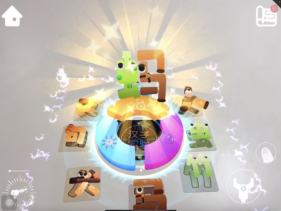
Figure 3: Screenshot of the game design interface of “Chinese Character Factory”.
Design Framework Layer “Chinese Character Factory”is based on Unity3D engine and can run on IOS platform and use iPad for game experience.
The Chinese character experiment system mainly includes card recogni- tion, character selection, and Chinese character synthesis functions; the map collection system includes stamp incentive, Chinese character map, and voice reading functions; the entertainment interaction system includes laser sweep, laser word elimination, Chinese character clip, and finger touch functions.
The machine selection button can be recognized by placing the matching paper map on a flat desktop with iPad camera alignment; the corresponding Chinese character model can appear after the card recognition; clicking on the Chinese character clip in the lower right corner can select and move the Chinese character model; the correct Chinese character can be synthesized by placing the corresponding Chinese character into the correct machine.
Clicking on the atlas in the upper right corner opens the kanji collection system and incentive mechanism; clicking on the kanji deck plays professional explanations; the laser symbol in the lower left corner allows you to click to sweep the model and long press to eliminate the kanji model, and the finger in the lower right corner also allows you to touch the kanji model (as shown in Figure 3).
The final AR game is developed based on Unity 3D, and the AR foundation technology realizes the AR part of the work implementation.
CONCLUSION
This study introduces augmented reality technology into the product design of children’s Chinese character construction education and enlightenment, which deeply explores the development characteristics of children’s Chinese character enlightenment, and improves the singularity of the research on children’s Chinese character enlightenment at the theoretical level; at the pra- ctical level, it makes up for the deficiency of augmented reality technology in the field of children’s education, and helps children grow and develop better through reasonable and effective design means to bring into play their initi- ative. The research is based on the following principles The technical route mentioned in this study, combined with the characteristics of children’s visual perception, can provide some reference for subsequent related research.
116 Cai
ACKNOWLEDGMENT
I would like to thank the BiBoBox studio at Shanghai Jiao Tong University for their great support during the design and writing process. Thanks to Yue Shi for modeling the 3D model and coordinating with me on concept impro- vements. Thanks to Xu Meng for illustrations and ideas for the game. Yuanlu Wang for suggesting ideas to improve the program. I would also like to thank my supervisor, Associate Professor Bo Liu from Shanghai Jiaotong University, who gave me valuable theoretical advice and technical support.
REFERENCES
Cai Su, Wang Peiwen, Yang Yang, et al. An overview of educational applications of augmented reality (AR) technology[J]. Journal of Distance Education, 2016, 34(5): 27–40. He J, Ren J, Zhu G, et al. Mobile-Based AR Application Helps to Promote EFL Chil-
dren’ S Vocabulary Study[C]. Proceed- ings of the 2014 IEEE 14th International Conference on Ad-vanced Learning Techno logies, Athens: IEEE, 2014. Hou Yuanqi. Research on user experience-based literacy reading mobile application for children aged 3-6: [Master’s thesis][D]. East China University of Science and Technology, 2017. Li Tie-Meng, Su Li-Bo, Lv F. et al. Augmented reality-based literacy education system
for preschool children and experimental research[J]. Software,2015,(4):44-49. Li Xiaojing, Zhang Yimin, Research on the publication of AR children’s books in the perspective of children’s cognitive mechanism[J]. Publishing and Distribution Research, 2018(12):46–48, 62. Li, Dove. Holistic processing or feature analysis--character processing in Chinese
character recognition of 3-6 year old children[D]. Changchun: Northeast Normal University, 2016. Mason.J. M. (1980).When do children begin to read:An exploration of four year old children’s letter and word reading competencies. Reading Research Quarterly, 15, 203–227. Tian Yuan, Zhou Mi, Xia Dan, et al. Research and design of educational games
for preschool children based on mobile augmented reality [J]. Electrochemical Education Research, 2019, 40(4): 68–75. Zhang, Lele. Research on the design of mobile media resources for preschool children [D]. Xuzhou: Jiangsu Normal University, 2014. Zhao J, Li S. The development of Chinese character glyph cognition in children aged
3–6 years old [J]. Psychological Science, 2014,37(2):357–362. Zhao Yanqin. AR and VR technologies in children’s publishing [M]: Beijing: Modern Education Press. 2016.
LISTED IN THE AHFE DIGITAL BOOKSTORE CATALOGUE
Explore the complete digital volume
Human Factors in Virtual Environments and Game Design
Read this individual research paper free through the original publisher, or explore the full digital proceedings book.
ISBN 978-1-958651-26-1
Explore this ISBN in the AHFE Bookstore ↗Listed in the July 2026 bookstore catalogue; search by ISBN to confirm current availability · Digital book purchase optional