Jan Finke, Sebastian Hoose, Jana Jost, Moritz Roidl (2022). Replacing Common Picking Devices from Augmented Reality Scenarios at Warehouses by a Laser Projection System. In: Human Factors in Virtual Environments and Game Design. AHFE Open Access, vol. 50, pp. 92–99. https://doi.org/10.54941/ahfe1002065
The human worker will still play a major part in the factory of the future. The number of tasks to accomplish is constantly rising in modern production facilities and warehouses, whereas the shortage of skilled workers is increasing. As a result, fewer professionals must work alongside with many roustabouts at highly complex technical systems and in short clock cycles. Therefore, in this paper, we present a laser projection system as a new way of provision of information to guide the worker through the processes. Further, we demonstrate the usage of the system in a common logistic process and compare it with other established interaction modalities
To become more efficient, companies in the field of production and logi- stics need to focus today on a better integration and assistance of the mainly unskilled human workers. Only a few interaction modalities offer the pos- sibility to meet the various needs of the individual worker. As a result, the often very generic descriptions and instructions of the tasks lead to errors and inefficient processes. One approach to assist the worker is the usage of Augmented Reality (AR) glasses. Nonetheless, AR glasses struggle in multiple properties i.e., ergonomics or scalability.
In this paper, we present a laser projection system which represents a replacement of mixed reality devices such as AR glasses to reduce costs and to improve ergonomics for human workers in logistic and production envi- ronments while preserving the flexibility and individuality of mixed reality devices.
BACKGOUND The following two sections describe the current state of the art in the field of worker guiding systems and the state of the art in the field of laser projection systems.
Replacing Common Picking Devices from Augmented Reality Scenarios 93
Current Guiding Systems In current warehouses and production facilities various systems are in use to guide workers e.g., in picking scenarios, to storage areas and shelves. Those guiding systems mainly aim to support the workers to both, increasing their productivity and to create a more ergonomic work environment by reducing stress.
One of the most traditional ways to organize the picking of multiple goods is represented by simple picking lists which are presented to workers e.g., on stationary displays, on paper lists or on handheld devices such as tablets or smartphones (Iben et al. 2009). Picking lists are simple to implement and simple to understand but mostly lack any kind of support while localizing goods that must be picked in a picking task.
Another frequently used guiding system for picking tasks is represented by pick by voice systems. In pick by voice systems a picker in a warehouse or production facility wears a wireless headset system which assigns a picking task to the picker. In addition, pick by voice systems are capable of guiding the picker to the location where the next good on the current order list is located and which quantity of this good must be picked. Finally, the picking worker can communicate with the system, e.g., confirming the pick of a good, using the voice of the worker (de Vries et al. 2016).
To facilitate the localization of a good which is e.g., located within a shelf, pick by light can be implemented in warehouses and production facilities as well. Pick by light can e.g., be built into shelves using a light source, which illuminates the area where the goods which should be picked next are located. Pick by light systems can, but not necessarily have to, be integrated in other picking and worker guiding systems (de Vries et al. 2016).
Another system to guide and support pickers using a picking system is represented by pick by feel systems. In pick by feel guiding systems pickers are equipped with e.g., vibration actuators at their wrists. Those actuators can indicate a correct picking position e.g., within a shelf, by vibrating. Pick by feel picking guiding systems are usually combined with other picking guiding systems such as pick by voice systems or picking lists (Grzeszick et al., 2016).
In the past years, AR glasses became available at the consumer market such that picking guiding systems using AR glasses have been developed. In most cases, AR glasses in picking scenarios are displaying the current picking list to a picker, highlighting the location of goods which have to be picked or navi- gating through warehouses and production facilities (Bräuer & Mazarakis. 2018).
Current Laser Projection Systems Laser projections systems are well known in the entertainment industry to create visual effects. In the field of civil engineering, lasers are in use for accu- rate measurements during planning and construction. When talking about laser projections, one must differentiate between the approach of using sta- tic components and moving a laser beam above a surface using mirrors. For example, the use of a diffraction grating will result in static projections which cannot be changed.
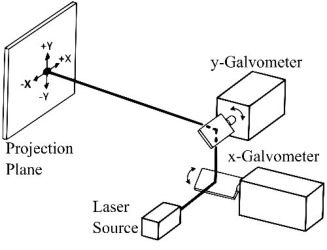
Figure 1: Working principle of a laser projector (Goodsell, 2019).
This paper focuses on the second approach using mirrors. In this approach, a laser beams direction is changed by two mirrors as pictured in Figure 1. These two mirrors, which allow a change of the direction of the laser beam in two axes, are moved with two sperate galvometers. Galvometers, in our use-case, can be modelled as motors which can move a relatively small mass at a very fast speed, compared to classical DC motors. The combination of two mirrors and two motors will be called scanner in all further descriptions. The scanner is controlled by a data processing system which will guide the laser across the projection plane depending on the shape of the projection object. (Seet et al., 2016). The fast sequential illumination of points on a plane will be seen like a simultaneous illumination of all points by the human eye. This effect is called Persistence of vision.
Exposing human tissue to high doses of light may cause damage. Especially the human eye can take serious damage when exposed to high doses of energy in the area of visible light. The reason is that visible wavelengths are focused by the optics of the eye to a small spot size on the retina. Hence, even small doses of light on the eye lens can cause a high irradiance on the retina.
To avoid injuries standards with a maximum exposure have been defined. Depending on the country, different standards might be valid. For example, in the US the “American National Standard for Safe Use of Lasers”(L.I.A. 2007) provides a Maximum Permissible Exposure (MPE). This Exposure limit is defined depending on the wavelength, the pulse length and the number of pulses per second.
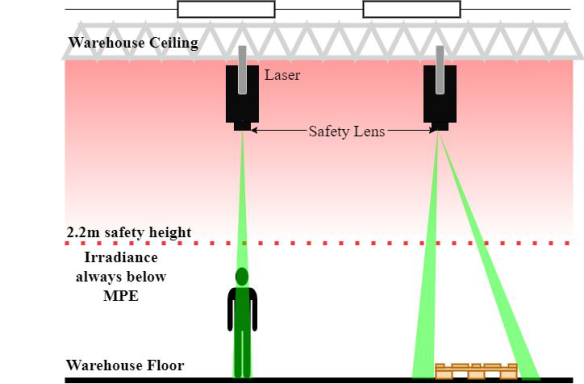
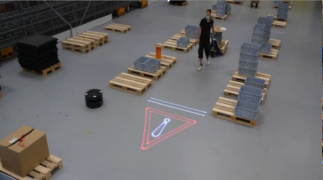
DEVELOPMENT OF A LASER GUIDING SYSTEM FOR LOGISTIC AND PRODUCTION ENVIRONMENTS Our laser system projects from a factory or warehouse ceiling on the floor as displayed in Figure 2. For safety reasons, the parameters of the laser must be set to a level such that the irradiance always stays below the MPE at a height of 2.2 meters measured from the projection plane.
To stay within the MPE we reduced the maximum output power and incre- ased the divergence of the laser using a lens. This will create a wider beam on the Floor, but it is necessary to stay within safe irradiance levels and to ach- ieve clearly visible symbols. Since the MPE also depends on the pulse width
Replacing Common Picking Devices from Augmented Reality Scenarios 95
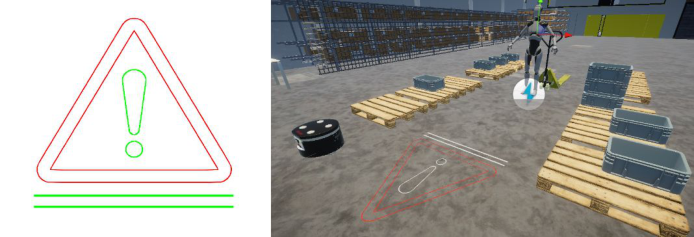
Figure 2: Laser projection from the warehouse ceiling.Figure 3: Example projection symbols within our library an inside the digital twin of the warehouse in Unity.
and the pulse repetition we measure these Parameters manually in the field for each projection object in our library and validate the MPE.
For our scenario, we mainly used arrows and warning symbols with a size of 1.5m by 1.5m. The output power of the laser projectors has been set to values, such that it stays below the MPE at each Point for all symbols. These objects can be scaled up in size but not down since this would increase the irradiance.
The laser guiding system was implemented in the 3D game engine Unity. A digital twin of the warehouse was created. The system is connected to our laser control software using a generic software development kit. Placing sym- bols inside the scene of the digital twin and moving them will be transferred to the real warehouse and hence, be displayed by our laser guiding system.
A Multiuser Guidance Scenario High volume of information and greater dynamics require a flexible intera- ction of the employee with systems in his surrounding environment during
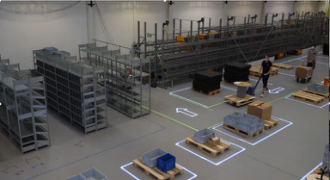
Figure 4: Individual guidance of workers through the warehouse.Figure 5: Realtime process information for a) crossing robots b) drop-off positions.
logistic processes. Therefore, the usage of common interaction modalities like picking lists is too limited. Regarding the shortage of qualified workers, indi- vidual and intuitive visualization of information is needed so that the level of information is adjusted depending on the degree of experience of the wor- ker as well as individual aspects e.g., visual impairments. We have designed and implemented a picking and palletizing process in a multiuser scenario in warehouses. Figure 4 shows a common picking task where multiple users are guided through a warehouse. During the whole process information is displayed directly on the floor in front of the users. At the intersection areas different colors, symbols, user-IDs or other intuitive visualization options can be used to guide a worker into the correct aisle or storage position. Wor- kers can be warned of crossing robots which might not be in their field of view yet so that collisions are avoided (see Figure 4a). Sudden changes i.e., change of drop-off positions due to e.g., order prioritization, can be directly communicated to the worker (see Figure 4b).
EVALUATION To evaluate the above proposed laser guiding system a qualitative comparison between alternative guiding systems, described in the background section, has been accomplished as described below using the following criteria:
Possibe Time of Use The criteria possible time of use describes how long a certain system can be used, which is e.g., limited by the battery capacity of a device. Hence, all guiding systems which rely on a mobile device, namely AR glasses, pick by voice, pick by feel and picking lists on handheld devices have a limited use
Replacing Common Picking Devices from Augmented Reality Scenarios 97
time since they depend on the life of their internal batteries. In comparison, guiding systems such as pick by light, centralized picking lists and a laser projection system do not depend on batteries or other constraints which limits the time of use.
Ergonomics Since humans are working with a picking system many hours every day, ergo- nomic factors must be considered to ensure a healthy and comfortable work environment. Guiding systems as described in section I might have different impacts on the workers ergonomics. In detail, handheld devices or picking lists keep at least one hand occupied and most AR glasses are uncomfortable to wear over a long period of time.
Scalability The scalability in number of workers and space used in a facility plays a significant role for the industry, since there are many workers involved in the processes. In terms of scalability, a guiding system which relays on a laser projection system, as presented above, and pick by light installations do not need to be extended when the number of workers rises. In contrast to all device dependent guiding systems, e.g., AR glasses or pick by voice, where one or more devices need to be provided per worker. In addition, pick by light needs to be rearranged when the structure of the facility changes. In contrast, the presented laser guiding system only needs to be extended when the space, in which the system should be used, is expanded. Nonetheless, a laser projection system might have guiding disadvantages when too many workers are working in a strongly limited space, since every worker would be capable of seeing every guiding information of every worker who is near his or her own location.
Level of Augmentation The level of augmentation describes how immersive a system is in the experie- nce of a human. In detail, a guiding system has a higher level of augmentation, hence is more immersive towards a worker, if the system is more capable to integrate itself into the workflow of a worker until the worker forgets about the fact that he or she is using a guiding system. Since AR glasses usually have a limited field of view, a user is likely to not have a fully immersive experie- nce. In addition, in all scenarios where handheld devices are used or headsets must be worn, a user is always reminded that he or she depends on the device. In contrast, in pick by light and the laser guiding system proposed above, the user has the chance to accept the guiding system as part of the facility itself which again increases an immersive experience.
Dynamics of Interaction To ensure that workers are capable to interact with a guiding system to e.g., accept tasks, a dynamic interaction with said system is useful. In common picking applications, different dynamic interaction interfaces can be imple- mented. In contrast, the presented laser guiding system does not include any
interaction interfaces. Nonetheless, it is possible to combine the proposed system with an e.g., motion tracking system to enable a direct interaction of workers.
CONCLUSION
In this paper, a laser guiding system for logistic and production environments has been presented which is capable to provide workers with projections which helps them to find goods or guides them on specific routes in a safe and ergonomic manner. In contrast to other guiding techniques such as picking lists, pick by voice or the usage of augmented reality glasses the system pro- posed by this paper extends the possible time of use, improves ergonomics, extends scalability and increases the immersive experience of users. None- theless, the current system does not include the possibility of a dynamic interaction of a user with the system itself. In addition, safety aspects are currently limiting the flexibility of the system, since projection patterns must be safe for the human eye.
Outlook In the future, we want to take a deeper look into the comparison of the diffe- rent picking and guiding systems by e.g., measuring the picking time. Further, we want to conduct a user experience study to validate ergonomics aspects of the different interaction modalities. Therefore, we aim to combine the laser guiding system with a motion capturing system to track the user as well as his or her behaviors.
To increase the variation of projection symbols in our library with safe irradiance levels we aim to develop a solution which does not require manual measurements. Depending on the beam parameters and the projection pat- terns the software should automatically adjust the beam power to stay below the MPE and to achieve the best visibility.
ACKNOWLEDGMENT
The authors would like to acknowledge the center of excellence logistics and IT for contributing the projection system.
REFERENCES
Bräuer, Paula and Mazarakis, Athanasios. (2018). AR in order-picking – experimental evidence with Microsoft HoloLens. Mensch und Computer 2018 – Workshopband. Gesellschaft für Informatik e.V, DOI: 10.18420/muc2018-ws07- 0463 Goodsell (2019), Build the Laser Pencil Engraver Website: https://www.nutsvolts.co
m/magazine/article/build-the-laser-pencil-engraver Grzeszick, Rene. Feldhorst, Sascha. Mosblech, Christian. ten Hompel, Michael and Fink, Gernot. (2016). Logistics Journal: Proceedings 2016.10. Iben, Hendrik. Baumann, Hannes. Ruthenbeck, Carmen and Klug, Tobias. (2009).
Visual Based Picking Supported by Context Awareness: Comparing Picking Performance using Paper-Based Lists versus Lists Presented on a Head Moun- ted Display with Contextual Support, Proceedings of the 2009 International Conference on Multimodal Interfaces. New York, NY, United States: ACM.
Replacing Common Picking Devices from Augmented Reality Scenarios 99
Jelle de Vries, René de Koster & Daan Stam (2016). Exploring the role of picker personality in predicting picking performance with pick by voice, pick to light and RF-terminal picking, International Journal of Production Research, 54:8, 2260–2274, DOI: 10.1080/00207543.2015.1064184 L.I.A, Laser Institute of America, American National Standard for Safe Use of Laser,
papers2://publication/uuid/D2E145A0-6015-4317-895E-3644589A4A40. Seet, G. & Iastrebov, Viatcheslav & Huy, Dinh & Pang, Wee Ching. (2016). Laser Graphics in Augmented Reality Applications for Real- World Robot Deployment. 10.5772/63635.
LISTED IN THE AHFE DIGITAL BOOKSTORE CATALOGUE
Explore the complete digital volume
Human Factors in Virtual Environments and Game Design
Read this individual research paper free through the original publisher, or explore the full digital proceedings book.
ISBN 978-1-958651-26-1
Explore this ISBN in the AHFE Bookstore ↗Listed in the July 2026 bookstore catalogue; search by ISBN to confirm current availability · Digital book purchase optional