Byungjoon Kim, Tracey Kim (2025). Dependency of Postural Control Factors on Sway in Individuals with/without Diabetic Peripheral Neuropathy. In: Neuroergonomics and Cognitive Engineering. AHFE Open Access, vol. 167, pp. 1–10. https://doi.org/10.54941/ahfe1006122
Diabetic peripheral neuropathy (DPN) is one of the leading causes of decreased sensation in the feet. This consequentially deteriorates the capability of postural control and increases the potential risk of slips or falls. Various studies have investigated the effect of DPN on postural control, incidents of slips or falls, and gait changes by measuring postural sway. The dependent measurements used in the analysis of the effect of DPN on postural instability include displacement of sway path, velocity or acceleration of sway, and virtual time to contact a boundary. These measurements characterize how quickly or slowly the body sway may reach an area for postural control and not regain stability after a perturbation. In the literature, many studies have concluded that individuals with DPN tend to sway more than those without DPN, and thus may be at higher risk of slips or falls. This inference has been based on comparisons of descriptive statistics for observed sway measure between the two groups. Additionally, most of these studies applied different postural control factors, perturbation types, apparatus of measurement, and dependent variables. As a result, there are inconsistent reports regarding the effect of DPN on instability. Several studies have discussed potential causes of the inconsistency. From the perspective of sensory information processes needed, these include variability of perturbed sensory perceptual systems and different types of postural control triggers such as local-control using postural muscles or central-control using sensory cueing. Postural control requires many different neuromusculoskeletal components working at various joints. However, all studies in the literature have used the simple outcome resulted by working those components together as a dependent variable without considering a possible dependency of those components on sway in individuals with/without DPN. To date, few studies have considered DPN as a dependent variable and measure of sway as an independent variable. The objective of this study was to propose an application of mediation analysis to measure an impact of sway on determination of DPN by considering sway measure as a mediator variable between postural control factors and DPN.
In the US, falls are the primary cause of injuries in adults aged 65 and older with 1 in 4 older adults reporting an incident every year (Kakara et al., 2023).
Postural control is essential to recover the body’s stability before falls when an event disturbs postural balance or to maintain the stability even during quiet standing. In order to achieve the task effectively, the human body’s fundamental functions such as visual, vestibular, and somatosensory systems should correctly coordinate together without any interference. The perceived output of those systems can trigger appropriate musculoskeletal responses to maintain the stability. Accordingly, the erect human body can be viewed as a complex system composed of various geometric shapes. So, when people have at least one of those functions deteriorated due to diseases or injuries, it can be expected their control performance would be worse than healthy people. One of the diseases that affects those functions is diabetes (Simoneau et al., 1994).
A major complication of diabetes is diabetic peripheral neuropathy (DPN). DPN is a type of damage on large or small fibers of the extremities and can deteriorate the ability of proprioception (Vaz et al., 2013). Since the peripheral nerves transmit sensory information to the central nervous system through sensory nerves, DPN is more peripheral than central damage (Cavanagh et al., 1993; Uccioli et al., 1997). But sensory impairment of the lower extremities can be an influential factor for instability of posture (Toosizadeh et al., 2015). When recovering postural stability from disturbed posture, individuals with DPN tend to exhibit more difficulties than healthy individuals, resulting in up to two times greater likelihood of falls or slips (Schwartz et al., 2002). In the group of DPN aged over 65 years, the prospect of hospitalization due to fall-related injuries was almost three times greater than the age-matched control group (Zaida and Alexander, 2001). It has been widely recognized that postural stability is a strong predictor of falls (Lord et al., 1994).
In the literature, the ability of postural control has been assessed by measuring the sway characteristics during standing still or after disturbance. The primary neuromusculoskeletal assumption is that the more the basic functions for postural control decreased, the more the body swayed (Simoneau et al., 1995). For determining any significant difference in postural control between individuals with DPN and the control group, the observed statistic of sway characteristics such as displacement of sway or velocity/ac- celeration of sway has been tested. All the previous studies have employed the measurement of sway characteristics as a dependent variable. However, the measurement of the control mechanisms involved in maintaining stability can be quite variable due to the aggregated effect of various neuromuscu- loskeletal components acting at various joints (Collins and De Luca, 1993). Consequently, there have been contradictory reports against the effect of DPN on postural control.
Currently, few studies have considered DPN as a dependent variable and a measure of sway as an independent variable. The purpose of this study is to propose an application of mediation analysis to measure an impact of sway on the determination of DPN by considering sway measure as a mediator variable between postural control factors (PCFs) and DPN.
Dependency of Postural Control Factors on Sway in Individuals 3
MEASUREMENT OF POSTURAL CONTROL Posturography of Sway
A posturography is introduced to quantify the body sway (Collins and De Luca, 1993). The movement is measured by observing the trajectory of the center of pressure (COP) under the feet. The COP trajectory is recorded using force platforms, which traces the point of ground reaction forces that occur under the feet. The plot of the time-varying coordinates of the trajectory is called a stabilogram. In the literature, two types of force platforms have been employed – static platforms and dynamic platforms (sway-reference moving platforms). Certain measurements of COP used as a dependent variable include path length of anterior-posterior (AP) or medial-lateral (ML) direction (Yamamoto et al., 2001), total path length (Simoneau et al., 1995; Cavanagh et al., 1993; Yamamoto et al., 2001; Simoneau et al., 1994), range/root mean square (Corriveaue et al., 2000; Dickstein et al., 2001), mean velocity (Uccioli et al., 1997; Turcot et al., 2009), AP and ML range (Turcot et al., 2009; Hijmans et al., 2008) or initial velocity (Dickstein et al., 2003), mean stabilogram radius (Priplata et al., 2003), scalar range (Turcot et al., 2009), and virtual time to contact with stability boundaries (Haibach et al., 2007). The experiment trial time for observing COP trajectory differs from one study to another.
Perturbed Sensory Information From the perspective of peripheral sensory neuropathy hypothesis, the less perceptual information, the worse postural control. Different perturbations have been examined to impede the perception processes. Under the condition of disturbed sensory information, the difference of postural control between individuals with DPN and without DPN has been examined in the literature (Priplata et al., 2003). However, the difference has been inconsistent with the conditions of perturbations applied.
No Disturbances: The characteristics of sway were observed in a quiet stance without any sensation disturbed (Corriveaue et al., 2000; Dickstein et al., 2001; Turcot et al., 2009). After analyzing the difference of COP, individuals with DPN tend to display greater displacement of sway than control. It may be possible to deduce that individuals with DPN could have more difficulty in postural control when any perceptual sensory system is disrupted.
Visual Perturbation Only: The COP was measured on a firm surface under changed visual conditions such as eyes-closed, open-halfway, view a moving background, or use a time interval to allow full-vision and no-vision during a trial (Yamamoto et al., 2001; Corriveaue et al., 2000; Dickstein et al., 2001; Turcot et al., 2009; Hijmans et al., 2008). In only the AP direction, the Romberg Quotient of COP was significantly higher in individuals with DPN than control (Bergin et al., 1995). In only the ML direction, individuals with DPN showed significantly greater COP measurements than control with respect to the COP’s range, scalar range, and mean velocity between open eyes and open-halfway during a specific trial period (Boucher et al., 1995).
4 Kim and Kim
Vestibular Perturbation Only: Two studies (Simoneau et al., 1994; Simoneau et al., 1995) disrupted vestibular perception by tilting the head backwards compared to keeping the head straight. A significant difference in COP excursion was observed based on ANOVA when comparing two patient groups, such as a group with DPN vs. a group with diabetes without DPN or a group with neither diabetes nor DPN.
Somatosensory Perturbation Only: Sway-referenced moving platforms were used to disrupt the somatosensory perception. Although one study (Simmons et al., 1997) reported a greater COP excursion in DPN individuals than control, another study (Di Nardo et al., 1999) found insignificant difference between them. Studies based on displacement of COP investigated postural control by measuring the degree of motion away from an equilibrium point of the stance by applying the inverted pendulum models of body sway (Goldie et al., 1989). Instead of observing the rhythmical properties of COP, the dynamics of COP were considered by measuring a virtual time to reach to any boundary of maximum stability region (Slobounov et al., 1997). The region was defined by the boundaries of which individuals can lean forward as far as possible before initiating a step. A study (Haibach et al., 2007) utilizing healthy young people found a correlation between the degree of deprived somatosensory information and instability of posture by observing a virtual time to contact postural stability boundaries. The virtual time to contact was shorter as the foam thickness increased. It implies that the more somatosensory information is deprived, the more postural instability.
Visual and Vestibular Combined Perturbations: Under the head-up with eyes-closed condition, DPN individuals swayed much more than control (Oppenheim et al., 1999). Although when a galvanic vestibular stimulation (GVS) was given at 0.75 or 1 mA under the condition of eyes-closed with keeping the head up, down, right, or left, the range of COP was greater for DPN individuals than for control, there was no significant difference at no or low (0.25 and 0.5 mA) GVS (Horak and Hlavacka, 2001).
Visual and Somatosensory Combined Perturbations: Based on a t-test, DPN individuals demonstrated significantly greater COP displacement than control when standing on a sway-referenced platform with eyes-closed (Di Nardo et al., 1999). Nevertheless, any significant difference was not observed when analyzing the COP using a multi-factor analysis of variance (Horak et al., 2002).
Variability of COP Measures It is anticipated that measures of COP would be significantly varied among participants even in the same group and be quite dependent on levels of perceptions for postural control. The levels of perceptions are different due to single or multiple degraded perceptions, so these differences will intensify significant variation to measures of COP. Furthermore, diabetic individuals can experience disease-related visual problems such as retinopathy, cataracts, or glaucoma even before neuropathy, which can lead to 60 to 170% higher
Dependency of Postural Control Factors on Sway in Individuals 5
chances of correctable and uncorrectable visual impairments than in non- diabetic individuals (Zhang et al., 2008). Even healthy individuals with visual impairment experienced significant postural sway (Ray and Wolf, 2008). Hence, the correlation of DPN complication-related impairments on perception to COP measures should be considered.
Additionally, individuals with DPN can have bone deformations at the ankle resulting in reduced ankle proprioception thresholds and weak muscle strength (Bonnet et al., 2009). Due to the deterioration at the ankle, they demonstrated significantly decreased movement in the ML coordination, indicating inversion/eversion control mechanisms (Lafond et al., 2004) which are not essential functions to postural control in the ML axis, but increased movement in the AP axis. Based on this finding, different postural control mechanisms were analyzed in individuals with DPN, using proximal control at the hip, known as hip strategy, instead of distal control at the ankle, known as ankle strategy (Lafond et al., 2004). While distal control movements are associated with fine motor abilities, proximal control movements are associated with gross motor abilities. Therefore, individuals with DPN experiencing degraded perceptions of the lower extremity tend to compromise the accurate motor movements at the ankle for the coarse motor movements at the trunk. However, it is uncertain how much of the difference in COP measures between individuals with and without DPN is caused by the selection of the control mechanism. This uncertainty can add up another variation element to observed COP measures.
Postural control mechanisms could also be different depending on the period of time for sway. Previous studies have identified two control stages observed while controlling balance – local-control stage and central-control stage. The local-control stage is for a short period of time for sway. Its control mechanism, called open-loop control of posture, relies on local postural muscle control without utilizing sensory feedback from visual, vestibular, or somatosensory systems (Collins and De Luca, 1993). It is assumed that the control mechanism is initiated by establishing an activity level required for postural muscles to control a short-interval body’s sway. Meanwhile, the central-control stage is for a longer period of time, and its control mechanism, called closed-loop control of posture, is managed by feedback from all possible sensory perceptions. A study (Toosizadeh et al., 2015) revealed that individuals with DPN had a higher rate of body sway during the local-control stage, but lower rate during the central-control stage than did healthy individuals. It would be deduced that the time-period applied during sway can also increase variation of COP measures.
Most of the current postural control analyses on differences between individuals with and without DPN utilize the hypothesis that DPN may directly affect characteristics of sway. However, the mechanism of how the complications of DPN impact the characteristics remains uncertain. In the literature, most studies considered measures of COP as a dependent variable and compared them between two considered groups. The comparison was primarily conducted by utilizing a t-test or ANOVA. However, there are certain requirements to apply those tests such as normality, homogeneity of variance across samples, and suitable sample size (Mishra et al., 2019).
6 Kim and Kim
Since COP measures will significantly vary from one condition to another condition or even within participants, those requirements may not be satisfied. Moreover, potential effects of different levels of sensory perceptions on COP measures have not been examined.
MEDIATION ANALYSIS When analyzing a two-variable relation, X and Y, X is considered a possible cause of Y, denoted by X →Y, under the conditions that units to values of X are random, independent across and within them. Mediation analysis may add a third variable (M) to this X →Y relation, whereby X causes the mediator, M, and M causes Y, X →M →Y. After a relation X →Y is observed, a mediator in a causal sequence between X and Y can be introduced to improve the understanding of the relation or to determine if the relation is illegitimate (Hyman, 1955). There is a direct relation between X and Y and a mediated relation between X and Y through M. When a study can measure X, M, and Y variables, the mediation may be analyzed statistically.
Assessment of Mediation Four coefficients of independent variables need to be estimated in three regression equations (Baron and Kenny 1986) as follows:
regression equation #1: the coefficient of β11 is estimated in the regression equation for the direct relation of the independent variable X to the dependent variable Y, that is, y = β01 + β11x + ε1 for the relation X →Y,
where β01 and ε1 are intercept and error, respectively.
regression equation #2: the coefficient of β12 is estimated in the regression equation for the relation of the independent variable X to the hypothesized mediating variable M, that is, m = β02 + β12x + ε2 for the relation X →M,
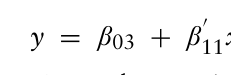
where β02 and ε2 are intercept and error, respectively, regression equation #3: the coefficient of β13 is estimated in the regression equation for the relation of the mediating variable M to the dependent variable Y when both the independent variable and mediating variable are included in the relation to Y, that is,
Equation reproduced from the original PDF.
′ 11x + β13m + ε3 for the relation X →M →Y where β03 and ε3 are intercept and error, respectively.
There are two methods to assess the mediation effect for the single- mediator model (MacKinnon et al., 1995). One method is based on the difference between the estimated coefficients in the relation X →Y and X →M →Y, that is, bβ11 −bβ′
11. It represents the reduction of the effect of X on Y when the relation is adjusted by a mediator M. The ratio of the difference to the standard error of the difference can be used to test the significance of the mediation effect by applying z-distribution. The other method is based on the product of two estimated coefficients in the relation X →M and X →M →Y,
Dependency of Postural Control Factors on Sway in Individuals 7
that is, bβ12 × bβ13. This assessment is to combine the impact of the regressor X on the mediator M and the impact of the mediator M on the outcome Y. The ratio of the product to the standard error of the product can be used to test the significance of the mediation effect by applying z-distribution.
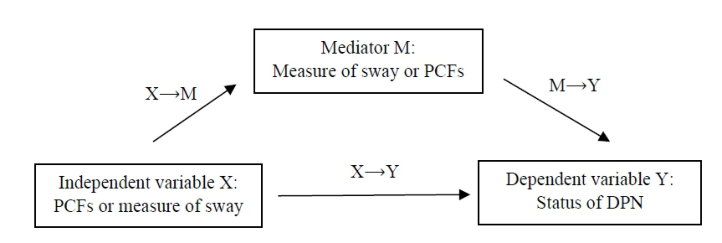
Application of a Single Mediator Model to DPN Most previous studies examine the relationship of DPN to measure of sway in which the status of DPN is the independent variable X and the measure of sway is the dependent variable. The measure of sway was tested to determine if there is a significant difference between individuals with DPN and without DPN, but not to what magnitude. Furthermore, it does not consider a potential effect of PCFs on measure of sway. This study proposes an alternative method that switches the independent and dependent variable and introduces a mediate variable between them. The status of DPN changes from the independent variable X to the dependent variable Y. PCFs and measure of sway become either the independent variable X or a mediator variable M. The relation is depicted in Figure 1.
Figure 1: A single mediator model for DPN.
Since the two relations, PCFs →status of DPN and PCFs →measure of sway, have been verified in previous studies, it can be expected that the relation of PCFs →measure of sway →status of DPN may be established. Postural control factors (PCFs) can include the insensitivity of the feet which can be tested by Semmes-Weinstein monofilament or vibration perception threshold (VPT) scores, the strength of the lower extremity muscles, or the deformity of ankle muscles, in addition to measures of visual, vestibular, and somatosensory functions.
Mediating Effect Analysis for Binary Dependent Variable When the dependent variable is a category variable, like the status of DPN, the normal distribution assumption cannot be valid anymore. For the three mediation regression equations, normal theory ordinary least squares (OLS) and maximum likelihood estimation (MLE) can generate an equivalent mediation effect assessment from the two different methods, that is, bβ11 −bβ′
11 = bβ12 × bβ13 for the continuous dependent variable (MacKinnon et al., 1995). However, this mediating effect analysis method
8 Kim and Kim
for the continuous dependent variable cannot be applicable to the category dependent variable (MacKinnon et al., 2007). In this case, logistic regression can be used instead of OLS linear regression (Pregibon, 1981). The residual in ordinary linear regression is a random variable, which is usually assumed to be normally distributed while the residual variance in logistic regression is fixed at a constant value (π2/3). Because of this fixed value, the scale of the dependent variable is not identical across logistic regression models for the relations X →Y and X →M →Y in Figure 3. For estimating the mediating effect, regression coefficients in the relation X →Y need to be standardized to have an identical scale with the relation X →M →Y. After the coefficients are standardized, it is expected for the two mediating effect values, bβ11 −bβ′
11, bβ12 × bβ13 to be estimated.
CONCLUSION
Most of the previous studies have focused on the difference of sway characteristics between individuals with DPN and without DPN. Depending on experiment conditions, the results have been inconsistent. Even if a significant difference between them was found, its result could not discover any possible relationship between postural control factors (PCFs) and sway characteristics in individuals with DPN such as how much PCFs can impact degree of sway. Thus, it will be difficult to develop a program for fall prevention or postural restoration for individuals with DPN without detailed information of the relation. This study proposed an application of mediation analysis of which a causally related variable, the mediator variable, is introduced between PCFs and DPN to analyze the relation. Sway characteristics can be a mediator variable that may be targeted to intervene in fall prevention in individuals with DPN. The effect of the mediator variable can be estimated using binary logistic regression equations and can be utilized to delineate what PCFs should be improved for postural control.
REFERENCES
Baron, Reuben and Kenny, David. (1986). The Moderator-Mediator Variable Distinction in Social Psychological Research: Conceptual, Strategic, and Statistical Considerations, Journal of Personality and Social Psychology Volume 51, No. 6. Bergin, Peter. Bronstein, A. M. Murray, N. M. Babic, Snezana and Zeppenfeld, D. K.
(1995). Body Sway and Vibration Perception Thresholds in Normal Aging and in Patients with Polyneuropathy, Journal of Neurology, Neurosurgery & Psychiatry Vol. 58, No. 3. Bonnet, Cedrick. Carello, Claudia and Turvey, M. T. (2009). Diabetes and Postural Stability: Review and Hypotheses, Journal of Motor Behavior Vol. 41, No. 2. Boucher, Pierre. Teasdale, Normand. Courtemanche, Richard. Bard, Chantal and
Fleury, Michelle. (1995). Postural Stability in Diabetic Polyneuropathy, Diabetes Care Vol. 18, No. 5. Cavanagh, Peter. Simoneau, Guy and Ulbrecht, Jan. (1993). Ulceration, Unsteadiness, and Uncertainty: The Biomechanical Consequences of Diabetes Mellitus, Journal of Biomechanics Vol. 26, No. 1. Collins, James and De Luca, Carlo. (1993). Open-Loop and Closed-Loop Control of Posture: A Random-Walk Analysis of Center-of-Pressure Trajectories, Experimental Brain Research Vol. 95, No. 2.
Dependency of Postural Control Factors on Sway in Individuals 9
Macheuz, Pierre and Ardilouze, Jean-Luc. (2000). Evaluation of Postural Stability in Elderly with Diabetic Neuropathy, Diabetes Care Vol. 23, No. 8. Di Nardo, Walter. Ghirlanda, Giovanni. Cercone, Stefania. Pitocco, Dario. Soponara, Caterina. Cosenza, Antonella. Paludetti, GaetaNo. Di Leo, Mauro and Galli, Iacopo. (1999). The Use of Dynamic Posturography to Detect Neurosensorial Disorder in IDDM without Clinical Neuropathy, Journal of Diabetes and Its Complications Vol. 13, No. 2. Dickstein, Ruth. Shupert, Charlotte and Horak, Fay. (2001). Fingertip Touch
Improves Postural Stability in Patients with Peripheral Neuropathy, Gait & Posture Vol. 14, No. 3. Dickstein, Ruth. Peterka, Robert and Horak, Fay. (2003). Effects of Light Fingertip Touch on Postural Response in Subjects with Diabetic Neuropathy, Journal of Neurology, Neurosurgery and Psychiatry Vol. 74, No. 5. Goldie, Patrcia. Bach, T. M. and Evans, Owen. (1989). Force Platform Measures
for Evaluating Postural Control: Reliability and Validity, Archives of Physical Medicine and Rehabilitation Vol. 70, No. 7. Haibach, Pamela. Slobounov, Semyon. Slobounova, Elena and Newell, Karl. (2007).
Virtual Time-to-Contact of Postural Stability Boundaries as a Function of Support Surface Compliance, Experimental Brain Research Vol. 177, No. 4. Hijmans, Juha. Geertzen, Jan. Zijlstra, Wiebren. Hof, At and Postema, Klaas. (2008).
Effects of Vibrating Insoles on Standing Balance in Diabetic Neuropathy, Journal of Rehabilitation Research & Development Vol. 45, No. 9. Horak, Fay and Hlavacka, F. (2001). Somatosensory Loss Increases VestibuloSpinal Sensitivity, Journal of Neurophysiology Vol. 86, No. 2. Horak, Fay. Dickstein, Ruth and Peterka, Robert. (2002). Diabetic Neuropathy
and Surface Sway-Referencing Disrupt Somatosensory Information for Postural Stability in Stance, Somatosensory & Motor Research Vol. 19, No. 4. Hyman, H. H. (1955). Survey Design and Analysis: Principles, Cases, and Procedures, Glencoe; Free Press. Kakara, Ramakrishna. Bergen, Gwen. Burns, Elizabeth and Stevens, Mark. (2023).
Nonfatal and Fatal Falls among Adults Aged ≥65 Years-United States, 2020– 2021, Morbidity and Mortality Weekly Report 2023 Vol. 72, No. 35. Lafond, Danik. Corriveau, Helene and Prince, Francois. (2004). Postural Control Mechanisms during Quiet Standing in Patients with Diabetic Sensory Neuropathy, Diabetes Care Vol. 27, No. 1. Lord, Stephen. Ward, John. Williams, Philippa and Anstey, Kaarin. (1994).
Physiological Factors Associated with Falls in Order Community-Dwelling Women, Journal of the American Geriatrics Scociety Vol. 42, No. 10. MacKinnon, David. Warsi, Ghulam and Dwyer, James. (1995). A Simulation Study of Mediated Effect Measures, Multivariate Behavioral Research Vol. 30, No. 1. MacKinnon, David. Lockwood, C. Brown, C. Wang, W and Hoffman, J. (2007). The
Intermediate Endpoint Effect in Logistic and Probit Regression, Clinical Trials Vol. 4, No. 5. Mishra, Prabhaker. Pandey, Chandra. Singh, Uttam. Gupta, Anshul. Sahu, Chinmoy and Keshri, Amit. (2019). Descriptive Statistics and Normality Tests for Statistical Data, Annals of Cardiac Anaesthesia Vol. 22, No. 1. Oppenheim, Uri. Kohen-Raz, Reuven. Alex, Daitz. Kohen-Raz, Achi and Azarya,
Morris. (1999). Postural Characteristics of Diabetic Neuropathy, Diabetes Care Vol. 22, No. 2.
10 Kim and Kim
Pregibon, Daryl. (1981). Logistic Regression Diagnostics, The Annals of Statistics Vol. 9, No. 4. Priplata, Attila. Niemi, James. Harry, Jason. Lipsitz, Lewis and Collins, James.
(2003). Vibratory insoles and balance control in elderly people, The Lancet Vol. 362, No. 9390. Ray, Christopher and Wolf, Steven. (2008). Review of Intrinsic Factors Related to Fall Risk in Individuals with Visual Impairments, Journal of Rehabilitation Research and Development Vol. 45, No. 8. Schwartz, Ann. Hiller, Teresa. Sellmeyer, Deborah. Resnick, Helaine. Gregg, Edward. Ensrud, Kristine. Schreiner, Pamela. Margolis, Karen. Cauley, Jane. Nevitt,
Michael. Black, Dennis and Cumming, Steven. (2002) Older Women with Diabetes Have a Higher Risk of Falls: A Prospective Study, Diabetes Care Vol. 25, No. 10. Simmons, Roger. Richardson, Charles and Pozos, Robert. (1997). Postural Stability of Diabetic Patients with and without Cutaneous Sensory Deficit in the Foot, Diabetes Research and Clinical Practice Vol. 36, No. 3. Simoneau, Guy. Ulbrecht, Jan. Derr, Janice. Becker, Michael and Cavanagh,
Peter. (1994). Postural Instability in Patients with Diabetic Sensory Neuropathy, Diabetes Care Vol. 17, No. 12. Simoneau, Guy. Ulbrecht, Jan. Derr, Janice and Cavanagh, Peter. (1995). Role of Somatosensory Input in the Control of Human Posture, Gait Posture Vol. 3, No. 3. Slobounov, Semyon. Slobounova, Elena. and Newell, Karl. (1997). Virtual Time-
to-Collision and Human Postural Control, Journal of Motor Behavior Vol. 29, No. 3. Toosizadeh, Nima. Mohler, Jane. Armstrong, David. Talal, Talal and Najafi, Bijan.
(2015). The Influence of Diabetic Peripheral Neuropathy on Local Postural Muscle and Central Sensory Feedback Balance Control, PLoS One Vol. 10, No. 8. Turcot, Katia. Allet, Lara. Golay, A. Hoffmeyer, Pierre and Armand, Stephane.
(2009). Investigation of Standing Balance in Diabetic Patients with and without Peripheral Neuropathy Using Accelerometers, Clinical Biomechanics Vol. 24, No. 9. Uccioli, Luigi. Giacomini, Pier. Pasqualetti, Patrizio. Di Girolamo, StefaNo. Ferrigno, Paola. Monticone, Giovanna. Bruno, Ernesto. Boccasena, Paolo. Magrini, Antonio. Parisi, Lea. Menzinger, Guido and Rossini, Paolo. (1997). Contribution of Central Neuropathy to Postural Instability in IDDM Patients with Peripheral Neuropathy, Diabetes Care Vol. 20, No. 6. Vaz, Maita. Costa, Gustabo. Reis, Julia. Junior, Wilson. Albuquerque de Paula, Francisco and Abreu, Daniela. (2013). Postural Control and Functional Strength in Patients with Type 2 Diabetes Mellitus with and without Peripheral Neuropathy, Arch Phys Med Rehabil Vol. 94, No. 12. Yamamoto, Ritsuko. Kinoshita, Toru. Momoki, Tadahisa. Takashi, Arai. Okamura,
Atsushi. Hirao, Kouichi and Sekihara, Hisahiko. (2001). Postural Sway and Diabetic Peripheral Neuropathy, Diabetes Research Clinical Practice Vol. 52, No. 3. Zaida, Dorothy and Alexander, Mary. (2001). Falls in the Elderly: Identifying and Managing Peripheral Neuropathy, Nurse Practice Vol. 26, No. 3. Zhang, Xinzhi. Gregg, Edward. Cheng, Yiling. Thompson, Theodore Geiss, Linda.
Duenas, Michael and Saaddine, Jinan. (2008). Diabetes Mellitus and Visual Impairment, Archaives of Ophthalmology Vol. 126, No. 10.
LISTED IN THE AHFE DIGITAL BOOKSTORE CATALOGUE
Explore the complete digital volume
Neuroergonomics and Cognitive Engineering
Read this individual research paper free through the original publisher, or explore the full digital proceedings book.
ISBN 978-1-964867-43-4
Explore this ISBN in the AHFE Bookstore ↗Listed in the July 2026 bookstore catalogue; search by ISBN to confirm current availability · Digital book purchase optional