Skip to article
AHFE AHFE Discoveries AHFE International Open Access Journal
AHFE OPEN ACCESS OPEN ACCESS CONFERENCE PROCEEDINGS PAPER

Assessing the effectiveness of virtual reality tasks as stress-inducing environments

1 University of South Florida, Tampa, FL 33620, USA ↗
2 University of Sao Paulo, Sao Paulo, SP 05508-900, Brazil ↗
Publication year
Digital Object Identifier10.54941/ahfe1006134

Abstract

For safety reasons, the impact of stress on cognitive readiness cannot be assessed, in real-time hazardous working scenarios, by several psychophysiological methods. This study aimed to assess the validity of virtual reality environments in eliciting a significant level of stress, allowing the study of behaviours that might mimic those typically expressed by workers in an oil platform. Humans have a complex brain structure that enables learning, task performance, and responsiveness to stimuli. Cognitive readiness refers to the state in which alertness and mental preparation reach the necessary level for an adequate performance, especially in complex and unpredictable environments. However, external factors, such as pressure and stress, may impair cognitive readiness, posing a long-term challenge in several activities, particularly in offshore oil platform workers, who frequently operate in adverse and risky conditions. Therefore, developing innovative technologies to monitor cognitive readiness using accessible, simple, and quickly executed tasks could reduce work-related accidents in these and other hazardous scenarios. However, for safety reasons, psychophysiological measures, such as electroencephalographic signals and electrodermal potentials, which could provide valuable information in developing such technologies, cannot be collected during real-time activities. To partially overcome this experimental barrier, we assessed the effectiveness of a virtual reality (VR) simulation wherein a stress-inducing task was akin, in essential sensorimotor attributes, to complex procedures typically carried out in oil platforms. Materials and methods Adult volunteers were subjected to two tasks: a bomb deactivation simulation in a VR environment (submitting the volunteers to the Keep Talking and Nobody Explodes game under noisy instructions) followed by the presentation on a computer screen of a sequence of either positive or negative images selected from the International Affective Picture System (IAPS). Electrodermal potentials (galvanic skin response, GSR), heart rate (HR), and electroencephalographic activity (EEG) were acquired during the behavioural procedures. The subjective mood questionnaire State- Trait Anxiety Inventory - Scale (STAI-S) was applied before the tasks to evaluate overall anxiety. The STAI-T and the Visual Analogue Mood Scale (VAMS) were also applied after each task to assess feelings of tension, anxiety, and nervousness. Results In this preliminary study, since the main objective was the validation of the stress-inducing VR environment, we concentrated on analysing the impact of the bomb deactivating procedure and the presentation of both kinds of affectively arousing images on the mood state expressed by the volunteers. For the data obtained from the State-Trait Anxiety Inventory scale, a 2X3 two-way mixed design ANOVA, with the between-subjects factor Group (positive vs. negative images) and the within-subjects factor Time (pre-test, post-game, and post-images) revealed a highly significant main effect of the factor Time (F[84,2] = 20.33, p < 0.0001, partial eta-sqr = 0.326). A marginal interaction between the two factors (F[84,2] = 2.548, p = 0.084, partial eta-sqr = 0.057) is in agreement with a post-hoc analysis (Holm’s test) that revealed no statistically significant differences between the three levels of the factor Time for the positive image group. In contrast, a statistically significant difference (p < 0.001) was found between the pre-test average score and the two following average scores (post-game and post-images levels), which did not differ statistically from one another (p > 0.99). For the VAMS data, a 2X2 mixed design ANOVA showed similar results, with a marginal interaction between the two factors (F[41,1] = 2.843, p = 0.099, partial eta- sqr = 0.065), which agrees with a qualitatively (but non-statistically significant) decrease in the anxiety average score only for the positive image group. Conclusion Our findings have shown that the VR-simulated task was able to elicit a substantial level of anxiety that persisted throughout the presentation of the sequence of affective images only in the negative- image group, tending to decline toward normal levels in the positive-image group. Therefore, this setup can be used as a tool to investigate, by means of other psychophysiological methods, a behaviour that mimics real working scenarios.

INTRODUCTION

The human brain’s complexity allows for learning, task performance, and adaptive responses to stimuli. Cognitive readiness denotes a state in which alertness and mental preparation reach a level conducive to optimal performance (Fletcher, 2004; O’Neil et al., 2014; Crameri, Hettiarachchi and Hanoun, 2021). This readiness becomes critical in complex and unpredictable environments. However, external factors like pressure and stress can impair cognitive readiness, posing long-term challenges in high- risk sectors, such as oil platforms, deep diving, or bomb disposal units, where workers often operate under adverse and dangerous conditions (Lafond et al., 2012; vonRosenberg, 2019; Chowdhury et al., 2025). Innovative technologies capable of monitoring cognitive readiness through accessible, simple, and efficient tasks could help reduce work- related accidents in hazardous scenarios. However, for safety reasons, psychophysiological measures, such as electroencephalographic signals and electrodermal potentials, which provide valuable insights for developing such technologies, cannot be collected during real-time operations (Chowdhury et al., 2025). To address this experimental limitation, we evaluated the effectiveness of a virtual reality simulation involving a stress-inducing task, designed to emulate essential sensorimotor attributes of procedures performed in dangerous situations.

© 2025. Published by AHFE Open Access. All rights reserved. 133

MATERIALS AND METHODS

Fifty adult volunteers were initially recruited from among university students. However, six participants were excluded from the analysis due to corrupted or missing data. The final sample comprised 44 participants (21 males and 23 females), aged 18 to 30 years. All participants completed two tasks: (i) Bomb deactivation simulation: In this VR task, participants played the game Keep Talking and Nobody Explodes, having to dismantle a bomb under a noisy environment, increasingly complex instructions, and time pressure. This game was selected for its intrinsic potential to elicit acute stress and anxiety.

(ii) Affective image presentation: After the VR task, participants viewed a five-minute sequence of either positive (P) or negative (N) images selected from the International Affective Picture System (IAPS; Lang et al., 2020) on a computer screen. Participants were divided into two groups (P and N) according to the nature of the images presented. They were instructed to observe the images without any additional task.

The State-Trait Anxiety Inventory (STAI) was administered in its two forms. The Trait form (STAI-T) was applied at the start of the experiment (pre-test) to assess overall anxiety. The State form (STAI-S), along with the Visual Analogue Mood Scale (VAMS), were administered following each task (post-game and post-images) to evaluate levels of tension, anxiety, and nervousness.

Electrodermal potentials (galvanic skin response, GSR), heart rate (HR), and electroencephalographic activity (EEG) were recorded from all participants during the behavioural procedures. The data derived from these measures are still under analysis and will not be presented in this report.

RESULTS

This preliminary study focused on validating the stress-inducing VR environment by analysing the impact of the bomb deactivation task and the affective image sequences on participants’ mood states.

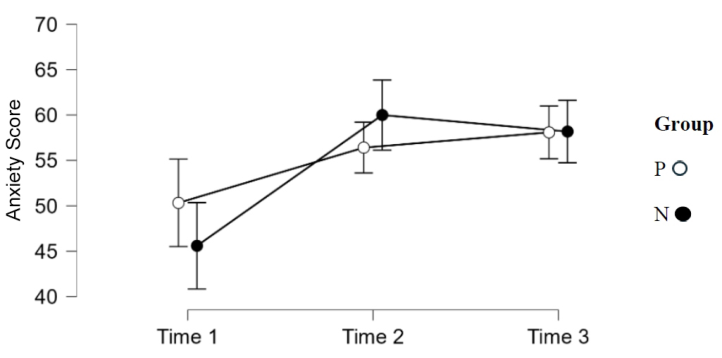
Analysis of the STAI data (Figure 1) using a 2x3 two-way mixed-design ANOVA, with Group (positive vs. negative images) as a between-groups factor and Time (pre-test, post-game, and post-images) as a within-groups factor, revealed a highly significant main effect of Time (F[84,2] = 20.33, p < 0.0001, partial eta-squared = 0.326). A marginal interaction between the two factors (F[84,2] = 2.548, p = 0.084, partial eta-squared = 0.057) aligned with a post-hoc Holm’s test, indicating no statistically significant differences between time points for the positive image group (p > 0.095). Conversely, a significant difference (p < 0.001) was observed between the pre-test and both post-game and post-images scores for the negative image group, with no significant difference between the latter two (p > 0.99).

A pairwise comparison (Holm’s test) between the levels of the factor Time across the combined groups (P and N) confirmed the highly significant difference between pre-test and both post-game and post-images scores

Assessing the Effectiveness of Virtual Reality Tasks as Stress-Inducing Environments 135

Mathematical equation reproduced from the original PDF
Equation reproduced from the original PDF.

VAMS data yielded similar findings. A 2x2 mixed-design ANOVA revealed a marginal interaction between factors (F[41,1] = 2.843, p = 0.099, partial eta-squared = 0.065), consistent with a non-significant decrease in anxiety scores only for the positive image group.

Figure 1: Mean scores from the State-Trait Anxiety Inventory scale (STAI). The lines show the STAI scores at three moments (Time 1 to 3 indicate pre-test, post-game, and post-images points in time) for both participant groups (P and N code the groups exposed to positive or negative images, respectively). Error bars denote 95% confidence intervals.
Original PDF Figure 1:

CONCLUSION

Our findings indicate that the VR-simulated task successfully induced a substantial level of anxiety, persisting during the presentation of negative images but diminishing towards normal levels with positive images. While the experimental procedure closely mimicked tasks performed by bomb disposal units, the physiological and emotional effects observed may generalise to other high-pressure, stressful environments, such as oil platforms, deep-sea diving and air traffic control towers, among others.

Further validation is required to confirm the task’s relevance as a tool for investigating psychophysiological responses in real-world scenarios. However, these preliminary results suggest that VR-based simulations offer promising avenues for studying stress and cognitive readiness in settings where real-time data collection is unfeasible.

ACKNOWLEDGMENT

The authors would like to acknowledge Cognittiv Technology.

REFERENCES

Chowdhury, T. I. et al. (2025) ‘A Review of Cognitive Readiness, Wearable Devices, and Prospects’. arXiv. Available at: https://doi.org/10.48550/arXiv.2501.03537. Crameri, L., Hettiarachchi, I. and Hanoun, S. (2021) ‘A Review of Individual

Operational Cognitive Readiness: Theory Development and Future Directions’, Human Factors, 63(1), pp. 66–87. Available at: https://doi.org/10.1177/ 0018720819868409. Fletcher, J. D. (2004) Cognitive Readiness: Preparing for the Unexpected: Fort Belvoir, VA: Defense Technical Information Center. Available at: https://doi.org/ 10.21236/ADA458683. Lafond, D. et al. (2012) ‘Support Requirements for Cognitive Readiness in Complex

Operations’, Journal of Cognitive Engineering and Decision Making, 6(4), pp. 393–426. Available at: https://doi.org/10.1177/1555343412446193. Lang, P. J. et al. (2020) ‘International Affective Picture System’. Available at: https:// doi.org/10.1037/t66667-000. O’Neil, H. F. et al. (2014) ‘What Is Cognitive Readiness?’, in H. F. O’Neil, R. S. Perez,

and E. L. Baker (eds) Teaching and Measuring Cognitive Readiness. Boston, MA: Springer US, pp. 3–23. Available at: https://doi.org/10.1007/978-1-4614-7579- 8_1. vonRosenberg, J. (2019) ‘Cognitive Appraisal and Stress Performance: The Threat/ Challenge Matrix and its Implications on Performance’, Air Medical Journal, 38(5), pp. 331–333. Available at: https://doi.org/10.1016/j.amj.2019.05.010.

Cover of the proceedings volume Neuroergonomics and Cognitive Engineering

Explore the complete digital volume

Neuroergonomics and Cognitive Engineering

Read this individual research paper free through the original publisher, or explore the full digital proceedings book.

ISBN 978-1-964867-43-4

Explore this ISBN in the AHFE Bookstore Listed in the July 2026 bookstore catalogue; search by ISBN to confirm current availability · Digital book purchase optional

Explore Related Research

Related research 8 matches

More papers from this volume

← Back to Research ExplorerBrowse the full library →