Marc Antoine Moinnereau, Abhishek Tiwari, Danielle Benesch, Nicole Bolt, Gregory P Krätzig, Simon Paré, Tiago Henrique Falk (2025). Subjective and Objective Assessment of the Impact of Stress and Mental Workload on Cybersickness During Virtual Reality Training. In: Metaverse, Virtual Environments and Game Design. AHFE Open Access, vol. 178, pp. 87–98. https://doi.org/10.54941/ahfe1006348
Cybersickness is an issue in immersive virtual reality (VR), akin to motion and simulator sickness, resulting in symptoms such as nausea, dizziness, and eye strain. Cybersickness has been shown to affect a significant portion of VR users. In training scenarios involving demanding tasks (e.g., for first responders' training), however, reports of cybersickness symptoms are higher than those for the average user. It is hypothesized that the stress and mental workload generated by these scenarios may be the cause for this increased propensity for cybersickness. In this study, we investigate the impact of stress alone, mental workload alone, and their combined impact on cybersickness levels. The levels of stress and mental workload are manipulated while participants perform a driving simulator task. In the high mental workload condition, the driver has to keep an eye on the road while driving from one location to another, as well as monitor and count the number of pedestrians wearing a certain colour shirt. In the high stress condition, traffic conditions become heavy, background noise increases, and sudden breaks are needed to avoid accidents (e.g., from a ball rolling into the road to a car suddenly changing lanes). Lastly, the combined condition contains all the elements of the previous two conditions. In all cases, a baseline driving period is present (without stress or workload) and is used for comparisons within each subject. Both self-report and neurophysiological measurements are used to gauge the impact of these three conditions on cybersickness. Self-report questionnaires are used to assess stress (DASS-21), mental workload (NASA-TLX), and cybersickness symptoms (SSQ) at several instances during the experiment. In turn, an instrumented Meta Quest 3 VR headset is used equipped with 16 electroencephalography (EEG) and electro-oculography (EOG) sensors, while wearable devices are used to monitor photoplethysmography (PPG), electrocardiography (ECG), and respiration signals. These neurophysiological signals are used to continuously extract measures of mental workload, stress, and other cognitive/affective states almost in real-time. In this paper, we describe the experimental setup, the instrumented headset, the EEG and biosignal metrics that are computed, and provide preliminary subjective and objective findings based on the first 12 participants (four per condition). The study is ongoing and aims to collect data from 60 participants (20 per condition). It is hoped that these preliminary insights will help the research community refine VR training protocols, making them more comfortable and effective for students.
Virtual reality (VR) is a powerful training tool for high-risk professions such as law enforcement, emergency response, and aviation (Dodoo et al., 2025; Kleygrewe et al., 2024). The immersive nature of VR allows for controlled exposure to complex and hazardous scenarios, making it a valuable asset for skill development and decision-making under pressure (Harris et al., 2023). However, despite its advantages, VR training is frequently hindered by cybersickness, a condition similar to motion sickness that manifests as nausea, dizziness, and disorientation (Oh & Son, 2022). Studies have estimated that up to 60% of VR users experience some form of cybersickness, with rates increasing in high-intensity training scenarios (Caserman et al., 2021; Sepich et al., 2022). Given that VR is often used in demanding and high-pressure environments, understanding the factors that contribute to cybersickness is critical for optimizing its effectiveness.
Previous research has primarily attributed cybersickness to sensory conflict, wherein discrepancies between visual, vestibular, and proprioceptive cues disrupt the user’s perception of motion (Dennison & D’Zmura, 2017). However, recent evidence suggests that psychological and cognitive factors, such as stress and mental workload, may also play a significant role in exacerbating cybersickness symptoms (Garrido et al., 2022; Pöhlmann et al., 2023). Stress is known to induce physiological changes that can modulate sensory processing, potentially increasing susceptibility to cybersickness (Kim et al., 2021). Similarly, high cognitive load has been linked to increased symptoms of motion sickness, as it may limit attentional resources required for sensory reweighting and adaptation in VR environments (Souchet et al., 2023). Our previous survey (Moinnereau et al., 2024) reviewed the literature on these relationships and found that while both stress and cognitive load appear to influence cybersickness, the evidence was more consistent for stress. Effects related to cognitive load were more variable, with some studies even suggesting that task-related distraction could reduce symptoms. This reinforces the need for further controlled empirical validation.
To address this gap, the present study investigates the direct impact of stress and mental workload on cybersickness through a controlled VR driving simulation. Participants performed driving tasks in three experimental conditions designed to elicit (1) high mental workload (requiring visual target identification while driving), (2) high stress (navigating a high-speed traffic scenario with unpredictable hazards), and (3) a combined condition incorporating both stress and workload elements. Across these conditions, self-reported measures were collected for cybersickness using the Simulator Sickness Questionnaire (SSQ) (Bouchard et al., 2007), for stress using the Depression Anxiety Stress Scale (DASS-21) (Lovibond, 1995), and for cognitive load using the NASA Task Load Index (NASA-TLX) (Hart et al., 1988). In addition, numerous neurophysiological signals were recorded alongside head movement patterns recorded via an accelerometer.
Understanding how stress and cognitive load influence cybersickness is important for improving VR training, especially in contexts where stressful situations are common. If these factors increase the severity of cybersickness, it becomes necessary to adapt training systems, for instance, by adjusting
Subjective and Objective Assessment of the Impact of Stress and Mental Workload 89
workload, integrating biofeedback, or modifying scenarios. This study offers initial insights that can help guide the development of VR protocols that are both more effective and more comfortable for users.
METHODOLOGY
Participants Twelve participants (6 males, 6 females) aged between 24 and 38 years took part in this study. All participants were in good health. Most had prior experience with VR, although two were using it for the first time, and a few reported occasional use. The selection criteria ensured that no participants had a history of severe motion sickness, vestibular disorders, or neurological conditions that could interfere with physiological signal acquisition. The study was conducted under the approval of the INRS Research Ethics Committee for Human Studies, and each participant provided informed consent before engaging in the experiment. Additionally, they completed the Generalized Anxiety Disorder (GAD-7) questionnaire to assess baseline anxiety levels. Prior to the experiment, participants were instructed to maintain proper hydration and eat a balanced meal to reduce the effects of cybersickness. To further control external factors, all experimental sessions were conducted in an air-conditioned room maintained at a constant temperature of 19
C, with a fan placed near the simulator to improve air circulation and help reduce cybersickness symptoms (Ang & Quarles, 2023).
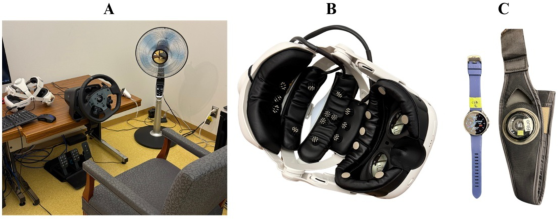
Experimental Setup The experimental setup was designed to closely replicate a realistic driving scenario in VR while enabling physiological monitoring (see Figure 1A). The driving simulation used a Logitech G PRO Racing Wheel, mounted to a table, with floor-positioned pedals to provide a stable and ergonomic platform. The force feedback settings of the wheel and pedal resistance were calibrated via Logitech software, with default resistance levels maintained across all participants to ensure consistency in the driving experience. The VR simulation was developed using Unity by SimLeader (SimLeader, Canada), based on an existing virtual city and adapted for the stress-inducing and cognitive load scenarios of the study.
Figure 1: (A) Experimental setup showing the steering wheel and pedal system. (B) Instrumented Meta Quest 3 headset with integrated dry EEG electrodes. (C) Fossil smartwatch and Zephyr BioHarness used to collect ECG, PPG, and respiration signals.
Participants wore an instrumented Meta Quest 3 headset (see Figure 1B), developed in our laboratory, which was customized to integrate 16 dry EEG and electrooculography (EOG) sensors for real-time physiological data collection. The headset included strategically placed electrodes based on a prior literature review highlighting the importance of certain brain regions in cybersickness-related studies (Agi´c & Mandi´c, 2019; Chang et al., 2023; Yang et al., 2022). The reference and bias electrodes were both positioned on the mastoids, as this location provides a neutral zone and improved signal quality. Electrodes were placed at O1, Oz, O2, P3, P4, C1, C2, F1, F2, Fp1, Fpz, Fp2, and four EOG electrodes for vertical and horizontal eye movement tracking. No formal calibration procedure was required prior to the experiment. The in-house developed software provided indication of electrode impedance, ensuring adequate contact with the participant’s scalp. Continuous signal quality checks were performed during the experiment. Additionally, data from the Zephyr BioHarness 3 and Fossil smartwatch (Figure 1C) were used to collect electrocardiography (ECG), respiration rate, and photoplethysmography (PPG) signals through the SensorHub system (Gagnon et al., 2014). This integration enabled real-time synchronization of multiple physiological data streams, providing additional insights into cardiovascular and respiratory responses.
Study Protocol Participants were assigned to one of three experimental scenarios, each designed to elicit different levels of stress and cognitive workload. The first scenario, referred to as the mental workload (MW) condition, required participants to count the number of times a pedestrian wearing a yellow shirt appeared alongside another pedestrian wearing a blue shirt while driving. This task was designed to generate an additional cognitive demand by diverting attention from the primary driving task, thereby increasing mental workload. The second scenario, designed to induce stress, placed participants in a high-pressure emergency driving situation where they were instructed to transport an injured person to a hospital. During this scenario, external stressors such as aggressive traffic, unpredictable pedestrian crossings, honking, and sudden obstacles, including a soccer ball rolling onto the road, were introduced. Finally, the third scenario, designed to combine both stress and cognitive load (referred to as MW+Stress), required participants to drive under high-stress conditions while simultaneously completing the cognitive counting task, thereby integrating both elements within the same simulation.
Each scenario lasted 25 minutes and was structured into distinct conditions that progressively increased task difficulty. The initial condition involved straight-line driving at a low speed for four minutes without any traffic, serving as a baseline. The second condition introduced turns with light traffic and pedestrian activity, encouraging head movements while driving. In the third condition, the complexity was further increased with additional turns and denser traffic, requiring participants to engage more actively with their surroundings. The final condition, specific to each scenario, introduced either mental workload, stress, or a combination of both. Throughout the
Subjective and Objective Assessment of the Impact of Stress and Mental Workload 91
experiment, participants completed self-report questionnaires five times per scenario: before the baseline condition, and after each of the experimental conditions. Responses were recorded within the VR environment using a ten-point Likert scale ranging from 0 to 10, with 0.1 resolution increments. Importantly, numerical values were not displayed on the scale to minimize potential response bias. While the SSQ and NASA-TLX were used in full, only a subset of 7 items from the DASS-21 was retained. These items specifically targeted physiological and emotional stress indicators such as tension, panic, trembling, and breathing difficulty, as they were considered more directly relevant to cybersickness-related symptoms.
Data Processing and Feature Extraction The analysis focused on comparing condition 3 (the high traffic driving segment occurring after approximately 15 minutes of VR exposure) and condition 4, which introduced one of three experimental manipulations: MW, stress, or a combination of both. This comparison allowed us to assess how added cognitive or emotional demands impacted cybersickness symptoms and physiological responses.
EEG preprocessing was conducted using MNE toolbox in Python. First, a finite impulse response (FIR) bandpass filter was applied within the range of 0.5–40 Hz. To further enhance signal quality, independent component analysis (ICA) was used. Independent components were visually inspected and those corresponding to motion artefacts and blinks were isolated and removed, followed by signal reconstruction. EEG signals were then segmented into 2-second epochs with no overlap and the power spectral density was computed for the five standard frequency bands: delta (1–4 Hz), theta (4–8 Hz), alpha (8–12 Hz), beta (12–30 Hz), and gamma (30–40 Hz). Alpha power is of particular interest, as its decrease, especially over parietal and occipital regions, has been linked to increased cortical activation and cognitive engagement during task performance (Klimesch, 1999).
Accelerometer data were collected using the onboard sensor integrated into the EEG data acquisition board. Since the device was mounted directly on the VR headset, the recorded signals reflect head movements during the simulation. The raw x, y, and z accelerometer signals were segmented into 2-second sliding windows with 50% overlap. For each window, movement dynamics were quantified by computing the number of significant changes in acceleration along the left-right, forward-backward, and up-down axes. Additionally, the total movement amplitude and the overall number of movement events were calculated. These features were selected to capture head movement dynamics, as previous studies have shown that increased or irregular head motion can increase cybersickness symptoms (Salehi et al., 2024). Similarly, physiological data collected via the BioHarness 3 and Fossil smartwatch were analyzed. Heart rate variability (HRV) and respiration rate were extracted from the ECG signals. HRV and respiration have been identified in prior research as reliable indicators of autonomic responses linked to cybersickness, with altered HRV patterns and irregular breathing frequently observed in affected individuals (Dennison et al., 2016; Reyero Lobo & Perez, 2022). The PPG signals are not used in this analysis.
RESULTS
Subjective Assessment
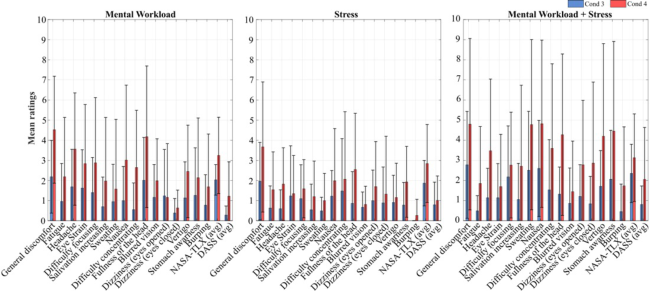
Figure 2 presents mean ratings for all self-reported symptoms and questionnaire items, including the SSQ, NASA-TLX, and selected DASS-21 items, across condition 3 and condition 4 for each experimental scenario. It shows that across all three scenarios, symptom ratings increased from condition 3 to condition 4. This trend was most pronounced in the MW+Stress group, where nearly all symptoms showed a marked increase, with average values ranging from 4 to 5 for symptoms like general discomfort, nausea, sweating, vertigo, and stomach awareness. Some participants even reported values near 9 on the scale. In contrast, symptoms such as blurred vision, fatigue, and eye strain remained relatively lower. In the MW condition, symptom ratings also increased notably in condition 4. The most affected symptoms were general discomfort, fullness of the head, headache, and nausea, with average values between 2.5 and 4.5. Sweating and dizziness (eyes closed) were among the least reported symptoms in this scenario. For the Stress condition, symptom increases between conditions 3 and 4 were less pronounced. The higher symptoms included general discomfort, fullness of the head, and difficulty concentrating, ranging between 1.5 and 3.5. The lowest-rated symptoms included burping, blurred vision, and sweating. NASA-TLX scores followed a consistent trend across all three groups, with a moderate increase from condition 3 to condition 4 and average values between 2 and 3.5. In contrast, DASS ratings remained low across all scenarios, generally between 0 and 1.5.
Figure 2: Mean self-reported ratings for each symptom and questionnaire item across conditions 3 (Blue bars) and 4 (red bars), grouped by experimental scenario: MW (left), stress (middle), and MW + stress (right).
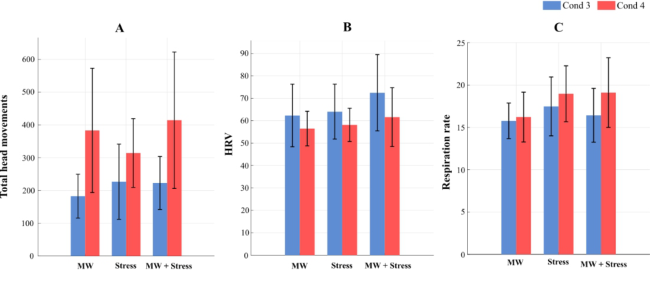
Objective Assessment Across all three experimental scenarios, condition 4 showed higher values of head movement and respiration rate compared to condition 3, while HRV, measured as the standard deviation of normal-to-normal intervals, tended
Subjective and Objective Assessment of the Impact of Stress and Mental Workload 93
to decrease. In terms of total head movement (Figure 3.A), participants in the MW and MW+Stress groups showed the highest values in condition 4. The number of movements nearly doubled from condition 3, rising from approximately 180 to 380 in the MW scenario and from 220 to 410 in the MW+Stress scenario. In contrast, the Stress condition showed a smaller increase, from about 230 to 320 movements on average. HRV (Figure 3.B) showed a consistent trend of reduction between conditions 3 and 4. In the MW group, HRV dropped from 63 to 57 ms. A similar pattern was observed in the Stress group (from 65 to 58) and the MW+Stress group (from 72 to 62). Respiration rate (Figure 3.C) increased across all three scenarios. In the MW group, the rate was slightly higher, from 16 to 16.5 breaths per minute. In the Stress and MW+Stress conditions, the increase was more pronounced, from approximately 17.5 to 19 and 16.5 to 19 breaths per minute, respectively. Overall, these results indicate consistent physiological and behavioral changes between the two conditions, with stronger effects observed in the MW and MW+Stress scenarios, particularly in head movement and respiration.
Figure 3: Objective physiological and behavioral measures recorded in condition 3 (blue) and condition 4 (red) for each experimental group. (A) Total head movements extracted from accelerometer data. (B) Heart rate variability (HRV). (C) Respiration rate.
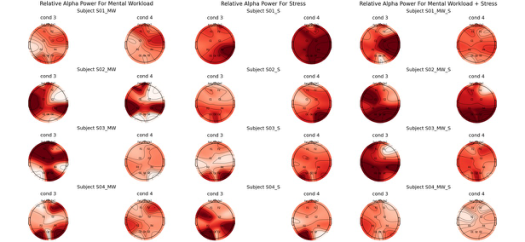
Figure 4 presents the topographic distributions of relative alpha power for each participant, comparing condition 3 to condition 4 across the three scenarios. In the MW scenario, all four participants show a visible reduction in alpha power in condition 4. This decrease is most consistently observed over occipital electrodes. For participants S03_MW and S04_MW, the reduction extends into the frontal regions. In the Stress scenario, participants S03_S and S04_S show a decrease in occipital alpha power from condition 3 to 4. In contrast, participants S01_S and S02_S show a slight increase in alpha power, primarily in posterior and central areas. In the MW+Stress condition, a reduction in alpha power is observed for all participants, specifically across occipital and frontal sites.
Figure 4: Topographic maps of relative alpha power (8–12 Hz) for each participant in conditions 3 and 4 across the three experimental scenarios: mental workload (left), stress (middle), and mental workload + stress (right).
DISCUSSION
The combined analysis of subjective reports and physiological data suggests that the intensity of cybersickness symptoms was strongly influenced by both the nature of the task and the duration of VR exposure. While all participants completed the simulation, discomfort became more prominent toward the end of condition 4, especially in scenarios involving active visual scanning. This supports the idea that cybersickness is not only time-dependent but also task-dependent. Post-session debriefs revealed that this task significantly worsened their symptoms, particularly during moments involving turning, braking, and elevation changes in the road. These events were frequently cited as the most uncomfortable aspects of the simulation. Participants reported that symptoms intensified during the end of turns, when the vehicle straightened, and during abrupt stops or drops in the road level. Such events likely increased sensory conflict by generating a mismatch between visual motion and the lack of corresponding vestibular input, a mechanism well- documented in the literature on simulator sickness (Dennison & D’Zmura, 2017; Reason & Brand, 1975). The subjective reports are further supported by accelerometer data, which showed that total head movements nearly doubled from condition 3 to condition 4 in both the MW and MW+Stress groups. Head movement is a known aggravating factor in VR-induced discomfort, as it amplifies visual-vestibular mismatches, particularly when combined with prolonged exposure (Kemeny et al., 2017; Salehi et al., 2024). In contrast, participants in the Stress condition remained more visually and posture stable. The lower movement levels observed in this group coincide with milder SSQ ratings and fewer reported symptoms. However, while the Stress scenario introduced unpredictable traffic, honking, and background noise, it did not produce the expected stress response. DASS scores remained low across all participants, and none spontaneously reported feeling emotionally overwhelmed. The scenario may have lacked sufficient unpredictability or realism to elicit greater stress. These findings suggest that the stress manipulation was not as effective under the current design, and that future iterations may require
Subjective and Objective Assessment of the Impact of Stress and Mental Workload 95
adaptive or personalized stress triggers to better simulate pressure and urgency.
From a physiological perspective, reduced HRV is a well-established marker of increased sympathetic activation and has been linked to cybersickness in both VR and motion simulation studies (Kim et al., 2005; Dennison et al., 2016). The strongest decrease in HRV was observed in the MW+Stress group, possibly reflecting cumulative effects of sustained cognitive effort and physical discomfort. Respiration rate also increased in condition 4 across scenarios, especially in the Stress and MW+Stress groups. Changes in respiration have been associated with emotional arousal and sensory conflict. Elevated respiratory activity may indicate compensatory physiological responses to discomfort or cognitive strain (Reyero Lobo & Pérez, 2022). Moreover, EEG results revealed a consistent decrease in alpha power, particularly over occipital regions, in the MW scenario. Alpha suppression is frequently associated with increased visual and cognitive engagement (Klimesch, 1999; Wascher et al., 2014). The observed pattern suggests greater cortical activation in condition 4, likely due to the added demands of the visual search task. In the Stress and MW+Stress scenarios, alpha activity showed more variability, with some participants showing a decrease and others more stable patterns. This variability may reflect individual differences in how participants cope with multisensory stimulation and workload.
Taken together, these findings suggest that cybersickness during immersive VR is primarily driven by visual complexity, attentional demands, and head movement dynamics, rather than emotional stress alone. Although the Stress condition included aggressive traffic and sound cues, it did not generate strong subjective stress or marked physiological arousal, as reflected in low DASS scores and relatively stable EEG and respiration measures. In contrast, scenarios requiring active visual search and more frequent head movement consistently produced stronger subjective and objective responses. Environmental factors also influenced symptom development. The presence of a fan near the simulator helped reduce thermal discomfort, which participants spontaneously mentioned during debriefs. This likely contributed to the relatively low sweating scores observed across all conditions, despite the overall increase in cybersickness symptoms.
Beyond the main trends, some individual differences were also noted. Two participants were unable to complete the protocol due to severe discomfort occurring during condition 2, where road turns were first introduced. This underscores how specific scenario features, such as sudden directional changes, can trigger acute cybersickness early in the session. Conversely, two participants with regular gaming experience reported that although they initially experienced discomfort during condition 2, symptoms decreased as the session progressed. This habituation effect is consistent with previous findings showing that sustained VR exposure can, over time, lead to reduced symptom intensity (Hill & Howarth, 2000). Finally, participant feedback highlighted that the most problematic events were turns, braking phases, and elevation changes in the virtual environment. These elements repeatedly triggered discomfort and should be carefully considered when
designing training scenarios. Scenario pacing, movement complexity, and exposure time appear to be critical factors in user experience. Adjusting these parameters thoughtfully could help minimize cybersickness and ensure greater effectiveness and comfort in VR-based training applications.
CONCLUSION
This study examined how stress and mental workload (alone and combined) impact cybersickness in an immersive VR driving simulation. The results show that task design plays a central role in symptom development: scenarios involving sustained visual scanning and head movement, such as those in the mental workload conditions, led to stronger subjective and physiological responses than the stress condition. Despite efforts to simulate pressure through temporal and environmental cues, the stress manipulation did not elicit a strong emotional or physiological reaction. Measures such as HRV, respiration rate, and EEG alpha power supported these findings and aligned with known markers of discomfort and cognitive load in VR. These results highlight the need for adaptive VR systems that integrate physiological monitoring to dynamically adjust scenario pacing and interaction complexity based on user state, ultimately improving comfort and reducing cybersickness in long or demanding VR sessions.
ACKNOWLEDGMENT
The authors would like to acknowledge funding from NSERC and MITACS under the Alliance Grants Program (ALLRP576732–22).
REFERENCES
Agi´c, A., & Mandi´c, L. (2019). Evaluation of cybersickness in virtual reality in driving simulator. Acta Graphica: Znanstveni ˇCasopis Za Tiskarstvo i Grafiˇcke Komunikacije, 30(2), 11–16. Ang, S., & Quarles, J. (2023). Reduction of cybersickness in head mounted displays
use: A systematic review and taxonomy of current strategies. Frontiers in Virtual Reality, 4, 1027552. Bouchard, S., Robillard, G., & Renaud, P. (2007). Revising the factor structure of the simulator sickness questionnaire. Annual Review of Cybertherapy and Telemedicine, 5(Summer), 128–137. Caserman, P., Garcia-Agundez, A., Gámez Zerban, A., & Göbel, S. (2021).
Cybersickness in current-generation virtual reality head-mounted displays: Systematic review and outlook. Virtual Reality, 25(4), 1153–1170. Chang, E., Billinghurst, M., & Yoo, B. (2023). Brain activity during cybersickness: A scoping review. Virtual Reality, 27(3), 2073–2097. Dennison, M. S., & D’Zmura, M. (2017). Cybersickness without the wobble: Experimental results speak against postural instability theory. Applied Ergonomics, 58, 215–223. Dennison, M. S., Wisti, A. Z., & D’Zmura, M. (2016). Use of physiological signals
to predict cybersickness. Displays, 44, 42–52.
Subjective and Objective Assessment of the Impact of Stress and Mental Workload 97
Dodoo, J. E., Al-Samarraie, H., Alzahrani, A. I., & Tang, T. (2025). XR and Workers’ safety in High-Risk Industries: A comprehensive review. Safety Science, 185, 106804. Gagnon, J.-F., Lafond, D., Rivest, M., Couderc, F., & Tremblay, S. (2014). Sensor-
Hub: A real-time data integration and processing nexus for adaptive C2 systems. 63–67. Garrido, L. E., Frías-Hiciano, M., Moreno-Jiménez, M., Cruz, G. N., García-Batista, Z. E., Guerra-Peña, K., & Medrano, L. A. (2022). Focusing on cybersickness: Pervasiveness, latent trajectories, susceptibility, and effects on the virtual reality experience. Virtual Reality, 26(4), 1347–1371. Harris, L. M., Chakraborty, S., & Srinivasan, A. R. (2023). Use of immersive virtual
reality-based experiments to study tactical decision-making during emergency evacuation. arXiv Preprint arXiv:2302.10339. Hill, K. J., & Howarth, P. A. (2000). Habituation to the side effects of immersion in a virtual environment. Displays, 21(1), 25–30. Hart, S. G., & Staveland, L. E. (1988). Development of NASA-TLX (Task Load
Index): Results of empirical and theoretical research. In Advances in psychology (Vol. 52, pp. 139-183). Kemeny, A., George, P., Colombet, F., & Merienne, F. (2017). New vr navigation techniques to reduce cybersickness. Kim, H., Kim, D. J., Chung, W. H., Park, K.-A., Kim, J. D., Kim, D., Kim, K., & Jeon,
H. J. (2021). Clinical predictors of cybersickness in virtual reality (VR) among highly stressed people. Scientific Reports, 11(1), 12139. Kleygrewe, L., Hutter, R. V., Koedijk, M., & Oudejans, R. R. (2024). Virtual reality training for police officers: A comparison of training responses in VR and real-life training. Police Practice and Research, 25(1), 18–37. Klimesch, W. (1999). EEG alpha and theta oscillations reflect cognitive and memory
performance: A review and analysis. Brain Research Reviews, 29(2–3), 169–195. Lovibond, S. (1995). Manual for the depression anxiety stress scales. Psychology Foundation. Moinnereau, M. A., Benesch, D., Krätzig, G. P., Paré, S., & Falk, T. H. (2024).
A Survey on the relationship between stress, cognitive load, and movement on cybersickness. Human Factors in Virtual Environments and Game Design, 137(137). Oh, H., & Son, W. (2022). Cybersickness and its severity arising from virtual reality content: A comprehensive study. Sensors, 22(4), 1314. Pöhlmann, K. M. T., Maior, H. A., Föcker, J., O’Hare, L., Parke, A., Ladowska, A., &
Dickinson, P. (2023). I think I don’t feel sick: Exploring the Relationship Between Cognitive Demand and Cybersickness in Virtual Reality using fNIRS. Proceedings of the 2023 CHI Conference on Human Factors in Computing Systems, 1–16. Reason, J. T., & Brand, J. J. (1975). Motion sickness. Academic press. Reyero Lobo, P., & Perez, P. (2022). Heart rate variability for non-intrusive cybersickness detection. 221–228. Salehi, M., Javadpour, N., Beisner, B., Sanaei, M., & Gilbert, S. B. (2024).
Cybersickness detection through head movement patterns: A promising approach. 239–254. Sepich, N. C., Jasper, A., Fieffer, S., Gilbert, S. B., Dorneich, M. C., & Kelly, J.
W. (2022). The impact of task workload on cybersickness. Frontiers in Virtual Reality, 3, 943409.
Souchet, A. D., Lourdeaux, D., Pagani, A., & Rebenitsch, L. (2023). A narrative review of immersive virtual reality’s ergonomics and risks at the workplace: Cybersickness, visual fatigue, muscular fatigue, acute stress, and mental overload. Virtual Reality, 27(1), 19–50. Yang, A. H. X., Kasabov, N., & Cakmak, Y. O. (2022). Machine learning methods
for the study of cybersickness: A systematic review. Brain Informatics, 9(1), 24.
LISTED IN THE AHFE DIGITAL BOOKSTORE CATALOGUE
Explore the complete digital volume
Metaverse, Virtual Environments and Game Design
Read this individual research paper free through the original publisher, or explore the full digital proceedings book.
ISBN 978-1-964867-54-0
Explore this ISBN in the AHFE Bookstore ↗Listed in the July 2026 bookstore catalogue; search by ISBN to confirm current availability · Digital book purchase optional