Marilia Karla Soares Lopes, Belmir Jose De Jesus Junior, Olivier Rosanne, Susanna Pardini, Lora Appel, Christopher Smith, Tiago Henrique Falk (2025). Changes in Heart Rate Variability During Immersive Multisensory Forest Bathing Experiences. In: Metaverse, Virtual Environments and Game Design. AHFE Open Access, vol. 178, pp. 76–86. https://doi.org/10.54941/ahfe1006347
Exposure to nature promotes relaxation and reduces stress, but accessibility concerns have led to increased investigation of virtual reality nature simulations, including “virtual forest bathing.” This study examines the effects of audiovisual (AV) and audio-visual-olfactory (AVO) immersive VR experiences on relaxation, quality of experience (QoE), and heart rate variability (HRV) among nurses in a mental health inpatient unit. Participants experienced 2.5-min sessions of 360° natural scenes with counterbalanced conditions. Both conditions (AV and AVO) showed improvements in relaxation and QoE ratings, while the AVO condition resulted in greater HRV changes towards the end of the experience, as well as greater correlations with subjective relaxation and QoE ratings.
Chronic stress is increasingly recognized as a global health issue with significant implications for mental well-being. Research shows that exposure to natural environments can promote relaxation and help reduce anxiety and stress. One example of this is “forest bathing,” a practice that involves immersive, multisensory engagement with nature. However, access to such outdoor activities can be challenging for many individuals, including those with limited mobility, hospitalized patients, or residents of highly urbanized areas. In these environments, where green spaces may be scarce and the urban lifestyle often contributes to elevated stress levels, finding natural retreats can be difficult. The modern urban lifestyle is increasingly linked to chronic stress, further emphasizing the need for solutions that address both accessibility and mental health (World Health Organization, 2023).
Changes in HRV During Immersive Multisensory Forest Bathing Experiences 77
A promising alternative is the use of virtual reality (VR) to simulate nature experiences, referred to as “virtual forest bathing.” While most VR applications primarily focus on audio-visual stimuli, there is a growing trend towards the development of multisensory immersive experiences, where additional senses, such as olfaction, are also stimulated. In the past, research has demonstrated that these multisensory immersive experiences can have an impact on various physiological markers, including changes in blood pressure, heart rate, and heart rate variability (HRV) (Jo and Miyazaki, 2019; Lee et al., 2022), as well as neuromarkers extracted from electroen- cephalograms (Lopes et al., 2024a and De Jesus Jr. et al., 2023).
In this study, we aim to quantify the differences between audio-visual (AV) and audio-visual-olfactory (AVO) immersive virtual forest bathing experiences. To achieve this, we analysed self-reported ratings of relaxation and quality of experience (QoE) provided by the participants. Additionally, we use an instrumented VR headset capable of measuring heart rate information through photoplethysmography (PPG). Several time-domain, frequency-domain, and non-linear objective measures of heart rate variability (HRV) are calculated. Differences between the two conditions are presented here. We also explore the potential of HRV as a correlate of the subjective ratings.
MATERIALS AND METHODS
Participants Twenty-seven nurses (16 females, average age 40.5 ± 10.4 years) from the mental health in-patient unit at Michael Garron Hospital consented to participate in the study. Each nurse experienced two 2.5-minute immersive sessions in 360
natural environments, one using the AV condition and the other using the AVO condition, with the order of sessions counterbalanced to avoid ordering effects. Participants selected from three natural scenes (beach, waterfall, and lake) while using a Quest 2 VR headset equipped with an OVR ION2 scent diffusion device (OVR Technologies, USA) placed near the nose. The scent kit contained nine nature aromas: flowers, earth dirt, forest, ocean breeze, grass, wood, beach, lavender, and citrus. Scents varied by scene but were consistent in intensity and duration across participants.
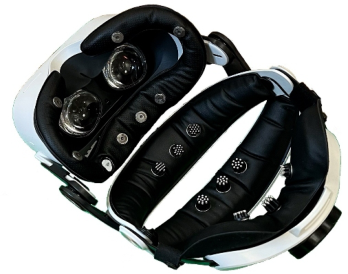
Experimental Setup The study used an in-house instrumented Meta Oculus Quest 2 head- mounted display (HMD) equipped with integrated electroencephalogram (EEG) sensors around the straps, electro-oculogram (EOG) sensors on the faceplate, and a photoplethysmography (PPG) sensor placed at the center of the forehead on the faceplate, as shown in Figure 1. While prior work (Lopes et al., 2024a) focused on the EEG results, this paper presents findings from the PPG-based heart rate variability (HRV) analyses.
Participants were given the option to choose from three 360
nature videos for the immersive experience. The first scene showcased the serene Alpine Lake in Bavaria, Germany, featuring a calm lake surrounded by
distant mountains, cabins, trees, and rocks. The second scene took viewers to the Arctic Beach on the Lofoten Islands, Norway, with fine white sand, a turquoise sea, distant mountains, and a clear blue sky. The third scene transported participants to a forest in Tasmania, Australia, with a cascading waterfall surrounded by moss-covered rocks, trees, and logs. Nature sounds, including waves, birdsong, and rustling leaves, were provided as audio stimuli, sourced and licensed from the Atmosphaeres Library.
Different scents were diffused using the ION2 device to correspond with each scene. For the lake scene, a blend of flower, earthy dirt, forest, and grass aromas was used. The waterfall scene included the same scents, with the addition of wood. For the beach scene, beach and ocean breeze aromas were selected. To ensure consistency, scent intensities were set to 1 out of a maximum of 5 due to the hospital setting, and the timing of scent dispersion was kept the same across all videos to minimize bias.
Figure 1: In-house developed instrumented head-mounted display used in the study.
Experiment Description The study was conducted in a nursing break room with only the participant and two evaluators present to ensure a controlled environment. Participants rated their relaxation levels on an eleven-point Likert scale (0 = very low, 10 = very high) both before and after each VR session. Post-immersion, they also evaluated different QoE metrics, including presence/immersion, engagement, losing track of time, and forgot everyday concern. After completing both sessions and removing the HMD, participants filled out a final questionnaire about their overall experience, providing feedback and suggestions to refine the protocol for future use with individuals with mental health disorders. This feedback was used to refine the experimental protocol for potential applications with patients. Further details about the experimental procedures can be found in (Lopes et al., 2024a).
Signal Preprocessing, Feature Extraction, and Test Setup For the HRV metrics calculation, the PPG signals were first pre-processed using a singular value decomposition (SVD) technique for motion artifact
Changes in HRV During Immersive Multisensory Forest Bathing Experiences 79
removal. First, a bandpass filter from 0.5 Hz to 4.0 Hz was applied, then the Short-Time Fourier Transform (STFT) was computed as a complex matrix, which was then decomposed via SVD. SVD components deemed as outliers are discarded prior to an inverse STFT being performed. More details about this pre-processing step can be found in (Rojano and Isaza, 2016). Next, several time, frequency, and non-linear HRV measures were computed from the PPG signals. Table 1 summarizes all the extracted features per domain. HRV measures were computed over the entire 2.5-minute session, as well as during the first and last minute of each session to gauge the temporal changes that occurred during each condition. To test the differences between the two conditions, a Shapiro-Wilk test was first performed to check the normality of the data distributions. For normally distributed data, a paired t-test was used; otherwise, the Wilcoxon test was applied.
Table 1: List of extracted features for each domain.
Table available in the original PDF paper.
Domain Features Time-Domain Heart rate (HR), Interbeat interval (IBI), Standard deviation of RR intervals (SDNN), Standard deviation of successive differences (SDSD), Root mean square of successive differences (RMSSD), Successive differences above 50ms (NN50), Proportion of successive differences above 50ms (pNN50) Frequency Domain Low-frequency spectrum between 0.05-0.15Hz (LF),
High-frequency spectrum between 0.15-0.5Hz (HF), High frequency / low frequency ratio (HF_LF), Normalized LF (nLF), Normalized HF (nHF) Non-linear Domain Standard deviation perpendicular to identity line (SD1), Standard deviation along identity line (SD2), SD1/SD2 ratio (SD1_SD2)
RESULTS
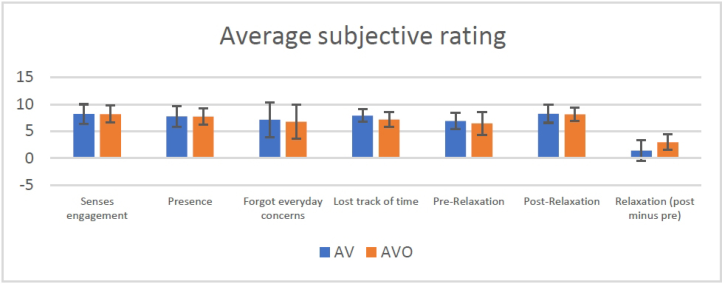
Subjective Ratings As mentioned, the PPG sensor was placed near the participants’ forehead. Unfortunately, this placement caused connectivity issues and signal loss for thirteen participants, particularly those who wore glasses, which hindered the headset’s proper contact with the forehead. As a result, the analyses presented below are based on data from only fourteen participants. Figure 2 shows the distribution of the different QoE and relaxation ratings for both conditions. As seen, senses engagement, presence, forgetting everyday concerns, and losing track of time showed similar results for both conditions, with the average in AV being slightly higher than AVO; the p-values are well above the significance threshold and negligible effect sizes. However, for “Post- relaxation”, while there was no significant difference in overall ratings, the change in relaxation level, i.e., “Relaxation (post minus pre)” was significantly higher in the AVO condition (M = 2.95, SD = 1.42) compared
to the AV condition (M = 1.4, SD = 1.96), with a p-value of 0.029 and a large effect size (Cohen’s d = −0.819).
Objective HRV (Comparison Between the First and Last Minutes) Next, we examine the changes observed in the objective HRV metrics, beginning with a comparison of the first and last minutes of the experiences, as outlined in Table 2. Time-domain metrics consistently showed reductions in HRV over time in both AV and AVO conditions, suggesting increased physiological arousal as the experiment progressed. Notably, RMSSD and NN50, both markers of parasympathetic activity, showed pronounced declines in both conditions. This trend was particularly marked in the AVO condition, where reductions were associated with large effect sizes. Such findings suggest that the addition of olfactory stimuli in the AVO condition may amplify physiological arousal compared to the AV condition.
Frequency-domain metrics displayed greater variability compared to time- domain measures. LF Power and HF Power exhibited opposite trends in AV and AVO conditions. Specifically, AV showed slight increases in both LF and HF power, whereas AVO displayed decreases in these measures. The LF/HF ratio showed minimal changes in both conditions, with slightly higher values in AVO. This observation suggests that the addition of olfactory stimuli may cause participants to experience greater arousal or engagement compared to the AV condition, although the short time windows used for frequency-domain analysis may limit the reliability of these measures.
The SD1 and SD2 showed a consistent decline in both conditions, reflecting reduced variability and short-term parasympathetic activity. The decline in SD1 was more pronounced in the AVO condition, suggesting more substantial impact on parasympathetic withdrawal when adding olfactory stimuli. This may result from increased engagement due to added sensory input or from stimulus incongruence, as noted by Lopes et al. (2024a), where some participants reported a mismatch between smell and the beach scenario.
Figure 2: Average QoE and relaxation ratings across both conditions.
Changes in HRV During Immersive Multisensory Forest Bathing Experiences 81
Table 2: Slope direction and significance for HRV metrics. *p ≤0.05, **p ≤10−2, ***p ≤10−3.
Correlation Analyses The Spearman correlation analysis revealed significant relationships between objective physiological metrics and subjective ratings for both the AV and AVO conditions over the full 2.5-minute signal duration. In the AV condition, the significant correlations are listed in Table 3, while the significant correlations for the AVO condition are shown in Table 4. Notably, the LF_HF ratio was positively correlated with “Relaxation (post minus pre)”; however, this correlation was not statistically significant.
Table 3: Spearman correlation results for AV condition.
Table available in the original PDF paper.
Physio Rating Metric Correlation
P-value Duration
Metric
Coefficient
nHF Forgot everyday concerns −0.613 0.02 Full Mean_IBI Post-relaxation 0.586 0.028 Full SD1_SD2 Presence 0.642 0.033 Full HR Post-relaxation −0.583 0.037 Full Mean_IBI Presence 0.542 0.045 Full LF_Power Pre-relaxation −0.605 0.029 First minute HR Post-relaxation −0.583 0.037 Last minute Mean_IBI Post-relaxation 0.586 0.028 Last minute HF_Power Relaxation (post minus pre) 0.905 0.3−3 Last minute LF_HF_Ratio Lost track of time 0.556 0.039 Last minute nHF Senses engagement −0.666 0.018 Last minute
Table 4: Spearman correlation results for AVO condition.
Table available in the original PDF paper.
Physio Rating Metric Correlation
P-value Duration
Metric
Coefficient
LF_HF_Ratio Lost track of time 0.6 0.023 Full pNN50 Forgot everyday concerns −0.636 0.048 Full HR Pre-relaxation −0.601 0.03 First minute SDNN Presence 0.663 0.013 Last minute Continued
Table 4: Continued Physio Rating Metric Correlation
Table available in the original PDF paper.
P-Value Duration
Metric
Coefficient
RMSSD Presence 0.57 0.042 Last minute SDSD Presence 0.57 0.042 Last minute LF_HF_Ratio Relaxation (post minus pre) 0.519 0.069 Last minute SD1 Presence 0.57 0.042 Last minute
DISCUSSION
Subjective Ratings: Comparing AV and AVO Conditions In this study, participants reported similar levels of senses engagement, presence, forgetting everyday concerns, and losing track of time in both the AV and AVO conditions. Interestingly, the relaxation change score (post minus pre) was significantly higher in the AVO condition (p = 0.03), suggesting that the addition of olfactory stimuli enhanced relaxation. This finding is consistent with previous research indicating that olfactory cues can improve relaxation and mood in virtual environments (Lopes et al., 2024a; Rojano et al., 2016; Lopes et al., 2022; De Jesus Jr. et al., 2023; Amores et al., 2018; Lopes et al., 2024b).
Objective Physiological Changes Across Time Significant changes in HRV metrics were observed between the first and last minutes of both conditions. AV and AVO conditions exhibited reductions in Mean_IBI, SDNN, RMSSD, SDSD, NN50, pNN50, and SD1, coupled with an increase in HR. The AVO condition also demonstrated significant reductions in the SD1_SD2. These changes indicate a consistent decline in short-term HRV and parasympathetic activity over time, which may reflect increased engagement and attentional focus as the VR session progresses. The substantial effect sizes (e.g., Cohen’s d values ranging from 0.60 to 0.76) further emphasize the physiological significance of these changes.
The reduction in variability measures, such as RMSSD and SDSD, alongside decreases in NN50, pNN50, and SD1, reflect decreased parasympathetic activity and increased sympathetic dominance. Despite the VR experience involving nature VR experiences with the goal to promote relaxation, participants also reported high levels of engagement, presence, and immersion. This likely explains the observed reduction in HRV metrics (e.g., SDNN, RMSSD, SD1) and increased HR, particularly in the AVO condition. The multisensory nature of AVO may have intensified cognitive and emotional engagement, leading to greater sympathetic activation and further reductions in HRV compared to AV.
In fact, as shown in Lopes et al. (2024a), participants report a greater sense of engagement during AVO condition: (1) “More senses were activated making the experience more engaging and increasing the sense of presence”, (2) “I preferred the multisensory experience because I could engage with the environment better. I think the smell is a smooth smell and it makes me relax better”, and (3) “It is great. I have not tried VR before, with smells being more engaging and more relaxing. I wanted to stay there longer”.
Changes in HRV During Immersive Multisensory Forest Bathing Experiences 83
The AV condition showed increases in LF and HF power, indicating balanced autonomic activity, while AVO exhibited decreases, suggesting reduced parasympathetic modulation and a shift toward sympathetic dominance. The higher LF/HF ratio in AVO supports the idea that olfactory stimuli enhance arousal and engagement, consistent with research linking olfactory inputs to emotional and attentional responses (Herz, 2016).
Lastly, although the short duration (2.5 minutes) of the videos may have limited the potential for relaxation, the subjective responses indicate high levels of relaxation, presence, and engagement, emphasizing the immersive potential of the stimuli. Additionally, the participants’ background as mental health nurses may have heightened their physiological responses, given their elevated baseline arousal and sensitivity.
Comparing HRV Metrics in AV and AVO Conditions It is worth noting that when comparing the HRV measures computed during the first minute of the experiments between the AV and AVO conditions, none of the features showed significant differences. This suggests that participants may still be in an initial adjustment phase, during which they regulate their heart rate. This early regulation period likely represents the transition from baseline to immersive engagement, during which autonomic responses stabilize.
While no significant differences were found between AV and AVO conditions during the first minute, the last-minute comparisons revealed that the AVO condition induced greater reductions in HRV metrics, such as SDNN, RMSSD, SDSD, SD1, and the SD1_SD2 ratio. This suggests that the inclusion of olfactory stimuli may lead to a more pronounced decrease in parasympathetic activity over time. Although the changes in HRV may be linked to stress (Kim et al., 2018; Boyett et al., 2019), participants also reported an increase in the sense of engagement, presence, and relaxation, further corroborating some previous works (Kim et al., 2021). Participants also reported that while they felt relaxed during the immersive experience, spending more time in the virtual environment would have been ideal to deepen their relaxation.
Correlation Between HRV Metrics and Subjective Ratings Significant correlations were found between HRV metrics and subjective ratings. Considering the overall 2.5 minutes in the AV condition, positive correlations of Mean IBI and SD1_SD2 with “Post-relaxation” and “Presence” highlight the role of parasympathetic activity in fostering these subjective experiences. Conversely, the negative correlation between HR and “Post-relaxation” reinforces that lower HR, indicative of parasympathetic dominance, could be an indicative of a relaxed state (Rudics et al., 2025; Osborne et al., 2020; Immanuel et al., 2023). During the initial phase, “Pre- relaxation” feelings were negatively linked to LF_power in the AV condition and HR in the AVO condition, suggesting that initial parasympathetic activity plays a crucial role in shaping baseline relaxation. The strong positive correlation between HF_power and the change in relaxation from start to
finish “Relaxation (post minus pre)” in the AV condition underscores the relationship between parasympathetic activity and self-reported relaxation. These findings align with the literature, which links parasympathetic increases to enhanced relaxation (Lehrer and Gevirtz, 2014).
The positive correlation between “Presence” and HRV features (SDNN, RMSSD, SDSD, and SD1) in the AVO condition suggests that greater immersion in audiovisual-olfactory environments improves autonomic regulation. These HRV measures reflect parasympathetic activity, indicating relaxation and better physiological balance. The findings highlight how the addition of olfactory stimuli enhances the sense of presence, which may promote relaxation and emotional engagement (Lopes et al., 2022; De Jesus Jr. et al., 2022).
Study Limitations and Future Directions This study had a limited sample size due to data loss from signal acquisition issues, which may impact the generalizability of the findings. Future research should aim for larger sample sizes and investigate the long-term effects of multisensory VR exposure on both subjective experiences and physiological responses. Additionally, exploring individual differences in response to multisensory stimuli could offer insights into personalized VR interventions for stress relief.
Furthermore, given the nurses’ demanding schedules, the experiment was time-restricted, necessitating the use of single-item Likert scale questions rather than standardized tests. Standardized tests, which typically consist of multiple items aggregated into a final score, provide a more comprehensive evaluation. This limitation may account for the lack of significant differences in many subjective responses between the two conditions. Future research should consider using standardized questionnaires to enable more robust comparisons.
Finally, future studies should explore how individual preferences and adaptive VR systems can optimize the balance between relaxation and engagement, tailoring experiences to specific user needs. Integrating generative AI tools to create individualized virtual environments could be one potential approach. Additionally, real-time physiological feedback could be employed to dynamically adjust stimuli, further enhancing the effectiveness of VR interventions across various applications.
CONCLUSION
Significant differences in several HRV metrics were identified between the initial and final segments for both AV and AVO conditions. Correlation analysis showed stronger links between HRV metrics, relaxation levels, and QoE ratings in the AVO condition, particularly in the final segments. These results indicate that both AV and AVO conditions enhanced relaxation and QoE while inducing measurable HRV changes. This study underscores the importance of customizing multisensory virtual reality stimuli to achieve specific outcomes, such as relaxation, engagement, or a balance of both.
Changes in HRV During Immersive Multisensory Forest Bathing Experiences 85
ACKNOWLEDGMENT
Authors acknowledge funding from NSERC (RGPIN-2021-03246) and TD Community Health Solutions (2022-06-RIC003).
REFERENCES
Amores, J., Richer, R., Zhao, N., Maes, P. and Eskofier, B. M., 2018, March.
Promoting relaxation using virtual reality, olfactory interfaces and wearable EEG. In 2018 IEEE 15th international conference on wearable and implantable body sensor networks (BSN) (pp. 98–101). IEEE. Boyett, M., Wang, Y. and D’Souza, A., 2019. CrossTalk opposing view: Heart rate variability as a measure of cardiac autonomic responsiveness is fundamentally flawed. The Journal of physiology, 597(10), p. 2599. De Jesus Jr., B., Lopes, M., Moinnereau, M. A., Gougeh, R. A., Rosanne, O. M.,
Schubert, W., Oliveira, A. A. and Falk, T. H., 2022, June. Quantifying multisensory immersive experiences using wearables: Is (stimulating) more (senses) always merrier?. In Proceedings of the 2nd Workshop on Multisensory Experiences- SensoryX’22. SBC. De Jesus Jr., B. J., Perreault, L., Lopes, M. K., Roberge, M. C., Oliveira, A. A.
and Falk, T. H., 2023. Using Multisensory virtual reality nature immersion as a therapeutic modality for improving HRV and cognitive functions in post- traumatic stress disorder: A pilot-study. Frontiers in Virtual Reality, 4, p. 1261093. Herz, R. S., 2004. A naturalistic analysis of autobiographical memories triggered by olfactory visual and auditory stimuli. Chemical senses, 29(3), pp. 217–224. Immanuel, S., Teferra, M. N., Baumert, M. and Bidargaddi, N., 2023. Heart rate variability for evaluating psychological stress changes in healthy adults: A scoping review. Neuropsychobiology, 82(4), pp. 187–202. Jo, H., Song, C. and Miyazaki, Y., 2019. Physiological benefits of viewing nature: A
systematic review of indoor experiments. International journal of environmental research and public health, 16(23), p. 4739. Kim, H., Kim,D.J., Kim, S., Chung, W.H., Park, K.A., Kim, J.D., Kim,D., Kim,M.J., Kim, K. and Jeon, H. J., 2021. Effect of virtual reality on stress reduction and change of physiological parameters including heart rate variability in people with high stress: An open randomized crossover trial. Frontiers in psychiatry, 12, p. 614539. Kim, H. G., Cheon, E. J., Bai, D. S., Lee, Y. H. and Koo, B. H., 2018. Stress and
heart rate variability: A meta-analysis and review of the literature. Psychiatry investigation, 15(3), p. 235. Lee, M., Kim, E., Choe, J., Choi, S., Ha, S. and Kim, G., 2022. Psychological effects of green experiences in a virtual environment: A systematic review. Forests, 13(10), p. 1625. Lehrer, P. M. and Gevirtz, R., 2014. Heart rate variability biofeedback: How and
why does it work?. Frontiers in psychology, 5, p. 756. Lopes, M., and Falk, T. H., 2024b. Audio-visual-olfactory immersive digital nature exposure for stress and anxiety reduction: A systematic review on systems, outcomes, and challenges. Frontiers in Virtual Reality, 5, p. 1252539. Lopes, M.., De Jesus Jr., B. J., Rosanne, O. M., Pardini, S., Appel, L., Smith, C.
and Falk, T. H., 2024a. Stop to smell the virtual roses: A mixed-methods pilot study on the impact of multisensory virtual reality nature experiences on feelings of relaxation. Frontiers in Virtual Reality, 5, p. 1451704.
Lopes, M.., de Jesus, B. J., Moinnereau, M. A., Gougeh, R. A., Rosanne, O. M., Schubert, W., de Oliveira, A. A. and Falk, T. H., 2022, October. Nat (UR) e: Quantifying the relaxation potential of ultra-reality multisensory nature walk experiences. In 2022 IEEE International Conference on MetroXRAINE (pp. 459–464). IEEE. Osborne, M. T., Shin, L. M., Mehta, N. N., Pitman, R. K., Fayad, Z. A. and Tawakol,
A., 2020. Disentangling the links between psychosocial stress and cardiovascular disease. Circulation: Cardiovascular Imaging, 13(8), p. e010931. Rojano, J. F. and Isaza, C. V., 2016. Singular value decomposition of the timefrequency distribution of PPG signals for motion artifact reduction. Int. J. Signal Process. Syst, 4(6), pp. 475–482. Rudics, E., Buzás, A., Pálfi, A., Szabó, Z., Nagy, Á., Hompoth, E. A., Dombi, J.,
Bilicki, V., Szendi, I. and Dér, A., 2025. Quantifying Stress and Relaxation: A New Measure of Heart Rate Variability as a Reliable Biomarker. Biomedicines, 13(1), p. 81. World Health Organization, 2023. Regional Office for Europe. (2016). Urban green spaces and health. World Health Organization. Regional Office for Europe. https://apps. who. int/iris/handle/10665/345751
LISTED IN THE AHFE DIGITAL BOOKSTORE CATALOGUE
Explore the complete digital volume
Metaverse, Virtual Environments and Game Design
Read this individual research paper free through the original publisher, or explore the full digital proceedings book.
ISBN 978-1-964867-54-0
Explore this ISBN in the AHFE Bookstore ↗Listed in the July 2026 bookstore catalogue; search by ISBN to confirm current availability · Digital book purchase optional