Krisha Malik, Samantha Lewis-fung, Jiamin Liang, Dhvani Patel, Joanne Berrigan, Barry Wilson Pendergast, Ron Belano, Katherine Bourolias, Lora Appel (2025). VR&R: Preliminary Results on the use of At-home VR-Therapy for Caregiver Respite and Symptom Management in Dementia. In: Human Factors in Design, Engineering, and Computing. AHFE Open Access, vol. 199, pp. 1751–1760. https://doi.org/10.54941/ahfe1006986
Introduction: With an aging population and rising dementia rates, there is an urgent need for affordable, personalized, at-home respite solutions. While caregivers of people living with dementia (PLwD) experience the highest levels of burden and distress, formal respite services are often costly or inaccessible. Respite interventions that both enhance mood and engagement in PLwD offer a promising way to reduce caregiver burnout. Therapeutic virtual reality (VR) is a safe, enjoyable approach that shows potential to reduce BPSD, improve quality of life (QoL), and foster social connection in PLwD and yet its potential to provide caregiver respite remains unexplored.Objectives: Here we present the preliminary results of “VR&R”, a 6-week open-label, pragmatic crossover trial with a target sample of 50 caregiver–PLwD dyads. This study aims to compare the impact of Solo versus Social VR therapy on (1) caregiver respite, resiliency, burden, and well-being, and (2) PLwD mood and BPSD, in order to inform the design of at-home VR-based interventions.Methods: Outcomes were assessed through mixed methods including standardized questionnaires, observations, semi-structured interviews, and in-app usage metrics. After VR training, dyads were randomized to complete two weeks in each VR condition (starting with Solo or Social) followed by 2 weeks of no VR access. In the Solo-VR condition, the PLwD experienced VR content independently, with the length and frequency of exposure determined at the dyad’s discretion. For Social-VR, participants co-experienced sessions with a trained research assistant skilled in supportive communication with older adults. The intervention included access to 94 360°-videos through “caregiVR”, a VR platform validated as dementia-appropriate through prior studies. The system includes a Meta Quest 2 headset with navigation and real-time casting managed via a paired Samsung tablet.Results: As of September 19, 2025, nine dyads have completed the 6-week protocol, including nine caregivers (average age 60.8 years; 66.7% female) and nine PLwD (MMSE range 7–26; average age 78.7 years; 44.5% female). VR-therapy sessions lasted approximately 30 minutes across conditions. The mean System Usability Scale score was 77.8 (range 67.5-92.5), corresponding to an “A” rating. Post-session satisfaction ratings averaged 4.5/5 stars in the social setting and 4.2/5 stars in the solo setting. Caregiver training required less than 30 minutes, and no technical support calls were reported. During VR-therapy sessions, top respite activities included socializing (e.g., phone calls, emails), completing household chores, and relaxing. Notably, 89% of caregivers were very likely to recommend VR- therapy to other caregivers.Conclusion: This is the first study to explore how VR-therapy can be used to achieve at-home respite time for caregivers of PLwD. Preliminary results suggest that both Solo and Social VR are superior to having no VR access, with caregivers reporting greater benefits from Social VR in terms of achieving uninterrupted respite time for themselves and social connection for the PLwD.
Dementia is a major global health challenge, affecting both those diagnosed and the people who care for them. Much of the emotional and financial cost of dementia care is borne by informal caregivers, typically family members, who provide an average of five hours of daily care (WHO, 2025). Notably, caregivers for people living with dementia (PLwD) experience almost twice the rate of elevated distress compared to those caring for other older adults (CIHI, n.d.), particularly when behavioural and psychological symptoms of dementia (BPSD) are present. Caregiver respite, defined as a temporary period of rest or relief, is a critical protective factor, allowing caregivers to recover and sustain their role. Existing respite services, however, are often inaccessible, costly, or unsuitable due to cultural, logistical, or emotional barriers (Leocadie et al., 2018). There is thus an urgent need for flexible, affordable, and independently accessible at-home respite solutions.
Virtual reality (VR) may represent one such option. VR immerses users in simulated environments through head-mounted displays (HMDs) that combine 360
visual and auditory stimulation, creating a strong sense of presence. For PLwD, VR offers opportunities to experience meaningful and engaging environments without the stress of physical travel. A growing body of research shows that VR is safe, acceptable, and enjoyable for PLwD, with promising effects on mood, quality of life (QoL), and reductions in BPSD (Appel et al., 2020; Huang et al., 2025). Our own work has demonstrated feasibility across care settings, from long-term care to acute care and community programs, where VR has reduced agitation, enhanced relaxation, and promoted positive affect (Appel et al., 2024, 2023).
Despite these promising findings, there remain significant gaps in how VR has been studied and deployed. Most prior work has relied on researcher- or clinician-led sessions in institutional settings, limiting generalizability and overlooking the potential of VR as an at-home, caregiver-administered intervention. To the best of our knowledge, no studies to date have addressed how VR can create meaningful respite opportunities for caregivers themselves, a critical factor in reducing burnout.
Importantly, VR is emerging as a feasible and user-friendly tool for both caregivers and older adults. Recently, we conducted a trial where caregivers were trained in one 30-minute session (Saryazdi et al., 2024). This ease of adoption is essential if VR is to fill the current gap in respite services: providing caregivers with flexible, on-demand relief without requiring significant outside resources or complex technical knowledge. The optimal format for VR in this context also remains unclear. One- on-one “solo” VR administered by the caregiver offers familiarity and immediacy but may nominally increase caregiver workload by requiring setup and social engagement. In contrast, “social” VR facilitated by trained personnel allows the caregiver to disengage temporarily, but introduces other challenges, including schedule coordination and rapport-building with new visitors (Leocadie et al., 2018). This study seeks to address these gaps by systematically comparing Solo versus Social VR therapy to better understand how VR can function as a sustainable, at-home respite intervention.
VR&R: Preliminary Results on the Use of At-Home VR Therapy 1753
OBJECTIVES The primary aim of this study is (1) to evaluate the impact of VR therapy on caregiver outcomes, including (a) respite, (b) resiliency, (c) burden, and (d) well-being. The secondary aims are to: (2) assess the impact of VR therapy on BPSD and mood in PLwD; (3) compare the relative effectiveness of VR modalities (Solo-VR vs. Social-VR) in achieving both primary and secondary outcomes; and (4) identify design considerations for optimizing at-home VR administration by caregivers, with a focus on respite.
METHODS
This open-label, pragmatic crossover trial uses random allocation to two arms over a four-week home-based VR intervention with a two-week follow- up. Methods were designed to minimize caregiver burden, informed by partner consultations and prior research. Ethics approval was obtained from York University (ID:2024-178), and the protocol is registered on ClinicalTrials.gov (NCT05867641).
Population and Recruitment The study will enroll 50 dyads of PLwD and their caregivers (N = 100). Recruitment is conducted in the Greater Toronto Area through community partners, clinician referrals, self-referrals, and study advertisements. Inclusion criteria for PLwD are: age ≥65 and mild-to-moderate dementia (confirmed by diagnosis or baseline screening). Exclusion criteria include significant simulator sickness, inability to communicate verbally or non-verbally, or medical conditions preventing safe VR-HMD use (e.g., pacemaker, facial wounds). Caregivers must be informal or professional, provide care at least 2–3 times per week, and speak and understand English.
Intervention The caregiVR app (caregiVR Inc., 2025) was co-designed for use in senior care and is delivered through a Meta Quest 2 HMD, controlled via a Samsung Galaxy S9 tablet by a caregiver or research assistant (RA). The app has undergone rigorous usability testing with PLwD and their caregivers (Alizai et al., 2025). It includes a library of 94 curated 360
videos (e.g., nature, music, travel, animals, sports), reviewed by three clinicians to reduce simulator sickness and rated on a 4-level scale for motion, height, and sensory intensity.
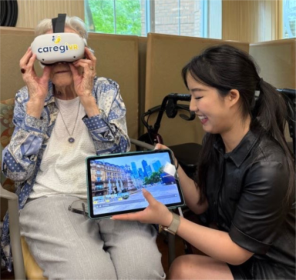
In the Solo-VR condition, the caregiver assists the PLwD be getting them set up with the headset and selecting VR experiences, after which the caregiver may engage in respite activities (e.g., coffee, phone call) while remaining nearby for safety. Sessions are participant-driven (recommended 2–3 times/week, up to 30 minutes). In the Social-VR condition, a trained RA visits the dyad at home, engaging the PLwD in friendly conversation during VR use (Figure 1). Sessions are scheduled 2–3 times/week, up to 30 minutes, based on participant preference.
Figure 1: Older adult and research assistant using the caregiVR platform.
Procedures At baseline (≈2 hours), the research coordinator (RC) visits the dyad’s home. After obtaining written consent and assent, the PLwD trials VR to confirm enjoyment and safety. The RC trains the caregiver on device use and safety (e.g., close supervision, seated use, removal at any sign of distress), administers the Mini-Mental State Exam (MMSE) (Woodward and Galea, 2005) to the PLwD, and collects caregiver baseline measures. Dyads are reminded that VR is a recreational therapy and should only be used with PLwD assent.
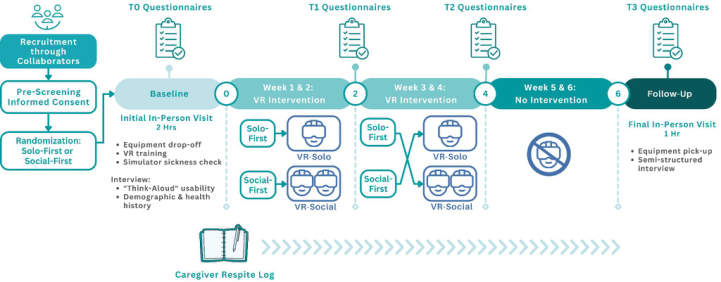
Following baseline, the study is conducted remotely except for Social-VR visits by the research assistant (RA). Dyads randomized to the Social-First arm complete two weeks of that modality, followed by two weeks of Solo- VR; the Solo-First arm follows the reverse order. Both arms then complete a two-week washout (no VR) (Figure 2). Caregivers receive a $20 gift card after study completion.
Figure 2: Study timeline.
Outcome Measures Objectives are evaluated using a mixed-methods approach (Figure 2). At baseline, health history, technology familiarity, and caregiver respite needs
VR&R: Preliminary Results on the Use of At-Home VR Therapy 1755
are collected via questionnaires and a 10-minute semi-structured phone interview. Ongoing session measures include PLwD pre/post mood and experience ratings through the caregiVR app, passively collected usage data, and a caregiver log describing respite quantity and quality. At follow-up, usability is assessed with the System Usability Scale (SUS) (Lewis, 2018), and all outcomes are explored in a 30-minute caregiver interview. Results from validated self-report instruments on caregiver resilience, burden, well- being, and PLwD BPSD (at baseline and biweekly after each condition) will be reported in future publications.
Analysis Data from the first 9 participants were analyzed. Quantitative measures were summarized using descriptive statistics, while qualitative data were examined using thematic analysis guided by a coding framework developed by five authors. JL and DP coded transcripts, resolving discrepancies through discussion. SL-F and LA reviewed the coding and collaborated to refine and interpret themes.
RESULTS
Recruitment began in February 2025. As of September 19, 2025, nine dyads have completed the study (n = 4 Solo-First; n = 5 Social-First), with an additional three enrolled. One participant was excluded at baseline due to limited communication abilities, and no participants have withdrawn.
The average age of caregivers was 60.8 years (range 45–73). The average age of PLwD was 78.7 years (range 64–95). Among caregivers, six (66.7%) were female and three (33.3%) were male. Among PLwD, four (44.4%) were female and five (55.6%) were male. Caregiver frailty levels were reported based on the Clinical Frailty Scale (CFS) (Rockwood et al., 2005). Three caregivers self-rated as very fit, three as managing well, and two as living with very mild frailty. PLwD self-rated frailty levels included one managing well, one living with very mild frailty, two living with mild frailty, and two living with severe frailty. Caregivers were most often adult children (4, 44.4%) or spouses (3, 33.3%), with one professional (11.1%) and one sibling (11.1%). Two caregivers (22.2%) and one PLwD (11.1%) reported prior experience with VR. Two PLwD (22.2%) scored within the severe impairment range on the MMSE, two (22.2%) within the moderate, two (22.2%) within the mild, and one (11.1%) within the normal range. One participant (11.1%) was unable to understand the assessment (language barrier), and another (11.1%) was unable to complete it due to distress from limited comprehension and fatigue.
Session Duration and Frequency
Table 1 summarizes the average session duration and total number of sessions completed across participants. Overall, the mean duration of social VR sessions was 30.7 minutes (SD = 10.0, range = 15.3–44.3), while the mean duration of solo VR sessions was 29.3 minutes (SD = 11.4, range = 17.0– 55.3). Participants completed an average of 4 social sessions and 4.6 solo
sessions (SD = 1.5, range = 3–7). Across the participants, this corresponded to a total of 36 social sessions and 41 solo sessions.
Table 1: Average session duration and total sessions by participant in social and solo conditions.
Overall mean (SD, range) aCalculated from *2/4 **3/4 ***5/6 sessions due to missing session end times
Impact on Caregivers Eight caregivers took part in a variety of activities including socializing (e.g., calling or messaging a friend), productivity (e.g., cooking, paperwork, tidying), taking personal time (e.g., coffee, resting, reading) and planning (e.g., outings, household tasks). One caregiver was unable to take respite time because the PLwD did not enjoy VR and was confused by the content. One caregiver did the majority of sessions with his wife out of enjoyment and another took part in three sessions where they invited the PLwD’s close friends.
Six caregivers described ways in which participating positively impacted their sense of resiliency, burden, and well-being. Most commonly reported was a sense of emotional contagion described as, “I am happy when he is happy,” and, “Hearing my wife happy and amused with the VR content was a source of joy.” Also noted was a better caregiving relationship and ability. This included a sense of fulfillment from doing a new experience together, feeling more patience with the PLwD, and confidence in having a tool to keep the PLwD meaningfully engaged. Others described ways in which the increased respite time improved wellbeing (e.g., able to focus on self, turn off brain, feel lighter). For example, one caregiver noted: “It was definitely helpful and I probably felt better myself and more patient with him since I’d had a good respite time” and “For the social[-condition, that’s] the time that I don’t worry for him. I can be somewhere to enjoy myself.”
Social-VR was consistently described as more effective than Solo VR for enabling caregivers to disconnect, as they felt the PLwD “was in good hands.” Several caregivers also noted that Social-VR either supported their resilience,
VR&R: Preliminary Results on the Use of At-Home VR Therapy 1757
reduced burden, or enhanced their well-being compared to Solo-VR. Respite time in Solo-VR was more often interrupted by the need to supervise, adjust the HMD, or continue engaging with the PLwD. Respite quality ratings were collected for both Solo (n = 7 dyads) and Social (n = 8 dyads) sessions, where lower scores reflected fewer interruptions (1 = fully uninterrupted to 4 = frequently interrupted). Solo sessions had an average rating of 2.7 (SD = 0.9; range 1.6–4.0), while Social sessions showed a slightly lower average of 2.6 (SD = 1.3; range 1.0–4.0).
Impact on Participants Living With Dementia Overall, caregivers described VR as an enjoyable and beneficial experience, offering meaningful engagement. There was consensus that Social-VR was preferred because of the social aspect, with one caregiver noting it was the ‘highlight of [the PLwD’s] day.’ Caregivers observed several positive impacts during sessions, including relaxation, reminiscence, and improved mood. Two caregivers emphasized that VR was more stimulating than other activities: “[The participant] was actually immersed, and we don’t get this anymore.” Another noted, “With the cow video and the Northern Lights, she kept moving her head around. The Beach Boys had her tapping her feet.” One caregiver also found VR more effective than other strategies for distracting the PLwD from repetitive behaviors (e.g., searching for food). In addition, two caregivers noted lasting benefits beyond the sessions, such as improved mood or increased socialization following Social-VR. Negative reactions included one episode of agitation related to a specific video (cause unclear) and one hallucination in a participant with a history of hallucinations. In both cases, distress resolved quickly and participants continued to use VR in subsequent sessions.
VR-Therapy Design for At-Home Respite Participants described the caregiVR platform as easy to use, with an average SUS score of 77.8 (SD = 8.2, range = 67.5–92.5), indicating a “good” level of usability. Technology training took less than 30 minutes (conducted once at baseline), and participants who encountered difficulties were able to troubleshoot independently. Suggestions for improvement included embedding troubleshooting tips directly into the platform (rather than relying on the accompanying instruction sheet), adding a function to re-center the video so the scene’s focal point always aligns with the PLwD’s gaze, eliminating the need for hand controls, and enabling a feature to store favourite videos.
Challenges were primarily related to hardware. Six participants reported discomfort or facial irritation from the HMD due to weight or poor fit. Complaints of blurriness were common in final interviews and RC observations, though it was unclear whether this stemmed from poor headset fit, inability to wear glasses inside the HMD,or video quality. Side effects were mild with one participant each reporting headache, neck pain, mild dizziness from unfocused videos, eye strain, or cautiousness when looking down or backwards.
Participants suggested improvements to content and overall experience design, including longer session durations, a greater variety of videos such as cultural content, and the availability of materials in multiple languages.
Overall Feedback and Willingness to Use When asked about future use of VR with the PLwD, six caregivers indicated they would continue, three said they would not, and one said they would if more content were available. Caregivers rated the likelihood of recommending VR to another caregiver highly (M = 9.0, SD = 1.6, range = 6–10). In the solo setting, the average post-session satisfaction score was 4.2 out of 5 stars (SD = 0.6, range = 3.3–5.0), whereas in the social setting the average score was higher at 4.5 (SD = 0.4, range = 4–5). Feedback from final interviews was coded by two coders on a five-point helpfulness scale. All nine caregivers rated Social-VR as either definitely helpful (5, 55.5%) or somewhat helpful (4, 44.4%). Solo-VR was more mixed, with six participants (66.6%) rating it somewhat helpful, two participants (22.2%) rating it neutral, and one (11.1%) as definitely unhelpful.
DISCUSSION
Solo vs. Social: Impacts Social-VR was particularly helpful for enabling caregivers to disconnect, as the presence of a trained facilitator provided reassurance and the added benefit of social engagement for the PLwD on top of the VR experience, even when language barriers were present. Notably, several PLwD with limited English proficiency were still able to build rapport and enjoy meaningful interaction through alternative communication strategies. These findings highlight the potential of a Social-VR model as a feasible approach for respite and suggest opportunities to extend its application to intergenerational or community-based programming. While short sessions were beneficial, many caregivers identified an “ideal” respite period as being long enough to leave the home, consistent with prior reports (Utz et al., 2025). Future work should explore strategies to integrate VR into models that allow caregivers to take longer breaks while ensuring safety and meaningful engagement for PLwD.
Technology Considerations Although the caregiVR platform demonstrated adequate usability, several limitations highlight the need for refinement. Participants emphasized comfort as a key barrier, citing issues with weight, fit, and compatibility with glasses, which are well-documented challenges with current VR HMD models (Matsangidou, 2025). Reports of blurriness often reflected headset fit rather than video quality, underscoring the importance of caregiver assistance for proper adjustment. Suggestions for glasses-style rather than helmet-style devices align with efforts to make VR more accessible for older adults.
While the Solo-VR condition demonstrated feasibility, some caregivers experienced stress when first learning the technology, supporting feedback from stakeholders that beginning with Social-VR may be preferable, though
VR&R: Preliminary Results on the Use of At-Home VR Therapy 1759
not possible in a randomized design. Compared to prior studies, this trial involved longer and repeated exposures, making comfort and content variety particularly important. Caregivers also expressed interest in culture- and language-specific content, echoing findings from prior research (Leocadie et al., 2018). Future work should prioritize recruitment of caregivers less familiar with technology to better understand adoption challenges and strategies for support (Appel et al., 2023).
CONCLUSION
This study is the first to explore VR for at-home respite among caregivers of PLwD. All dyads completed the study and the technology demonstrated adequate usability following only brief training. Both Solo- and Social-VR conditions were rated more favorably than no VR, with most caregivers able to take short breaks and reporting benefits to their well-being. Caregivers observed positive impacts for PLwD during sessions, with lasting effects noted for two individuals. Taken together, these interim results suggest that VR is a feasible and well-accepted approach for supporting both caregivers and PLwD. Future work (subsequent manuscript) will report on the complete sample and will draw additional quantitative and qualitative conclusions on the intervention’s impact on caregivers and PLwD.
ACKNOWLEDGMENT
The authors would like to acknowledge our community partners: Acclaim Health, Circle of Care, Chester Village, the NORC Innovation Centre, and Toronto Grace Health Centre; our research assistants: Sahil Patel, Anahita Soleymani, Yiping Luo, and Shia Surani. This study was funded by CIHR through the Brain Health and Cognitive Impairment in Aging (BHCIA) Research Initiative: Mechanism in Brain Aging and Dementia Operating Grants.
Disclosure Statement: Authors LA, SLF, RB, and KB are shareholders in the caregiVR Inc. company.
REFERENCES
Alizai, H., Wong, M., Tchao, D., Appel, L., 2025. Navigating Immersion: Usability Study of a Virtual Reality Application Designed for Older Adults with Dementia and Their Caregivers. J. Med. Ext. Real. 2, 84–94. Appel, L., Appel, E., Bogler, O., Wiseman, M., Cohen, L., Ein, N., Abrams, H. B.,
Campos, J. L., 2020. Older Adults With Cognitive and/or Physical Impairments Can Benefit From Immersive Virtual Reality Experiences: A Feasibility Study. Frontiers in Medicine, 6, 329. Appel, L., Appel, E., Kisonas, E., Lewis-Fung, S., Pardini, S., Rosenberg, J., Appel, J., Smith, C., 2024. Evaluating the Impact of Virtual Reality on the Behavioral and Psychological Symptoms of Dementia and Quality of Life of Inpatients With Dementia in Acute Care: Randomized Controlled Trial (VRCT). J. Med. Internet Res. 26, e51758.
Appel, L., Saryazdi, R., Lewis-Fung, S., Qi, D., Tesfaye, E.M., Garito, I., Campos, J. L., 2023. VRx@Home Pilot: Can Virtual Reality Therapy Improve Quality of Life for People with Dementia Living at Home?, in: 2023 IEEE International Conference on Systems, Man, and Cybernetics (SMC), pp. 4542– 4549. CaregiVR Inc., 2025. High-tech, Immersive VR Therapy for Seniors. URL https://www.mycaregivr.com/(accessed 9.3.25). CIHI, n.d. Unpaid caregiver challenges and supports | CIHI [WWW Document].
URL https://www.cihi.ca/en/dementia-in-canada/unpaid-caregiver-challenges- andsupports (accessed 9.3.25). Feast, A., Moniz-Cook, E., Stoner, C., Charlesworth, G., Orrell, M., 2016.
A systematic review of the relationship between behavioral and psychological symptoms (BPSD) and caregiver well-being. Int. Psychogeriatr. 28, 1761–1774. Huang, L.C., Chien, C.F. and Yang, Y.H., 2025. Exploring the Immediate and Long- Term Effects of Immersive Virtual Reality on Behavioral and Psychological Symptoms of Dementia and Caregiver Burden: Longitudinal Observational Study. JMIR Serious Games, 13(1), p. e73044. Leocadie, M.-C., Roy, M.-H., Rothan-Tondeur, M., 2018. Barriers and enablers
in the use of respite interventions by caregivers of people with dementia: An integrative review. Arch. Public Health 76, 1–11. Lewis, J.R., 2018. The system usability scale: past, present, and future. International Journal of Human⣓Computer Interaction, 34(7), pp. 577–590. Matsangidou, M., 2025. Virtual Reality Design Principles for Psychophysiological
Interventions in Dementia: A Systematic Review of Research. Computers in Human Behavior Reports, p. 100758. Rockwood, K., Song, X., MacKnight, C., Bergman, H., Hogan, D.B., McDowell, I.
and Mitnitski, A., 2005. A global clinical measure of fitness and frailty in elderly people. Cmaj, 173(5), pp. 489–495. Saryazdi, R., Appel, L., Lewis-Fung, S., Carsault, L.A., Qi, D., Garcia-Giler, E. and Campos, J.L., 2024. VRx@ Home protocol: A virtual reality at-home intervention for persons living with dementia and their care partners. BMJ open, 14(12), p. e085442. Utz, R., Godfrey, D.A., Wong, B., Thompson, A.D., Coleman, M.E. and Sparks, C.,
2025. Respite time-use among dementia caregivers. Frontiers in Health Services, 5, p. 1598518. Woodward, M. and Galea, M., 2005. Mini-mental state examination (MMSE). Aust J Physiother, 51(3), p. 198. World Health Organization, 2025. Fact Sheet- Dementia [WWW Document]. URL
Human Factors in Design, Engineering, and Computing
Read this individual research paper free through the original publisher, or explore the full digital proceedings book.
ISBN 978-1-964867-75-5
Explore this ISBN in the AHFE Bookstore ↗Listed in the July 2026 bookstore catalogue; search by ISBN to confirm current availability · Digital book purchase optional