Shene Abdalla, Siby Samuel, Amandeep Singh (2025). Effects of Illuminance Levels on Driver Comfort: Evidence from a High-Fidelity Simulator Study. In: Human Factors in Design, Engineering, and Computing. AHFE Open Access, vol. 199, pp. 1541–1551. https://doi.org/10.54941/ahfe1006965
This study examined the effects of illuminance level on physiological and perceptual responses during simulated nighttime driving. Thirty licensed drivers, 15 younger (21–45 years) and15 older (65–82 years), completed three driving trials under low, medium, and high illuminance levels calibrated within roadway standards. Heart rate (HR) and subjective comfort ratings were collected to evaluate autonomic activation and perceptual experience. Results showed that illuminance level significantly affected HR, F (3, 87) = 5.94, p = 0.001. HR increased under all lighting conditions relative to baseline, but medium illuminance-maintained values closest to baseline, indicating balanced arousal. Subjective comfort ratings also varied significantly across lighting levels, F (2, 58) = 31.84, p < 0.001, with medium illumination rated highest. Age group had no interaction effect on either measure. Convergent findings identify medium illumination as the optimal level for nighttime driving, offering the best trade-off between visibility, comfort, and physiological stability.
Lighting is a primary environmental factor influencing human performance, comfort, and safety. In driving and other operational tasks, illuminance determines hazard visibility, supports alertness, and affects perceptual accuracy. Human-factors research shows that light intensity and distribution influence both visual and physiological processes by affecting visual clarity, workload, and arousal (Boyce et al., 2006; Smolders and de Kort, 2014). Adequate illumination maintains visual comfort and attention, whereas insufficient or excessive brightness causes eye strain, fatigue, and slower responses (Abboushi, Fotios and Miller, 2023).
Physiologically, illumination regulates retinal and circadian mechanisms that influence autonomic balance and cardiovascular activity (Cho et al., 2025). The Yerkes-Dodson principle states that moderate arousal supports optimal performance (Yerkes and Dodson, 1908). Lighting that maintains this equilibrium supports perceptual comfort and vigilance, whereas extremes either overstimulate or reduce alertness. Empirical findings support this
optimal-arousal interpretation: intermediate illumination is associated with steadier attention and reduced visual strain (Boyce, 2021).
Although illumination standards in transportation specify photometric thresholds for safe visibility, few studies describe the physiological or perceptual responses within those limits. Clarifying these relationships is essential for defining lighting that maintains comfort and physiological stability. Such evidence provides a foundation for illumination design that supports human performance, safety, and sustainable energy use.
Research Gap, Objective and Significance Lighting influences human performance (Boyce, 2021), but most applied studies have tested only one or two intensity levels or compared general layouts rather than controlled illuminance steps. Field investigations examined office or task lighting and recorded comfort or performance outcomes but rarely covered a graded illumination levels (Boyce et al., 2006; Boyce, 2021). Laboratory studies comparing two illumination conditions (e.g., 200 vs. 1000 lx) reported improved alertness at higher intensity but provided limited data for intermediate ranges (Smolders and de Kort, 2014). The bright light influences circadian activation and heart-rate patterns but were not designed to test multiple controlled levels (Cho et al., 2025). Comprehensive reviews confirm that experiments covering multiple illumination levels within roadway-relevant ranges remain scarce, leaving little evidence on graded physiological and perceptual effects (Lok et al., 2018; Siraji et al., 2022). Roadway and illumination standards define required luminance and illuminance ranges to ensure safe visual performance for drivers (International Commission on Illumination, 2010; FHWA, 2018). These standards rely on photometric visibility models rather than direct human-centred physiological and comfort data. Experimental validation linking illumination within standard ranges to changes in comfort, vigilance, or physiological steadiness is limited.
Individual differences in lighting tolerance arise from variation in visual and cognitive profiles, including contrast sensitivity, dark adaptation, and glare resistance (Gibbons and Nussbaum, 2019). Age affects pupil response, contrast sensitivity, and glare resistance: older individuals require higher luminance for clarity yet experience discomfort more readily (Easa et al., 2024; Yu et al., 2025). Few studies have compared younger and older drivers across illumination intensities relevant to roadway vision. Such comparison supports inclusive design and ensures that illumination standards meet the needs of diverse populations.
Therefore, this study examines three illumination levels (low, medium, and high) within IES and CIE standard ranges. The objective was to quantify physiological and perceptual responses in younger and older drivers and to identify the illumination level that optimizes both. It was hypothesized that medium illumination would yield the most stable physiological responses and highest perceived comfort compared with the low and high levels.
This study provides experimental evidence linking illumination level to physiological and perceptual responses across age groups in simulated
Effects of Illuminance Levels on Driver Comfort 1543
driving. All illumination parameters, apparatus settings, and analysis procedures will be made available to qualified researchers for verification and reproducibility. The experiment integrates physiological and perceptual evaluation within one framework, establishing quantitative relationships between illumination intensity, comfort, and arousal stability. Optimizing intensity for comfort and efficiency supports the Pan-Canadian Framework on Clean Growth and Climate Change and Canada’s Road Safety Strategy 2025 (Government of Canada, 2022; CCMTA, 2025). Overall, this work strengthens the empirical foundation for ergonomic lighting standards and demonstrates the contribution of human factors research to guiding safe, inclusive, and sustainable transport design.
METHODOLOGY
Participants We screened 70 participants, and 30 met the predefined inclusion and exclusion criteria. Eligible participants held a valid Ontario G2 or G driver’s license for at least two years, reported regular nighttime driving experience, and had normal or corrected-to-normal vision. Individuals with colour blindness, cardiac conditions, seizure history, or high motion-sickness susceptibility were excluded. The final sample comprised fifteen younger adults aged 21–45 years (M = 29.5, SD = 6.2) and fifteen older adults aged 65–82 years (M = 72.7, SD = 5.8). Gender distribution was balanced (53% male, 47% female). Younger drivers averaged 7.5 years of licensed experience, and older drivers averaged 53.6 years. Annual mileage was moderate in both groups, typically 5,000–10,000 km. All participants had normal or corrected vision; a few used glasses or contact lenses. Older participants were simulator-naïve, and only a small subset of younger drivers reported limited prior simulator exposure. Motion-sickness susceptibility was low (MSSQ-Short: M = 6.2, SD = 4.3) and did not differ between age groups (Golding, 2006). The study received ethical approval from the University of Waterloo Research Ethics Board (REB #46838). Participants were compensated at an average rate of $15 CAD.
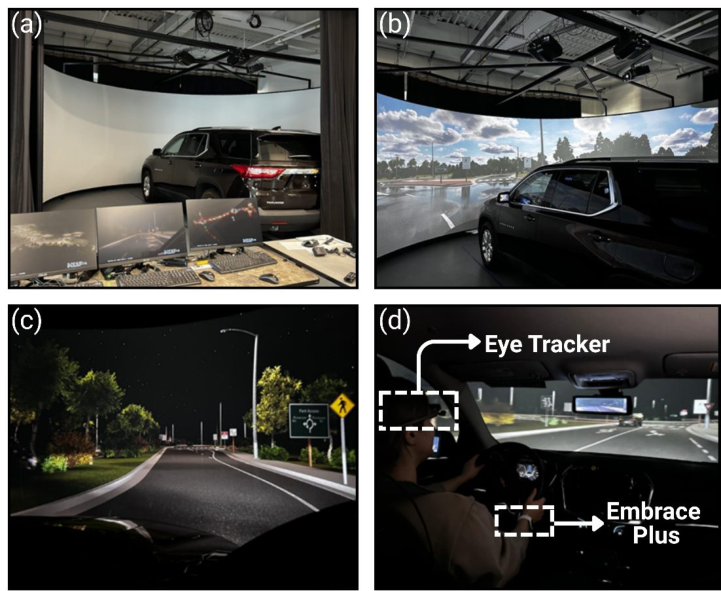
Apparatus and Simulator Setup The experiment was conducted in the Autonomous Vehicle Research and Intelligence Laboratory at the University of Waterloo using a Vi-Grade STATIC Driving Simulator configured with a Chevrolet SUV cabin and Original Equipment Manufacturer controls (Umpaipant et al., 2024). The fixed-base simulator provided a 278-degree cylindrical projection operating at 120 Hz. It included functional mirrors, an instrument cluster, a 5.1-channel surround sound system, and seat-integrated haptic feedback that reproduced realistic steering resistance and vibration cues. The driving environment was developed in Unreal Engine using RoadRunner for road network generation and scene layout to replicate an urban collector corridor in the city of Waterloo (Figure 1 (c &d)). The roadway model incorporated consistent geometry, signage, and pavement reflectance representative of
real urban infrastructure. Ambient illumination and contrast were calibrated photometrically to maintain uniformity across experimental sessions.
Physiological data were recorded using the Empatica EmbracePlus wrist- worn sensor (Figure 1(d) placed on the participant’s non-dominant wrist (Alguindigue et al., 2024). The device uses photoplethysmography to detect blood-volume pulse, sampling raw data at 64 Hz and deriving heart rate (HR) and inter-beat-interval series at 1 Hz. Eye-movement behaviour was captured using the Ergoneers head-mounted eye tracker (Figure 1(d), which was compatible with participants wearing eyeglasses (Lee et al., 2025; Shariatmadari et al., 2025). The system recorded first-person-view video at 1920 × 1080 pixels and 30 fps, and binocular pupil images at 648 × 488 pixels and 60 Hz. Data were processed in Ergoneers D-Lab software.
Subjective ratings of perceived comfort, visibility, and fatigue were collected after each illumination condition using a brief 9-item post-session questionnaire based on a 5-point Likert scale. The internal reliability of this questionnaire was evaluated using Cronbach’s alpha to confirm the consistency of participant ratings across illumination conditions. In the present study, only HR and perceived comfort measures are reported as physiological and perceptual indicators of participant response under different illumination levels.
Figure 1: Overview of the experimental setup: (a) simulator configuration within the AVRIL facility; (b) participant view of the nighttime driving scene; (c) interior driving perspective; (d) physiological and behavioural data acquisition instruments.
Effects of Illuminance Levels on Driver Comfort 1545
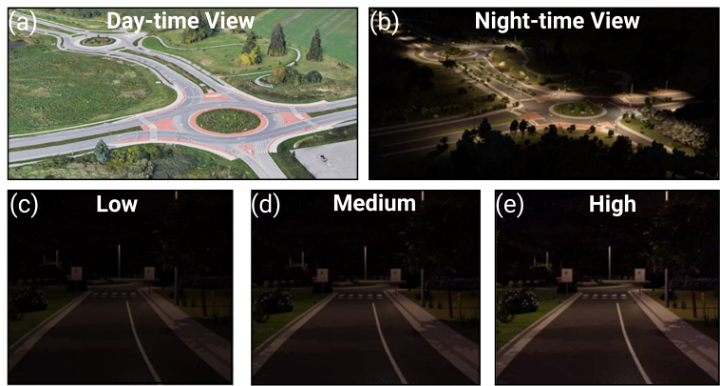
Lighting Conditions Three illumination levels i.e., low, medium, and high were implemented to replicate realistic nighttime roadway lighting for urban collector and low- speed arterial corridors. Figure 2 illustrates both the reference roadway under day (a) and night (b) conditions and the three simulated illumination levels (c-e) used in the experiment, showing the progression in brightness and visual clarity across the calibrated range.
The luminance targets, approximately to 0.3–1.2 cd/m2, were selected within the standard ranges (International Commission on Illumination, 2010; FHWA, 2018). These levels were photometrically calibrated in the simulator as described earlier to ensure realistic luminance distribution and contrast consistent with roadway standards. All lighting conditions used a neutral-white correlated colour temperature of 3500 K, representative of LED luminaires widely adopted in municipal applications. This temperature range was selected because prior studies have shown that neutral-white light (≈3500–4000 K) provides an optimal balance between visual clarity and comfort, reducing glare and visual fatigue relative to cooler sources (≥5000 K) while maintaining adequate contrast and alertness compared with warmer tones (≤3000 K) (Chen et al., 2024).
Figure 2: Reference and simulated lighting conditions. (a) Daytime and (b) nighttime aerial views of the reference roadway. (c–e) Simulated driving scenes under low, medium, and high illumination levels used in the experiment.
Procedure The experimental protocol followed a structured sequence of briefing, baseline recording, exposure to illumination conditions, and post-session evaluation. All sessions were conducted individually in a quiet laboratory environment to minimize distraction and external light interference. Before beginning the experiment, participants completed a digital consent form, demographic questionnaire, the Motion Sickness Susceptibility
Questionnaire (MSSQ), and the Driver Behavior Questionnaire (DBQ). They were then familiarized with the simulator controls and instructed to maintain normal driving behaviour while obeying roadway signs and speed limits. The Empatica EmbracePlus wrist sensor and the Ergoneers head-mounted eye tracker were fitted and calibrated prior to each session. Physiological and behavioural data were recorded continuously and synchronized with simulator event logs for precise temporal alignment. Each trial began with a three-minute baseline period in which participants sat quietly in the stationary simulator to establish resting physiological measures. They then completed three nighttime driving scenarios, each corresponding to one illumination level (low, medium, or high). The order of illumination conditions was counterbalanced across participants to control for sequence and adaptation effects. Each driving segment lasted approximately eight minutes and maintained constant roadway geometry, traffic conditions, and environmental parameters. After each scenario, participants completed a brief post-session questionnaire assessing perceived comfort, visibility, and fatigue on a five-point scale. Upon completing all three conditions, they provided overall feedback and were debriefed on the study objectives. The full session, including setup and rest periods, lasted approximately 60 minutes per participant.
RESULTS
Illuminance level had a significant effect on drivers’ physiological activation as indexed by HR. Descriptive statistics by age group and lighting level are presented in Table 1. A repeated-measures ANOVA across the four conditions (baseline driving, low, medium, and high illuminance) revealed a main effect of lighting, F (3, 87) = 5.94, p = 0.001. Mean HR increased when any lighting was introduced relative to the baseline condition, indicating increased cardiovascular arousal under illuminated environments.
Table 1: Mean HR (bpm) by lighting level and age group.
Table available in the original PDF paper.
Age Group Baseline Low Medium High Younger 74.5 (11.0) 77.6 (10.0) 76.8 (9.0) 78.5 (11.3) Older 71.7 (12.4) 76.0 (15.1) 72.5 (12.7) 73.8 (12.8) Overall 73.1 (11.6) 76.8 (12.6) 74.6 (11.0) 76.1 (12.1)
Post-hoc comparisons summarized in Table 2 confirmed that HR rose significantly from baseline to both low (p < 0.001) and high (p = 0.018) illuminance levels, whereas differences among the three illuminated conditions (low, medium, high) were non-significant (p > 0.05). When age group was included as a between-subjects factor, neither the main effect of age (p = 0.128) nor the interaction between age and condition (p = 0.999) reached significance, indicating that younger and older participants exhibited similar illumination-related trends.
Effects of Illuminance Levels on Driver Comfort 1547
Table 2: Post-hoc pairwise comparisons for HR means (Holm–Sidak for overall; Bonferroni for age-specific analyses).
Table available in the original PDF paper.
Group Condition Mean Difference Adjusted p Cohen’s d Overall Baseline →Low Light +3.69 0.0003*** 0.87 Baseline →Medium Light +1.51 0.315 n.s. 0.28 Baseline →High Light +3.01 0.018* 0.58
Within-group analyses showed that both age groups experienced significant increases in HR from baseline to low illumination, but only younger participants demonstrated an additional rise under high illumination. No significant changes were observed between baseline and medium lighting in either group. Older participants displayed greater variability in HR across conditions, consistent with broader cardiovascular dispersion typically observed with age, yet the direction and magnitude of responses remained parallel between groups.
Cronbach’s alpha exceeded the standard reliability threshold of 0.70 for each condition, confirming that participants rated comfort items coherently under different lighting environments: High (α = 0.848), Medium (α = 0.936), and Low (α = 0.900). These values indicate that the scale provided stable and interpretable measures of perceived comfort. Descriptive statistics for overall and age-specific ratings are summarized in Table 3. Medium illuminance yielded the highest mean comfort score (M = 4.30, SD = 0.61), followed by High (M = 4.02, SD = 0.70) and Low (M = 3.57, SD = 0.78). Low illumination also showed the widest response range, suggesting that drivers’ reactions to insufficient light were less consistent than their evaluations of brighter conditions. Younger drivers reported slightly higher comfort overall, but both age groups exhibited the same rank order (i.e., Medium > High > Low).
Table 3: Mean perceived comfort by lighting level and age group.
Table available in the original PDF paper.
Age Group Low Medium High Younger 3.86 (0.67) 4.56 (0.38) 4.19 (0.59) Older 3.29 (0.84) 4.04 (0.75 3.85 (0.77) Overall 3.57 (0.78) 4.30 (0.61) 4.02 (0.70)
A repeated-measures ANOVA showed a main effect of illumination on comfort, F (2,58)=31.84, p<0.001, ηp2=0.523. Comfort increased with lighting intensity, with High rated higher than Low (p = 0.0007), while Medium–High (p = 1.000) and Medium–Low (p = 0.053) did not differ,
indicating near-optimal comfort at medium intensity. Including age yielded a smaller lighting effect, F (2,58)=3.93, p = 0.023, ηp2=0.086, with no main age effect (p = 0.855) or interaction (p = 0.948). Older participants rated High more comfortable than Low (p = 0.022); younger showed no significant differences. Overall, illumination strongly influenced comfort, but age did not alter this trend. Medium levels provided balanced comfort and minimal variability across participants.
Table 4: Post-hoc pairwise comparisons for comfort means (Holm–Sidak for overall; Bonferroni for age-specific analyses).
Table available in the original PDF paper.
Group Condition Adjusted p Cohen’s d Overall Medium →High Light 1.000 n.s. 0.17 Medium →Low Light 0.0529 n.s. 0.59 High →Low Light 0.0007*** 0.76
Younger Medium →High Light 1.000 n.s. 0.48 Medium →Low Light 0.4923 n.s. 0.60 High →Low Light 0.0526 n.s. 0.43 Older Medium →High Light 1.000 n.s. 0.30 Medium →Low Light 0.1599n.s. 0.76 High →Low Light 0.0225* 0.81
Equation reproduced from the original PDF.
DISCUSSION AND IMPLICATIONS Illuminance produced convergent effects on physiological activation and perceived comfort, identifying medium illumination as the optimal level for nighttime driving. HR analysis showed that illuminated conditions increased cardiovascular activation relative to baseline, confirming elevated arousal in the presence of roadway lighting. Among the three illumination levels, medium illumination-maintained HR closest to baseline, indicating balanced autonomic regulation and sufficient alertness without overstimulation. Both low and high levels produced larger HR deviations, suggesting that insufficient or excessive brightness increases physiological load. Perceptual responses mirrored this pattern. Participants rated medium illumination highest in comfort, while low illumination consistently reduced comfort and high illumination offered no added benefit. The convergence between physiological stability and perceptual preference shows that moderate luminance provides the most favorable trade-off between visibility and comfort, consistent with findings that excessive luminance elevates glare, adaptation strain, and visual fatigue (Boyce, 2021). Age-related differences were limited to response variability: older drivers exhibited broader HR dispersion and slightly lower comfort ratings, yet their illumination-response patterns remained consistent with younger drivers.
The combined physiological and perceptual evidence identifies medium illumination as an ergonomic and energy-efficient target for urban nighttime driving. This level supports visual clarity and sustained alertness while minimizing physiological strain, aligning with modern lighting standards
Effects of Illuminance Levels on Driver Comfort 1549
that emphasize context-sensitive design rather than maximum brightness. The results provide a quantitative foundation for performance-based lighting guidelines, where illumination design is validated through human-response metrics rather than purely photometric criteria. Integrating HR and comfort measures into roadway lighting assessment can help transportation authorities optimize safety, energy efficiency, and user well-being within sustainable infrastructure frameworks.
CONCLUSION, LIMITATIONS AND FUTURE SCOPE The findings show that nighttime illumination significantly affects both autonomic and perceptual responses during simulated driving. Among the tested levels, medium illuminance yielded the most stable HR and the highest comfort ratings, confirming the hypothesis. The results support a human- performance-based criterion for roadway lighting, in which physiological and perceptual evidence jointly define the range of safe, comfortable, and energy-efficient illumination for varied driver populations.
The study used a limited sample (n = 30), restricting generalization. Future studies should include larger and more diverse participants to capture variability in age, vision, and driving experience. Only HR was analysed; future work should integrate EEG, eye tracking, and HRV to assess neural and attentional responses. The fixed-base simulator limited immersion; motion or VR-based setups could improve ecological validity (Sun et al., 2024). All conditions used a fixed colour temperature (3500 K); future studies should vary spectral composition to test combined effects of luminance and colour. Illumination effects were measured over short exposures; longer trials are needed to assess adaptation and circadian influences. The single roadway and traffic scenario limits generalization and requires validation across varied driving context.
ACKNOWLEDGMENT
This research was supported by the Natural Sciences and Engineering Research Council of Canada (NSERC) Discovery Grant RGPIN-2019- 05304. The authors acknowledge the participants for their contribution and the Autonomous Vehicle Research and Intelligence Laboratory (AVRIL) at the University of Waterloo for providing the simulation facilities. This paper was supported in part by the Sharratt Scholarship funded through the Schlegel-UW Research Institute for Aging.
REFERENCES
Abboushi, B., Fotios, S. and Miller, N. J. (2023) “Predicting discomfort from glare with pedestrian-scale lighting: A comparison of candidate models using four independent datasets,” Lighting Research & Technology [Preprint]. Available at: https://doi.org/10.1177/14771535231162505. Alguindigue, J. et al. (2024) “Biosignals Monitoring for Driver Drowsiness Detection
Using Deep Neural Networks,” IEEE Access, 12, pp. 93075–93086. Available at: https://doi.org/10.1109/ACCESS.2024.3423723.
Boyce, P. R. (2021) “Light, lighting and human health,” Sage Journals [Preprint].
Available at: https://doi.org/10.1177/14771535211010267. Boyce, P. R. et al. (2006) “Lighting quality and office work: Two field simulation experiments,” Sage Journals [Preprint]. Available at: https://doi.org/10.1191/ 1365782806lrt161oa. Cajochen, C. et al. (2000) “Dose-response relationship for light intensity and
ocular and electroencephalographic correlates of human alertness,” Behavioural Brain Research, 115(1), pp. 75–83. Available at: https://doi.org/10.1016/ S0166–4328(00)00236–9. CCMTA (2025) Road Safety Strategy (RSS) by Canadian Council of Motor Transport Administrators, RSS. Available at: https://roadsafetystrategy.ca/en/ strategy (Accessed: October 25, 2025). Chen, Q. et al. (2024) “An Investigation into the Effects of Correlated Color
Temperature and Illuminance of Urban Motor Vehicle Road Lighting on Driver Alertness,” Sensors, 24(15), p. 4927. Available at: https://doi.org/10.3390/ s24154927. Cho, Y. et al. (2025) “EEG-based evaluation of illuminance and correlated color temperature adjusted to fatigue levels in a VR residential environment,” Building and Environment, 286, p. 113702. Available at: https://doi.org/10.1016/ j.buildenv.2025.113702. Easa, S. M. et al. (2024) Effect of Road Lighting on Night Driving of Older Adults.
report. Toronto Metropolitan University. Available at: https://doi.org/10.32920/ 25413112.v1. FHWA (2018) Guidelines for The Implementation of Reduced Lighting on Roadways. Available at: https://www.fhwa.dot.gov/publications/research/safety/ 14050/ (Accessed: October 25, 2025). Golding, J. F. (2006) “Predicting individual differences in motion sickness susceptibility by questionnaire,” Personality and Individual Differences, 41(2), pp. 237–248. Available at: https://doi.org/10.1016/j.paid.2006.01.012. Government of Canada (2022) Pan-Canadian Framework on Clean Growth and
Climate Change. Available at: https://www.canada.ca/en/services/environment/ weather/climatechange/pan-canadian-framework.html (Accessed: October 25, 2025). International Commission on Illumination (2010) Lighting of roads for motor and pedestrian traffic, 2nd Edition | CIE. Available at: https://cie.co.at/publications/ lighting-roads-motor-and-pedestrian-traffic-2nd-edition (Accessed: October 25, 2025). Lee, H. et al. (2025) “Collision Risk Perception Models Using Physiological and Eye-
Tracking Signals,” IEEE Access, 13, pp. 136745–136767. Available at: https:// doi.org/10.1109/ACCESS.2025.3594806. Lok, R. et al. (2018) “Light, Alertness, and Alerting Effects of White Light: A Literature Overview,” Journal of Biological Rhythms, 33(6), pp. 589–601. Available at: https://doi.org/10.1177/0748730418796443. Sahin, L. et al. (2014) “Daytime light exposure: Effects on biomarkers, measures
of alertness, and performance,” Behavioural Brain Research, 274, pp. 176–185. Available at: https://doi.org/10.1016/j.bbr.2014.08.017. Shariatmadari, K. et al. (2025) “Comparison of Two-Level and Three-Level Graded Collision Warning Systems under Distracted Driving Conditions,” IEEE Access [Preprint]. Available at: https://ieeexplore.ieee.org/abstract/document/10916632/ (Accessed: October 26, 2025).
Effects of Illuminance Levels on Driver Comfort 1551
Sinoo, M. M., van Hoof, J. and Kort, H. S. M. (2011) “Light conditions for older adults in the nursing home: Assessment of environmental illuminances and colour temperature,” Building and Environment, 46(10), pp. 1917–1927. Available at: https://doi.org/10.1016/j.buildenv.2011.03.013. Siraji, M. A. et al. (2022) “Effects of Daytime Electric Light Exposure on Human
Alertness and Higher Cognitive Functions: A Systematic Review,” Frontiers in Psychology, 12. Available at: https://doi.org/10.3389/fpsyg.2021.765750. Smolders, K. C. H. J. and de Kort, Y. A. W. (2014) “Bright light and mental fatigue: Effects on alertness, vitality, performance and physiological arousal,” Journal of Environmental Psychology, 39, pp. 77–91. Available at: https://doi.org/10.1016/ j.jenvp.2013.12.010. Sun, C., Singh, A. and Samuel, S. (2024) “Evaluation of control modalities in highly
automated vehicles: A virtual reality simulationbased study,” IEEE Transactions on Intelligent Vehicles [Preprint]. Available at: https://ieeexplore.ieee.org/abstract/ document/10666098/ (Accessed: July 17, 2025). Sun, Z. et al. (2025) “The Impact of Lighting Conditions on Users’ Alertness and Working Memory in Confined Spaces,” PsyCh Journal, 14(4), pp. 614–629. Available at: https://doi.org/10.1002/pchj.70022. Umpaipant, W. et al. (2024) “Improving Takeover Requests in Automated Vehicles: The Role of Dynamic Alerts and Cognitive State,” IEEE Transactions on Intelligent Vehicles, pp. 1–18. Available at: https://doi.org/10.1109/ TIV.2024.3509315. Wood, J. M. (2020) “Nighttime driving: visual, lighting and visibility challenges,”
Ophthalmic and Physiological Optics, 40(2), pp. 187–201. Available at: https:// doi.org/10.1111/opo.12659. Yerkes, R. and Dodson, J. (1908) “The relation of strength of stimulus to rapidity of habit-formation.” Available at: https://psychclassics.yorku.ca/Yerkes/ Law/ (Accessed: October 25, 2025). Yu, D. et al. (2025) “Assessment of visual function under various lighting conditions
in a cohort of active older drivers: Dimensionality and principal metrics,” Frontiers in Neuroscience, 19, p. 1511366. Available at: https://doi.org/10.3389/ fnins.2025.1511366.
LISTED IN THE AHFE DIGITAL BOOKSTORE CATALOGUE
Explore the complete digital volume
Human Factors in Design, Engineering, and Computing
Read this individual research paper free through the original publisher, or explore the full digital proceedings book.
ISBN 978-1-964867-75-5
Explore this ISBN in the AHFE Bookstore ↗Listed in the July 2026 bookstore catalogue; search by ISBN to confirm current availability · Digital book purchase optional