Chongren Sun, Siby Samuel (2022). Micro scenarios – A Theory-based Intervention to Alleviate Simulator Sickness for Older Drivers in Driving Simulators. In: Human Factors in Transportation. AHFE Open Access, vol. 60, pp. 465–475. https://doi.org/10.54941/ahfe1002479
Driving continues to be the fundamental way for people to transit in North America. For older adults with physical or cognitive comorbidities, automobiles remain the most suitable method to increase mobility, independence, and quality of life. However, research shows that elderly drivers are more likely to be involved in traffic accidents. For instance, drivers over 65 are overrepresented in crashes at signalized and unsignalized four-way intersections. Driving simulator-based training interventions are a safe way for training elderly drivers, particularly on effective ways to negotiate intersections. However, driving simulators result in simulator sickness or simulation adaptation syndrome (SAS). SAS can cause nausea, disorientation, vertigo, vomiting, and sickness in humans. The adverse effects of SAS are more pronounced in older drivers over 65 compared to their younger counterparts. Studies show that the dropout rates for older drivers from simulation experiments are much higher than those for younger or middle-aged drivers. Evidence from literature largely corresponds to the Motion Cue Conflict theory by Reason and Brand. It posits that the precipitating factor for SAS is the disconnect between the participants’ visual system (in motion) and their vestibular system (stationary). Several other theories may potentially explain the occurrence of SAS, such as Poison theory, the Postural Instability theory, and the Rest-frame Theory. Treisman’s Poison theory is an evolutionary theory that identifies nausea as a natural body response to complex symptoms that resemble poisoning. Riccio and Stoffgren’s postural instability theory offers an ecology-based perspective where our action and perception systems continually attempt to maintain postural stability in our environment. According to this theory, participants get sick trying to maintain stability in a new or unfamiliar environment, such as a driving simulator. Lastly, Prothero’s rest-frame theory identifies conflicting rest-frames instead of conflicting cues as the precipitator for SAS. Across the four theories, the amount of visual flow in the simulator and the time participants spend in a simulator are the common factors potentiating SAS. To alleviate SAS, several methods and approaches have been developed and evaluated. These include galvanized vestibular stimulations, galvanic cutaneous stimulation, appropriate visual background manipulations, virtual guiding avatars, and the use of alternative sensory conditions. However, none of the above interventions have improved older driver secondary glance behavior. The current paper proposes a novel methodological approach - micro scenarios, which can effectively reduce optical flow to target older driver SAS problems, especially in scenarios involving the negotiation of left turns at intersections. Micro scenarios specifically aim to decrease the total exposure time and increase the frequency of rest breaks while striving to retain the effectiveness of the training itself. Microscenarios are driven by the Postural Instability theory and the Motion cue conflict theory. Simulator-based evaluations of micro scenarios produced very low dropout rates, and participants reported very low levels of simulator sickness compared to typical scenarios. Practitioners may use these findings to train and assess at-risk populations on driving simulators.
Driving continues to be the fundamental way for people to transit in North America. For older adults with physical or cognitive comorbidities, automo- biles remain the most suitable method to increase mobility, independence, and quality of life. However, research shows that elderly drivers are more likely to be involved in traffic accidents. Older drivers are at a high risk of crashing at intersections (Mayhew, et al. 2006); the relative risk is 10.62 for drivers aged 85 years and older than middle-aged drivers aged 30–65. Intersections are
the most frequent crash type involving older drivers (Guerrier, et al. 1999). Studies show that older drivers need more detailed training to avoid traffic accidents, especially in the intersection scenario (Samuel, et al. 2016). Evide- nce shows that training programs with on-road instruction are more efficient than training programs that only teach in the classroom (Michelle, M Porter. 2013). However, driver training on the road in a real-world vehicle is not suitable for older people who are highly likely to be involved in traffic acci- dents. One solution is using a typical mid-level fixed-base driving simulator to train senior people (Kaptein, Theeuwes, Van der Horst. 1996).
However, the side-effect of utilizing a driving simulator also exists. Unlike driving on the actual road, a driving simulation may cause simulator sickness, also referred to as Simulator Adaptation Syndrome (SAS). SAS can cause nau- sea, disorientation, vertigo, vomiting, and sickness in humans. The adverse effects of SAS are more pronounced in older drivers over 65 compared to their younger counterparts. Like motion sickness, SAS can be measured through objective or subjective methods. As for motion sickness, the most accepted theory is a mismatch between human stimulation of the real-world experience and sensorial stimulation created by simulators (Vincenzi et al. 2009). It posits that the precipitating factor for SAS is the disconnect betw- een the participants’ visual system (in motion) and their vestibular system (stationary).
Research on the road (Bao et al. 2009) and a driving simulator (Romoser, et al. 2009; Romoser, et al. 2013) indicates that older drivers are less likely to glance toward potential threats than middle-aged drivers. Glances execu- ted during the approach to an intersection or when the driver is stopped at the intersection have been termed as primary glances. In contrast, glances towards potential threat vehicles after the driver enters the intersection are labeled secondary glances (Yamani, et al. 2015).
Several other theories may potentially explain the occurrence of SAS. For example, Treisman’s Poison theory is an evolutionary theory that identi- fies nausea as a natural body response to complex symptoms that resem- ble poisoning. Riccio and Stoffgren’s postural instability theory offers an ecology-based perspective where our action and perception systems conti- nually attempt to maintain postural stability in our environment. According to this theory, participants get sick trying to maintain stability in a new or unfamiliar environment, such as a driving simulator. Lastly, Prothero’s rest- frame theory identifies conflicting rest-frames instead of conflicting cues as the precipitator for SAS. Across the four theories, the amount of visual flow in the simulator and the time participants spend in a simulator are the common factors potentiating SAS.
We propose a novel methodological approach driven by the four theories mentioned. The novel approach can decrease the presence of optical flow and the total length of the exposure and increase the frequency of the breaks, the three significant factors in the development of simulator sickness. Failures to take secondary glances are most likely to lead to a crash (Yamani, et al. 2015). Many possibilities can explain older drivers’ reduced likelihood of executing secondary glances while navigating intersection (Clapp, et al. 2011). These explanations include age-related declines in cognitive and visual processing,
Micro-Scenario: A Theory Based Intervention to Alleviate Simulator Sickness 467
such as declines in the ability to multi-task, in the attentional field of view, in working memory, in decision making, in vision, and flexibility (Braitman, et al. 2007; Clapp, et al. 2011; Kramer, et al. 1999).
Methodology
This paper briefly reviews simulation adaptation syndrome related to older drivers in a simulator-based training context. The purpose of this paper is to:
1. Identify the most general factors that cause SAS among older drivers. 2. Search for relative theories that can explain the occurrence of SAS. 3. Propose a novel methodological approach - micro scenarios, which may effectively reduce optical flow to target older driver SAS problems.
Several criteria are employed in this literature review to choose articles or papers. Articles reviewed here met the following criteria - (1) were written in English, (2) relevant to simulation adaptation syndrome, (3) targeted older people (average ages 63.7 years) (4) articles are available online and reliable. Articles or studies were excluded from this review if the papers (1) did not discuss human-in-the-loop simulators or if the (2) study participants for the group were too young (less than 40 years old).
Age Related Intersection Navigation Review As age increases, many physical and cognitive functional abilities are less fle- xible and agile for older drivers (Eby, D W. 1998). Failures to take secondary glances are most likely to lead to a crash in the signed or unsigned traffic inter- section (Yamani, et al. 2015). Several possibilities can explain older drivers’ reduced likelihood to execute secondary glances while navigating intersecti- ons (Guerrier, et al. 1999). These explanations include age-related declines in cognitive and visual processing, such as declines in the ability to multi-task, in the attentional field of view, in working memory, in decision making, in vision (Braitman, et al. 2007; Clapp, et al. 2011; Kramer, et al. 1999).
Our tentative hypothesis is the “decoupling hypothesis among the seve- ral explanations.” The nature of the turning maneuvers drives the choice of decoupling hypothesis as a potential explanation at intersections. Typically driving involves drivers’ coordinated head, foot, and eye movements as they accelerate into an intersection (i.e., the simultaneous turning of the wheel and glancing to the side while accelerating into the intersection). However, when a latent hazard exists in the opposite side of the driver’s intended path, such as an intersection scenario under consideration here, drivers will need to decou- ple their head/eye control (to execute a secondary glance) from hand/foot movements (to control the vehicle). We suspect this necessary decoupling of multiple motor movements while maneuvering an intersection is a criti- cal source of the age-related changes in glancing patterns. The coupling of movements can be explained by the potential visual and cognitive declines experienced by older drivers. Older drivers are less likely to glance towards the side opposite to the direction of their immediate path because they fail to decouple steering control and head/eye movement (Yamani, et al. 2016).
468 Sun and Samuel
Driving simulator-based training programs are proven successful at incre- asing the frequency of secondary glances. Typically, older drivers in the field take a successful secondary glance at roughly 40% of the intersections (Romoser, et al. 2009). However, following a one-hour intersection negoti- ation training program on a driving simulator, the proportion of secondary glances is doubled to nearly 80%. The effects of the training program on the driving simulator have been shown to transfer to the field at intervals of three months (Romoser, et al. 2009) and two years (Romoser, et al. 2013) after training, indicating strong retention of the trained skills (Clapp, et al. 2011). However, the high simulator sickness rate for older drivers - typically 40% - is one issue that affects the effectiveness of utilizing simulators to train older drivers (e.g., 38.6% of older trainees exhibited signs of SAS in Romoser & Fisher 2009).
Age Related Simulator Sickness Review Few studies have demonstrated the differences between younger and older adult drivers related to simulator sickness. For example, recent research by Bakhtiari and colleagues (2019) examined simulator sickness scores between two groups (younger and older) of drivers before and after an experiment and found significant differences before and after the experimentation for both groups (Bakhtiari, et al. 2019). The study compared the performance of younger and older drivers while navigating left turns at intersections in the presence and absence of bimodal audiovisual alerts on a fixed-base simulator. SSQ was utilized to obtain the simulator sickness scores across participants. While the older drivers were found to exhibit significantly higher simulator sickness scores, the effect was found to be identical in the presence/absence of bimodal audiovisual alerts.
Keshavarz explored four different multisensory conditions (visual only, visual plus auditory, visual plus motion, and a trimodal condition involving visual, auditory, and motion senses). The results showed that older drivers experienced more simulator sickness across all sensory conditions than youn- ger drivers. However, the study also found combined motion/auditory cues to help accelerate the recovery of older adults following simulator sickness (Keshavarz, et al. 2018). The drivers in the study navigated a virtual envi- ronment of a rural road with guardrails incorporating a series of left and right curves of different radii (400 m, 800 m, or 1200 m). The environ- ment did not involve any other moving objects (such as pedestrians, bicyclists, other cars, or animals). To simulate motion, a 6 DOF motion base was utili- zed. The motion base provided smooth motion with a flat dynamic response up to 10Hz. Recovery was measured using the Fast Motion Sickness Scale (Keshavarz, et al. 2011). FMS is a verbal rating scale ranging from 0 (no sickness) to 20 (severe sickness), administered every minute during the driving task. FMS is specifically designed to capture the nausea aspect of simulator sickness and does not capture fatigue, dizziness, or oculomotor symptoms typically captured by SSQ. Participants had to report a single score from the FMS for every minute of their drive that best indicated level of sickness at that moment. Change in FMS score reflected the rate of recovery for
Micro-Scenario: A Theory Based Intervention to Alleviate Simulator Sickness 469
participants. Older drivers reported more sickness on the FMS than younger drivers (Keshavarz, et al. 2018).
Key Contributing Factors and Theories Toward SAS Motion Cue Conflict theory (Reason, J.T. & Brand J.J. 1975). Mollenhauer (2004) suggests that the major contributing factor to SAS is the mismatch between the visual and the vestibular systems, at least in fixed-based simula- tors. While the visual cues indicate motion in fixed-based simulators, the vestibular cues indicate no motion. In other words, there is a mismatch between visual cues indicating that the driver is stationary and the inertial cues indicating that the driver may be moving (Duh, Parker 2004). In many systems, the self-motion and self-orientation cues received by the vestibular receptors tend to differ from those obtained by the visual receptors, and the resulting conflict may cause SAS.
Poison theory (Treisman, M. 1997). According to poison theory, the com- plex symptoms (such as vomiting, dizziness, and instability) that occur when an individual experiences simulator sickness physiologically resemble what the individual experiences when being poisoned (or ingests certain neuroto- xins). Nausea is potentiated because it is the evolutionary response to these symptoms, and the body responds by trying to purge the toxin by vomi- ting. Poison theory is an evolutionary theory, and subsequent research has no support for the hypothesis.
Postural Instability theory (Riccio 1991). According to postural instabi- lity theory, an ecology-based perspective, our perceptual and action systems are continually attempting to maintain our postural stability in our environ- ment. Sickness occurs when an individual is attempting to maintain stability under a set of new environmental conditions – such as a driving simulator with a virtual environment – when they have not yet learned strategies for accomplishing the task (Stoffgren, et al. 2000). A subsequent study that fixed participants’ positions found that simulator sickness was alleviated in older adults, thus supporting the postural instability theory (Keshavarz 2017).
Rest-frame theory (Prothero, et al. 1999). According to rest-frame theory, the presence of conflicting ‘rest-frames’ instead of conflicting motion cues contributes to simulator sickness. Derived from physics, reference frames represent a coordinate system used to define positions, angular orientations, and motions. When such a reference frame is perceived to be stationary by the driver, the reference frame is called a rest-frame (Prothero, et al. 1997). In that case, the rest-frame defined by some elements is the room itself (if the chair in the room upon which the driver is sitting is at rest, then the driver is at rest). In contrast, the rest-frame defined by the displays on the screen is the virtual world (if the driver is moving through the virtual world, then the dri- ver is in motion). A study investigating the effect of a physical rest-frame on reducing simulator sickness found no such effects on older adults (Heutink, et al. 2019).
Common factors that potentiate SAS across the four theories 1) the amount of visual flow in a simulator and 2) the length of time participants spend in a simulator (Stoner, et al. 2011). First, the rate of optic flow of a virtual world
470 Sun and Samuel
can be a significant factor that causes SAS (Kennedy, et al. 1989; Casali, et al. 1986) – a visual flow created by the movement of elements in the optic array that occur as an observer moves relative to their environment (Goldstein, E.B. 1989). Second is the time length that the participant operates in the virtual environment. The more frequent are the breaks between drives, the less likely symptoms of SAS are to occur (Kennedy, et al. 1987).
Interventions that Alleviate SAS for Older Drivers Various interventions derived from SAS theories have been evaluated as pos- sible ways to reduce SAS. Appropriate cueing for motion and sensing can potentially alleviate discomfort (Mollenhauer, M. A. 2004). Galvanized vesti- bular stimulation and galvanic cutaneous stimulation were found to reduce the total score on the simulator sickness questionnaire (Kennedy, et al. 1993) and improve vehicular control (Reed-Jones, et al. 2007)). Appropriate visual background manipulations (such as “graying out” when head motion exce- eds a certain threshold velocity, faint static gridlines superimposed over a moving scene, or use of an independent visual background such as clouds) may have a role in reducing simulator sickness symptoms (DiZio, et al. 1997; Duh, H. B. L. 2001; Duh, et al. 2004). Virtual guiding avatars (in the shape of an airplane) that combine self-motion prediction cues, and an indepen- dent visual background was found to reduce simulator sickness (Lin, et al. 2004). More recently, research by Keshavarz explored the impact of sensory factors on simulator sickness in younger and older drivers by adding auditory motion cues to visual inputs in a driving simulator (Keshavarz, et al. 2018). Specifically, four sensory conditions were explored (visual cues alone, visual plus auditory cues, combined visual and motion cues, and all three cues). The research showed that older adults experienced more simulator sickness than young adults overall and that females were more likely to drop out overall (Kennedy, et al. 1992). While no differences were found across the sensory conditions, older adults required more time to recover following their expo- sure to solely visual cues. Their research concluded that auditory and motion cues provided a pathway to accelerate the recovery process following simu- lator sickness. However, none of these interventions are effective with older drivers in a training context for improving older drivers’ secondary glance behaviors.
In this paper, the proposed method is a ‘micro-scenario approach’ where the scenarios are condensed to the critical regions of interest within the forw- ard roadway to reduce total exposure while ensuring that the behavior of interest can be observed. In the case of intersection negotiation, it is essential to measure participants’ head/eye movements as they navigate left turns at intersections. Specifically, scenario reduction is in the portion that involves a turning maneuver. By reducing the extent of the turning maneuver, the tech- nique directly addresses the mismatch between visual and vestibular systems that is accentuated by motion cue conflicts.
Micro-scenarios can decrease the presence of optical flow, the total length of the exposure, and the frequency of breaks can significantly reduce dropout rates to as low as 12% for older drivers in intersection scenarios of potential
Micro-Scenario: A Theory Based Intervention to Alleviate Simulator Sickness 471
threats in a driving simulator (Schneider, et al. 2016; Romoser, et al. 2009). The proposed technique also reduces the number of conflicting rest-frames within a scenario segment, thereby addressing the rest-frame theory. Also significant is that the proposed micro-scenario approach lends well to the underlying premise of the decoupling hypothesis as micro-scenarios enable decoupling of steering control and head/eye movements.
Previous research using micro-scenarios has sought to demonstrate the applicability of micro-scenarios at alleviating simulator sickness or SAS without dwelling on the theoretical factors that may enable the mitigation of simulator sickness. Specifically, no previous research has reported the underlying theory that makes micro-scenarios a valuable intervention for older drivers in simulator-based training environments focused on improving older drivers’ ability to negotiate and traverse left turns/right turns at road intersections.
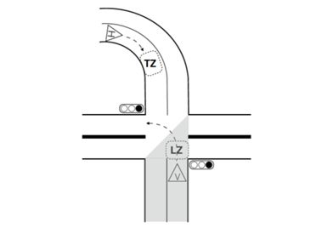
Novel Methodological Approach Driving simulators incorporate virtual simulations and texture databases that can be programmed and modeled to create different virtual environments or scenarios. Scenarios are short, continuous drives in a virtual world that approximate the real world. Micro-scenarios are subsections of scenarios where the driver is exposed to the smallest section of the forward roadway where the behavior of interest can be observed. This typically includes the portion of the road immediately upstream of the intersection and part of the turning maneuver when considering intersections. The turning maneuver is interrupted after the driver typically completes the secondary glance (or gla- nces) but right before the driver finishes the turn (Figure 1). Note that the intersection training scenarios aim to teach drivers to take secondary gla- nces. Thus, the integrity of the training scenarios is not compromised when the turn is not completed if the driver has enough time to take the required secondary glance after entering the turn. Decreasing the length of exposure in the scenario of interest allows for the removal of nauseogenic cues that precipitate when turns are fully completed.
Micro-scenarios aim to decrease the total exposure and increase the fre- quency of rest breaks while still useful as intersection training scenarios. In a series of driving simulator studies conducted by our team, each scenario was 45 seconds in length on average, and participants were given a brief break (10 - 15 seconds) between each of a series of eight micro-scenarios. Micro- scenarios further limit the optic flow during navigation of the intersections since the driver did not complete the turn, thereby decreasing the oculomotor cues, which increase levels of SAS (Kennedy, et al. 1989, Casali, et al. 1986). Micro-scenarios produced low dropout rates in driving simulator-based expe- riments (Schneider, et al. 2016). For example, reported 14.3% and 11.8% of dropout rates when older drivers were exposed to medium and low levels of immersion in a driving simulator, which was significantly lower than 38.6%, the dropout rate reported in Romoser and Fisher (2009), z = 2.029, p = .042 and z = 2.206, p = .039, respectively. Additionally, Yamani and col- leagues (2016) measured older and middle-aged drivers’ secondary glances
472 Sun and Samuel
Figure 1: An example of an intersection scenario with latent hazard. Drivers should glance toward the target zone (TZ) while in a launch zone (LZ). The area under the shadow is the virtual world that drivers maneuver in a micro-scenario.
at intersections in a medium fidelity driving simulator using micro-scenarios. None reported any signs of simulator sickness.
CONCLUSION
Micro-scenarios, driven by theories of simulator sickness, might offer an effe- ctive means to reduce simulator sickness for older drivers who could benefit greatly from cognitive skill training for improving their visual attention at intersections. Micro-scenarios end right before drivers makes a turn, thereby limiting the mismatch between visual and vestibular inputs to minimize opti- cal flow, the total exposure of the virtual world, and the frequency of breaks between scenarios. Researchers who utilize simulation that can comprise vari- ous levels of visual flow such as intersection scenarios, may use this technique to alleviate users’ simulator sickness and use simulators as effective platforms for training and assessing at-risk populations. Future research should further explore the underlying mechanisms that may explain how micro-scenarios can help reduce simulator sickness, specifically in older drivers, so simulated training can be effective.
REFERENCES
Bao, S., & Boyle, L. N. (2009). Age-related differences in visual scanning at mediandivided highway intersections in rural areas. Accident Analysis & Prevention, 41(1), 146–152. Bakhtiari, S., Zhang, T., Zafian, T., Samuel, S., Knodler, M., Fitzpatrick, C., &
Fisher, D. L. (2019). Effect of Visual and Auditory Alerts on Older Drivers’ Gla- nces toward Latent Hazards while Turning Left at Intersections. Transportation research record, 2673(9), 117–126. Braitman, K. A., Kirley, B. B., Ferguson, S., & Chaudhary, N. K. (2007). Factors leading to older drivers’ intersection crashes. Traffic injury prevention, 8(3), 267–274. Casali, J.C., and Wierwille, W.W. (1986). Vehicular simulator-induced sickness,
volume III: Survey of etiological factors and research facility requirements. (NTSC-TR86- 012). Orlando, FL: Naval Training Systems Center.
Micro-Scenario: A Theory Based Intervention to Alleviate Simulator Sickness 473
Clapp, W. C., Rubens, M. T., Sabharwal, J., & Gazzaley, A. (2011). Deficit in switching between functional brain networks underlies the impact of multitasking on working memory in older adults. Proceedings of the National Academy of Sciences, 108(17), 7212–7217. DiZio, P., & Lackner, J. R. (1997). Circumventing side effects of immersive virtual
environments. Advances in human factors/ergonomics, 21, 893–896. Duh, H. B. L. (2001). Use of an independent visual background to alleviate simulator sickness in virtual environments that employ wide-field displays. Unpublished doctoral dissertation, University of Washington, Seattle. Duh, H. B. L., Parker, D. E., & Furness, T. A. (2004). An independent visual back-
ground reduced simulator sickness in a driving simulator. Presence: Teleoperators & Virtual Environments, 13(5), 578–588. Duh, H. B. L., Parker, D. E., Philips, J. O., & Furness, T. A. (2004). “Conflicting” motion cues to the visual and vestibular self-motion systems around 0.06 Hz evoke simulator sickness. Human Factors, 46(1), 142–153. Eby, D. W. (1998). The assessment of older drivers’ capabilities: A review of the
literature. Goldstein, E.B. (1989). Sensation and perception (3rd Ed.). Belmont, CA: Wadsworth Publishing Company. Guerrier, J. H., Manivannan, P., & Nair, S. N. (1999). The role of working memory,
field dependence, visual search, and reaction time in the left turn performance of older female drivers. Applied Ergonomics, 30(2), 109–119. Heutink, J., Broekman, M., Brookhuis, K. A., Melis-Dankers, B. J., & Cordes, C.
(2019). The effects of habituation and adding a rest-frame on experienced simula- tor sickness in an advanced mobility scooter driving simulator. Ergonomics, 62(1), 65–75. Kaptein NA, Theeuwes J, van der Horst R. Driving Simulator Validity: Some Considerations. Transportation Research Record. 1996;1550(1):30–36. doi:10.1177/0361198196155000105 Kennedy, R. S., Lilienthal, M. G., Berbaum, K. S., Baltzley, D. R., & McCauley, M. E.
(1989). Simulator sickness in US Navy flight simulators. Aviation, Space, and Environmental Medicine, 60(1), 10–16. Kennedy, R. S., Berbaum, K. S., Lilienthal, M. G., Dunlap, W. P., & Mulligan, B. E. (1987). Guidelines for alleviation of simulator sickness sympto- matology (No. NAVTRASYSCEN-TR-87-007). NAVAL TRAINING SYSTEMS CENTER ORLANDO FL. Kennedy, R. S., Lane, N.E., Berbaum, K.S. & Lilienthal, M.G. (1993). Simulator Sickness Questionnaire: An enhanced method for quantifying simulator sickness. The International Journal of Aviation Psychology, 3(3), 203–220. Kennedy, R. S., & Fowlkes, J. E. (1992). Simulator sickness is polygenic and
polysymptomatic: Implications for research. The International Journal of Aviation Psychology, 2(1), 23–38. Keshavarz, B., Ramkhalawansingh, R., Haycock, B., Shahab, S., & Campos, J. L.
(2018). Comparing simulator sickness in younger and older adults during simula- ted driving under different multisensory conditions. Transportation research part F: traffic psychology and behaviour, 54, 47–62. Keshavarz, B., & Hecht, H. (2011). Validating an efficient method to quantify motion sickness. Human factors, 53(4), 415–426. Keshavarz, B., Novak, A. C., Hettinger, L. J., Stoffgren, T. A., & Campos, J. L. (2017).
Passive restraint reduces visually induced motion sickness in older adults. Journal of experimental psychology: applied, 23(1), 85.
474 Sun and Samuel
Kramer, A. F., Hahn, S., Irwin, D. E., & Theeuwes, J. (1999). Attentional capture and aging: implications for visual search performance and oculomotor control. Psychology and aging, 14(1), 135. Lin, J. J., Abi-Rached, H., & Lahav, M. (2004, April). Virtual guiding avatar:
An effective procedure to reduce simulator sickness in virtual environments. In Proceedings of the SIGCHI conference on Human factors in computing systems (pp. 719–726). Mayhew, D. R., Simpson, H. M., & Ferguson, S. A. (2006). Collisions involving senior drivers: high-risk conditions and locations. Traffic injury prevention, 7(2), 117–124. Mollenhauer, M. A. (2004). Simulator Adaptation Syndrome Literature Review.
Royal Oak, MI: Realtime Technologies. Porter, Michelle M. Older Driver Training Using Video and Global Positioning System Technology—a Randomized Controlled Trial, The Journals of Geronto- logy: Series A, Volume 68, Issue 5, May 2013, Pages 574–580, https://doi.org/10. 1093/gerona/gls160 Prothero, J. D., Draper, M. H., Furness 3rd, T. A., Parker, D. E., & Wells, M. J. (1999).
The use of an independent visual background to reduce simulator side-effects. Aviation, space, and environmental medicine, 70(3 Pt 1), 277–283. Prothero, J. D., Draper, M. H., Furness, T. A., Parker, D. E., & Wells, M. J. (1997, May). Do visual background manipulations reduce simulator sickness? In Pro- ceedings of the international workshop on motion sickness: medical and human factors (pp. 18–21). Reason, J.T. & Brand J.J. (1975). Motion Sickness. London: Academic Press. Reed-Jones, R. J., Reed-Jones, J. G., Trick, L. M., & Vallis, L. A. (2007). Can
galvanic vestibular stimulation reduce simulator adaptation syndrome. In Proce- edings of the 4th International Driving Symposium on Human Factors in Driver Assessment, Training and Vehicle Design (pp. 534–540). Reed-Jones, R., Vallis, L., Reed-Jones, J., & Trick, L. (2008). The relationship between postural stability and virtual environment adaptation. Neuroscience Letters, 435, 204–209. Reed-Jones, J. G., Reed-Jones, R., Trick, L., Toxopeus, R., & Vallis, L. (2009).
Comparing techniques to reduce simulator adaptation syndrome and improve naturalistic behaviour during simulated driving. In Proceedings of the 5th Inter- national Driving Symposium on Human Factors in Driver Assessment, Training and Vehicle Design (pp. 276–283). Riccio, G. E., & Stoffgren, T. A. (1991). “An ecological theory of motion sickness and postural instability.” Ecological Psychology, 3(3), pp. 195–240. Romoser, M. R., & Fisher, D. L. (2009). The effect of active versus passive training
strategies on improving older drivers’ scanning in intersections. Human Factors: The Journal of the Human Factors and Ergonomics Society, 51(5), 652–668. Romoser, M. R., Pollatsek, A., Fisher, D. L., & Williams, C. C. (2013). Comparing the glance patterns of older versus younger experienced drivers: Scanning for hazards while approaching and entering the intersection. Transportation research part F: traffic psychology and behaviour, 16, 104–116. Samuel, S., Yamani, Y., & Fisher, D. L. (2016). Large reductions are possible in
older driver crashes at intersections. Clinical and experimental optometry, 99(5), 419–424. Schneider, C., Hajiseyedjavadi, F., Zhang, J., Romoser, M., Samuel, S., Knodler, M., & Fisher, D. (2016, September). Use of Micro-Scenarios to Reduce the Effects of Simulator Sickness in Training Intervention Studies. In Proceedings of the Human Factors and Ergonomics Society Annual Meeting (Vol. 60, No. 1, pp. 1946–1950). Sage CA: Los Angeles, CA: SAGE Publications.
Micro-Scenario: A Theory Based Intervention to Alleviate Simulator Sickness 475
Stoffregen TA, Hettinger LJ, Haas MW, Roe MM, Smart LJ. Postural Instability and Motion Sickness in a Fixed-Base Flight Simulator. Human Factors. 2000;42(3):458-469. doi:10.1518/001872000779698097 Stoner, H. A., Fisher, D. L. and Mollenhauer, M. A. (2011). Simulator and scena-
rio factors influencing simulator sickness. In D. Fisher, M. Rizzo, J. Caird, and J. Lee (Eds.), Handbook of Driving Simulation for Engineering, Medicine and Psychology. Boca Raton, FL: CRC Press. Treisman, M. (1977). Motion Sickness: An evolutionary hypothesis. Science, 197, 493–195. Vincenzi, D. A., Wise, J. A., Mouloua, M., & Hancock, P. A. (2009). Human
factors in simulation and training. CRC Press Taylor & Francis Group. Yamani, Y., Samuel, S., Gerardino, L. R., Zafian, T., & Fisher, D. L. (2015, September). Navigating intersections: Examining age-related differences in visual scanning on a driving simulator. In Proceedings of the Human Factors and Ergo- nomics Society Annual Meeting (Vol. 59, No. 1, pp. 1636–1640). Sage CA: Los Angeles, CA: SAGE Publications. Yamani, Y., Horrey, W. J., Liang, Y., & Fisher, D. L. (2016). Age-related differences in
vehicle control and eye movement patterns at intersections: older and middle-aged drivers. PLoS one, 11(10).
LISTED IN THE AHFE DIGITAL BOOKSTORE CATALOGUE
Explore the complete digital volume
Human Factors in Transportation
Read this individual research paper free through the original publisher, or explore the full digital proceedings book.
ISBN 978-1-958651-36-0
Explore this ISBN in the AHFE Bookstore ↗Listed in the July 2026 bookstore catalogue; search by ISBN to confirm current availability · Digital book purchase optional