Ilona Buchem, Oskar Stamm, Susan Vorwerg, Kai Kruschel, Kristain Hildebrand (2022). Evaluation of Rapport in Human-Agent Interactions with a VR Trainer after a 6-week Exergame Training for Senior Users with Hypertension. In: Human Factors in Virtual Environments and Game Design. AHFE Open Access, vol. 50, pp. 141–149. https://doi.org/10.54941/ahfe1002071
1 Berlin University of Applied Sciences, Luxemburger Str. 10, 13353 Berlin, Germany ↗
2 Charité – Universitätsmedizin Berlin, corporate member of Freie Universität Berlin and Humboldt-Universität zu Berlin, Reinickendorfer Str. 61, 13347 Berlin, Germany ↗
Human interactions with the trainer during physical training can be highly engaging and motivating [1] and are based on rapport as a dynamic structure of mutual attentiveness and coordination [2]. Human-Agent interaction in virtual reality (VR) aims to establish interaction patterns and rapport with virtual agents similar to real life. Research shows that users react towards virtual agents similar to real people [3] and that rapport is established similar to human rapport [4]. Therefore, rapport with virtual trainers in exergames is used to enhance an engaging and motivating user experience.In this paper we report on the results from an evaluation study on perceptions and interactions with the virtual trainer “Anna” after a 6-week exergame training for senior patients with hypertension. The human-like “Anna” is the key element of interaction design in a gamified series of exergames developed in the bewARe project. Anna was developed as a realistic, full body, female figure (silhouette) to motivate participation in the VR training. The primary goal of our research was to evaluate to what extent senior users can establish rapport with the virtual trainer as a factor contributing to positive user experience and training outcomes. The evaluation was conducted with 23 participants aged 65 and older with diagnosed hypertension. The virtual trainer Anna facilitated user participation in both exergames by giving instructions, modeling movements and providing feedback during the exergames in the HTC Vive Pro Headset. We used the 15-item rapport scale by [5] to measure rapport. The study also applied further research instruments to explore perceptions of the virtual trainer such as the trait list with 9 items describing selected features of the virtual trainer, and the bipolar uncanniness questionnaire with 40 adjectives used to assess possible Uncanny Valley effects described by [6]. The results of the rapport scale indicate that the design of the virtual trainer was effective for establishing rapport especially in terms of building a relationship with the virtual trainer and enhancing the engagement of senior users to participate in the VR training. However, the design was less effective in creating a positive perception of the trainer as a warm, caring and respectful agent. The overall median of the rapport scale was 6 (Min:1,Max:8). The results of the evaluation of the trait list revealed that voice quality, speech pauses and bodily movements were rated highest, followed by head and hand movements. The lowest values were researched for face expression. In the Uncanny Valley questionnaire, the median value for the humannes scale was 1 (Min:-3,Max:3), for the attractiveness 1 (Min:0,Max:3) and for the eeriness 0 (Min:-1,Max:0). Furthermore, the paper explores the relationships between the rapport scores and the perception of senior trainees of selected characteristics of the virtual agent and the uncanniness scale. Finally, given the diverse results from the study, the paper discusses possible design options for enhanced rapport and motivational effects of a virtual trainer based on the analysis of literature in related areas.References1. Ghosh, P., Satyawadi, R., Prasad Joshi, J., Ranjan, R. & Singh, P.: Towards more effective training programmes: a study of trainer attributes, In: Industrial and Commercial Training, vol. 44, pp. 194-202 (2012).2. Tickle-Degnen, L. & Rosenthal, R.: The Nature of Rapport and Its Nonverbal Correlates. In: Psychological Inquiry, vol. 1, pp. 285-293 (1990).3. Garau, M., Slater, M., Pertaub, D. P. & Razzaque, S. The responses of people to virtual humans in an immersive virtual environment. Presence. 14, pp. 104–116 (2005).4. Huang, L., Morency, L., & Gratch, J.: Virtual Rapport 2.0. In: Vilhjálmsson H. H., Kopp S., Marsella S., Thórisson K.R. (eds.) Intelligent Virtual Agents. IVA 2011. Lecture Notes in Computer Science, vol. 6895, pp. 68--79. Springer, Berlin, Heidelberg (2011).5. Gratch J., Wang N., Gerten J., Fast E. & Duffy R.: Creating Rapport with Virtual Agents. In: Pelachaud C., Martin JC., André E., Chollet G., Karpouzis K., Pelé D. (eds) Intelligent Virtual Agents. IVA 2007. Lecture Notes in Computer Science, vol 4722. Springer, Berlin, Heidelberg, (2007).6. Ho, C., & MacDorman, K.F.: Revisiting the uncanny valley theory: Developing and validating an alternative to the Godspeed indices. Comput. Hum. Behav., 26, pp. 1508-1518 (2010).
Human-Agent Interaction (HAI) has focused on research on human intera- ction with conversational agents, virtual agents and other forms of embodied agents such as animated 2D or 3D characters resembling humans. The design approaches range from an animated face without a body to fully embodied agents (Buisine et al., 2004). Embodied conversational agents (ECAs) were defined as software entities with a certain degree of embodiment, autonomy and intelligence used to communicate with users (Ruttkay et al., 2004). The design of HAI in virtual reality (VR) has aimed to recreate or mimic intera- ctions from real life. Embodied agents have been applied to inform, explain and demonstrate sequences of activities in education, training, commerce and entertainment (Nijholt, 2002). Research shows that embodied agents can enhance motivation, enjoyment and perceived usefulness (Guo et al., 2016).
Embodied virtual trainers as a category of virtual agents, have been applied to support physical exercising in exergames (Shaw et al., 2016), not only to improve user experience but also to counteract low adherence in the use of eHealth applications (Nijland, 2011). Embodied virtual trainers have sup- ported fitness exercising (Reidsma et al., 2011), health self-management of chronic patients (van Wissen et al., 2016), and virtual balance therapies for older people (Kouris et al., 2018). Studies compared training with a virtual trainer in an exergame to training with a human trainer and showed that there were no significant differences in exercise adherence (Wilson and Brooks, 2013). Studies explored different aspects of the multimodal communicative beh- avior of virtual agents, including a combination of speech, gestures, appe- arance and content of presentation (Buisine et al., 2004), integration of verbal and nonverbal communication elements including gaze, gesture and body orientation (Rickel and Johnson, 2001), communicative functions of facial expressions (Pelachaud and Poggi, 2002), proximity and attentio- nal focus (Traum and Rickel, 2002). Appearance, emotions and relational behavior have been shown to affect likeability and interaction outcomes (Buisine et al., 2004). Perceptions of anthropomorphism have been exami- ned in relation to uncanny valley effects. Ruijten (2015) explored whether or not certain human-like characteristics are attributed to virtual health agents and how this affects the effectiveness of an agent-based health service. The review by Stal et al. (2020) indicated positive effects of agents’ relational behavior for rapport, intention to use and long-term use of eHealth-applications.
Rapport with Virtual Agents Rapport as a crucial characteristic of successful HAI, has been explored in the research based on the concept of rapport defined by Tickle-Degnen and Rosenthal (1990) as a dynamic structure of three interrelated compo- nents: mutual attentiveness, positivity, and coordination. Studies showed that rapport can be established between humans and virtual agents, especially through responsive behavior of the agent with the help of listening, feed- back, gazing, facial expressions, gestures and postures (Gratch et al., 2006). The feeling of being “in sync” associated with rapport can be established with virtual conversational partners and is linked to liking, trust, interaction and engagement (Gratch et al., 2006; Huang et al., 2011). Research studies also explored how different aspects of the agent’s behavior impact rapport. The study by Gratch et al. (2007) showed that both frequency and contin- gency of positive feedback from the virtual agent was crucial for creating rapport. Further studies showed that behaviors which indicate positive emo- tions, attention, mimicry and coordination through synchronized movements contribute to rapport with virtual agents (Huang et al., 2011). In the context of exergames, interpersonal synchrony, as a process of coordinating body movements, has been shown to play an important role for rapport (Park et al., 2013).
Evaluation of Rapport in Human-Agent Interactions with a VR Trainer 143
Uncanny Valley and Virtual Agents Research on the design of virtual agents, including in VR, has also addres- sed the question of how different levels of realism (e. g. a photo-realistic agent vs. a cartoon caricature) and human-likeness (i. e. anthropomorphism) affect the perception of virtual agents. Rooted in the Uncanny Valley theory by Mori (1970), designs of embodied agents aimed at creating a moderate degree of human-likeness to enhance the sense of affinity. The study by Sey- mour et al. (2019), however, explored the effects of crossing the uncanny valley and showed that participants had greater affinity and preference for more human-realistic VR avatars and perceived them to be more trustw- orthy. Further studies explored which design aspects of virtual agents can provoke negative feelings of dislike, aversion or eeriness, which are asso- ciated with the uncanny valley effect. Bartneck et al. (2009) proposed five Godspeed questionnaires including concepts of anthropomorphism, animacy, likeability, perceived intelligence, and safety. Godspeed as a measurement tool has been used in assessment of virtual agents as exercising partners (Schnei- der and Kummert, 2018) and perceptions of virtual health agents (Ruijten, 2015). However, Ho and MacDorman (2010) indicated that Godspeed may not be appropriate for evaluating human-like agents and proposed a new set of uncanny valley indices.
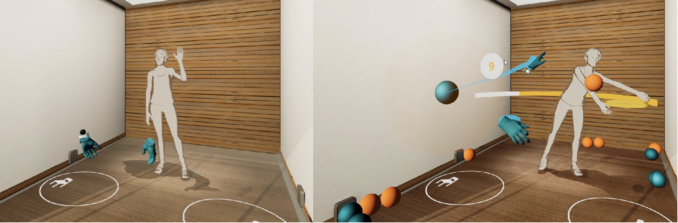
Design of the Virtual Trainer “Anna” This paper describes the results of the evaluation study on rapport and perce- ptions of senior users of the embodied virtual trainer “Anna” who supports physical training in an immersive virtual reality environment developed in the bewARe project. The bewARe training program is a non-drug hyperten- sion therapy for older patients with hypertension which exploits a range of AR/VR/MR technologies, wearable sensors and gamification techniques to deliver an immersive training experience. Based on the sensor data acquired during training, such as blood pressure and heart rate, the system adapts to the individual training needs of senior users. Anna is an animated 3D full-body female trainer silhouette (see Figure 1).
Figure 1: Design of the embodied virtual trainer “Anna” in virtual reality.
From the perspective of the uncanny valley theory, Anna has a higher level of human-likeness (female silhouette, voice and movements) and a lower
level of realism (low fidelity facial expression, body, hair and garment). The expressiveness of Anna is enhanced by the use of custom motion captured animations and professional voice acting. Abstracting the visual presentation communicates her role as the representation of the system and circumvents problems of a realistic depiction which would arise from technical limitations of today’s VR and 3D technologies. The abstracted visual design enables to leave out more detailed animations such as lip syncing, which allows to adjust and combine animations to communicate system’s feedback and the different exergames depending on the user’s fitness level and progression. The appli- cation of Anna in the set of exergames aims to enhance user engagement, possibly leading to a higher adherence. Anna supports the user in performing exercises such as endurance, strength, aerobics and coordination, following the training sequence displayed on the user interface. The virtual trainer Anna facilitates the participation of senior users in exergames by giving instructi- ons, modeling movements and providing feedback. Gamification elements are applied to support motivation and positive behavioral changes.
METHODS
The aim of this study was to evaluate to what extent senior users could establish rapport with the virtual trainer “Anna” and how they perceived different aspects of the multimodal virtual trainer design. The study included the evaluation of anthropomorphism, which may have effects on users’ emo- tional responses, perception of affinity and trustworthiness, as indicated by the uncanny valley theory.
The study was designed as an evaluation study on perceptions and inte- ractions of users with the virtual trainer “Anna” after a 6-week exergame training for senior patients with hypertension. Data was collected prospecti- vely. All participants gave their written consent prior to the study. The study was approved by the Ethics Committee of the Charité - Universitätsmedizin Berlin (EA4/010/21) and took place in the laboratory of the Charité’s Geria- trics Research Group. During the period of six weeks, participants had two training sessions each week. The first training session included five strength endurance exercises, the second session included four exergames focused on endurance and interaction with the trainer. Users were immersed in virtual exergames by wearing an HTC Vive Pro headset. Each session lasted approx. 30 minutes and had moderate intensity (40-60% of heart rate reserve). The evaluation took place after the 6-week exergame training.
To analyze the dyadic interaction with the trainer “Anna” the 15-item rapport scale by Gratch et al. (2007). A trait list with 9 items describing selected characteristics of the virtual trainer were included in the evalua- tion. The items 9 were derived from studies by Stein and Ohler (2017) and Cerekovic et al. (2017). All questions were answered on a Likert scale ranging from “0 = strongly disagreeable” to “8 = strongly agreeable”. In addition, the bipolar questionnaire by Ho and MacDorman (2017) with 40 adjectives was used to assess possible uncanny valley effects. Adjectives were rated on a 3-point importance scale (1. slightly important, 2. moderately
Evaluation of Rapport in Human-Agent Interactions with a VR Trainer 145
important, 3. very important). The analysis for the purpose of this paper was limited to descriptive statistics.
RESULTS
Participants Participants were recruited from the internal volunteer database of the Geria- trics Research Group of the Charité Berlin. The 23 participants were 65 years and older, had diagnosed hypertension, were independently mobile, had no risk of falling (Tinetti et al., 1986) and no cognitive impairments (Brandt et al., 1988). The mean age of the participants (n = 23) was 75.8 years (SD: 4.7; 60.9% female). The participants had a Tinetti score of 27.8 (SD: 0.5) and a TICS score of 36.2 (SD: 2.2). 43.5% reported university as their high- est education. 26.1% of participants already had some previous experience with virtual reality.
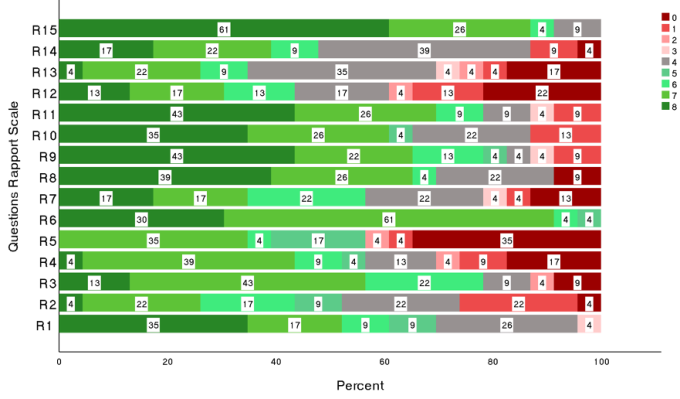
Rapport Scale The results of the rapport scale (see Figure 2) indicate that the design of the virtual trainer “Anna” was effective for establishing rapport especially in terms of building a relationship with the virtual trainer and enhancing the engagement of senior users to participate in the VR training. However, the design was less effective in creating a positive perception of the trainer as a warm, caring and respectful agent. The overall median of the rapport scale was 6 (Min:1, Max:8). The results of the rapport scale show the highest values with a median of 8 was reached in item 15 (“The interaction with Anna was frustrating”, recoded). The recoded value of 8 means that the interaction was not frustrating. A median of 7 were reached for items 1 (“The trainer Anna is friendly”), 3 (“The trainer engaged me in the workout”), 6 (“It was
Figure 2: Results of rapport scale in a diverging stacked bar chart in percentage (%) from the nine-point Likert scale.
important for me to imitate the movements of the trainer Anna as well as pos- sible”), 8 (“I had the feeling that the trainer Anna was not interested in me”, recoded), 9 (“The trainer Anna did not involved me in the training”, reco- ded), 10 (“I had the feeling that I had no connection to the trainer Anna”, recoded), 11(“I didn’t care if I was imitating the Anna’s movements well”, recoded). The lowest ratings with a median of 4 were researched for items 12 (“I could behave the way I wanted to behave”), 13 (“The trainer Anna was warm and caring”) and 14 (“The trainer Anna was respectful to me”).
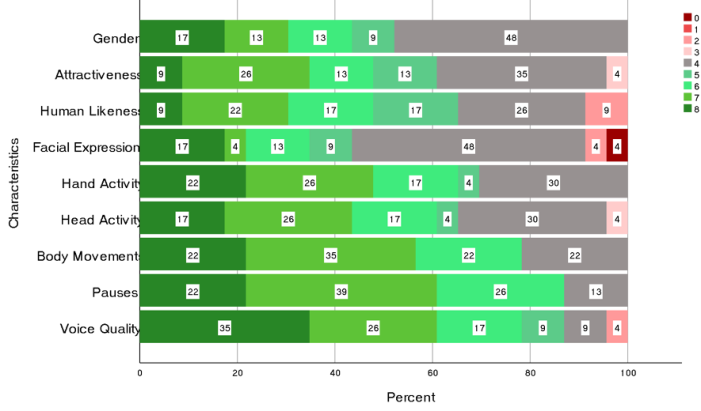
Trait List The trait list included 9 items to traits of the virtual trainer. The results of the evaluation (see Figure 3) of the trait list revealed that voice quality, speech pauses and bodily movements were rated highest with a median of 7, follo- wed by head and hand movements. The lowest values were researched for face expression with a median of 4 and the analysis of the qualitative data indicates that senior participants wished for a more expressive face of the virtual trainer.
Figure 3: Results of the trait list in a diverging stacked bar chart in percentage (%).
Uncanny Valley Indices The set of uncanny valley indices was used to assess a range of percepti- ons related to humanness, attractiveness and eeriness of the virtual trainer “Anna”. In the Uncanny Valley questionnaire, the median value for the humannes scale was 1 (Min: −3, Max:3), for the attractiveness 1 (Min:0, Max:3) and for the eeriness 0 (Min: −1, Max:0). Within the humanness index, the virtual trainer Anna was perceived as a living (Mdn: 1), human-like (Mdn: 1), but neutral regarding a definite lifespan (Mdn: 0). In summary, the
Evaluation of Rapport in Human-Agent Interactions with a VR Trainer 147
participants have seen “Anna”as slightly real (Mdn: 1) and were unsure whe- ther she was natural or artificial (Mdn: 0). Within the attractiveness index, Anna was perceived as sleek (Mdn: 2), agreeable (Mdn: 2) and attractive (Mdn: 1). Within the eeriness index, Anna was not perceived as predictable (Mdn: 0) and not eerie (Mdn: 0). The results indicate the virtual trainer Anna was not perceived as uncanny, freaky or weird by the senior participants of the study.
DISCUSSION AND FUTURE WORK The primary goal of this study was to evaluate the extent to which it was possible to establish rapport with the virtual trainer “Anna” in virtual reality exergames for senior users with hypertension. In summary, the results indi- cate that the design of the embodied virtual trainer in VR was effective in establishing rapport especially in relation to building a relationship with the trainer and enhancing the engagement of users. The results also show that the senior participants did not perceive the virtual agent as uncanny or weird, but rather as an attractive, human-like trainer with agreeable voice quality, spe- ech pauses and bodily movements. The study had some limitations including a small sample size and the lack of comparative variants of the virtual trainer in exergames tested with senior users, e. g. designed with different levels of human-likeness and realism. Despite these limitations, the evaluative results of the study lead to a hypothesis that the anthropomorphic but semi-abstract design of the virtual trainer “Anna” was effective for eliciting rapport with the virtual trainer, which seems to be plausible from the perspective of the uncanny valley theory. However, follow-up research in controlled laboratory settings would be needed to test the hypothesis related to the effects of diffe- rent levels of anthropomorphism and realism in the design of virtual agents on rapport building with users. Further studies should therefore have a more in-depth look into a relationship between the uncanny valley indices and the quality of rapport with virtual trainers. Studies should explore whether and how humannes index, attractiveness index and eeriness index are related to different aspects of rapport and whether the effects are different for diverse groups of users, e.g. older vs. younger users or users from different cultures.
ACKNOWLEDGMENT
This publication was produced as part of the bewARe project with the name. The bewARe project was a three-year (08/2018 - 12/2021) R&D project founded by the German Federal Ministry of Education and Research (BMBF). Project website: www.beware-projekt.de/en/index.html
REFERENCES
Bartneck, C., Kuli´c, D., Croft, E. and Zoghbi, S. (2009) Measurement Instruments for the Anthropomorphism, Animacy, Likeability, Perceived Intelligence, and Percei- ved Safety of Robots, International Journal of Social Robotics, Vol. 1 No. 1, pp. 71–81.
Brandt, J., Spencer, M. and Folstein, M. (1988) The Telephone Interview for Cognitive Status, Cognitive and Behavioral Neurology, Vol. 1 No. 2, pp. 111–117. Buisine, S., Abrilian, S. and Martin, J.-C. (2004) Evaluation of multimodal behaviour
of embodied agents, From Brows to Trust: Evaluating Embodied Conversational Agents, Kluwer Academic Publishers, USA, pp. 217–238. Cerekovic, A., Aran, O. and Gatica-Perez, D. (2017) “Rapport with Virtual Agents: What Do Human Social Cues and Personality Explain?”, IEEE Transactions on Affective Computing, presented at the IEEE Transactions on Affective Computing, Vol. 8 No. 3, pp. 382–395. Gratch, J., Okhmatovskaia, A., Lamothe, F., Marsella, S., Morales, M., van der
Werf, R.J. and Morency, L.-P. (2006) “Virtual Rapport”, in Gratch, J., Young, M., Aylett, R., Ballin, D. and Olivier, P. (Eds.), Intelligent Virtual Agents, Springer, Berlin, Heidelberg, pp. 14–27. Gratch, J., Wang, N., Gerten, J., Fast, E. and Duffy, R. (2007a) “Creating Rapport with Virtual Agents”, in Pelachaud, C., Martin, J.-C., André, E., Chollet, G., Karpouzis, K. and Pelé, D. (Eds.), Intelligent Virtual Agents, Springer, Berlin, Heidelberg, pp. 125–138. Gratch, J., Wang, N., Okhmatovskaia, A., Lamothe, F., Morales, M., van der Werf,
R.J. and Morency, L.-P. (2007b) “Can Virtual Humans Be More Engaging Than Real Ones?”, in Jacko, J.A. (Ed.), Human-Computer Interaction. HCI Intelligent Multimodal Interaction Environments, Springer, Berlin, Heidelberg, pp. 286–297. Guo, Y.R., Goh, D.H.-L., Muhamad, H.B.H., Ong, B.K. and Lei, Z. (2016) “Experimental Evaluation of Affective Embodied Agents in an Information Lite- racy Game”, Proceedings of the 16th ACM/IEEE-CS on Joint Conference on Digital Libraries, Association for Computing Machinery, New York, NY, USA, pp. 119–128. Ho, C.-C. and MacDorman, K.F. (2010) Revisiting the uncanny valley theory:
Developing and validating an alternative to the Godspeed indices, Computers in Human Behavior, Vol. 26 No. 6, pp. 1508–1518. Ho, C.-C. and MacDorman, K.F. (2017) Measuring the Uncanny Valley Effect, International Journal of Social Robotics, Vol. 9 No. 1, pp. 129–139. Huang, L., Morency, L.-P. and Gratch, J. (2011) “Virtual rapport 2.0”, Pro-
ceedings of the 10th International Conference on Intelligent Virtual Agents, Springer-Verlag, Berlin, Heidelberg, pp. 68–79. Kouris, I., Sarafidis, M., Androutsou, T. and Koutsouris, D. (2018) “HOLOBA- LANCE: An Augmented Reality virtual trainer solution forbalance training and fall prevention”, Annual International Conference of the IEEE Engineering in Medicine and Biology Society. IEEE Engineering in Medicine and Biology Society. Annual International Conference, Vol. 2018, pp. 4233–4236. Mori, M. (1970) Bukimi no tani [the uncanny valley], Energy, Vol. 7, pp. 33–35. Nijholt, A. (2002) “Embodied Agents: A New Impetus to Humor Research”, Pro-
ceedings of the Twentieth Twente Workshop on Language Technology, Trento, Italy. Nijland, N. (2011) Grounding eHealth: towards a holistic framework for sustainable eHealth technologies, available at:https://doi.org/10.3990/1.9789036531337. Park, T., Lee, U., Lee, B., Lee, H., Son, S., Song, S. and Song, J. (2013) “ExerSync:
facilitating interpersonal synchrony in social exergames”, Proceedings of the 2013 Conference on Computer Supported Cooperative Work, Association for Computing Machinery, New York, NY, USA, pp. 409–422.
Evaluation of Rapport in Human-Agent Interactions with a VR Trainer 149
Pelachaud, C. and Poggi, I. (2002) Subtleties of facial expressions in embodied agents, The Journal of Visualization and Computer Animation, Vol. 13 No. 5, pp. 301–312. Reidsma, D., Dehling, E., Welbergen, H. van, Zwiers, J. and Nijholt, A. (2011) “Lea-
ding and following with a virtual trainer”, Proceedings of the 4th International Workshop on Whole Body Interaction in Games and Entertainment, presented at the 4th International Workshop on Whole Body Interaction in Games and Entertainment, Lisbon, Portugal. Rickel, J. and Johnson, W.L. (2001) Task-oriented collaboration with embodied agents in virtual worlds, Embodied Conversational Agents, MIT Press, Cam- bridge, MA, USA, pp. 95–122. Ruijten, P.A.M. (2015) “On the perceived human-likeness of virtual health agents:
Towards a Generalized Measurement of Anthropomorphism”, Virtual Health Agents : IVA 2015 Workshop, 25 August 2015, Delft, The Netherlands, pp. 1–10. Ruttkay, Z., Dormann, C. and Noot, H. (2004) Embodied conversational agents on a common ground, From Brows to Trust: Evaluating Embodied Conversational Agents, Kluwer Academic Publishers, USA, pp. 27–66. Schneider, S. and Kummert, F. (2018) “Comparing the Effects of Social Robots and Virtual Agents on Exercising Motivation”, ICSR, available at:https://doi.org/10.1007/978-3-030-05204-1_44. Seymour, M., Yuan, L., Dennis, A. and Riemer, K. (2019) Crossing the Uncanny Valley? Understanding Affinity, Trustworthiness, and Preference for More Realistic Virtual Humans in Immersive Environments, available at:https://doi.org/10.24251/HICSS.2019.213. Shaw, L.A., Tourrel, R., Wunsche, B.C., Lutteroth, C., Marks, S. and Buckley, J.
(2016) “Design of a virtual trainer for exergaming”, Proceedings of the Austra- lasian Computer Science Week Multiconference, Association for Computing Machinery, New York, NY, USA, pp. 1–9. Stein, J.-P. and Ohler, P. (2017) Venturing into the uncanny valley of mind—The influence of mind attribution on the acceptance of human-like characters in a virtual reality setting, Cognition, Vol. 160, pp. 43–50. ter Stal, S., Kramer, L.L., Tabak, M., op den Akker, H. and Hermens, H. (2020)
Design Features of Embodied Conversational Agents in eHealth: a Literature Review, International Journal of Human-Computer Studies, Vol. 138, p. 102409. Tickle-Degnen, L. and Rosenthal, R. (1990) The Nature of Rapport and Its Nonverbal Correlates, Psychological Inquiry, Routledge, Vol. 1 No. 4, pp. 285–293. Tinetti, M.E., Williams, T.F. and Mayewski, R. (1986) Fall risk index for elderly pati-
ents based on number of chronic disabilities, The American Journal of Medicine, Vol. 80 No. 3, pp. 429–434. Traum, D. and Rickel, J. (2002) “Embodied agents for multi-party dialogue in immersive virtual worlds”, Proceedings of the First International Joint Conference on Autonomous Agents and Multiagent Systems: Part 2, Association for Computing Machinery, New York, NY, USA, pp. 766–773. van Wissen, A., Vinkers, C. and van Halteren, A. (2016) “Developing a Virtual Coach
for Chronic Patients: A User Study on the Impact of Similarity, Familiarity and Realism”, in Meschtscherjakov, A., De Ruyter, B., Fuchsberger, V., Murer, M. and Tscheligi, M. (Eds.), Persuasive Technology, Springer International Publishing, Cham, pp. 263–275. Wilson, K. and Brooks, K. (2013) “Virtual vs. Traditional Exercise Training in Previously Untrained Subjects”, International Journal of Exercise Science: Conference Abstract Submissions, Vol. 2 No. 5.
LISTED IN THE AHFE DIGITAL BOOKSTORE CATALOGUE
Explore the complete digital volume
Human Factors in Virtual Environments and Game Design
Read this individual research paper free through the original publisher, or explore the full digital proceedings book.
ISBN 978-1-958651-26-1
Explore this ISBN in the AHFE Bookstore ↗Listed in the July 2026 bookstore catalogue; search by ISBN to confirm current availability · Digital book purchase optional