Yulin Zhao (2024). Development of systematic measurement technology for girls’ breast size based on humanistic technology. In: Intelligent Human Systems Integration (IHSI 2024): Integrating People and Intelligent Systems. AHFE Open Access, vol. 119, pp. 186–192. https://doi.org/10.54941/ahfe1004482
The breasts of young girl have dynamic changes in different growth and development stages, and the adolescence is the most important. According to nearly half a century’s research, due to the imprecise measurement standards (easily displaced breast point, blurred breast boundary) and technical methods (simple upper and lower breast sizes, with no consideration for dynamically developed breast sizes), 80%-85% of girls don’t know how to choose suitable underwear. The purpose of this paper is to establish a systematic measurement method and technology of breast sizes based on the special physiological and psychological characteristics of adolescent girls.First of all, three research objectives were proposed based on a comprehensive examination of the related studies on clothing field and medical field. The first objective is to define the breast measurement benchmark that conforms to the rigorous ergonomics theory and establish a unified breast sizes measurement framework. The second objective is to develop a breast sizes measurement method suitable for dynamic growth data integrity and establish a systematic breast sizes measurement path. The third objective is to develop a breast sizes measurement technology that combines subjective comfort and objective accuracy and establish a measurement model that conforms to humanity technology.Second, a literature review was performed based on the above research objectives. For the first objective, this thesis are sorted out and analyzed mainly from the two aspects of measuring points and measuring coordinate system. For the second objective, this thesis focuses on the advantages and disadvantages of the current measurement of breast shape characteristics, volume and asymmetry. For the third objective, this thesis focuses on analyzing the advantages and disadvantages of mechanical, digital and high-tech measurement technologies. In addition, this thesis summarized key points that can be directly adopted should be improved, and need to be supplemented.In the third chapter, for the first objective, the features and parts of the anthropometric criteria that accord with ergonomics are sorted out, to get the most suitable breast sizes measurement point. Girls in different developmental stages are selected to carry out actual action experiments according to operational definitions, to verify whether the new breast sizes measurement points are available, the stability during the process, and the deviation in identification. Then, the smallest deviation is selected as the origin of constructing the new breast sizes measurement coordinate system. According to the experimental results, a new breast sizes measurement coordinate system is established. Meanwhile, the experiment verifies the accuracy of measurement and whether the measured error results are closer to the actual measured values than those measured in geodetic coordinate system.In the fourth chapter, for the second objective, based on the newly defined breast sizes measurement benchmarks, combined with the gaps of existing methods in literature research related to measurement methods, the breast shape characteristics of girls in different development stages are divided into three types: type A, type B and type C. The measurement parameters of each type and the logical relationship between the parameters are defined, the geometric shapes of each type are fitted with the parameters and their respective volume formulas are established. After verifying the accuracy of the proposed volume formulas, a new breast asymmetry evaluation model is established according to the breast volume and breast shape characteristics, and its feasibility is verified by actual measurement cases.In the fifth chapter, for the third objective, based on the innovative design thinking of mirror theory, considering the psychological characteristics of adolescent girls in development period, a new breast shape measurement model is constructed to develop a breast sizes measurement technology that conforms to humanity technology, and according to the value proposal of the new measurement model, a wearable breast shape measurement tool combined with the new breast shape measurement criteria is developed to obtain the breast shape characteristic data. Combined with the “Growth partner” measurement applet used by the new breast sizes measurement method, the acquired breast shape characteristic data are recorded, converted, and analyzed. Finally, the reliability, effectiveness and objectivity of the value proposal proposed by the measurement model are verified by experiments.
Breasts are an important body feature organ of women and the most impor- tant external markers of femininity. The starting point of female breast growth and development is puberty, the girl’s breast with the different stages of development also shows the flow of change. Adolescent women should wear appropriate bra products after the development of breasts, wearing a suitable and comfortable bra products for the development of young women’s breast comfort, health, cardiorespiratory activities, especially for their nor- mal development plays a very important role; the choice of an inappropriate bra, the light is caused by poor development, flared, sagging, affecting the
Development of Systematic Measurement Technology for Girls’ Breast Sizes 187
functionality of the adult and aesthetic, the heavy is the female mammary glands health buried hidden danger, and even increase the chance of breast disease.
By 2021, the world’s female population will total 3.943 billion, with China’s female population totaling 687 million. Up to 70% of teenage girls have a low level of satisfaction with their underwear comfort ratings; accord- ing to the Adolescent Physical and Mental Health Study, up to 80% of teenage bras sold on the market during the teenage developmental period are not up to standard; academics from the University of Portsmouth Research Center’s Breast Health Research Team surveyed 2,089 girls between the ages of 11 and 18 years of age, and of those, approximately 75% were unable to choose the right bra. This is a serious problem that has not been effectively addressed for a long time, which has led to this study’s focus on adolescent girls, and is the basis and source of this study.
LITERATURE REVIEW
Mechanical Measurement Techniques Mechanical measurement technology refers to the use of direct contact with the human body directly on the subject body surface size measurement, mainly using a soft ruler, Martin’s ruler and other measuring tools, each part of the human body can be measured directly in the horizontal and vertical dimensions. 1928 Berlei Underwear Co. of Australia for the first time to the upper chest circumference, chest circumference and the lower chest circumfer- ence as a difference between the size of the bra as a reference standard. Until now, there are still many scholars who use mechanical measurement tech- nology to carry out large-scale measurement and research on female breast data, and derive simple empirical formulas through statistical analysis based on the measurement results and formulate evaluation standards for the clas- sification of breast morphology accordingly, and the results of the research have been applied to guide the structural design of bras. This mechanical mea- surement technique is simple, easy to operate and popularize, so it is still in use today.
Mechanical Measurement Techniques Since the early 1990s, there has been a great development in body scanner hardware and software technology, and this study has been organized to find the main two-dimensional photo technology, three-dimensional scanning technology, and in vivo measurement technology.
The 2D photographic breast sizes measurement technique mainly includes three steps: measurement image acquisition, measurement image processing and measurement data extraction. First of all, through the camera to deter- mine the requirements of image acquisition and fix the human body mea- surement posture to obtain the subject’s two-dimensional shooting image; secondly, through the computer’s operations on the extracted contours of the human body image processing, such as grayscaled images, in the reduction of noise interference and detection of image edges can be extracted contours;
188 Zhao
and finally, through the mathematical modeling or through the programming of the human body to obtain the final characteristics of the parameters of the three-dimensional human body measurement. The technology can generate accurate and complete three-dimensional human body data, which can be broadly categorized into laser measurement, structured light measurement and stereophotogrammetry according to its measurement principle.
Advanced Measurement Techniques Due to the development of e-commerce, the global epidemic, the isolation policy has changed many of people’s habits, the network channel has become one of the fastest-growing emerging channels for underwear sales; coupled with the fact that more and more people are beginning to be enthusiastic about self-measurement and tracking records of various health data, a lot of new and high tech measurements came into being.
The Smart Mirror developed by Naked Labs is a non-contact represen- tation of high-tech measurement technology based on body scanning. It is equipped with three depth sensors to build a user’s unique 3D body model, a matching scale that rotates 360 degrees in 20 seconds, and the ability to wirelessly synchronize 3D body images to an app after they are generated. As information technology evolves, hardware-based solutions are gradually being overtaken by measurement technologies that are powered by artificial intelligence and are more affordable and convenient.
DEVELOPMENT AND VALIDATION OF NEW TECHNOLOGY FOR BREAST SIZES MEASUREMENT Design of a New Breast Sizes Measurement Tool Based on Humanistic Technology
Combining the design points of the valuable new chest shape measurement technology, namely reliability, validity and objectivity, we provide a new chest shape measurement technology and service model, which allows you to measure your own chest shape in the bedroom, bathroom and other home environments, which is convenient and quick to operate and at the same time avoids the embarrassment caused by other people’s assistance in the measure- ment, and the whole process maximizes the protection of the privacy of the young girls’ group and at the same time excludes the subjectivity caused by the human operation. The whole process maximizes the protection of the privacy of the girl group and eliminates the subjectivity brought by human operation, accumulating the data of chest shape at each stage of growth and development. The new breast shape measurement tool is wearable, with the breast shape measurement benchmark as the starting point and framework, and the acquisition of breast shape measurement parameters is based on the new measurement method proposed in this study, which is mainly to measure the breast circumference (lower chest circumference), length (vertical distance of the upper cup, arc distance of the lower cup), width (arc distance of the anterior cup, arc distance of the lateral cups), and the height value (breast height), so as to calculate the volume of the subsequent measured breasts,
Development of Systematic Measurement Technology for Girls’ Breast Sizes 189
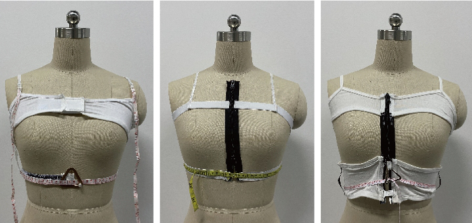
and to judge the asymmetry of their breasts. asymmetry of their breasts. The design of the new tool for breast shape measurement was updated in several iterations, prototyping, and actual wear measurements, as shown in Figure 1.
Figure 1: Iterative version of new chest measurement tool.
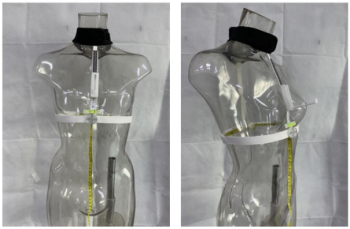
In this study, the optimal solution was chosen to be deepened, and the actual fabrication of sampling was done to test it, as shown in Fig. 2 and Fig. 3. The design program adopts wearable measurement, which is mainly divided into two parts: wearable adjustment and chest shape measurement. The wearing adjustment part includes neck cover, fixing belt, buckle, rear adjusting belt, side adjusting belt, left and right horizontal bubbles; the func- tion of the said neck cover and fixing belt is to stabilize and fix the new measuring tool to the user’s body, then use the buckle to fasten the left and right fixing belts together, and then adjust the position of the said rear adjust- ing belt and the said side adjusting belt according to the user’s own body shape and the degree of comfort in breathing; the function of the said left and right horizontal bubbles is to examine the degree of deviation when fas- tening the fixing belts, and then adjust the position of the said rear adjusting belt and the said side adjusting belts. Said left and right horizontal bubble function is to inspect the degree of offset when fastening the fixing straps to ensure the level of the y-axis direction of the new chest shape measurement coordinate system, and if there is a horizontal deviation adjust the position of the fixing straps to avoid measurement error; finally, ensure that said wearing adjustment part is comfortable and fit to complete the wearing.
Figure 2: Physical proofing.
190 Zhao
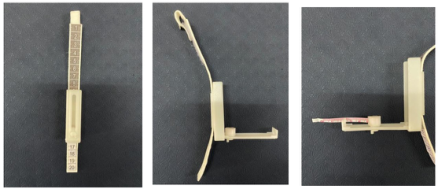
Figure 3: Height measuring device.
The vertical ruler is provided with an adjustable buckle to fix the vertical ruler on the neck cover and adjust the position of the vertical ruler to the origin of the new breast shape measurement coordinate system; the circum- ference scale is fixed on the inner side of the fixation strap to measure the size of the lower chest circumference; the height measurement device is provided with a slot on the back, which can be mounted on the vertical ruler and can be slid up and down flexibly, wherein the height measurement device contains a small measuring tape, a slide groove, and a scale for measuring the x-axis and y-axis data of the breasts in the new breast shape measurement coordi- nate system. Said upper and lower horizontal bubbles are also provided with card slots on the back, mounted on said vertical ruler to check the degree of left and right offset of the vertical ruler to ensure that the new chest shape measurement coordinate system axis direction of the vertical, if there is a ver- tical deviation to adjust the vertical ruler angular position in order to avoid measurement errors.
Measurement Program Development The version of WeChat Small Program development used this time is Sta- ble Build (1.03), a stable version of WeChat Developer Tools; WeChat Small Program is a new way for Tencent to connect users and services. It can be easily accessed and distributed in WeChat with a good user experience. WeChat small program mainly uses WXML (HTML5), WXSS (CSS) and JavaScript technology, the development process can be quickly accessed without downloading or installation of services, feature-rich, and provides a series of components and interfaces make the development effi- ciency. Compared with traditional APP, WeChat applets have the following advantages:
(1) Simple development. WeChat small program provides a simple and efficient application development framework and rich components and APIs to help developers develop services with local APP experience on WeChat. The development process is relatively simple and programmers have front-end development experience. It can be seamlessly and quickly launched.
(2) Convenient user experience. WeChat small programs do not need to be downloaded and installed, and they can be opened directly on WeChat by scanning and other means, and the small program will be automatically hidden after use, so the user experience will be better.
Development of Systematic Measurement Technology for Girls’ Breast Sizes 191
(3) Low technical maintenance costs. WeChat small program is based on the WeChat platform. Therefore, WeChat officially supports its maintenance, with lower costs, shorter cycles and simpler processes.
Core Functional Architecture In order to record data on the characteristics of the measured breast shape and to convert the data into a more intuitive and efficient way of obtain- ing breast volume and asymmetry categories, we developed “Growth partner Measurement Assistant”, a WeChat app for cell phones that carries a breast measurement tool, as a vehicle for recording, converting, and analyzing the data. The goal of “Growth partner Measurement Assistant” is not only to enable consumers to quickly record the value of their breast shape and to know the size of their breast volume and the category of asymmetry, but also to ensure privacy during the period of female development when breasts need to be measured frequently, regardless of the time, place and person; any mobile application can be used to record and analyze the data is related to the content and organization on which it is based, so based on the construction of the model for breast measurement, the information framework information of the applet will be refined and classified. Information architecture is the process of organizing and deciding what to include or omit from an appli- cation, and users can easily find what they are searching for through clear navigation choices.
CONCLUSION
This study takes into account the special physiological changes and psycho- logical needs of young girls during their developmental stage, and develops a new technique of breast shape measurement based on human characteristics, which mainly includes a wearable measurement tool and a small program sys- tem. The wearable measurement tool is a self-help measurement tool, which can be worn and measured independently by the young girls during their developmental stage in a private space, which greatly protects their privacy psychologically. The tool captures the dimensions of the characteristic param- eters of the breast shape in all dimensions of the coordinate system; to ensure the accuracy of the self-measurement, a standard operating procedure is pro- vided; and to quickly record, convert, and analyze the captured data, the study uses a WeChat applet to develop a system that can be used with the new breast shape measurement tool to calculate the volume of the breasts to compute and analyze the asymmetry of the breasts. The development of measurement technology provides a personal health data recording and ana- lyzing system that integrates human science and technology in the context of great health. With the development of electronic information technology, digital measurement technology will be developed in the coming research to improve the efficiency of measurement and to anticipate the physiologi- cal changes of women (adolescent development, menstrual cycle, infant milk swelling, menopause, etc.).
192 Zhao
REFERENCES
Archibald, A. B.; Graber, J. A; Brooks-Gunn, J. Pubertal processes and physiological growth in adolescence. Blackwell handbook of adolescence 2003, 01, 24–47. Brown, N.; Smith, J.; Brasher, A. Breast education for schoolgirls; why, what, when,
and how? The Breast Journal 2018, 24, 377–382. Deal, A. The Bra book: The fashion formula to finding the perfect bra; Texas: Benbella Books, 2009: 15–17. Farkas, L. G.; Katic, M. J.; Forrest, C. R. International anthropometric study of facial
morphology in various ethnic groups/races. Journal of Craniofacial Surgery 2005, 16, 615–646. Gao, Y.; Saksena, M. A.; Brachtel, E. F. How to approach breast lesions in children and adolescents. European Journal of Radiology 2015, 84, 1350–1364. Kinanthropometry. https://www.isak.global/WhatIsIsak/#GoToKina 2021-07-16. Kouchi, M. Anthropometric methods for apparel design: Body measurement devices
and techniques. Anthropometry, apparel sizing and design. Sawston: Woodhead Publishing, 2014: 67–94. Li, X. Experts explain the doubts in breast development of young girls, Research on Children and Youth 2002, 5, 17–18. Liang, W. H; Fang, F; Zhao, R. X. Analysis of bra perception and its causative factors
among female college students in Southwest China, Journal of Textile Research 2013, 34, 117–121. Olds, T.; Honey, F. The use of 3D whole-body scanners in anthropometry. Proceedings of the 9th International Conference of the International Society for the Advancement of Kinanthropometry. Taylor & Francis 2006, 1–12. Omrani, A.; Wakefield-Scurr, J.; Smith, J. Breast education improves adolescent girls’
breast knowledge, attitudes to breasts and engagement with positive breast habits. Frontiers in Public Health 2020, 8, 677–692. Zheng, R.; Yu, W.; Fan, J. Development of a new Chinese bra sizing system based on breast anthropometric measurements. International Journal of Industrial Ergonomics 2007, 37, 697–705.
LISTED IN THE AHFE DIGITAL BOOKSTORE CATALOGUE
Explore the complete digital volume
Intelligent Human Systems Integration (IHSI 2024): Integrating People and Intelligent Systems
Read this individual research paper free through the original publisher, or explore the full digital proceedings book.
ISBN 978-1-958651-95-7
Explore this ISBN in the AHFE Bookstore ↗Listed in the July 2026 bookstore catalogue; search by ISBN to confirm current availability · Digital book purchase optional