Kimberly Mitchell, Xiaopeng Zhao, Robert Bray, Luke Macdougall, Ella Hosse, Matt Rightsell (2023). Co-Designing a Friendly Robot to Ease Dementia. In: The Human Side of Service Engineering. AHFE Open Access, vol. 108, pp. 383–392. https://doi.org/10.54941/ahfe1003141
Currently the majority of care provided to a person living with Alzheimer’s disease or related dementia (ADRD) is from a family caregiver. There are approximately 55 million older adults in the world living with AD [1]. By 2030, there is estimated to be 8.4 million Americans living with Alzheimer’s [2]. Due to impaired memory and cognitive function, persons with ADRD often face pressing challenges such as loneliness, social isolation, anxiety, depression, and stress, which in turn accelerate cognitive and functional decline, increase premature mortality, and significantly reduce quality of life in these persons [3-6]. Our project aims to develop a scalable, personalized, accessible tool, named friendly robot to ease dementia (FRED), to engage with persons with ADRD and alleviate their challenges. Using state-of-the-art artificial intelligence (AI) and robotics techniques, FRED will assist with cognitive enrichment and physical activity to improve activities of daily living and quality of life for persons with ADRD and their care partners.By incorporating human centered design methods, our research engages the caregiving and Alzheimer and dementia community in the design of a non-drug intervention. Our paper will share results from our participatory focus group, which included people with ADRD and their caregivers (n12), in the assistance of the design and interactions of FRED.A thinking-aloud protocol was adopted once we had a prototype of FRED to share, where users were able to express freely any problems and/or concerns during interaction. Insights from the thinking-aloud results were used to improve the user interface design to enable the users and robot to interact and collaborate in an effective, natural way. Additional focus groups with our improved design are forthcoming.From our first stakeholder focus group, we have identified that ADRD patients need structure, organization, and routine. Initial reactions of the social robot were positive and supportive. Feedback from the focus group was carefully documented and the results will be shared in our paper.[1] World Health Organization, Dementia, 09/20/2022, Available from https://www.who.int/news-room/fact-sheets/detail/dementia [2] J. Resendez, S. Monroe, A Vision for Equity in Alzheimer’s Research in 2020, UsAgainstAlzheimer’s; [02/20/2022], Available from https://www.usagainstalzheimers.org/blog/vision-equity-alzheimers-research2020. [3] E.B. Larson, C. Stroud, Meeting the Challenge of Caring for Person’s Living with Dementia and their Care Partners and Caregivers: A Way Forward, Washington, DC: The National Academies Press, 2021. [4] P.N. Bennett, W. Wang, M. Moore, C.Nagle, Care Partner: A Concept Analysis, Nursing Outlook, Vol. 65, No. 2, pp. 184-194, 2017 [5] National Institute on Aging. Basics of Alzheimer’s Disease and Dementia, Available from https://www.nia.nih.gov/health/what-is-dementia [6] A. Atri, The Alzheimer’s Disease Clinical Spectrum: Diagnosis and Management. Medical Clinics, Vol. 103, No 2, pp. 263-293, 2019
The number of people living with dementia is increasing across the world, with 10 million new cases of dementia being reported every year (Alzheimer’s Association, 2022). There are about 6.5 million people that live with Alzheimer’s Disease (AD) or related dementias (ADRD) in the United States who are age 65 and older (IBID). This number of people is predicted to grow to 7.1 million by the year 2025 and 12.7 million by 2050, which
will greatly increase the need for growth in care (IBID). The dramatically increasing numbers of Alzheimer’s and dementia diagnoses worldwide com- bined with our rapidly aging population and other age-related declines in health, will soon be putting us in a caregiving crisis. By 2034, there will be more older adults aged 65 years and older than there will be under 18 (Global Coalition on Aging, 2021). It is estimated that by 2040, the caregiver workforce in the US needs to increase by 235% to meet demand (IBID). A large amount of caregiving for people with Alzheimer’s and demen- tia is being provided from unpaid family caregivers. In 2021, family members and friends provided more than 271 billion dollars of unpaid care to peo- ple living with Alzheimer’s and other dementias (Alzheimer’s Association, 2022). The uptick of predicted diagnoses and the future state of caregiving is going to put our workforce in a crisis. It is clear that new solutions are necessary to meet this growing need and address the problems with caregiving.
One solution that has increasing support and research is the development of socially assistive robots (SARs) that are specialized for people living with ADRD. These robots are supported by newly developed artificial intelligence (AI) that is designed to help caregivers deliver care to their patients, replace caregivers in certain tasks, and increase the quality of life and mental health of people living with dementia (PLWDs) and their caregivers. It has been shown that SARs with human-like qualities, like Pepper and NAO, can serve as effective tools for providing therapy to PLWDs for their communication and motor skills, language, and cognitive abilities (Pu et al., 2019). There have also been robotic animals, like PARO and AIBO, who have been shown to have positive impacts on the mental wellbeing of PLWDs, such as reduced stress and loneliness (Miller, 2017). These solutions are well-known for their costly price tags, however, with some like the NAO robot costing as much as $10,000. This price can be extremely prohibitive, especially for families that are already paying for a professional caregiver for their loved ones.
The Friendly Robot to Ease Dementia (FRED) is designed to fulfill the role of an aid to PLWDs and caregivers at an affordable price. The hope is to create an effective SAR for under $300 that PLWDs can use every day to give them company and entertainment, and caregivers can create helpful reminders for medication and events and keep the PLWD in touch with their loved ones. FRED is a fully 3D printed robot based on affordable computa- tion. In previous work, a usability study was performed with two versions of FRED, both based on an Android phone and an Arduino (Bray et al., 2022). From the user interaction results, it was clear that the system needed to be more robust and refined, which was the goal of the prototype for our focus group.
PROTOTYPE DEVELOPMENT For our initial focus group study, one prototype of FRED was developed to assess user interaction, and two different versions of the user interface were developed in order to assess user opinions on the design choices made for each.
Co-Designing a Friendly Robot to Ease Dementia 385
Body Design Previous research has been performed on the appearance preferences of SARs among health care workers and others involved in the industry. In Bradwell et al., 223 professionals in the healthcare field were shown live demonstra- tions of four different social robots, which were PARO, Miro, Pepper, and Padbot. The study found that many preferred a more humanoid appearance that was friendlier and “softer.” They also preferred for the robot to have an “androgynous appearance.” These results help to guide the design of the FRED body, but this study also seeks to further verify these results.
In previous work, two body versions were developed and compared in the usability study with college age students (Bray et al., 2022). In this work, it was found that 53.3% of participants preferred the appearance of Version 2, so this version was chosen as inspiration for the new prototype and improved upon for this focus group. The appearance is very similar but is larger in size in order to accommodate a larger screen. The body design concept and finished prototype can be seen in Figure 1.
Robot Operating System Previously, the FRED robot operated on an Android phone connected to an Arduino which controlled either the servo or LED face (IBID). These two devices were connected by bluetooth in order to communicate with each other. Although this was affordable, it was clear that it was possible to cre- ate FRED based solely on a Raspberry Pi, since the Pi would be able to perform both roles that the phone and Arduino fulfilled with its operating system and its ability to control GPIO devices, like the servo or the LED face. Additionally, the previous Android platform was difficult to develop on for FRED specifically, and required much more code to maintain the connection between the two devices than it was worth. Therefore, the new prototype developed for this focus group is operating solely on a Raspberry Pi. The Pi operates both the operating system and the LED face through its GPIO pins. The software developed for FRED is Python-based, and the user interface
Figure 1: Body design concept and finished prototype. The prototype features a wider body to accommodate the larger screen, and a more relaxed face visor to make the appearance more friendly.
(UI) is created using the Kivy and KivyMD libraries. Google speech-to-text and text-to-speech are utilized to facilitate conversation, and conversatio- nal responses to user speech is generated using the OpenAI API available in Python. The OpenAI model used is a GPT-3 model called “text-davinci-002.”
Robot Functions For people with ADRD, there are certain tasks that have been identified as important for a SAR to be able to perform. In a study performed by Yuan et al., a survey was given to the general public, including people with ADRD, mild cognitive impairment (MCI), and caregivers, which focused on the acceptance of SARs for caregiving. There were many functions identified, however, the top three reported were emergency calls, calling medical pro- fessionals, and reminders for taking medication. Another study performed by Shin et al., supports these findings, in which those who were interviewed reported that they wanted to be able to set reminders and call for emergency help while using a telepresence robot. Lastly, caregivers have suggested that a SAR can be used for recreational activities, like playing music, for people with ADRD in a study performed by Zushnegg et al.
In the previous usability study for FRED, some basic prototypes for robot functions were developed in order to assess the capabilities of the robot and its acceptance among participants (Bray et al., 2022). For our focus group, three functions were developed to showcase the capabilities of FRED in more depth, with more complex interactions. These three functions were:
1. creating a contact, 2. performing a check-in with FRED on the user’s mood, 3. playing a story game in which the user described an image to FRED, and FRED then asked them questions about it.
These functions are much more detailed in order to truly assess the ability of older adults and people with ADRD to interact with FRED and determine the problems with the current design. Creating a contact is an important step in making emergency calls, as the person with ADRD needs to be able to quickly tell FRED who to call. The story game is aimed at being an interactive recreational activity that will give the user cognitive stimulation. Lastly, the check-in will enable caregivers to keep track of the person with ADRD over a longer period of time. In the future, the caregiver will be able to see graphs and statistics that show the trend of the person’s mood in order to better plan intervention to make sure the person has a higher quality of life.
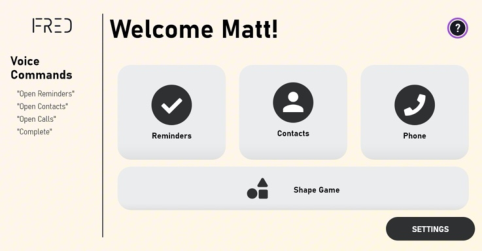
User Interface Design Two different interface designs were created to be shown to participants, as seen in Figure 2. Both designs feature large, simple buttons that will be easy to press. This is important for people with tremors and struggle with motor function, or those with age related vision changes. They also both feature a help button that is available to guide them through the current screen.
Co-Designing a Friendly Robot to Ease Dementia 387
Figure 2: Home screens of design 1 and 2.
METHODOLOGY
The study protocol outlined here was approved by the Institutional Review Board (IRB) of the University of Tennessee, Knoxville. The IRB number is UTK IRB-22-06870-XP. This study involved conducting a focus group with the target population of the FRED robot, including people with dementia and their caregivers, healthy older adults, nursing staff, and neurologists. Participants were recruited through physical flyers distributed by associated organizations or through emails. Participants were screened for eligibility for the study by conducting interviews via Zoom or phone. In order to determine their eligibility, participants were asked whether they had a legally authori- zed representative that signed documents for them. If so, they were asked if they could invite this person to the consent interview in order to have them review the consent process together with them. During the consent interview, the participant was briefed on the study procedure, determine their eligibility and review the consent forms approved by the IRB. In order to determine their ability to consent, the Decision-Making Capacity Assessment Tool (DMCAT) was administered to the participant. If they were unable to complete this test, the participant was asked if they have a legally authorized representa- tive that can consent on their behalf. If not, the participant was thanked for their time and was not included in the study. No data was collected on any representative of the potential participant during this consent interview.
At the beginning of the focus group, each participant signed a new consent form and completed a preliminary survey that asked demographic questions, as well as their thoughts and feelings about dementia care if they were a
Table 1. Results for question 9 of preliminary survey: The person I am caring for currently receives/hasreceived the following types of services/care provided by health, community, and/or social services organizations. Select all that apply.
Table available in the original PDF paper.
Service received Number of Responses
Percent of Responses
2 33.33%
Not applicable; no formal services need 0 0.00% Grooming (e.g. hair washing, brushing teeth) 2 33.33% Personal care (e.g. bathing, dressing, transfers to/from bed)
2 33.33%
Giving medicines or cues/reminders to take medicines 4 66.67% Health/nursing/medical procedures (e.g. diabetic injections or wound care)
3 50.00%
Social/companionship support 5 83.33% Support that enables you or other family members/friends to take a break
2 33.33%
Emotional support (e.g. reassurance or encouragement) 5 83.33% Preventing or addressing a behavior (e.g. wandering or confusion) Meal preparation 4 66.67% Household tasks (e.g. cleaning. Laundry) 3 50.00% Financial tasks (e.g. help with bills, banking, insurance) 2 33.33% Shopping or errands 3 50.00% Transportation 3 50.00% Going to medical appointments 4 66.67%
caretaker for a person living with ADRD. If the participant consented to the study, they were assigned name tags with “PX” written on them, where X is an identifying number to know how their answers relate to the demographic survey taken, however, there was no record taken of matching names to par- ticipant identifiers at any point during the study. Afterwards, the question and answer session was conducted, where they were asked questions that relate to dementia care and living with dementia (see Table 1). After the ses- sion, there was a lunch break in which no notes were taken. Finally, after the break, participants were divided into three groups: two groups that viewed the two different interface designs on tablets and one group that interacted with the FRED robot itself. During both sessions, notes were taken by several researchers on their answers to questions and feedback on the interfaces and robot.
RESULTS
Twelve participants took part in the focus group. Among them, eight parti- cipants were ages 65 years and older, and four were ages 46–64 years old. Seven participants were people living with dementia and four were caregi- vers. Two participants identified themselves as being the child of the person they cared for, and three identified as the spouse of the person with demen- tia. Four of the caregivers in attendance had been caring for someone with
Co-Designing a Friendly Robot to Ease Dementia 389
dementia for more than 5 years and one person had been caring for betw- een 1–5 years. When asked “Do you have access to tools and resources to help you plan and/or access care for the person?”, only one person identi- fied that they do not have access to proper tools to support the person that they cared for. Resources identified by the participants include local Alzh- eimer’s communities, local government support, private care facilities, and family members. Tools identified by the participants include Google calendar, written reminders, Google home, timers, pill boxes, etc. Many participants stated that one of the most life-changing and positive aspects about the dis- ease is the community and support that they have experienced since their diagnosis.
Table 1 shows the results from Question 9 in the survey, which asked care- givers to identify the services that the person living with ADRD is currently receiving or has received. It can be seen that the services that received the most responses are social in nature, for example, many identified that their person with ADRD received “social/companionship support” or “emotional support” at 83.33% each. These needs are addressable by FRED, but there are also needs that are not addressable by FRED, such as transportation or household tasks. A final qualitative observation can be made from survey question 16 “What is the biggest barrier as a family caregiver?” Three out of five responses were related to time. This is one aspect of caregiving that FRED is being designed to address is time-saving features, like direct contact or reminders that are easy to make.
During the question and answer session, participants identified some important needs for the user interface (UI) design. One important aspect that was agreed upon by all was the fact that the interface design needs to stay the same once a person with ADRD begins using it. Participants did not like the idea that the UI could be updated at a later point, and applicati- ons or activities would be arranged differently from how they were before. Another important aspect of the disease that was repeated among partici- pants is the need for routine. Additionally, they identified that they want the ability to personalize the layout and available features within the app to their individual needs. Lastly, when asked if machine learn- ing or artificial intelligence would be unsettling if implemented in FRED, many participants were open to the idea as long as they had assurance that their data remained private.
During the interactive session, participants identified a few aspects of the current design that they do not prefer. First, participants did not like the face LED’s, with multiple participants stating that it would give them a migraine, and that it would be too distracting. One participant stated that a new expe- rience from the disease is that they are very easily distracted, and that this constant LED movement would be too much to handle. Also, participants said that the contacts on the contact page were too small for them. Lastly, participants did not like the idea of having multiple levels of interface pages, meaning that if they have to navigate through an intermediary screen to get to the next activity, this would be confusing for them to navigate, especially when they would need to navigate backwards. They would prefer to have one central screen that they always return to, such as the home screen. They
also identified parts of the current design that they liked. Participants were excited by the interactive conversation of FRED, and said that they would like to have even more of that. They also thought that the check-in page was helpful for caregivers.
CONCLUSION
The preliminary survey results show that every participant who was a care- giver is also closely related to the person that they are caregiving for, whether they are their spouse or the child of the person with ADRD. It is also appa- rent that much of the support or kinds of services that participants receive are social or emotional in nature, the problems of which are addressable by a SAR like FRED. Finally, it showed that one of the biggest barriers to care- giving identified by caregiving participants is time. It is clear that some of the features of FRED need to save time in some aspect in order to be a better solution for caregivers specifically.
The question-and-answer session elucidated important aspects to the design of FRED, especially for the UI. Many participants identified the impor- tant of routine for people with ADRD, stating that the UI should never change once they are introduced to it, and that they need the locations of activities or settings to stay the same. Also, participants were open to the idea of the use of artificial intelligence or machine learning in order to enhance their experience while using FRED as long as their data remained private. It is important to know this when adding features like facial recognition, which has the benefit of keeping their local information private to them, but could be unsettling for some.
The interactive session highlighted crucial aspects of the FRED design that needed to change in order to better serve people with ADRD. For example, the LEDs were disliked across the board by participants, both caregivers and people with ADRD. This needs to be changed in order to make the experience of interacting with FRED pleasant for everyone. In the future, the face design will be static colors, or slow-moving eyes that still convey FRED’s mood or talking/listening status. Overall, it seemed that participants wanted the UI designs to be even more simplified, and to make everything easier to read and touch, which entails making the text and buttons much larger. One last observation is that many participants wanted a larger screen. Although this might be strictly possible, the “7” screen will stay the same size for future work due to increased cost and power concerns, rather the UI elements and text will increase and size and be rearranged in order to take more advantage of the available screen real estate.
Our team has spent the last month and a half revising the user interface and capabilities of FRED after our initial focus group findings. Additional focus groups are forthcoming, and each focus group will have very spe- cific goals assigned. In the future, we will look specifically and in more detail at our redesigned user interface designs and complete AB testing with our current robot body design compared to a new design with facial features.
Co-Designing a Friendly Robot to Ease Dementia 391
ACKNOWLEDGMENT
The authors would like to acknowledge our first focus group members, for their time and expertise, as well as Alzheimer’s Tennessee for hosting our focus group.
REFERENCES
Alzheimer’s Association. 2022. 2022 Alzheimer’s disease facts and figures. Alzheimers Dementia 18, 4 (2022), 700–789. https://doi.org/10.1002/alz.12638. Global Coalition on Aging, Building the caregiving workforce our aging world needs (2021), https://globalcoalitiononaging.com/wpcontent/uploads/ 2021/06/GCOA_HI_Building-the-Caregiving-Workforce-Our-Aging-World- Needs_REPORT-FINAL_July-2021.pdf. Fengpei Yuan, Joel G. Anderson, Tami H. Wyatt, Ruth Palan Lopez, Monica Crane,
Austin Montgomery, and Xiaopeng Zhao. 2022. Assessing the acceptability of a humanoid robot for Alzheimer’s disease and related dementia care using an online survey. (2022). Fengpei Yuan, Elizabeth Klavon, Ziming Liu, Ruth Palan Lopez, and Xiaopeng Zhao. 2021. A systematic review of robotic rehabilitation for cognitive training. Frontiers in Robotics and AI 8 (2021), 105. Hannah Louise Bradwell, Gabriel E. Aguiar Noury, Katie Jane Edwards, Rhona
Winnington, Serge Thill, and Ray B. Jones. 2021. Design recommendations for socially assistive robots for health and social care based on a large scale analysis of stakeholder positions: Social robot design recommendations. Health Policy and Technology 10, 3 (2021), 100544. https://doi.org/10.1016/j.hlpt.2021.100544. Julia Zuschnegg, Lucas Paletta, Maria Fellner, Josef Steiner, Sandra Pansy- Resch, Anna Jos, Marisa Koini, Dimitrios Prodromou, Ruud JG Halfens, Christa Lohr- mann. 2022. Humanoid socially assistive robots in dementia care: A qualitative study about expectations of caregivers and dementia trainers. Aging & men- tal health 26, 6 (2022), 1270–1280. https://doi.org/10.1080/13607863.2021. 1913476. Justyna Gerłowska, Marzena Furtak-Niczyporuk, and Konrad Rejdak. 2020. Robo-
tic assistance for people with dementia: A viable option for the future? Expert Review of Medical Devices 17, 6 (2020), 507–518. a systematic review on effects and quality of reporting. Journal of Alzheimer’s Disease 79, 2 (2021), 773–792. https://doi.org/10.3233/JAD-200347. Liesi Hebert, Jennifer Weuve, Paul A. Scherr, Denis A. Evans. 2013. Alzheimer disease in the United States (2010–2050) estimated using the 2010 census. Neurology 80.19 (2013): 1778–1783. https://doi.org/10.1212/0b013e31828726f5. Lihui Pu, Wendy Moyle, Cindy Jones, and Michael Todorovic. 2019. The effecti-
veness of social robots for older adults: a systematic review and meta- analysis of randomized controlled studies. The Gerontologist 59, 1 (2019), e37–e51. https://doi.org/10.1093/geront/gny046. Mark Miller. 2017. The future of U. S. caregiving: High demand, Scarce workers.
Reuters (Aug 2017). https://www.reuters.com/article/us-column-miller-caregiver s/the-future-of-u-s-caregiving-high-demand-scarce-workers- idUSKBN1AJ1JQ. Marlena H Shin, Jaye McLaren, Alvin Ramsey, Jennifer L Sullivan, and Lauren Moo.
2022. Improving a mobile telepresence robot for people with Alzheimer disease and related dementias: semistructured interviews With stakeholders. JMIR Aging 5, 2 (2022). https://doi.org/10.2196/32322.
Richard Sather, Mahsa Soufineyestani, Arshia Khan, and Nabiha Imtiaz. 2021. Use of humanoid robot in dementia care: a literature review. Journal of Aging Science 9 (2021), 249. Robert Bray, Luke MacDougall, Cody Blankenship, Kimberly Mitchell, Fengpei
Yuan, and Xiaopeng Zhao. 2022. Development and Assessment of a Fri- endly Robot to Ease Dementia. In International Conference on Social Robotics. Springer. Su-Jeong Hong, Eyohan Ko, Malrye Choi, Nam-Ju Sung, and Myeong-Il Han. 2022.
Depression, anxiety and associated factors in family caregivers of people with dementia. Journal of Korean Neuropsychiatric Association 61, 3 (2022), 162. ht tps://doi.org/10.4306/jknpa.2022.61.3.162.
LISTED IN THE AHFE DIGITAL BOOKSTORE CATALOGUE
Explore the complete digital volume
The Human Side of Service Engineering
Read this individual research paper free through the original publisher, or explore the full digital proceedings book.
ISBN 978-1-958651-84-1
Explore this ISBN in the AHFE Bookstore ↗Listed in the July 2026 bookstore catalogue; search by ISBN to confirm current availability · Digital book purchase optional