Pierpaolo Testa (2023). Digital Transformation, Servitization and Governmentality. In: The Human Side of Service Engineering. AHFE Open Access, vol. 108, pp. 102–113. https://doi.org/10.54941/ahfe1003111
There is no doubt that the digital transformation is assuming some characteristic features: progressive digitization of the economy, increased relevance of digital platforms, progressive digitization of business models, disintermediation due to e-commerce, servitization of the value proposition and/or operating model, digital re-invention, spread of technoculture in consumer contexts, managerial automation due to algorithms and AI adoption, increased consumers’ brand experience, social engagement, big data analysis centrality, symbiotic value creation expectations at societal level.However, now very little is investigated the effect on governmentality (or the art of government) of these transformations. What role should the public system and actors play? In a first preliminary analysis it seems that this role could be confined but not limited to: 1. promoting a growing adoption of these transformations from all the economic system’s key players (firms, retailers, suppliers, technology vendors, Universities, research centers, consumers). 2. fostering networking for DT3. Financially supporting DT and disciplining it4. Protecting the SME promoting DT processes at an aggregate level (districts, supply chains, clusters, Regional Innovation Systems). 5. Digital transformation of public administration itself, permitting the same to evolve towards a systemic view of governmentality 6. Adoption of a digital service culture.The general aim of this article is to assess the main directions along which the digital transformation is affecting global economy, mainly under a twofold perspective. 1.A firm’s and managerial perspective, discussing the most relevant managerial topic emerging with the digital transformation and above listed. 2.A governmentality perspective, studying some calls launched by some of the most relevant European Countries (Italy, Germany, England, France) to investigate the main objectives and scopes of digital transformation under a public management eye. Primary and secondary sources of information will be integrated for achieve such a research purpose. The information borrowed from institutional calls will be integrated by media interpretations of the phenomenon under analysis. Reports on the digital transformation by leading consulting firms operating in the countries will be also analyzed.The contribution is conceptual and interpretive in nature.
The topic of digital transformation (DT) has long been a fundamental topic of scientific research during the last decade. But not only the scientific com- munity has paid so much attention to this topic. Governments have been concentrating huge resources on this goal for some time because they know that the future strategic superiority of their economies depends precisely on the adoption of digital technologies by firms, organization, and public insti- tutions. For some time, even the main consultancy firms in the world have paid attention to the issue by creating interpretative models that have the merit of being able to guide firms adopting digital technologies and evalu- ating the level of its adoption. The digital transformation argument could represent for management consulting firms what the theme of the manage- ment of diversified companies represented in the 90s. In those years, the big five provided the academy with the main decision-making and interpretative models, which management students currently study in classrooms. There is currently a lack in the literature on the topic of research that is able to trian- gulate three different study perspectives: scientific, practitioners’, and which also embraces the point of view of the public actor who intends to maxi- mize the return on investment in new interactive and connective technologies (ICTs) by the firms.
RESEARCH DESIGN AND METHODOLOGY The general aim of this article is to assess the main directions along which the digital transformation is affecting global economy, mainly under three
Digital Transformation, Servitization and Governmentality 103
different perspectives. A. A scientific perspective, discussing the most rele- vant managerial topics emerging with the digital transformation. B. A practitioners perspective analysing how some leading consulting firms are approaching digital transformation and reinvention. C. A governmentality perspective, analysing the main performances of Digital Transformation in Economy and Society (based on DESI index) of some leading relevant Euro- pean Countries (France, Germany, Italy, Spain, Sweden) to investigate the argument under a public management eye (European Commission). Primary and secondary sources of information have been integrated for achieve such a research purpose. The information borrowed from institutional sources have been integrated by media interpretations of the phenomenon under analysis. Reports on the digital transformation by leading consulting firms opera- ting in the countries have been also analysed. Therefore, the contribution is conceptual and interpretive in nature.
DIGITAL (BUSINESS) TRANSFORMATION OPPORTUNITIES: A PROPOSAL OF A HOLISTIC MODEL Consulting best practice has developed several models to interpret, design and adopt a digital transformation by the firm. McKinsey talks of digital rei- nvention (2017) as the attitude of a firm to act on four levers’ progressive process: a. discover: identify new insights in order to shape digital ambition, strategy and business case; b. design: reinvent and prototype new capabili- ties and a breakthrough journey as part of the program; c. deliver: activate an ecosystem to rapidly deliver at scale ; d. de-risk: structure a change pro- gram, resources and commercial model to reduce operational and financial risks. Under Capgemini (2011) perspective digital transformation permits the firm to exploit internal and external opportunities. External opportu- nities on customer side for both the use by the firm of tracking or analytical tools to analyze customer behavior patterns and generate insights and/or to adopt new Customer Experience tools to design a multichannel and integra- ted customer experience across mobile, social, and online platforms. Internal opportunities because the digital technologies permit to improve operational efficiency. In fact, it permits to achieve cost and time saving both reducing sel- ling, delivery and service costs and/or accelerating time to market. The firm can also lever on productivity improvement at organizational and emplo- yees level adopting digital tools. Finally, again externally but on product side, digital technologies permit to create new product or services: create new digital products such as consumer devices, eBooks and smart meters and/or extending service offerings to technology enabled platforms such as online & mobile.
IBM (2011) focalizes on digital transformation of the firm achieved by integrating the physical and digital customers’ needs with digital and physi- cal operations. The firm, on the operating model side, can leverage digital technologies to create digital operation, to adopt them to integrate digital with physical operation. On the value proposition side, the firm can adopt digital technologies enhancing, extending, or redefining the value proposition or core benefits created to the customers. Thus, the firm can run three dif- ferent paths to digitalization. Path 1: create and integrate digital operations
104 Testa
first. Then address the customer value proposition to achieve full transfor- mation; Path 2: enhance, extend, or reshape the customer value proposition with digital content, insight, and engagement. Then focus on integrating digital operations; Path 3: build a new set of capabilities around the tran- sformed customer value proposition and operating model in lockstep. Thus, IBM (2011) permits to distinguish firms that trough digital technologies can become: a. BM Optimizers, enhancing their value proposition and adopting only some digital operations along the value chain; b. BM Innovators, that improve or create radically new value propositions and leverage or integrate off-online digital operations; c. BM Disruptors, or firms that create radically new online operating model and create a radically new value proposition. There are also born digital business models in the literature and various classifications of them.
The 4C classification proposed by Wirtz et al. (2010) is aimed, in a holi- stic and exhaustive way, at covering most of the “classic” business model design activities on digital markets. The framework is characterized by four basic types of online business models: Content, Commerce, Context and Connection-oriented business models. The problem of defining the taxo- nomy of online BMs had already been addressed previously by Rappa (2006, 2004, 2003) who had identified nine categories of business models: 1. The brokerage model: e.g. eBay; 2. The advertising model: e.g. Google; 3. The infomediary model: it is aimed at providing consumer information that facilitates the definition of marketing campaigns: for example, audience mea- surement, or panel analyses: e.g. Nielsen; 4. The merchant model connected to the distribution of products or services: e.g. I-tunes; 5. The manufacturer or direct model: e.g. Dell; 6. The affiliation model which consists in directing Internet users to partner sites: e.g. Amazon; 7. The community model that leverages the loyalty of Internet users; revenues may depend on the derivative proposal of products or services: e.g. Wikipedia; 8. The subscription model: a timed subscription is billed to take advantage of premium services or con- tent, e.g. online magazines, software; 9. The utility model: based on the “pay and go” approach: for example, sites that offer paid spot online content: e.g. downloading films or study or research reports.
Of a different opinion respect to IBM (2011) is Christensen (2020; p. 3): […] Disruptive innovation describes a process by which a product or service powered by a technology enabler initially takes root in simple applications at the low end of a market —typically by being less expensive and more accessi- ble — and then relentlessly moves upmarket, eventually displacing established competitors […] disruption does not mean “breakthrough” […] disruption is a process. It’s intertwined with the resource allocation process in the firm, in the changing needs of customers and potential customers, and in the constant evolution of technology. Inspired by companies such as Airbnb, Uber, Boo- king, Iansiti and Lakhani (2020) have coined the term of a further competitive dynamic enabled by new digital technologies: the digital collision. It occurs when a pure web operator equips itself with an algorithm and/or a massive data analysis system that works as an external operating system for incum- bent companies in the sector (Booking) or for new operators (Airbnb and
Digital Transformation, Servitization and Governmentality 105
Uber). In this way, the bottlenecks and inefficiencies of the traditional opera- tive model are outsourced with the consequence that there is a collision of the operating system of the traditional operator that can’t reorganize itself (arch- itectural inertia: Henderson and Clark, 1990) and that of the new operator, which does not suffer from such diseconomies of scale. Thus, the digital colli- sion does not act on the side of the value proposition, like the disruption, but on the side of the operating model. Gawer and Cusumano (2014) distinguish between “internal (company or product) platforms as a set of assets orga- nized in a common structure from which a company can efficiently develop and produce a stream of derivative products” and “external (industry) plat- forms as products, services, or technologies that are similar in some ways to the former but provide the foundation upon which outside firms (organized as a “business ecosystem”) can develop their own complementary products, technologies, or services” (p. 418). The same authors clarify that “Internal platforms allow their owners to achieve economic gains by reusing or rede- ploying assets across families of products developed by either the firm or its close suppliers. By contrast, industry platforms allow firms to manage a division of innovative labor that originates beyond the confines of the firm or its supply chain” (p. 428). Cusumano et al. (2020) distinguish platform in three kinds: Innovation platforms that facilitate the development of new, complementary products and services, such as PC or smartphone apps, that are built mostly by third-party companies without traditional supplier con- tracts. Microsoft Windows, Google Android, Apple iOS, and Amazon Web Services are commonly used innovation platforms. Transaction platforms are intermediaries or online marketplaces that make it possible for participants to exchange goods and services or information. Google Search, Amazon Mar- ketplace, Facebook, Tencent’s WeChat, Alibaba’s Taobao marketplace, Uber, and Airbnb are commonly used transaction platforms. Hybrid ones: hybrid companies contain both innovation and transaction platforms. Apple with its App Store, Likewise, Facebook and WeChat, Google’s and Android, Ama- zon’s and Amazon Web Services, Alexa-Echo home AI devices, Uber’s and Airbnb’s decisions to allow third-party companies to offer services that com- plement their ridesharing and room-sharing are all case histories of hybrid platforms. Cusumano et al. (2020) also argue about platform disruption that can come from above, as well as from below, differently from disruption alone that can come only from below. For example, Apple and the iPhone disrupted the smartphone industry from above.
Finally, Mckinsey (2017) explains how digitization can modestly change industries when it modifies the nature of supply, demand, or both. In fact, it can permit modest change in the nature of demand and/or supply when: a. undistorts demand addressing unmet demand by unbundling or tailoring the offer system or eliminating time to market (make it easy and make it now); b. unconstraint supply: uncovering latent supply or making capacity avai- lable in smaller increments; c. makes new markets: find new—cheaper and easier—ways to connect supply and demand. Digital technologies can also extremely transform or disrupt industries when: d. create new value propo- sitions: enriching the product or service with information, social content, or connectivity and/or doing more of the customers work for them; e. reimagine
106 Testa
business systems: change supply-side cost structure by automating, virtua- lizing, or disintermediating; f. hyperscale platforms: face new competitors and/or opportunities by leveraging customer relationships or information or create or fight network effects.
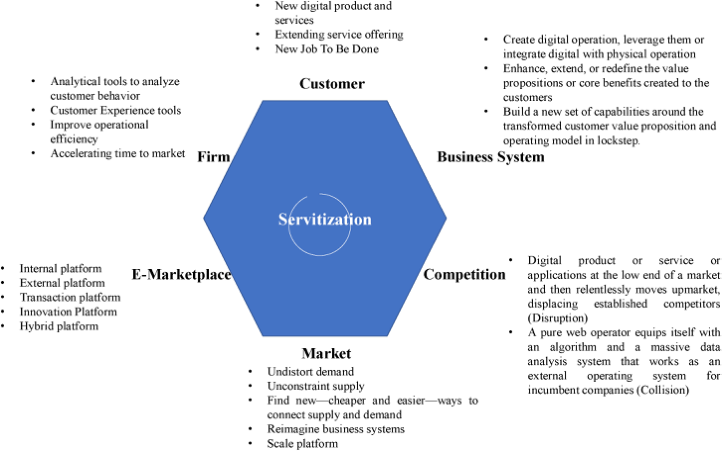
Digital transformation, therefore, may concern (Figure 1) the firm side by the adoption of digital technologies to improve individual activities or opera- tional processes. It may also concern the customer by the adoption of digital technologies to improve the product, the service or the relationship with the customer or its experience. It may imply also a more DT deepen ado- ption consisting in improving the relationships of firm within the business system, empowering the business model’s value proposition and/or operating system side or creating radically new business models. We can distinguish among business model’s optimizers and innovators depending on the degree of digital technologies adoption. The digital transformation can also bring a disruption or collision with the competition when the innovator targets the low-end level of demand and increases during the time the technology adoption and the organization (disruption) or when a newcomer configure itself as an external operating model (collision) for the incumbents of the entire industry (Booking, Airbnb). In both this case the architecture inertia prevents the incumbents to reorganize their value proposition (disruption) or operating model (collision) and the innovator scale up the market, targeting the high-end customers or not customers segments undermining competitors. Furthermore, the digital transformation may simplify the meeting between supply and demand in individual markets, changing the structure of the markets or creating completely new e-marketplace. In this case digital tran- sformation disrupts the overall ecosystem creating transaction, innovation or hybrid platform and permitting many to many relationships by scaling
Figure 1: A conceptual model for digital transformation adoption by the firms.
Digital Transformation, Servitization and Governmentality 107
up demand and offer. Several may be the benefits, to firms, customers, and other business stakeholders. Whatever the digital transformation configura- tion adopted by incumbent or new entrant companies, it cannot be faulted that this choice increases the level of company servitization, for the custo- mer, the partners in the business system, the business ecosystem, competition, demand/ offer or the entire market.
DIGITAL TRANSFORMATION AND SERVITIZATION Paiola and Gebauer (2020) and Cantone et al. (2022) argue that the inter- net of things, cloud platforms, big data and data analysis will contribute even more to increasing the opportunity for companies to create service- centric business models (Kindström, 2010). The same authors state that the literature research, at that time, did not stop to investigate the existing relati- onship between technological innovations and the evolution of the business models of pre-existing industrial companies in the direction of servitization. The authors, conducting a qualitative study on 25 BtoB manufacturing com- panies, highlight how digital servitization opens significant service-based growth spaces for these companies and implies the need to configure scena- rio analyses to monitor the evolution of technology and markets. According to Li (2018) not only are digital technologies causing a transformation in the business models of industrial companies but, if we look at companies in the creative sectors, it is determining the tendency of the same firm to develop multiple business models where value is created through dynamic upstream, downstream, and horizontal interactions with multiple stakehol- ders in a complex business ecosystem (think about the music industry). This is because digital platforms make it possible to manage different business models and relationship systems with suppliers, customers, and other stake- holders simultaneously and at manageable costs. Frank et al. (2019; p. 345) argue that BMI can follow two strategic trajectories: an internal one - the digitalization level - guided by the implementation of 4.0 technologies and aimed at corporate objectives of increasing value through the redefinition of internal processes (cost reduction, flexibility and productivity); the second of an external type – the servitization level - which follows a demand pull tra- jectory, based on different levels of service and the dominance of the service with the customer-focused value proposition (market expansion and custo- mer retention). The firm can move along the servitization axis by leveling, adapting and replacing old services with new ones. While the firm can move along the axis of digitalization by three levels of adoption of the technology (low, medium and high). The first level are the manual services: the services continue to be provided manually to the customer while the technology is adopted in a weak way exclusively to build customer databases and activate CRM initiatives. The second level are the “digital services”: in this case the adoption of 4.0 technologies is more marked and aimed at providing servi- ces to the customer. Think of apps, cloud computing and embedded software that are used to deliver customer services. At these two levels - manual and digital services - technology is used in the firm in the exclusive interest of the customer. The third level is that of the “industry 4.0 related-services”:
108 Testa
in this case the 4.0 technology, in addition to being used in the interest of the customer, is also aimed at redefining the company’s operational proces- ses. Let’s think of manufacturing companies that are in the most advanced stage of digital transformation when, with the Internet of Things technologies and business processes are interconnected and integrated to deliver superior value both for the customer and for the firm’s internal processes. Tavoletti et al. (2021) state that digitization in the service industry can facilitate busi- ness model innovation in different ways: a. enabling businesses to configure new value offerings; b. increase understanding of customer needs; c. create an ecosystem of collaborations with other actors outside the boundaries of the company; d. change the way value is offered to customers: acquiring new digital skills, defining processes and activities in a scalable perspective that allows delivery on a global scale, and reviewing roles and responsibilities in the industrial ecosystem. Also digitization can help you: e. improve the profit formula by lowering costs, through the improvement/efficiency of internal processes, increasing revenues, revenue sources. Finally, f. can contribute to greater transparency in relationships with customers and other players in the business ecosystem. According to Remane et al. (2017), many managers of traditional sectors (automotive, logistics, health, consumer electronics, mach- inery and energy) operating in the current market contexts, while feeling the need to embrace a digital transformation in their businesses, are failing to implement it. This because the business models to which they refer would not include the technological dimension which instead would be an integral and non-supporting part of any digital business model. The characteristics of a digital business model would be different from those of a traditional business model. First, the products and services could be reproduced at pra- ctically zero marginal cost (e.g. mobile phone apps) and would increase in value as users increase (such as smartphones which would have only marginal value if they were not used as interfaces for access online services payments, mobile, etc. Then, in digital business models value would be created directly in use. Finally, digital business models would require a digital platform to balance benefits within an ecosystem to which many organizations and indi- viduals participate. Thus, the digital business model VISOR framework was advanced by El Sawy and Pereira (2013). Compared to a traditional busi- ness model, this framework emphasizes the importance of customer contact points (i.e. interface), the central role of a digital platform (i.e. service plat- form) and the need to orchestrate a complex system of multiple actors (i.e. organizing model). The digital business model consists of five dimensions: 1. Value proposition: the reason why a particular customer would want to pay for a product or service. 2. Interface: the method of interaction between the customer and the service platform. 3. Service platform: the engine that allows the delivery of products and services. 4. Organizing model: ecosystem structure and processes to create products and services. 5. Revenue model: the distribution of revenues and costs among the participants in the business ecosystem. According to Remane, et al. (2017), the discovery of the digi- tal business model would follow three distinct phases: a. identify existing products and services that satisfy a certain need; b. deconstruct the traditi- onal business models adopted by existing operators; and c. discovering new business model configurations through digital.
Digital Transformation, Servitization and Governmentality 109
THE ROLE OF GOVERNMENTALITY Now very little is investigated the effect on governmentality (or the art of government) on these digital transformation strategies. To understand what the orientation of the main European countries towards digital transfor- mation is, reference was made to the Digital Economy and Society Index (DESI). The DESI (https://digital-strategy.ec.europa.eu/en/policies/desi) is a metric calculated by European Commission and monitors Europe’s overall digital performance and tracks the progress of EU countries in their digital overall competitiveness. We have compared the DESI, at the aggregate level and in reference to its four key components (human capital, connectivity, integration of digital technologies, digital public service), considering only six geographic dimensions (France, Germany, Italy, Spain, Sweden, and the European Union). It is possible to highlight how the performance of the Euro- pean Union and that of the main countries considered in the analysis grew constantly in terms of performance from 2017 to 2022. If we consider the aggregate DESI, Sweden and Spain grow more than the European reference average performance, Germany and France reflect the European performa- nce, while Italy is below the European average growth. When the analysis is carried out on the individual components of the DESI, it should be noted that in terms of human capital, Sweden’s performance is well above the European average. France and Spain also have values higher than the European average. Germany shows a performance in line with the European average and Italy has a performance well below the European average. On the other hand, if we look at connectivity, Sweden presents a performance slightly higher than that of the other European countries until the mid-2020s, being then surpas- sed in order by Spain, Germany, starting from the second half of 2021, and France in the last period of 2022; Italy stably underperforming the Euro- pean countries in the considered period until 2022, when it aligns with the European Union. If we look at the integration of digital technologies by com- panies, we will notice that France and Germany, are stably slightly below the average of European countries, while Sweden is stably well above the Euro- pean average. Italy and Spain aligned until 2020, and in 2021, while in 2022 above the European average but below Sweden, with Italy better than Spain. Finally, looking at the digitization of public services, it emerges that Sweden and Spain are well above the European Union average, Italy below the Euro- pean average and Germany and France in line with the European average, with France better than the Germany.
This brief contribution demonstrates that the European countries that pay greater attention to digital transformation have understood how it is not reso- lved solely in the adoption of digital technologies by companies but requires a holistic approach which also involves the adoption of broadband conne- ction technologies, the digital acculturation of human capital and, finally, the digitization of public services. However, the greatest impact of digital transformation is determined when digital technologies are aimed at impro- ving customer benefits, optimizing, innovating, or disrupting their business models, creating digital platforms when they determine real collisions or disruption of the competition, being able in the latter case some time to
110 Testa
reorganize the offer and the demand side of entire businesses and rarely to digitally transform the markets. The real question to ask is to what extent governments can help steer these highly evolved levels of digital transfor- mation. One thing is certain that without making progress in these areas, markets and entire economies could collapse internationally and globally. This is both a risk and an opportunity for those countries which, like Italy, have a large percentage of small and medium-sized enterprises.
CONSLUSION This research shows how the political actor, management consulting firms and scientific research are perfectly complementary each other. In fact, management consulting has been concerned with developing complete and informative decision-making models on strategic choice options of DT at the firm, customer, and market level. Scientific research has been more concer- ned with investigating the theoretical advancement of managerial literature because of the digital transformation, qualifying the service-centric nature of the DT process, the impact on competition (disruption vs collision), and pre- senting where possible taxonomies in digital tools (AI, IoT, digital platforms, etc.). Finally, the political actor has not only been concerned with facilitating the adoption of digital technologies by firms, financing it, but with helping to determine those conditions of context, digital literacy of human capital, adoption of connection technological infrastructure at the country level, and digitization of essential public services. In the future, digital transformation will see those economies that are best able to adopt a holistic approach to digital transformation triumph. However, this study also demonstrates that creativity is once again the key variable for success even in digital contexts. Ultimately, it is always up to the human being to have the ability to implement creative solutions regarding the dimensions of the problem defined above and which lead to real and sustainable competitive success.
Dimension Sub-dimension Indicators 1a Internet user skills (50%) 1 Human capital (25%)
1a1 At least basic digital skills 1a2 Above basic digital skills 1a3 At least basic digital content creation skills 1b Advanced skills and development (50%)
2a1 Overall fixed broadband take-up 2a2 At least 100 Mbps fixed broadband take-up 2a3 At least 1 Gbps take-up 2b Fixed broadband coverage (25%)
2b1 Fast broadband (NGA) coverage 2b2 Fixed Very High Capacity Network (VHCN) coverage 2c Mobile broadband (40%) 2d1 Broadband price index
2c1 5G spectrum 2c2 5G coverage 2c3 Mobile broadband take-up 2d Broadband prices (10%) 3a Digital intensity (15%)
3 Integration of digital technologies (25%)
3a1 SMEs with at least a basic level of digital intensity 3b Digital technologies for businesses (70%)
4a e-Government (100%)
3b1 Electronic information sharing 3b2 Social media 3b3 Big data 3b4 Cloud 3b5 AI 3b6 ICT for environmental sustainability 3b7 e-Invoices 3c e-Commerce (15%) 3c1 SMEs selling online 3c2 e-Commerce turnover 3c3 Selling online cross-border 4 Digital public services (25%)
4a1 e-Government users 4a2 Pre-filled forms 4a3 Digital public services for citizens 4a4 Digital public services for businesses 4a5 Open data
Berman, S. J., & Bell, R. (2011). Digital transformation: Creating new business models where digital meets physical. IBM Institute for Business Value. Bonnet, D. N., & Nandan, P. (2011). Transform to the Power of Digital. Capgemini
Consulting. Bughin, J., LaBerge, L., & Mellbye, A. (2017). The case for digital reinvention.
McKinsey Quarterly, February, Cantone, L., Testa, P., Marrone, T., & Cantone, G. F. (2022). Innovazione del modello di business ≪service-centric≫nell’era della trasformazione digitale. In Innovazione e Management. Omaggio a Salvio Vicari (pp. 307–314). EGEA. Chesbrough, H. W. (2011). Bringing open innovation to services. MIT sloan
management review, 52(2), pp. 85–90. Christensen, C. M., & Dillon, K. (2020). Disruption 2020: An Interview With Clayton M. Christensen. MIT Sloan Management Review, 61(3), pp. 21–26. Cusumano, M. A., Yoffie, D. B., & Gawer, A. (2020). The future of platforms. MIT
Sloan Management Review, pp. 26–34. El Sawy, O. A. and Pereira, F. (2013), Business Modelling in the Dynamic Digital Space: An Ecosystem Approach, SpringerBriefs in Digital Spaces, Springer, Berlin. Frank, A. G., Mendes, G. H., Ayala, N. F., & Ghezzi, A. (2019). Servitization and
Industry 4.0 convergence in the digital transformation of product firms: A business model innovation perspective. Technological Forecasting and Social Change, 141, pp. 341–351.
Digital Transformation, Servitization and Governmentality 113
Henderson, R. M., & Clark, K. B. (1990). Architectural innovation: The reconfiguration of existing product technologies and the failure of established firms. Administrative science quarterly, pp. 9–30. Iansiti, M., & Lakhani, K. R. (2020). From disruption to collision: The new
competitive dynamics. MIT Sloan Management Review, 61(3), pp. 34–39. Kindström, D. (2010). Towards a service-based business model–Key aspects for future competitive advantage. European Management Journal, 28(6), pp. 479–490. Li, F. (2020). The digital transformation of business models in the creative industries: A holistic framework and emerging trends. Technovation, 92, 102012. Paiola, M., & Gebauer, H. (2020). Internet of things technologies, digital serviti-
zation and business model innovation in BtoB manufacturing firms. Industrial Marketing Management, 89, pp. 245–264. Rappa, M. (2003). Business models on the web. Available at Managing the Digital Enterprise website: https://digitalenterprise. org. Rappa, M. (2004), The utility business model and the future of computing services,
IBM Systems Journal, Vol. 43, No. 1, pp. 32–42. Rappa, M. (2006). Business Models on the Web. Managing the digital enterprise.
The Excutive’s Journal, 16(4), pp. 26–32. Remane, G., Hanelt, A., Nickerson, R. C., & Kolbe, L. M. (2017). Discovering digital business models in traditional industries. Journal of Business Strategy. 38 (2), pp. 41–51. Tavoletti, E., Kazemargi, N., Cerruti, C., Grieco, C., & Appolloni, A. (2021).
Business model innovation and digital transformation in global management consulting firms. European Journal of Innovation Management. 1460-1060, DOI: 10.1108/EJIM-11-2020-0443. Testa, P., Cantone, L., Cantone, G. F., & Kandampully, J. (2021, July). The Role of Technological Platforms in Co-creating Symbiotic Relationships Between Firms and Society. In Advances in the Human Side of Service Engineering: Proceedings of the AHFE 2021 Virtual Conference on The Human Side of Service Engineering, July 25-29, 2021, USA (pp. 89–96). Cham: Springer International Publishing. Wirtz, B. W., Schilke, O., & Ullrich, S. (2010). Strategic development of business
models: implications of the Web 2.0 for creating value on the internet. Long range planning, 43(2), pp. 272–290.
LISTED IN THE AHFE DIGITAL BOOKSTORE CATALOGUE
Explore the complete digital volume
The Human Side of Service Engineering
Read this individual research paper free through the original publisher, or explore the full digital proceedings book.
ISBN 978-1-958651-84-1
Explore this ISBN in the AHFE Bookstore ↗Listed in the July 2026 bookstore catalogue; search by ISBN to confirm current availability · Digital book purchase optional