Sandra Frings, Holger Kett (2023). Method to Identify Data Related Characteristics for Detailing a Capability Maturity Model for the Smartification of Products. In: The Human Side of Service Engineering. AHFE Open Access, vol. 108, pp. 1–8. https://doi.org/10.54941/ahfe1003101
Digital transformation has many facets, one of them being the process of smartifying a traditional, non-smart product into a smart product as well as developing smart services. Smart products collect data via sensors, store, process and communicate data via a network, and react to data via actuators. As an added value, a company uses the processed data to offer smart services. The decisions a SME’s CEO needs to make when visioning to smartify or improve the smartification of own products also depend on the knowledge which capabilities need to be build up. Capability and maturity model (CMM) based approaches are common methods to identify the gap between the current situation and the target situation a SME needs to achieve in order to fulfill the business goals which have been set up. We research a methodological and tool-based approach to identify the maturity of SMEs on their way to smartify their products, which is made up of a three-dimensional CMM to determine the maturity levels regarding eleven areas of action as well as their cross-sectoral base capabilities, and a process model to apply the CMM. In this paper we describe a method to detail the subareas of action for each capability/maturity level within the CMM. We define the method requirements to be able to identify and integrate relevant characteristics in our CMM following the sole purpose of smartification but also looking into related subjects like digital transformation as well as retrofitting for Industry 4.0.
Digital transformation has many facets. Among others, digital transformation includes the digitalization of administrative processes, digitalization of product production sights as well as the process of transforming a traditional, non-smart product into a smart product and developing smart services (smartification) (Frings and Kett, 2021).
For small and medium enterprises (SMEs) developing and producing physical products (for example a walker being assigned to the health care sector) the internal and external pressure to participate in the digital
transformation is increasing. On the one hand, there are general factors like the need to keep up with the competition as well as to satisfy constantly changing customer expectancies (Engeln, 2020). On the other hand, paradigms like “data-driven” value creation or “data-centric” companies (Rashedi et al. 2022), the Internet of Things (IoT) and technologies like Artificial Intelligence (AI) have majorly advanced in the last years and are enablers for the digital transformation. Both need data to be generated, analyzed and used for optimization, automation, analytics, prediction, etc. One way to collect data is through sensors. Smart products (Neuhüttler et al. 2020; Tomiyama et al. 2019; Raff, 2019) collect data via sensors, store, process and communicate data via a network, and react to data via actuators. Beyond just automating data processing, Artificial Intelligence (AI) can be used to solve problems that humans find difficult or impossible to formalize. Smart services interact with different users and systems according to the processed data.
The strategic decisions a SME’s CEO faces when confronted with the opportunity to smartify a non-smart, traditional, physical product for the first time come with a number of questions and challenges: Is the SME “smartification ready” which also means “ready for change”, which business processes are affected, what will the customer expect, what will the benefits, technical and financial efforts be, which technical, organizational and base competencies and capabilities are available and needed, which partners would come into question for a joint development (Röcker and Mocker, 2018; Hölzle et al. 2019; Porter and Heppelmann, 2014, 2015) and will the collected data from sensors create value (Rashedi et al. 2022). The answers to those questions regarding current and targeted capabilities in the SME are needed input to set up a strategy for or against a topic like smartification before activities are initiated (Jung et al. 2018). A systematic approach to digital transformation begins at the strategic level. If SMEs act consistently strategically, they can reduce risks, improve their chances of an efficient and effective transformation and thus maintain and expand their competitiveness (Hölzle et al. 2020).
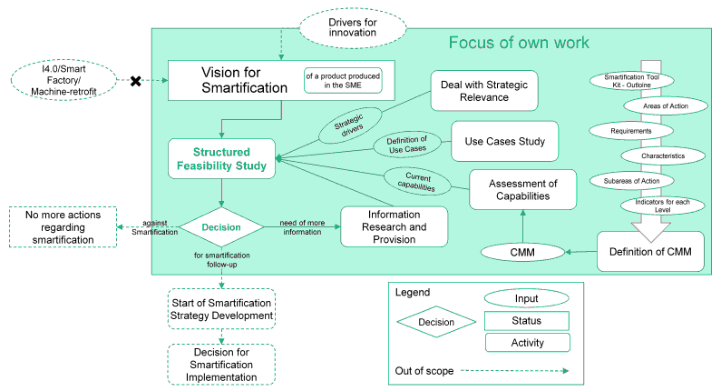
FOCUS OF WORK WITHIN THE SMARTIFICATION DECISION PROCESS The green part of Figure 1 shows the focus of our work. Drivers for innovation are important input for and can lead the CEO to a vision for smartification as described above. To be able to have enough information for a decision, our work proposes a structured feasibility study using input from a) an analysis of the strategic relevance of the visionary smartification, b) use cases in which users can use new smart services with the relevant product to be smartified, and c) the current capabilities in the SME for a visionary smartification (see section on previous work). In case enough information is provided, the CEO will follow up on the topic and develop a smartification strategy in the next steps.
Method to Identify Data Related Characteristics 3
Figure 1: Focus of own work within the smartification decision process (own work).
PREVIOUS WORK Simple readiness checks and more detailed and specific capability and maturity model (CMM) based approaches are a common and structured method to determine the approximate current maturity, competence and/or capability level of a single department or the entire organization regarding a specified topic (Steinlechner et al. 2021; Software Engineering Institute 2010). Since no publicly available CMM has put the emphasis solely on smartification, we are developing a Smartification Tool Kit (STK) to give support in the smartification decision-making process. The STK is made up of a process model for the application (Frings and Kett 2021), a generic level system for objects under consideration (OuC), a three-dimensional CMM to determine the capabilities and maturity regarding eleven areas of action (Frings et al. 2022), as well as their cross-sectoral base capabilities (Frings et al. 2023). Detailing the eleven areas of action – Strategy, Smart Product, Smart Service, Stakeholder, Data, Business Model, IT, Development, Operation, Organization, Project Management – into subareas of action means taking a deeper look into which characteristics need to be considered to make sure that the focus is on smartification. The right part of Figure 1 indicates the aspects that do not lose sight of such a focus when developing the CMM, namely the modules “requirements” and “characteristics”, which are modules in the method to identify the characteristics for the CMM.
METHOD FOR IDENTIFYING RELEVANT CHARACTERISTICS In our previous work (Frings and Kett, 2021), we stated the general requirements to be fulfilled for our CMM following the suggestions in Becker et al. (Becker et al. 2009). To be able to identify the characteristics needed to define indicators for each subarea of action and for each level within the CMM the following requirements for the method are essential.
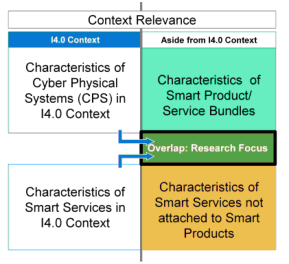
In our view, the most important requirement is context relevance to be able to use the CMM in an efficient way. Our overall context relates to the process of smartifying a traditional, physical product developed by the SME and develop smart services. This includes general context terms like “digital transformation”, since digitalization is the base for smartification which has hardly been touched in research, and more specific terms like “smartification”, “smart product”, “smart service”. Due to this focus, some characteristics of topics like Industry 4.0, smart factories or production machine-retrofit are somewhat relevant but generally out of scope since our aim is not to improve the production process of the SME but to deliver relevant information for the decision-making process. See Figure 2 where the overlap of relevant context is shown (orange-green striped). In a narrow sense, the context needs to be capability or maturity related and fit into the STK concept.
The right degree of detail of capability and maturity based approaches is another requirement when formulating the indicators of the CMM. The degree of detail needs to meet the application domain (see context relevance above) as well as the orientation of the potential users. A CEO of a SME is our main target group who intends to perform a rough feasibility study regarding smartification from a strategic point of view.
The method needs to be reasonable, clear, replicable, visible, and understandable. Furthermore, the method needs to be scientifically sound. Therefore, scientific publications are a main input for the development. Nevertheless, whitepapers are also relevant for literature analysis since they cover practical aspects which are relevant for the application of the method.
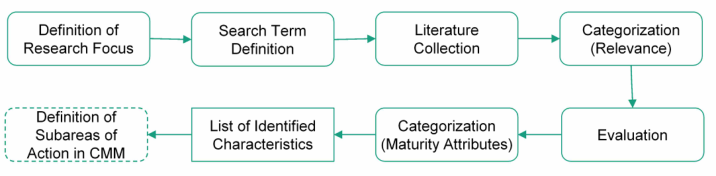
METHOD FOR IDENTIFYING RELEVANT CHARACTERISTICS This section covers the method including examples to identify relevant characteristics for detailing the CMM under consideration of the afore mentioned requirements (see Figure 3). Having our research focus in mind, the method was developed in accordance with scientific publications on systematic literature reviews (Kunisch et al. 2023; Booth et al. 2021; Randolph, 2009; Sipe and Stallings, 1996; vom Brocke et al. 2009).
Method to Identify Data Related Characteristics 5
Figure 3: Method to identify relevant characteristics (own work).
The definition of the research focus is covered in a section above and shown in Figure 1. From this, definition of terms for “SME”, “smart product”, “smart service”, “smartification”, “data-driven” were researched in a literature review. Related topics like “product enhancement”, “IoT adoption”, “product modernization”, “product innovation”, “next generation product” and “product intelligence” were identified. From this, search terms were defined with which a literature review was performed. Special focus was put on SME context, maturity models, readiness checks, role and skill profiles as well as technical indicators. The found publications were collected in a matrix indicating the source and the relevant information.
This information is categorized by associating it with 1) the detected object under consideration (OuC) (e.g. data strategy, data quality) found when considering the degree of maturity, 2) the original level system used (e.g. 3 or 5 levels), 3) the SME context and indicators, 4) the specific level the OuC is put on within the regarded information, 5) the strategic operationalization activity (e.g. data used for decision-making) and 6) one or more cross-sectoral base capabilities (e.g. human competence regarding data analytics, technological capability like data analytics system, business process integration of data management).
Furthermore, a degree of relevance is assigned to the information (very relevant, relevant, less relevant) regarding the following aspects: a) the assessment of strategic importance in the context of the smartification and the reason to follow this vision, b) the definition of the use case and the product to be smartified as well as the smart services to be offered, and c) the indicator input for the level definition in the CMM. Within the evaluation, the most relevant aspects are identified according to the frequency of mentioning. Those are categorized according to evaluability of maturity attributes. For example, qualitatively evaluable attributes are systematics (e.g. ad hoc, chaotic, process oriented, well organized), availability and usage of standardization and guidelines, time related attributes (e.g. never, sporadically, regularly), up-to-datedness, completeness, redundancy. Quantifiable attributes, for example, are available/not available, being performed/not being performed, being measured/not being measured, being monitored/not being monitored, being documented/not being documented.
From this evaluation, a list of relevant characteristics is derived. The characteristics are used as input for defining the level indicators for the subareas of action.
6 Frings and Kett
EVALUATION OF THE METHOD Over the last years, we manually collected more than 800 articles coming from mostly scientific publications listed in common search platforms (IEEE, Springer, ResearchGate, Web of Science, ACM, Semantic Scholar, Google Scholar) using the research focus and search terms mentioned above from which 481 have SME relevance. Currently, we are evaluating the method in step 4 by categorizing the identified literature.
The first finding during the application of the method is that the balancing act between the following aspects is challenging: a) applicability, level of detail, strategic relevance and completeness, b) huge amount of literature regarding CMMs, digital transformation and Industry 4.0 on the one side, but very few sources on smartification on the other, and c) lack of available information as well as sufficient degree of detail on the strategic aspects of SME regarding product enhancement. Our approach to meet these challenges is to go for semi-structured interviews with SMEs.
CONCLUSION AND OUTLOOK In the last few months, we observed (based on alerting functions by online platforms) of an increasing publication rate of scientific articles on digital transformation and maturity models in the SME context. Therefore, we see the chance, that our Smartification Tool Kit can help the CEO using a structured feasibility study to make a maturity and capabilities based as well as founded decision if a selected traditional, non-smart product should be smartified. The method to identify the relevant characteristics for the three-dimensional CMM contributes to more transparency in the capability assessment result, assisting to derive more specific and appropriate measures for the identified gaps. Our work will bring SMEs a step closer to their strategic decisions and emphasize the importance of taking risks in digitalization and going for a data-driven organization to be able to develop future service business and make more use of the advantages of the digital transformation.
REFERENCES
Becker, Jörg; Knackstedt, Ralf; Pöppelbuß, Jens (2009): Developing Maturity Models for IT Management. In Bus. Inf. Syst. Eng. 1 (3), pp. 213–222. DOI: 10.1007/s12599-009-0044-5. Booth, Andrew; Sutton, Anthea; Clowes, Mark; Martyn-St James, Marrissa (2021):
Systematic Approaches to a Successful Literature Review. 3rd. London: SAGE Publications Ltd. Engeln, Werner (2020): Methoden der Produktentwicklung. Technische Produkte kundenorientiert entwickeln. 3. Auflage. Essen: Vulkan-Verlag GmbH. Frings, Sandra; Kett, Holger (2021): Towards a Capability Based Approach
to Strengthen the Strategic Decision Making Process for Developing Smart Products and Services in SMEs. In : Advances in the Human Side of Service Engineering: AHFE International (12th International Conference on Applied Human Factors and Ergonomics (AHFE 2021)), pp. 189–196. Available online at http://publica.fraunhofer.de/dokumente/N-640229.html, checked on 1/16/2022.
Method to Identify Data Related Characteristics 7
Frings, Sandra; Kett, Holger; Falkner, Jürgen (2022): Essential Areas of Action for the Smartification of Traditional Products and Services Considering the Capabilities of SMEs. In : The Human Side of Service Engineering. 13th International Conference on Applied Human Factors and Ergonomics (AHFE 2022), July 24-28, 2022: AHFE International. Available online at https://play.google.com/store/books/series?id=5ZguGwAAABDKgM, checked on 2/28/2023. Frings, Sandra; Kett, Holger; Falkner, Jürgen (2023): Enhancing a Capability Maturity Model for the Smartification of Products by a Generic Approach and a Third Dimension. In : Proceedings of the 6th International Conference on Intelligent Human Systems Integration (IHSI 2023) - Integrating People and Intelligent Systems. Venice, Italy, February 22-24, 2023: AHFE International. Available online at https://books.google.com/books?id=J9msEAAAQBAJ, checked on 2/28/2023. Hölzle, Katharina; Kullik, Oliver; Gergeleit, Wiebke; Petzolt, Sophie (2020):
Strategie und digitale Transformation. Report 2020 - Wie systematisch gehen KMU die digitale Transformation an? Edited by BVMW. Gemeinsam digital. Available online at https://gemeinsam-digital.de/app/uploads/2020/09/report- digitalcheck-mittelstand.pdf, checked on 10/12/2020. Hölzle, Katharina; Petzolt, Sophie; Kullik, Oliver; Gerhardt, Fabian (2019): Reifegradmessung zur digitalen Transformation von KMU. Working Paper von _Gemeinsam digital. DOI: 10.13140/RG.2.2.28402.66242. Jung, Rüdiger H.; Heinzen, Mareike; Quarg, Sabine (2018): Allgemeine Managementlehre. Lehrbuch für die angewandte Unternehmens- und Personalführung. 7. neu bearbeitete Auflage. Berlin: Erich Schmidt Verlag (ESV basics). Kunisch, Sven; Denyer, David; Bartunek, Jean M.; Menz, Markus; Cardinal, Laura
B. (2023): Review Research as Scientific Inquiry. In Organizational Research Methods 26 (1), pp. 3–45. DOI: 10.1177/10944281221127292. Neuhüttler, Jens; Kett, Holger; Frings, Sandra; Falkner, Jürgen; Ganz, Walter; Urmetzer, Florian (2020): Artificial Intelligence as Driver for Business Model Innovation in Smart Service Systems. In Jim Spohrer, Christine Leitner (Eds.): Advances in the Human Side of Service Engineering, vol. 1208. Cham: Springer International Publishing (Advances in Intelligent Systems and Computing), pp. 212–219. Porter, Michael E.; Heppelmann, James E. (2014): How Smart, Connected Products Are Transforming Competition, 2014. Available online at https://hbr.org/2014/11/how-smart-connected-products-are-transforming- competition, checked on 2/6/2022. Porter, Michael E.; Heppelmann, James E. (2015): How Smart, Connected Products
Are Transforming Companies. Available online at https://hbr.org/2015/10/how- smart-connected-products-are-transforming-companies, checked on 2/6/2022. Raff, Stefan (2019): Products and Services in the Digital Age: Findings of a Multi-Perspective Approach. Dissertation. Technische Hochschule Aachen, Aachen. Available online at https://publications.rwth- aachen.de/record/775639/files/775639.pdf, checked on 2/28/2023. Randolph, Justus (2009): A Guide to Writing the Dissertation Literature Review.
Available online at https://scholarworks.umass.edu/pare/vol14/iss1/13/, checked on 2/27/2023. Rashedi, Jonas; Greiner, Ramona; Geuer, Marco; Borlik, Thomas Andreas (2022): Das datengetriebene Unternehmen. Erfolgreiche Implementierung einer data-driven Organization. 1. Auflage 2022. Wiesbaden: Springer Fachmedien Wiesbaden GmbH; Springer Gabler.
8 Frings and Kett
Röcker, Jana; Mocker, Martin (2018): Digital-physische Produkte. Stand und Herausforderungen beim Einsatz von IT in physischen Produkten in der Kreativwirtschaft. Edited by MFG Stiftung Baden-Württemberg. Stuttgart (Berichte aus dem Karl-Steinbuch Forschungsprogramm, 8). Available online at https://publikationen.reutlingen-university.de/frontdoor/index/index/docId/1711, checked on 2/28/2023. Sipe, Theresa Ann; Stallings, William M. (1996): Cooper’s Taxonomy of Literature
Reviews Applied to Meta-Analyses in Educational Achievement. Edited by Annual Meeting of the American Educational Research Association. New York. Available online at https://files.eric.ed.gov/fulltext/ED398275.pdf, checked on 2/27/2023. Software Engineering Institute (2010): Capability Maturity Model® Integration for Development (CMMI-DEV), Version 1.3. Improving processes for developing better Improving processes for developing better products and services (Technical Report). DOI: 10.1007/978-3-642-20279-7. Steinlechner, Markus; Schumacher, Andreas; Fuchs, Benedikt; Reichsthaler, Luisa;
Schlund, Sebastian (2021): A maturity model to assess digital employee competencies in industrial enterprises. In Procedia CIRP 104, pp. 1185–1190. DOI: 10.1016/j.procir.2021.11.199. Tomiyama, Tetsuo; Lutters, Eric; Stark, Rainer; Abramovici, Michael (2019): Development capabilities for smart products. In CIRP Annals 68 (2), pp. 727–750. DOI: 10.1016/j.cirp.2019.05.010. vom Brocke, Jan; Simons, Alexander; Niehaves, Björn; Riemer, Kai; Plattfaut, Ralf; Cleven, Anna (2009): Reconstructing the Giant: On the Importance of Rigour in Documenting the Literature Search Process. In 17th European Conference on Information Systems (ECIS). Available online at https://www.researchgate.net/publication/259440652, checked on 2/27/2023.
LISTED IN THE AHFE DIGITAL BOOKSTORE CATALOGUE
Explore the complete digital volume
The Human Side of Service Engineering
Read this individual research paper free through the original publisher, or explore the full digital proceedings book.
ISBN 978-1-958651-84-1
Explore this ISBN in the AHFE Bookstore ↗Listed in the July 2026 bookstore catalogue; search by ISBN to confirm current availability · Digital book purchase optional