Sandra Frings, Holger Kett (2023). Towards a Vision and Essential Steps in the Digital Transformation of Product Service Systems: A Scenario based Approach. In: Application of Emerging Technologies. AHFE Open Access, vol. 115, pp. 266–276. https://doi.org/10.54941/ahfe1004323
For traditional product manufacturers, digital transformation of products and services means dealing with challenges with which they have not dealt before. Especially the different measures to be taken on a business, organizational, technical and IT level and the competencies needed when advancing from traditional to smart products and services are often unclear for strategists in those companies. In our work, focusing on the early phase of smartification, we propose a support method for small and medium sized enterprises to formulate an ambitious product vision and derive a path of useful steps to go ahead from a traditional product without smart elements to the developed product vision using a scenario based approach. Our scenario framework was developed by analyzing and clustering characteristics of appropriate approaches resulting from a literature review, using two fundamentally different approaches which either develop products with a business model or a technical/functional perspective. In order to apply and support the product development with a maturity model of smartifying product service systems, the two different approaches were merged for elaborating a common product vision and three essential steps leading the path towards the vision. Starting with a product having no smart components, in the first step the product and services are digitalized and connectivity is added. The second step covers, next to further smart components, the enhancement of using AI technology in data processing. The third step brings innovative business models into play.
INTRODUCTION AND CHALLENGES Digitalization and digital transformation in general and specifically Internet of Things (IoT), Artificial Intelligence and smart products and objects, being present in everyone’s daily life (García et al., 2017), smart services, smart product-service systems (sPSS) have grown to be approaches which influence many or if not most aspects in business life (Lanzolla et al., 2021).
Traditional product manufacturers usually have mechanical engineering backgrounds and find the shift to software engineering difficult when transforming their traditional products and services into smart product
Towards a Vision and Essential Steps in the Digital Transformation 267
service systems (Porter and Heppelmann 2015). Next to the complexity of digital transformation and the fact that the adoption of a strategy based on smart things is more complex than the traditional way of supplying products, a lack of vision, unclear goals, short-term commitments, and lack of customer orientation are slowing down digital change (Salwin et al., 2019; OECD 2021). Small and medium enterprises (SMEs) would benefit from sPSS in ways of improving corporate image, using data for new service offerings, thus being able to develop into a service provider, opening up to new markets, building value creation systems, increasing competitiveness, productivity, sales volume and attractiveness for new employees, and most importantly, precisely meeting customer requirements (Schiller and Friedrich 2021; Kurtz et al., 2023; Beverungen et al., 2019).
In case organizations have understood potential advantages through sPSS and intend to adapt their products and services, they usually do not know how to proceed and how to integrate smart technologies and corresponding business models to continue to be competitive. The challenges for many small and medium sized product manufacturers are to approach and plan the digital transformation – the smartification – of their products and services in a methodically structured manner having a smartification strategy as an output, especially since this transformation will turn the manufacturer into a cross between a software company and a traditional product company which also requires new skills (Porter and Heppelmann 2015).
A strategy (Schuh and Kampker 2011) is influenced by multiple perspectives, which entail questions like: 1) Is the organization capable for change (technically, organizationally, business related)? 2) Does the organization want change (company’s internal ambitions and external influences like customer needs and expectations)? 3) Should the organization go for change (competition)? These aspects cannot be regarded separately and should all be part of the vision for digital transformation (Yu 2021).
One capability oriented way to manage the digital transformation is a step-by-step approach starting with the analysis of the current situation (e. g. using capability and maturity models)), going for the definition of the target state, to deriving and implementing identified measures, all based on a formulated vision and defined strategy for the digital transformation (Frings and Kett 2021).
Since digital transformation and specifically smartification lead to disruptive changes (Parker et al., 2017), a well-founded idea of the future, namely a vision, is necessary. The vision being part of a strategy needs to be understandable and clear to create orientation, identity and identification (Lipton 1996; Wolf 2017) and maintains the role of a lighthouse which guides SMEs on their transformation paths. How does such a vision and the essential steps for transforming an SME look like?
RESEARCH METHODOLOGY Digital transformation of products and services in SMEs has a very practice-oriented nature. Therefore, our research method starts with a domain analysis in which we looked at the needs product manufacturers have
268 Frings and Kett
regarding vision and process when they intent to smartify their products. Using the framework for literature review (vom Brocke et al., 2009) relevant publications were identified, analyzed and clustered. Within the gap analysis we compared the characteristics of identified clusters (e.g., business models, on products and services, technical, functional aspects) with our collected requirements. From this, we defined our solution approach of combining two fundamentally different approaches concerning the business model and technical/functional perspective. Since the application of a solution needs to support SMEs in smartification in a practical and easily understandable manner, we used the scenario technique which well supports the strategic orientation (Drewel et al., 2019). For the development of the scenarios, we performed a literature review on characteristics of smart “things” and smart services in accordance with our own method (Frings and Kett 2023) to be able to identify the mentioned influencing factors in scenarios. The scenario scope was defined, the topics were conceptualized, literature was searched and analyzed, dependencies were identified, and the scenarios were developed.
RELATED WORK
The given definitions and introduced (classification) approaches in this section are divided into business model and technical/functional perspective according to the gap analysis results mentioned above. We use the following two perspectives to create an integrated approach to be further used in our research (see next chapter).
Business Model Perspective A company’s business model focuses on the way how a company creates and generates value (Strunz-Happe et al., 2022). This can be done using “traditional” (e.g. transaction oriented) business models which comprises e.g., selling, renting, licensing a product and/or offering services. Digital and innovative business models take digital technologies as well as collected and processed data into account. This way use-oriented (e.g., number or duration of usage of a product), availability-oriented, result-oriented parameters are built into the revenue model. Product as a service, equipment as a service are examples of innovative business models relying on the characteristics of the corresponding smart product and/or smart service.
If smart services are seen in conjunction with innovative business models, a new user centered perspective arises for the service provider or manufacturer of the smart product. New digital technologies are integrated into services and data is processed in such a way that added value is created for the end user (e.g., tracking of products or situation dependent control of machines) (Meiren et al., 2021). An IT-enabled business solution that consists of a system of at least one (smart) product and one (smart) service to generate mutual benefits is defined as a (smart) product-service system.
Waidelich et al. published the results of an extensive scientific systematic literature review (Waidelich et al., 2019) in which they concentrated on the central question of how product service systems can be classified. They used four identified classification systems (Mont 2002, Tukker 2004, Meier
Towards a Vision and Essential Steps in the Digital Transformation 269
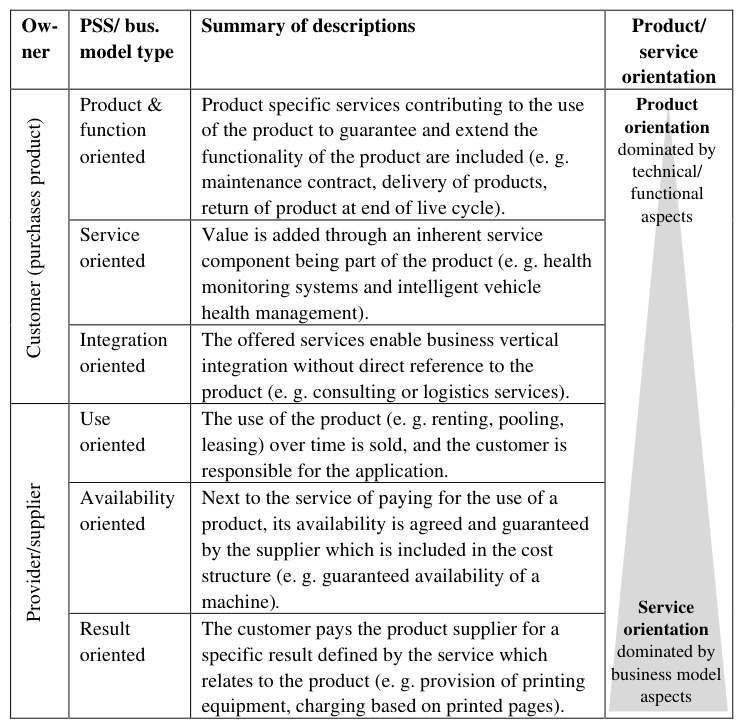
et al., 2005, Neely 2008) as well as Gassmann’s work on business model patterns (Gassmann 2013) and introduced a consolidation of PSS types and emphasize that Tukker’s classification (Tukker 2004) is widely acknowledged in literature. From these classification types, thus their understanding of PSS, Waidelich et al., derive that each PSS types can also be seen as a special form of a business model (Waidelich et al., 2019). Table 1 summarizes the six PSS/business model types emphasizing the roles having ownership of the product and the service characteristics as well as lists examples. The order of the six types (from top to bottom in the table) is chosen in such a way that the share of service within the business model goes from low to high (from product to service orientation).
Table 1. PSS/business model types according to Waidelich et al. (Waidelich et al. 2019).
Tukker’s classification is widely acknowledged in literature, it is consolidated by Waideling et al. referencing the previous work by Mont, Neely and Gassmann. This profound work resembles the needed research base to be used as reference point for our work.
270 Frings and Kett
Technical/Functional Perspective Porter and Heppelman defined smart, connected products to have three core technical elements, 1) the physical components, stage 2) the “smart” components which increase the capabilities and value of the physical component, and stage 3) the connectivity components which increase the capabilities and value of the smart components (Porter and Heppelmann 2014). Smart services are digital services, which generate value from the smart product’s generated data and thus enhance the functionality of the product, for example from connected, intelligent machines (Frank et al., 2018). Smart products enable the co-creation of smart services, whereby the co-creation is based on features like monitoring, optimization, remote control, and autonomous adaptation of products (Beverungen et al., 2019; Kurtz et al., 2023). Smartification of a traditional product is the process of adding smart components and technologies to the product itself and setting up a service landscape to be able to offer from the customers’ viewpoint relevant smart services to the market (Frings and Kett 2021; Kett et al., 2021).
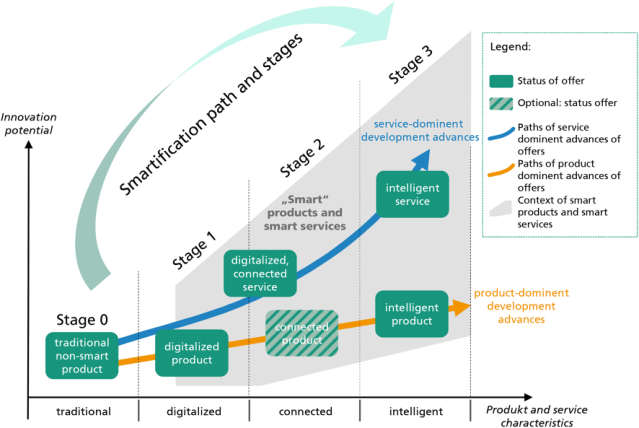
Figure 1: Smartification path from traditional to “smart” product and services (enhancement of (Kett et al., 2021)).
Figure 1 (based on our current work in accordance with Kett et al., (Kett et al., 2021)), shows the smartification path, where the grey area indicates the “smartness” which makes clear, that we use the term smart as collective term. We hereby introduce a smartification scale for easier referencing of the technical characteristics. Table 1 lists the stages, the name, indicates the smartness and examples of key features of smart products and services for
Towards a Vision and Essential Steps in the Digital Transformation 271
each smartification stage having an increase of capability requirements at each stage.
Table 2. Stages in the smartification path (based on Kett et al., 2021) and examples of key features of products and services.
Table available in the original PDF paper.
Stage Name Smart Examples of key features 0 Traditional no Traditional, analogue, electrical, mechanical product, traditional services 1 Digitalized yes Digital sensors, actuators, microprocessors, embedded operating system, data storage, batterie, local data processing, product status/behavior related local services or remote services 2 Digitalized and connected
yes Connectivity components like ports, antennae, and protocols to enable wired or wireless (e. g. one-to-one, one-to-many, many-to-many) connections between product(s) and the cloud, data processing in the cloud (e. g. IoT platform), connected services according to product status/behavior 3 Intelligent yes Data is processed using AI algorithms (e. g. for decentralized decision making) which has impacts on the AI-based services to be offered
Having analyzed the approach by Kett et al., we assigned the smartification stages to the product and service characteristics (see Table 2) and will use this result as base for the work in this paper.
COMPREHENSIVE APPROACH BASED UPON INTEGRATED PERSPECTIVES Many classifications in literature (Porter and Heppelmann 2014; Raff 2019; Kett et al., 2021; Fleisch et al., 2014) as well as our own classification by Kett et al. (Kett et al., 2021) focus on the stepwise addition of smartness to products and services (stages 1 to 3). We introduced the smartification path we see most relevant for our work. However, this work does not incorporate business models aspects. Waidelich et al. (Waidelich et al., 2019) focus on business model aspects and HOW (not WHAT) products could be offered but do not relate to the technical/functional aspects of products and services. The knowledge about both aspects (business model and technical/functional view) are necessary for product manufacturers to be able to formulate a vision and derive necessary steps on the way to the digital transformation of their products (Valencia et al., 2017).
Having those missing aspects in mind, we use the above mentioned two perspectives to create an integrated and combined approach as base for elaborating a common product vision and essential steps using scenarios by bringing together the business model side of “HOW” the business will be performed using the smartified products and services (the “WHAT”) with the technical as well as functional side of smartification of products and services.
272 Frings and Kett
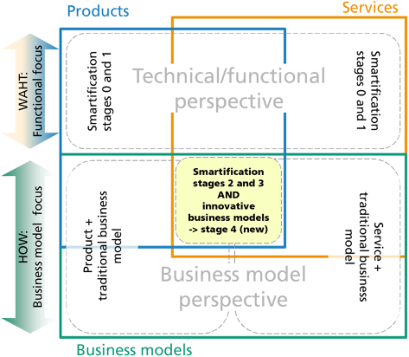
Figure 2: Combination of approaches.
We visually superimpose both perspectives in Figure 2, where we highlight the intersection of both approaches (solely technical/ functional and solely business model perspective) as the focus in our combined approach. We use the already mentioned stages 2 (digitalized and connected) as well as stage 3 (intelligent) and introduce a stage 4 (innovative business model) to our approach (also see Table 3).
The three resulting smartification steps are listed in Table 3 also indicating the transformation for the stages, the technical/functional as well as the business model aspects. Having this classification, we introduce one base scenario and three practice oriented enhancement scenarios which incorporate exactly those three steps (see details in the next chapter). The steps will be evaluated using the scenarios.
Table 3. Three essential smartification steps indicating the involved transformation and referencing the three enhancement scenarios.
Table available in the original PDF paper.
Step Transformation of product/service and business model Scenario Stage Technical/functional Business model
0 None, stays traditional None, stays traditional ⇒ Base 1 0 to 2 Traditional to digitalized + connected None, stays traditional ⇒ A 2 2 to 3 Digitalized + connected to intelligent None, stays traditional ⇒ B 3 3 to 4 None, stays intelligent Traditional to innovative ⇒ C
SCENARIO DESCRIPTION The base as well as the three enhancement scenarios and thus the three steps resulting from the combination of above mentioned approaches are described in this chapter. We use four different real-life SME use cases to be able to discuss practice oriented examples with SMEs to build a base for the smartification vision development.
In the base scenario the stakeholders are manufacturers who design and produce traditional, non-smart products. They also offer traditional services
Towards a Vision and Essential Steps in the Digital Transformation 273
like installation, repair, or maintenance of the product. Their business model is traditional; it is based on transactions, like selling or renting the product and invoicing installation, repair, and maintenance. In our four use cases, a carpenter installs, sells, and maintains kitchen cupboards having swing doors; a medical supply store designs, produces, sells, or rents, and maintains non-smart walkers; a lawn mower manufacturer designs, produces, and sells traditional push-lawn movers, and performs maintenance; a manufacturer of pesticides designs, produces, and sells plastic insect traps next to consumables like adhesive film, and pheromone tablets.
Within scenario A (the first smartification enhancement) the traditional product is digitalized and given connectivity (transformation from stages 0 to 2). In our use cases, the swing door is added with a motion sensor, the walker gets a GPS and tilt sensor, the lawn mower gets a motor for self-driving as well as a sensor to recognize the ground cable, the insect trap is supplied with a camera to be able to take pictures of the adhesive film where insects get stuck when walking into the trap. Once the product is used, the data collected from the sensors in all examples can be processed rule based and remotely (e.g., edge or cloud). The benefits arising from those enhancements are remote monitoring, remote software updates, location tracking, and thus possible alerting in case of safety issues (door hinges need to be maintained, person fell or is located outside of approved area, lawn mower is struck, insect trap shows Asian tiger mosquito). The business model stays traditional.
In scenario B (the second smartification enhancement) the product is made “intelligent” (transformation from stages 2 to 3) adding further smart components, like vibration sensors for the swing doors, rain sensor for the walker, enhanced displays, but most importantly the collected data is processed by AI algorithms, where appropriate. This data can be used for smart services by processing historical data and predict e. g. maintenance and risky safety situations.
The transformation focus within scenario C is put on introducing innovative business models for the already intelligent product and services (transformation from stages 3 to 4). According the consolidated PSS type classification (Waidelich et al., 2019) different business model types could be imaginable for the use cases. For example, the carpenter’s business model for the swing doors could depend on the number of smart swing doors in the house, the frequency and duration of the maintenance service (service oriented type). The business model for the walker could rely on the number of times care staff need to search for and return elderly people who use the smart walker and the product alerts the staff, that it is outside of allowed a region (integration oriented type). Due to high availability requirements, the lawn mower producer’s renting business model could depend on the time the product is out of order (availability oriented type). In the insect trap producer’s business model, the producer could rent the trap as well as offer a monitoring and emergency service to detect infestation in the trap using AI based image recognition for identifying dangerous insects and guaranteeing timely alerting (result oriented type).
There are numerous possibilities for an appropriate innovative business model and combinations of the above mentioned types could be appropriate.
274 Frings and Kett
Since this is not a simple task, business model aspects already need to be investigated when starting to define the product to be smartified at the very beginning of the smartification path.
CONCLUSION AND OUTLOOK For traditional product manufacturers, digital transformation of products and services poses strategical, organizational, technical as well as business model oriented challenges. The steps to take within the smartification process are seemingly very complex. One way to support SMEs on this path is to provide a practical method which starts at the early phase of vision formulation from which relevant steps can be taken. Our method proposes three essential steps made understandable using scenarios which were developed on the base of two selected approaches from literature which complement each other and are thus combined. One focusses on the functional view when making products and services smarter. The other solely uses the business model view. Our combined approach regarding both perspectives, which will be evaluated in the next steps of our work, will strengthen an integrated digital transformation of technical/ functional as well as business model aspects. When discussing the future development of products and services with SMEs using the scenarios as guidelines the presented results of the paper build a profound basis for deriving a maturity model for smart product service systems of SMEs.
REFERENCES
Beverungen, Daniel/Müller, Oliver/Matzner, Martin/Mendling, Jan/vom Brocke, Jan (2019). Conceptualizing smart service systems. Electronic Markets 29 (1), 7–18. https://doi.org/10.1007/s12525-017-0270-5. Drewel, Marin/Gausemeier, Jürgen/Vaßholz, Mareen/Homburg, Nils (2019). Einstieg in die Plattformökonomie. Symposium für Vorausschau und Technologieplanung (Band 15). Available online at https://www.researchga te.net/publication/338422692 (accessed 9/24/2023). Fleisch, Edgar/Weinberger, Markus/Wortmann, Felix (2014). Business Models
and the Internet of Things. Bosch IoT Lab White Paper. Available online at https://www.iot-lab.ch/wp-content/uploads/2014/11/EN_Bosch-Lab-White-P aper-GM-im-IOT-1_3.pdf (accessed 9/5/2023). Frank, Maximilian/Koldewey, Christian/Rabe, Martin/Dumitrescu, Roman/Gausemeier, Jürgen/Kühn, Arno (2018). Smart Services – Konzept einer neuen Marktleistung. Zeitschrift für wirtschaftlichen Fabrikbetrieb 113 (5), 306–311. https://doi.org/10.3139/104.111913. Frings, Sandra/Kett, Holger (2021). Towards a Capability Based Approach to Strengthen the Strategic Decision Making Process for Developing Smart Products and Services in SMEs. In: Advances in the Human Side of Service Engineering. AHFE International, 189–196. https://www.researchgate.net/publi cation/375109113 (accessed 11/13/23). Frings, Sandra/Kett, Holger (2023). Method to Identify Data Related Characteristics for Detailing a Capability Maturity Model for the Smartification of Products. In: The Human Side of Service Engineering, 14th International Conference on Applied Human Factors and Ergonomics, July 20-24, 2023. AHFE International. https://www.researchgate.net/publication/372283882 (accessed 11/13/23)
Towards a Vision and Essential Steps in the Digital Transformation 275
García, Cristian González/Meana-Llorián, Daniel/Pelayo G-Bustelo, B. Cristina/Cueva Lovelle, Juan Manuel (2017). A review about Smart Objects, Sensors, and Actuators. International Journal of Interactive Multimedia and Artificial Intelligence 4 (3), 7. https://doi.org/10.9781/ijimai.2017.431. Kett, Holger/Evcenko, Dimitri/Falkner, Jürgen/Frings, Sandra/Neuhüttler, Jens (2021). Künstliche Intelligenz als Veränderungstreiber für Geschäftsmodelle. In: Manfred Bruhn/Karsten Hadwich (Eds.). Künstliche Intelligenz im Dienstleis- tungsmanagement. Wiesbaden, Springer Fachmedien, 51–75. Kurtz, Julian/Zinke-Wehlmann, Christian/Lugmair, Nina/Schymanietz, Martin/Roth, Angela (2023). Characterising smart service systems – Revealing the smart value. Journal of Service Management Research 7 (2), 112–128. https://doi.org/10.5771/2511-8676-2023-2-112. Lanzolla, Gianvito/Pesce, Danilo/Tucci, Christopher L. (2021). The Digital Transformation of Search and Recombination in the Innovation Function: Tensions and an Integrative Framework. Journal of Product Innovation Management 38 (1), 90–113. https://doi.org/10.1111/jpim.12546. Lipton, Mark (1996). Demystifying the Development of an Organizational Vision.
Available online at https://marklipton.com/s/Demystifying-the-Development-of-a n-Organizational-Vision-SMR.pdf. Meiren, Thomas/Friedrich, Michaela/Schiller, Christian (2021). Smart Services - Studienergebnisse. Mit digital unterstützten Dienstleistungen in die Zukunft. https://doi.org/10.24406/publica-fhg-301164. OECD (2021). The Digital Transformation of SMEs. OECD. Parker, Geoffrey/van Alstyne, Marshall/Choudary, Sangeet Paul (2017). Die Plattform-Revolution. Von Airbnb, Uber, PayPal und Co. lernen: wie neue Plattform-Geschäftsmodelle die Wirtschaft verändern : Methoden und Strategien für Unternehmen und Start-ups. Frechen, mitp Verlags GmbH & Co. KG. Porter, Michael E./Heppelmann, James E. (2014). How Smart, Connected Products Are Transforming Competition 2014. Available online at https: //hbr.org/2014/11/how-smart-connected-products-are-transforming-competition (accessed 2/6/2022). Porter, Michael E./Heppelmann, James E. (2015). How Smart, Connected Products Are Transforming Companies. Available online at https://hbr.org/2015/10/how- smart-connected-products-are-transforming-companies (accessed 2/6/2022). Raff, Stefan (2019). Products and Services in the Digital Age: Findings of a Multi-Perspective Approach. Dissertation. Aachen, Technische Hochschule Aachen. https://doi.org/10.18154/RWTH-2020-00150. Salwin, Mariusz/Lipiak, Jan/Kulesza, Roman (2019). Product-Service System – a
literature review. https://doi.org/10.21008/j.2083-4950.2019.9.1.1. Schiller, Christian/Friedrich, Michaela (2021). Entwicklung und Verbreitung smarter Produkt-Service-Systeme in der Unternehmenswelt – Studie des Projekts bi.smart. Fraunhofer IAO. Available online at https://bismart.info/wp-content/uploads/ 2021/09/Studie-smarte-Produkt-Service-Systeme.pdf (accessed 9/8/2023). Schuh, Günther/Kampker, Achim (Eds.) (2011). Strategie und Management produziernder Unternehmen. Berlin, Heidelberg, Springer Berlin Heidelberg. Strunz-Happe, V./Böttcher, T./Weking, J./Krcmar, H. (2022). Digitale Geschäftsmodelle. In: Gerhard Oswald/Thomas Saueressig/Helmut Krcmar (Eds.). Digitale Transformation. Wiesbaden, Springer Fachmedien Wiesbaden, 81–109. Tukker, Arnold (2004). Eight types of product–service system: Eight ways to sustainability? Experiences from SusProNet. Business Strategy and the Environment 13 (4), 246–260. https://doi.org/10.1002/bse.414.
276 Frings and Kett
Valencia, Ana/Schoorman, Jan P. L./Mugge, Ruth (2017). An Exploration of Smart Product-Service System Design. Delft University of Technology. https://doi.org/10. 4233/uuid:a78ba8b6-b865-4408-9788-468e635fa39b. vom Brocke, Jan/Simons, Alexander/Niehaves, Björn/Riemer, Kai/Plattfaut, Ralf/Cleven, Anna (2009). Reconstructing the Giant: On the Importance of Rigour in Documenting the Literature Search Process. 17th European Conference on Information Systems (ECIS). Available online at https://www.researchgate.net /publication/259440652 (accessed 2/27/2023). Waidelich, Lukas/Bulander, Rebecca/Richter, Alexander/Kölmel, Bernhard/Glaser,
Patrice (2019). A Systematic Literature Review on Product-Service Systems Classifications and Types. In: Proceedings of the 16th International Joint Conference on e-Business and Telecommunications, 83–94. Wolf, Guido (2017). New Challenges of the Digital Transformation: The Comeback of the Vision-Mission System. In: Joachim Klewes/Dirk Popp/Manuela Rost-Hein (Eds.). Out-thinking Organizational Communications. Cham, Springer International Publishing. Yu, Xiu-bao (2021). The Fundamental Elements of Strategy. Concepts, Theories and Cases. Singapore, Springer Singapore.
LISTED IN THE AHFE DIGITAL BOOKSTORE CATALOGUE
Explore the complete digital volume
Application of Emerging Technologies
Read this individual research paper free through the original publisher, or explore the full digital proceedings book.
ISBN 978-1-958651-91-9
Explore this ISBN in the AHFE Bookstore ↗Listed in the July 2026 bookstore catalogue; search by ISBN to confirm current availability · Digital book purchase optional