Dimitri Evcenko, Holger Kett, Jürgen Falkner (2023). Equipment-as-a-Service – necessary changes for service-based business models. In: Human Systems Engineering and Design (IHSED 2023): Future Trends and Applications. AHFE Open Access, vol. 112, pp. 491–500. https://doi.org/10.54941/ahfe1004162
Everything-as-a-Service (XaaS) describes a paradigm in which all resources of an ecosystem are offered as services. If this approach is applied in the manufacturing industry with physical goods such as machines or equipment, we talk about Equipment-as-a-Service (EaaS). Depending on the value proposition of the EaaS, a distinction can be made between availability, utility, result, and success centric EaaS business models. For example, in availability centric EaaS business models, the value proposition consists of the availability of a service with agreed performance standards, with the billing parameter being the time in which it is being made available. In dependency of the value proposition the service provider takes over several risks. One risk he always must take over is the investment risk for the equipment To be able to realize the value propositions listed above and to assess and take over the risks, there is a need for change in the company of the provider. This work shows this need for change as a basis for the planning and implementation of EaaS services.To identify the need for change we conducted three workshops of 120 minutes each with 7 small and medium-sized enterprises (SME) from the field of mechanical and plant engineering to develop one of their transactional business models conceptually into an EaaS business model. The methodical approach of the workshops followed three phases which are necessary for the development of an EaaS business model: (1) target group orientation, (2) EaaS service and delivery and (3) benefit and pricing model. In the first phase, the focus is on the target group and its needs, which shall be satisfied with an EaaS service. The second phase focuses on the EaaS itself, which consists of physical and digital service components. In addition, the own organizational and technical as well as the cooperative structures required for the service provision are considered. In the third phase, a subscription-based pricing model must be developed based on the provided benefits.The results show that understanding EaaS users is fundamental in the development of an EaaS service. Since these are a combination of physical and digital service components, they can be designed very individually to meet the customer needs. This combination means that different types of users can and should be addressed in a company. This requires the development of additional services and the definition of performance guarantees, whose fulfillments should be made transparent to the service user. To do that corresponding technical and organizational measures are necessary, for which, for example, the digital support of administrative processes by monitoring systems or the change in sales or product management is required. If these requirements cannot be met with the company's internal structures, strategic partnerships with insurance companies, banks or IT providers are necessary to support the EaaS provider. All these changes require not only technological and organizational adjustments but also new pricing models, which are reflected in new methods for price calculation and usage assessment.
EVERYTHING AS A SERVICE (XAAS) IN THE MANUFACTURING INDUSTRY Everything as a Service (XaaS) is the paradigm in which all resources of an ecosystem are offered as services (Riasanow and Krcmar, 2020). If this approach is applied in the manufacturing industry with physical goods such as machines or equipment, we talk about Equipment as a Service (EaaS) (Stojkovski et al., 2021). Depending on the value proposition of the EaaS, a distinction can be made between availability, utility, outcome and
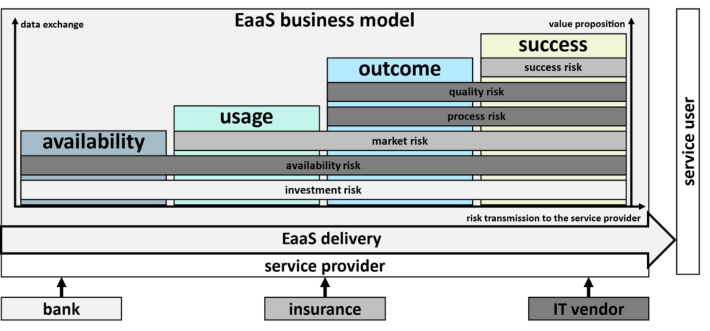
success-based EaaS business models. In availability-based EaaS business mod- els, the value proposition consists of the availability of a service with defined performance standards, with the billing parameter being the time in which it is made available. Usage-based value propositions have an identical value proposition, with the billing parameter being the usage intensity of the equip- ment. In outcome-based EaaS business models the value proposition consists of the production of an outcome of a defined quality. The billing param- eter here is the amount of outcome which meets the defined quality. The value proposition of success-based EaaS business models consists of the eco- nomic advantage that the service user receives when he cooperates with the service provider. For example, the cooperation could result in a higher pro- cess efficiency, which is linked to an economic metric that also represents the billing basis for the service provider (Roth and Stoppel, 2014). At the core of these value propositions there are different risks that are transferred from the service user to the service provider. However, in order to be able to adequately assess the various risks, many traditional production companies do not have the necessary resources and competencies (Schuh et al., 2015). That’s when strategic partnerships, in particular with banks, insurance com- panies (Stojkovski et al., 2021) and IT vendors (Relayr GmbH, 2022) become necessary.
EQUIPMENT AS A SERVICE (EAAS) – RISKS AND PARTNER The risk transfers associated with an EaaS business model can be differenti- ated into:
Investment risk: The service provider must secure the financing of the equipment. He has to bridge the initial income gap resulting from the lack of one-off payments from traditional equipment sales (Lah, 2016) and also has to take the risk of insolvent customers.
Availability risk: The service provider must maintain the agreed availabil- ity level of the equipment.
Market risk: The less orders the service user receives the lower the uti- lization of the equipment is, which forms the billing basis for the service provider.
Process risk: Incomplete or incorrect processes on the side of the service user lead to inefficient operation of the equipment (Roth and Stoppel, 2014).
Quality risk: The service provider guarantees a certain quality of the outcome of the equipment.
Value risk: If the billing basis of an EaaS business model is linked to the economic success of the service user, the service provider takes a part of the business risk from the service user, since, for example, company profits can fluctuate over time.
These risk transfers represent the core of the value proposition of an EaaS business model (Stich et al., 2022) with increasingly more risks being transferred to the service provider from availability-based to success-based
Equipment-as-a-Service – Necessary Changes for Service-Based Business Models 493
business models. While the service provider takes the investment and avail- ability risk in availability-based EaaS business models, he also must take the market risk in usage-based EaaS business models. If a outcome-based EaaS business model is pursued, the process risk and the quality and productiv- ity risk are also becoming part of the responsibility of the service provider. In success-based EaaS business models, the service provider also takes part of the service user’s value risk (Roth and Stoppel, 2014). These risks can be lowered with the use of appropriate strategic partnerships. While a strate- gic partnership with banks can help bridging the initial income gap and thus reduce the investment risk (Stojkovski et al., 2021), insurances can not only help the service provider to cushion their risks but also to iden- tify unproductive customers (Stich et al., 2022) and thus better assess the market and value risk. Further partnerships in the IT sector play another key role as service providers can reduce the quality and productivity risk as well as the availability risk, for example, by analyzing equipment data. The results of the analysis then form the basis for further optimizations, which can reduce the process or availability risk (Monitor Deloitte, 2021). To deliver the promised value, the service provider needs to continuously monitor the data of the equipment and evaluate the results produced by it (Dorka et al., 2017). As the risk transfers and thus the value proposi- tion of an EaaS business model increase, more data must be transmitted to the service provider. Figure 1 shows the different types of EaaS business models, the associated risks, and the potential benefits of different strategic partnerships.
Figure 1: Different types of EaaS business models, risks and support through strategic partnerships. Modified from (Evcenko et al., 2022).
To convince the customer of the performance of the EaaS business model and to build up trust, a service vendor can express the value proposition as performance guarantees or via service level agreement (SLA). While strate- gic partnerships with banks, insurances and IT vendors can help the service provider to reduce EaaS related risks, certain technical and organizational conditions must be met in the company of the service vendor, for him to be
able to offer and deliver an EaaS business model initially. If a service vendor is used to offer only transactional business models so far, he is faced with substantial technical and organizational changes, which is the focus of this work.
METHOD
To identify the organizational and technical need for change we want to answer the research questions summarized in Table 1.
Table 1. Overview of the research questions.
Table available in the original PDF paper.
RQ 1: Which peculiarities arise when developing the configuration of an EaaS offer?
RQ 2: Which technical and organizational needs for change exist for companies who want to deploy EaaS?
RQ 3: Which role do strategic partnerships with banks, insurances and IT vendors play when considering the technical and organizational needs for change?
To answer these questions, we first conduct a literature review. Based on this we define a procedure for developing EaaS which consists of three phases and to which we assign five core topics of change. This serves as taxonomy of changes. Following this we conduct workshops with 7 small and medium- sized enterprises (SME) from the field of mechanical and plant engineering to evaluate and specify the taxonomy with more detail. The companies are manufacturers of wearables for recording process steps in the manufacturing industry, small and larger machine components, location infrastructures and providers of holistic logistics solutions. In the workshops for each company at least one person representing the business and one person representing the technical view of point is present. A workshop consists of three individual sessions, while each sessions lasts around 120 minutes and focuses on one specific phase when developing an EaaS business model. Between the ses- sions there is a break of one to two weeks so that the companies can clarify questions which could not be answered during a session.
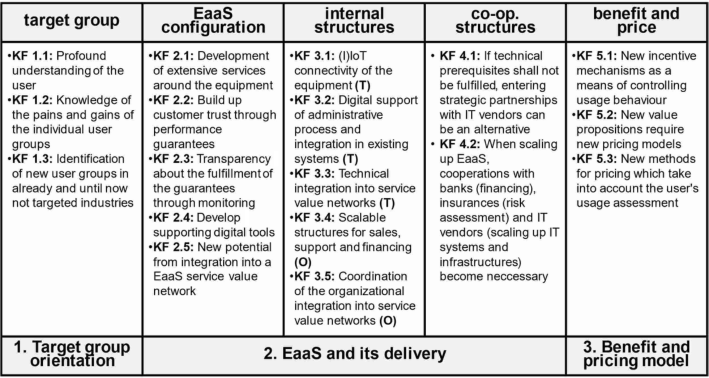
THREE PHASES TO DEVELOP EAAS AND FIVE CORE TOPICS OF CHANGE Based on findings from the literature review we identify three phases when developing EaaS. Using these phases, we then define a taxonomy of changes, consisting of five core topics.
Target Group Orientation EaaS focuses no longer on selling the equipment but on the associated value propositions of availability and/or results (Uhlmann and Meier, 2017). If the value propositions are fulfilled by the service provider and the user’s needs do not change, more sustainable and intensive customer relationships are
Equipment-as-a-Service – Necessary Changes for Service-Based Business Models 495
established, compared to the traditional sale of the equipment. EaaS con- sists of physical and digital service components (Schöllhammer et al., 2020), such as a machine and a related predictive maintenance application as well as usage-based billing, as it is common in XaaS business models (Henzel and Herzwurm, 2018). It therefore requires profound knowledge of the target group and its needs to configure the value proposition in the best feasible way, especially if the conditions, in which the EaaS is used, change perma- nently. This is the only way to create an offering that meets the increasing and more and more complex customer needs (Kolagar et al., 2022) without being cancelled by the customer beforehand.
EaaS and Its Delivery The EaaS configuration consists of the equipment associated with it, the ser- vices required for EaaS delivery, such as onboarding or support, the digital service components required for the equipment access such as digital tools and the value propositions associated with it (Monitor Deloitte, 2021). In addition to an (I)IoT connection (Relayr GmbH, 2022) of the equipment, technical structures like IT systems and IT infrastructure must also be imple- mented. With that the equipment can be monitored and controlled (Dorka et al., 2017) as there will be contractual penalties if the value propositions are not fulfilled, as it is common with SLA (Kohne, 2018). In addition, EaaS comes along with changes of the organizational internal structures, which, for example, take care of the integration of the EaaS into the service user’s organization with the goal of efficient service delivery (Schnaars et al., 2022) by providing appropriate human resources. Since different, special compe- tencies are absolutely necessary for EaaS provision and optimization and since these are normally not present in a company (Herzog et al., 2017) or cannot be built up on the short run (Farhadi, 2019), cooperations with appro- priate partner companies are a promising option (Kolagar et al., 2022) to compensate these deficits. With the establishment of co-operative structures, the above-mentioned strategic partnerships with banks, insurances and IT vendors emerge.
Benefit and Pricing Model The design of the pricing model for subscription-based business models such as EaaS (Stojkovski et al., 2021) is complex, so that the benefit of the EaaS, like the availability of the equipment (Schuh et al., 2019), must be taken into account when defining the price. At the same time, however, the oper- ating cash flow must also be included in the calculation, which requires a change in previously applied application systems due to smaller, recurring payments, especially for service providers with high-priced equipment (Stich et al., 2022). Finally, the risk transmission to the service provider and partic- ipating partners, such as the transmission of the market risk, play a key role when calculating the price.
Figure 2: Three phases for developing EaaS and five core topics of change.
Figure available in the original PDF paper.
KEY RESULTS The following is a qualitative summary of the key findings (KF), result- ing from the workshops based on the three phases for developing an EaaS business model and the five core topics of change described above.
Target Group Orientation Companies with an already functioning, transactional business model possess a sound understanding about their target groups and can define their EaaS value proposition clearly. In contrast, companies that want to define an EaaS offering from scratch, especially with target groups that are yet not known very well, find it difficult to work out their value propositions. A profound understanding of the user (KF 1.1) is necessary for a demand-oriented adap- tation of the EaaS for most of the target groups. Compared to transactional business models in EaaS the customer relationships last longer but can also be cancelled easier due to a shorter contract period. While the equipment of an EaaS offer can remain unchanged in many cases or undergo only marginal modifications, knowledge of the pains and gains of the user groups (KF 1.2) means that the services, digital tools and value propositions associated with the EaaS offer can be specifically configured for the interests and the “jobs to be done” (Christensen et al., 2010) of a user group by means of product accompanied services, guarantees and SLA and adapted over time to the con- stantly changing needs. With this, new user groups (KF 1.3) can be identified, both in already targeted but also in until now untargeted companies.
EaaS and Its Delivery The second phase is divided into the EaaS configuration, the internal and the co-operative structures.
EaaS Configuration When defining an EaaS offer, the companies with an existing and functioning business model and a profound understanding of their target groups were also able to clearly name the EaaS configuration. They were thus able to develop extensive services around the equipment (KF 2.1), adapted to the different companies and user types. These include configuration services, assistance systems and maintenance services. As the service vendor takes over certain risks and responsibilities the service user loses control over the equipment. Therefore, trust should be built through performance guaran- tees (KF 2.2) and transparency about their fulfillment through monitoring (KF 2.3). Supporting digital tools (KF 2.4) have been detailed for both cus- tomized services and transparency in EaaS delivery, which include access to
Equipment-as-a-Service – Necessary Changes for Service-Based Business Models 497
the equipment. In line with the vaguer notion of the target audience, the com- panies that wanted to define an EaaS offer from scratch were able to name the elements that belonged to it, but not in detail. What all the companies had in common, however, was that the new potential arising from integration with other EaaS offerings within an EaaS service value network (KF 2.5) enabled new design options for their own EaaS offer. For example, the integration of multiple EaaS services could be as follows: While one EaaS service records the movement of a worker’s manufacturing activities in the production pro- cess, the second transmits the location data of the semi-finished products to a third EaaS service, which preconfigures a system to suit these semi-finished products that are soon to be processed.
Internal Structures In terms of internal structures, a distinction must be made between tech- nical (T) and organizational (O) measures required for the delivery of an EaaS offer. While here, too, the companies with a functioning business model have at least partially implemented an (I)IoT connectivity of the equipment (KF 3.1), all companies were still at the beginning when it came to the digital support of administrative processes such as licensing or billing and their inte- gration into existing IT systems (KF 3.2) of the service user like an enterprise resource planning system (ERP system). However, both the connectivity and the necessary digital tools are prerequisites when it comes to the controlling of the equipment or delivering further services such as predictive maintenance. Furthermore if an EaaS should be integrated into a service value network, it also needs to be integrated technically (KF 3.3) through defined interfaces and data formats. The organizational measures reflect this. For example, all companies had structures for sales, support and financing of an EaaS. How- ever, these structures were not scalable. Thus, in the event of greater demand for the EaaS offering, scalable structures (KF 3.4) will be needed that focus, for example, on changing the sales incentive structures or the creation of dedicated positions for EaaS product management and development. Finally, prerequisites must be created to coordinate and administer the organizational integration of the EaaS offering into a service value network (KF 3.5). As the EaaS offering scales up, the question of how to finance the organizational and technical measures required for the EaaS delivery must also be answered anew.
Co-Operative Structures If a company cannot or will not fulfill the prerequisites for developing or delivering EaaS within its organization, it can enter strategic cooperations with banks, insurance companies or IT vendors. Those companies that had not yet implemented an (I)IoT connectivity to their equipment can benefit from cooperations with IT vendors (KF 4.1) that are able to, for example, provide them with this connectivity or with digital tools necessary for moni- toring or billing or they can support them when integrating their EaaS offer into existing systems like ERP systems. However, as soon as the scaling up of the EaaS offering becomes relevant, all companies would need to seek out to appropriate partners: banks for financing, insurances for a better assessment
and hedging of market and value risks and IT vendors for scaling up existing IT systems and IT infrastructure (KF 4.2).
Benefit and Pricing Model In line with their precise ideas about their target groups, some companies were able to describe the benefits and price model of their EaaS offering in concrete terms for each company and user group. This was not easy for those companies without a clear understanding of their target audience and the value their EaaS offering should provide. In general, new incentive mech- anisms were identified as a means of controlling usage behavior (KF 5.1), since, for example, careful equipment usage is reflected in a lower price. It became clear that the new value propositions provided with an EaaS offering require new pricing models (KF 5.2). These are not only dependent on pro- duction costs, margins or the risks transferred to the service provider. Here new methods for pricing are required that consider the service user’s usage assessment (KF 5.3). By transferring the availability and market risk to the service provider, he must assess the usage intensity and frequency to be able to take this into account when calculating the price.
NEED FOR CHANGE With the workshops we evaluated the three phases for developing EaaS and specified the five core topics of change. The findings complete our results from the literature review and can be seen as success factors for a service vendor who wants to offer EaaS. They are summarized in Figure 3.
Figure 3: Need for change when developing and delivering EaaS.
As Table 2 shows, the key findings can be used to answer the research questions.
Equipment-as-a-Service – Necessary Changes for Service-Based Business Models 499
Table 2. Overview of the research questions and assignment of the key findings.
Table available in the original PDF paper.
RQ 1: Which peculiarities arise when developing the configuration of an EaaS offer? – The knowledge of the target group is key (KF 1.1-1.3) as it is the base for a suitable EaaS configuration – equipment, extensive services, digital tools, guarantees and a possible integration into a service value network (KF 2.1-2.5) – which is the base when defining its benefit and price (KF 5.1-5.3).
RQ 2: Which technical and organizational needs for change exist for companies who want to deploy EaaS? – The equipment connectivity, digital support of administrative processes and the technical integration into existing systems and service value networks are technical prerequisites for EaaS (KF 3.1-3.3). Organizational need for change arises when considering scalable structures and the coordination of the integration into service value networks (KF 3.3-3.5).
RQ 3: Which role do strategic partnerships with banks, insurances and IT vendors play when considering the technical and organizational needs for change? – If a service provider cannot/will not fulfil the technical prerequisites or wants to scale up his EaaS offering in general, strategic partnerships become necessary (KF 4.1-4.2).
CONCLUSION
In this work we identified both a taxonomy of changes for EaaS business models and a procedure for the development of EaaS consisting of three phases which we assigned to the elements of the taxonomy. We then evaluated and specified this taxonomy of changes based on multiple workshops. The key findings from the workshops result in several organizational and techni- cal need for change, which can be seen as success factors for a EaaS service vendor. The next step would consist of the design of a cross-phase methodol- ogy that allows the creation of EaaS business models in a methodologically structured manner.
REFERENCES
Christensen, Clayton/McDonald, Rory/Day, Laura E./Roseman, Shaye (2010). Integrating Around the Job to Be Done. Harvard Business School Module Note 611–004. Dorka, Thomas/Morlock, Friedrich/Meier, Horst (2017). Management der IPSS-
Erbringung - IPSS-Execution System mit integrierter Performance-Messmethode. In: Horst Meier/Eckart Uhlmann (Eds.). Industrielle Produkt-Service Systeme. Berlin, Heidelberg, Springer Berlin Heidelberg, 137–161. Evcenko, Dimitri/Kett, Holger/Nebauer, Stephan (2022). Risiken managen – Einsatzpotenziale von EaaS-Lösungen in der Produktion. Zeitschrift für wirtschaftlichen Fabrikbetrieb 117 (12), 872–878. https://doi.org/10.1515/zwf- 2022-1164. Henzel, Robert/Herzwurm, Georg (2018). Cloud Manufacturing: A state-of-the-art
survey of current issues. Procedia CIRP 72, 947–952. https://doi.org/10.1016/j.pr ocir.2018.03.055. Kohne, Andreas (2018). Cloud-Föderationen. Wiesbaden, Springer Fachmedien Wiesbaden.
Kolagar, Milad/Parida, Vinit/Sjödin, David (2022). Ecosystem transformation for digital servitization: A systematic review, integrative framework, and future research agenda. Journal of Business Research 146, 176–200. https://doi.org/10. 1016/j.jbusres.2022.03.067. Lah, Thomas (2016). Technology-as-a-Service Playbook. How to Grow a Profitable
Subscription Business. s.l., Point B Inc. Monitor Deloitte (Hrsg.) (2021). Equipment-as-a-Service. From Capex to Opex – new business models for the machinery industry. Deloitte Touche Tohmatsu Limited. Available online at https://www2.deloitte.com/content/dam/Deloitt e/de/Documents/energy-resources/Deloitte_Equipment-as-a-Service.pdf (accessed 9/19/2022). Relayr GmbH (2022). Servitization in der Fertigugnsindustrie: Equipment-as-a-
Service als Zukunftsmodell? Riasanow, Tobias/Krcmar, Helmut (2020). Everything as a Service (XaaS). In: Tobias Kollmann (Ed.). Handbuch Digitale Wirtschaft. Wiesbaden, Springer Fachmedien Wiesbaden, 1–12. Roth, Stefan/Stoppel, Eduard (2014). Preissysteme zur Gestaltung und Aufteilung
des Service Value. In: Manfred Bruhn/Karsten Hadwich (Eds.). Service Value als Werttreiber. Wiesbaden, Springer Fachmedien Wiesbaden, 183–204. Schöllhammer, Oliver/Schmitt, Jan Lukas/Nebauer, Stephan/Bauernhansl, Thomas (2020). Everything-as-a-Service Geschäftsmodelle für die Industrie. In: Michael ten Hompel/Birgit Vogel-Heuser/Thomas Bauernhansl (Eds.). Handbuch Industrie 4.0. Berlin, Heidelberg, Springer Berlin Heidelberg, 1–17. Schnaars, Nico/Galipo˘glu, Erdem/Haasis, Hans-Dietrich/Kotzab, Herbert (2022).
Monetizing Industry 4.0: Design Principles for Subscription Business in the Manu- facturing Industry. In: 2019 IEEE International Conference on Engineering, Tech- nology and Innovation (ICE/ITMC),2019 IEEE International Conference on Engi- neering, Technology and Innovation (ICE/ITMC), Valbonne Sophia-Antipolis, France, 17.06.2019 - 19.06.2019. IEEE, 1–9. Stich, Volker/Müller, Daniela/Holst, Lennard/Frank, Jana (2022). Smart Services als Enabler von Subscription-Geschäftsmodellen in der produzierenden Industrie. In: Manfred Bruhn/Karsten Hadwich (Eds.). Smart Services. Wiesbaden, Springer Fachmedien Wiesbaden, 157–177. Stojkovski, Isabella/Achleitner, Ann-Kristin/Lange, Thomas (2021). Equipment as a
Service: The Transition Towards Usage-Based Business Models. SSRN Electronic Journal. https://doi.org/10.2139/ssrn.3763004. Uhlmann, Eckart/Meier, Horst (2017). Produktverständnis im Wandel. In: Horst Meier/Eckart Uhlmann (Eds.). Industrielle Produkt-Service Systeme. Berlin, Hei- delberg, Springer Berlin Heidelberg, 1–16.
LISTED IN THE AHFE DIGITAL BOOKSTORE CATALOGUE
Explore the complete digital volume
Human Systems Engineering and Design (IHSED 2023): Future Trends and Applications
Read this individual research paper free through the original publisher, or explore the full digital proceedings book.
ISBN 978-1-958651-88-9
Explore this ISBN in the AHFE Bookstore ↗Listed in the July 2026 bookstore catalogue; search by ISBN to confirm current availability · Digital book purchase optional