Dennis Dombrowski, Bernd Hienz, Stefan Aust, Ludwig Maul (2023). Customer-Centered Quality Function Deployment - A Framework for the Iterative Involvement of the Voice of the Customer and Derivation of Measurable Product Requirements in Innovation Design. In: Human Systems Engineering and Design (IHSED 2023): Future Trends and Applications. AHFE Open Access, vol. 112, pp. 1–9. https://doi.org/10.54941/ahfe1004107
Publisher statistics will load when you open Metrics.
AHFE OPEN ACCESS OPEN ACCESS CONFERENCE PROCEEDINGS PAPER
Customer-Centered Quality Function Deployment - A Framework for the Iterative Involvement of the Voice of the Customer and Derivation of Measurable Product Requirements in Innovation Design
In this paper, a new approach for the involvement of the voice of the customer in product innovation projects is discussed by using an example of automotive concept design. Today, a company's competitiveness is directly linked with its ability to innovate. At the same time, many product concepts fail in the market, as they do not satisfy customer requirements. Concurrently, the aim of this paper is to design a process that monitors the customers' needs throughout the product development process and allows to translate those requirements into measurable development targets. A literature review deems the traditional development of specification sheets to be static and superficial. Specification sheets often display a generic customer request, however, fail to convey the subliminal customer needs. On the other hand, customer-centred methods (e.g., Design Thinking) allow a deep understanding of those needs but lack their translation into the tangible language of engineers. Therefore, the target of this paper is to close the gap between the two approaches leveraging an adapted and iterative version of the Quality Function Deployment methodology. For this purpose, a three-step study is conducted. Firstly, requirements for the process are collected with the help of experts from the fields of technology, business, and human values. Secondly, a new process model is developed in workshops with experts. In a third step this new process is evaluated through expert feedback. As a result, a new process is presented for identifying, weighting and quantifying future proof product requirements.
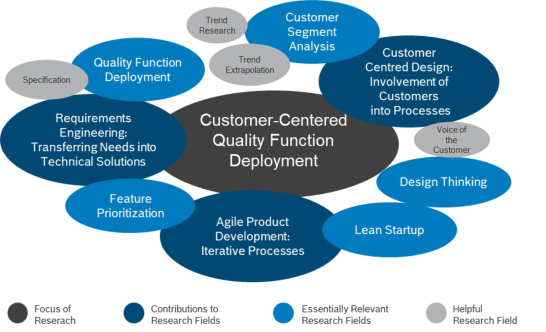
While emerging technology trends enable innovative products, 60 percent of inventions fail, as they do not meet the needs of the target group (Schneider and Hall, 2011). In the past, product requirement documents (PRD) domi- nated how requirements were aggregated in the automotive supply industry. While PRD provide a clear and static goal, they fail to reveal the key need of customers (Hofbauer and Wilhelm, 2015). On the other hand, iterative meth- ods like Design Thinking (DT) and Lean Startup (LSU), allow to uncover key needs that make a customer buy a product (Brown, 2008). However, these methods fail to translate the needs of customers into specific target values and thus the needs often get neglected during idea implementation (Gericke et al. 2010). This study proposes a new approach by iteratively revising and trans- lating the customer needs revealed in DT and LSU into measurable product KPIs by developing an iterative adaptation of the Quality Function Deploy- ment (QFD). The concept has been tested and evaluated in an innovation project at Robert Bosch GmbH. The research contributes to several fields of research (see Figure 1).
Figure 1: Helpful, relevant and focal fields of research.
STATE OF THE ART: PREDICTIVE APPROACHES TO REQUIREMENTS ENGINEERING IN PRODUCT DEVELOPMENT The predictive approach in requirements engineering (RE) relies on the devel- opment of the target prior to concept development and solution finding. After the completion of the RE, changes of the requirements base are only done when indispensable (VDI 2221 Blatt 1). The product’s area of application, requirements (functional and non-functional), interfaces and other factors for the definition of the development task are to be included in the PRD (Bender and Gericke, 2021). On the other hand, a predefined process leads to lethargy in the product development. Changes in the environment (e.g. the needs situation of the target group) can only be incorporated with an increased expenditure of resources (Gericke et al. 2010). The same applies
Customer-Centered Quality Function Deployment 3
to requirements that were not recognized in the RE-phase (Bender and Ger- icke, 2021). Another weakness of this approach is the lack of focus on the target group. A one-off declaration of all requirements does not allow for an in-depth understanding of customer needs (Brown 2008). An alterna- tive methodology that promises to place the customer at the center of RE is QFD. It transforms qualitative customer requirements (CR) into measurable product key performance indicators (KPI). CRs are not measurable through technical metrics, and are often only subliminally recognizable. Consumers often do not have the detailed technical knowledge to translate their needs into concrete measurable performance criteria themselves (Childs, 2014). For example, a customer wants to arrive at their destination on time (CR). To achieve this, a vehicle must have a certain acceleration behavior from 0 to 100 km/h (KPI). Not every CR can be described by a single KPI alone. For this reason, the QFD uses a matrix to link CRs with KPIs. In the creation of the matrix, the CRs are weighted according to their importance for the customer. In the central matrix of the QFD, it is discussed for each KPI how strongly it influences the fulfilment of a CR from a scale of 1 to 9 (Schmidt Steffenhagen 2007).
STATE OF THE ART: AGILE AND ITERATIVE APPROACHES TO REQUIREMENTS ENGINEERING IN PRODUCT DEVELOPMENT Unlike traditional product development, the requirements in iterative product development are constantly changing. Developers ask customers about their needs for a product, develop a simple prototype based on these needs and then present it to the customers to gain further insights into their needs. This process is repeated until the final product is market-ready. In its six phases, DT aims to place the needs of the customer at the center of product devel- opment (Brown, 2008). With the user journey method from the DT toolbox, for example, the process on how the customer interacts with the product is described. In each process step, current needs or issues can be recognized by the development team. Literature cites the strengthening of the target group’s understanding as an essential advantage of the above-mentioned approach. Through the recurring runs and the methods that encourage empathy, a deep understanding of the needs behind the statements of the customer can be built up (Brown, 2008). Product ideas that would otherwise not have been successful on the market can, in the best case, already be excluded in the test phase (Pelicioni et al. 2017). According to its founder Ries (2018), the LSU approach is an alternative approach to developing successful prod- ucts. It consists of three phases that are iterated through. In each run of the “Build-Measure-Learn cycle”, the requirements base is refined. In par- allel, the concept maturity increases from an idea to a final product (Eckert, 2017). Presenting the ideas using a physical product or an illustration makes it easier for the customers interviewed to understand what requirements they have for the product, which enables a deeper understanding of the target group. Furthermore, market changes can be integrated more flexibly and the market risk can be reduced (Ghezzi, 2019; Yaman et al. 2017). According to Gericke et al. (2010) a low level of detail in the final product ideas is a
weakness of iterative RE-approaches. The iterative RE processes end after the product idea has been established and evaluated and do not offer a sys- tematic approach to the implementation of the ideas. Because of this, the key need of the target group is often neglected in the idea implementation phase (Gericke et al. 2010). There is a gap in translating needs into measurable KPIs (Pelicioni et al. 2017).
OBJECTIVES AND METHODOLOGY OF RESEARCH Predictive approaches often provide specific jobs to focus on during product development, however, fail to convey the subliminal customer needs. On the other hand, iterative approaches allow a deep understanding of those needs but lack their translation into the tangible language of engineers. Therefore, the target of this paper is to close the gap between the two approaches by introducing a process for the systematic integration of customer requirements into pre-development. The process must be designed to be as flexible and iter- ative as possible to correspond to needs of agile innovation development. For this reason, it must be possible to subsequently incorporate findings in later cycles of the development project. At the same time, the needs of the customer must be translated into technical target values to ensure their implementation in the product concepts.
To define such a process, the following research questions need to be answered:
Which quality criteria does a process of iterative RE need to fulfill?
How can a RE process be iteratively aligned with the voice of the customer?
What benefits can be expected from an agile, iterative RE process that includes the voice of the customer?
The literature review on the state of the art on agile development of cus- tomer needs forms the basis of the work. Different methods and approaches are compared in the earlier chapters of this paper. Subsequently, in the next chapters, a stakeholder survey helps specify the criteria relevant for the def- inition of the process. Thereafter, the procedure is elaborated and tested on the basis of the example project. With this, measurable target requirements are created with the help of the Quality Function Deployment Methodology, based on methods from DT and the LSU Approach. The final chapter aims at evaluating the fulfilment and the benefits along the earlier defined process criteria in another stakeholder survey.
Figure 2: Methodology of the research.
Customer-Centered Quality Function Deployment 5
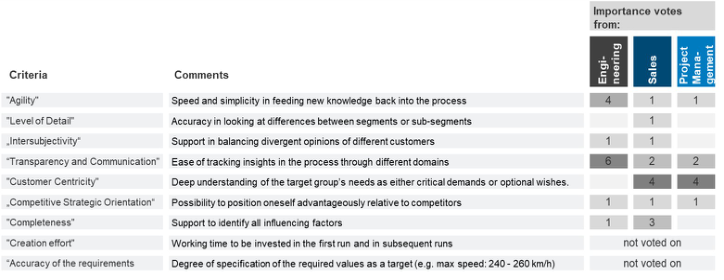
IDENTIFICATION OF CRITERIA The company’s internal quality criteria are determined with the help of a group survey of the process stakeholders. Several factors are influential for the selection of the group of participants: the workshop involves stakehold- ers from all sub-areas of the process to enable a holistic view of the spectrum of needs and to allow different perspectives. On the one hand, employ- ees from sales have the task of enquiring about or uncovering CR. On the other hand, the results of the process must be as easy to use as possible for development. Parallel to the points mentioned above, project management is involved in the implementation and control of the process. The selection of the three groups of participants is based on the definition of the concept of innovation from DT. According to DT, innovations have to be technically fea- sible, economically interesting and must fulfil an added value for the target group (see Figure 8) (Meinel and Leifer, 2011). Another diversification is the involvement of stakeholders from different divisions and central departments of Robert Bosch GmbH as well as from different sub-projects. The same group of eight experts participates in all process steps. During the workshop statements on relevant criteria for the process are collected and eventually clustered to find overlaps. The clustering shows that a large part of the inter- nally established quality criteria overlap with the criteria mentioned in the literature. Once the clusters are defined, participants from the different dis- ciplines can vote with up to three votes per person and criterion on how important each of the criteria is to their work. The developed quality criteria are depicted in Figure 3. They serve as input for a process framework to be developed in the following chapter.
Figure 3: Identified criteria from the different perspectives.
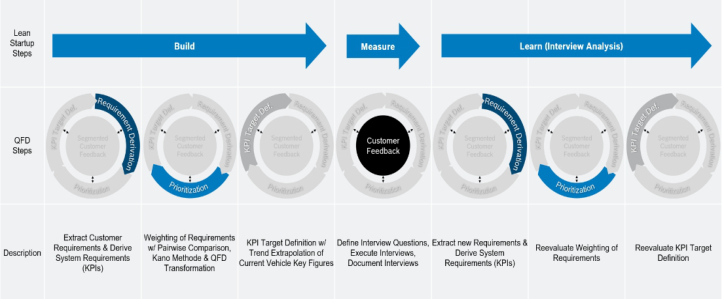
PROCESS FRAMEWORK The three core steps of the process presented here are based on the QFD procedure and at the same time are iterated analogously to LSU. The first three columns of Figure 4 represent the core steps. In the first core step of “Requirement Derivation”, KPIs are defined with the help of the col- lection of existing specifications. Additionally, CRs are gathered through methods from DT. In the second step of “prioritisation”, the individual CRs
are weighted on the basis of their importance, classified according to the established Kano-scheme and translated into measurable KPIs in the lan- guage of the developers with the help of the QFD-matrix. In the last step of the “KPI Target Definition”, target ranges for the individual KPIs are deter- mined with the help of regression of vehicle data over time. Analogous to the “Build-Measure-Learn-Cycle”, the three steps are to be iterated through. The first process run assembles the “Build”process step of the LSU. Hypothe- ses about the requirements base of the customers are made. Building on this base, a first prototype is created. In the “Measure” step, customer interviews are used to evaluate the prototype, but also the requirements base of the iterative QFD. In the preparation of the interviews, quantitative questions are created to evaluate the weighting of the CR. Qualitative questions can be used to uncover further CR. In team workshops, the interview results can be used to refine the data in the QFD as part of the Learn step. After the completion of each iteration, the QFD serves to support the develop- ment by setting specific targets in the development of a new concept version. The iterative procedure makes it possible to refine the targets with each iteration.
Figure 4: Identified criteria from the different perspectives.
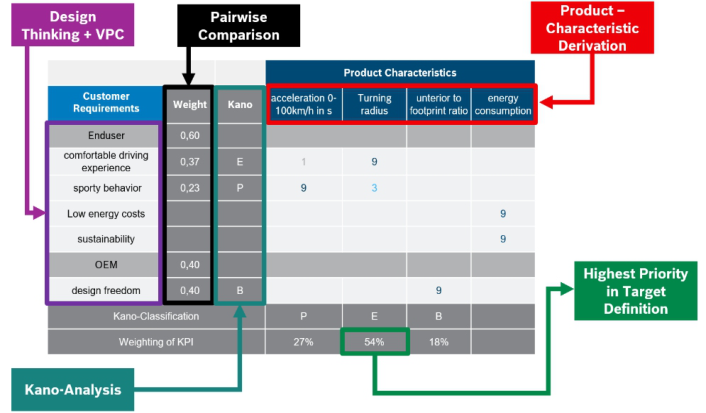
In the exemplary evaluation of the process, methods such as user journeys and personas are used to elicit the CR. The aim is to uncover both existing requirements and previously hidden needs of the customer in an empathetic and creative way. The process distinguishes between the needs of the OEMs and the needs of the end users of the cars. To serve as an example, only excerpts of the research are considered in the following. The KPIs at vehicle level are taken from an internal study, which is compiled with the help of expert interviews and former specifications. Within the scope of this work, the basis of KPIs is evaluated and completed. The weighting of the CRs is done with help of the pairwise comparison method. Through the correlation analysis (see Figure 5) it is determined how the fulfilment of a KPI affects the satisfaction of the target group regarding a specific CRs on a scale from 1 to 9. The correlation analysis between CRs and KPI can contribute to the understanding of the KPI and CR basis during the testing in the project. Some
Customer-Centered Quality Function Deployment 7
of the CRs identified are not represented by any KPI in the QFD matrix. The visual representation of the links between CRs and KPIs also shows that sus- tainability of a vehicle is not only determined by its electricity consumption, but also by the type of components used and their service life. This way, the QFD helps to cover previously unknown sub-aspects of individual CRs in the form of several technical KPIs. It can be expected that the method will also help to translate changes in the basis of CRs as a result of the customer sur- veys into KPIs. This is where the iterative nature of QFD becomes apparent. In the first test run of the process, newly introduced CRs are again weighted, and the correlation analysis is performed. It is expected that new criteria can also be easily implemented in the QFD matrix after surveying the customers in the second run. In practical application, the definition of a target for each KPI is achieved with the help of time regression of the performance data of different e-vehicle models. The discussion of these investigations will be omitted here.
Figure 5: Methods used in QFD (own illustration based on Schmidt und Steffenhagen 2007).
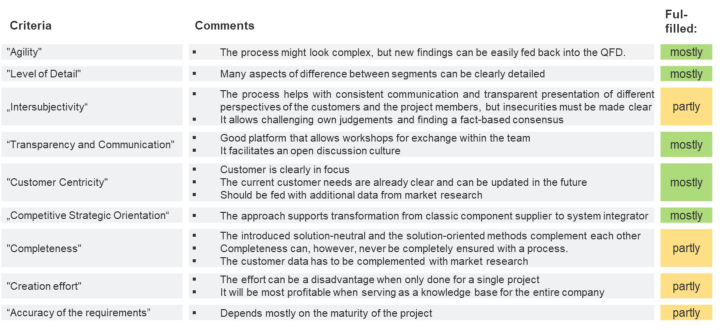
EVALUATION OF THE BENEFITS OF THE APPROAFCH In summary, the main strengths of the process are the adaptations of RE to a dynamic environment in the context of agile product development. The pro- cess supports the discovery of unknown needs and prioritizes them according to their differentiation potential. The systematic development of a key figure scheme enables a nearly complete mapping of the customer’s perspective in a form required by engineers. The disadvantage is the effort required for the creation of a database and the concretization of qualitative statements into quantitative values. Individual aspects of the benefits can be seen in the following figure.
Figure 6: Aspects of the evaluation with regard to the different quality criteria.
CONCLUSION AND OUTLOOK The aim of this paper is to present a process that can capture previously hid- den needs of a target group can help translate these into measurable product KPIs. Starting point for such a process are the current needs of agile prod- uct development and the combination of the strengths of the classical and the target group-oriented methods of RE. The presented approach has the advantage that it forces the process participants to illuminate different opin- ions. The different opinions can be recorded in the process, which is why uncertainties in individual assessments are made transparent. This makes it possible to verify the assumptions in future client interviews. Furthermore, the method creates a clear focus on the needs of the target group and offers a platform for transparent communication of these in interdisciplinary teams. For the future, the effort to create the knowledge base could generate added value across various projects. However, this needs to be verified in further studies. In the long term, central departments should own the maintenance of the knowledge base and distribute the generated knowledge within the company. Further development projects can serve to constantly update and supplement the requirements. Nevertheless, the implementation of such a process throughout project teams on system level and on component level is a change process and is best done iteratively much like in the product development approach which the process suggests.
REFERENCES
Bender, Beate/Gericke, Kilian (2021). Entwickeln der Anforderungsbasis: Requirements Engineering. In: Beate Bender/Kilian Gericke (Hg.). Pahl/Beitz Konstruk- tionslehre. Berlin Heidelberg: Springer Berlin Heidelberg, 169–210. Brown, Tim (2008). Design Thinking. Harvard Business Review (6), 84–92. Childs, Peter R. N. (2014). Mechanical design engineering handbook. Oxford:
Butterworth-Heinemann. Eckert, Roland (2017). Lean Startup in Konzernen und Mittelstandsunternehmen.
Wiesbaden: Springer Fachmedien Wiesbaden.
Customer-Centered Quality Function Deployment 9
Gericke, Kilian/Beinke, Christian/Gemmer, Pascal/Blessing, Luciënne (2010). Entwicklungsmethodik nach Pahl und Beitz und Design Thinking-Vergleich und Einordnung. In: Dieter Krause/Kristin Paetzold/Sandra Wartzack (Hg.). Design for X. Beiträge zum 21. DfX-Symposium, Symposium Design for X, Buchholz, 23.-24.09.2010. Hamburg: TuTech-Verl. Ghezzi, Antonio (2019). Digital startups and the adoption and implementation of Lean Startup Approaches: Effectuation, Bricolage and Opportunity Creation in practice. Technological Forecasting and Social Change 146, 945–960. Hofbauer, Günther/Wilhelm, Alexander (2015). Innovationsprozesse erfolgreich
managen - ein Praxisabgleich für die frühe Phase des Innovationsmanagements. Ingolstadt: Technische Hochschule Ingolstadt. Meinel, Christoph/Leifer, Larry (2011). Design Thinking Research. In: Christoph Meinel/Larry Leifer/Hasso Plattner (Hg.). Design Thinking. Understand - Improve - Apply. Berlin, Heidelberg: Springer Berlin Heidelberg, xiii–xxi. Pelicioni, Riccardo/Armellini, Fabiano/Kaminski, Paulo/Bassetto, Samuel (2017).
Including the voice of the client in the creative process. A case study of the inte- gration of Quality Function Deployment (QFD) to the Value Proposition Design (VPD) in the service sector. The Journal of Modern Project Management (2), 6–21. Ries, Eric (2018). The Startup Way. Das Toolkit für das 21. Jahrhundert, mit dem jedes Unternehmen erfolgreich sein kann. München: Verlag Franz Vahlen. Schmidt, Ralf/Steffenhagen, Hartwig (2007). Quality Function Deployment. In:
Berlin. Yaman, Sezin Gizem/Munezero, Myriam/Münch, Jürgen/Fagerholm, Fabian/Syd, Ossi/Aaltola, Mika/Palmu, Christina/Männistö, Tomi (2017). Introducing con- tinuous experimentation in large software-intensive product and service organi- sations. Journal of Systems and Software 133, 195–211.
LISTED IN THE AHFE DIGITAL BOOKSTORE CATALOGUE
Explore the complete digital volume
Human Systems Engineering and Design (IHSED 2023): Future Trends and Applications
Read this individual research paper free through the original publisher, or explore the full digital proceedings book.
ISBN 978-1-958651-88-9
Explore this ISBN in the AHFE Bookstore ↗Listed in the July 2026 bookstore catalogue; search by ISBN to confirm current availability · Digital book purchase optional