Shuo-fang Liu, Yi Qing Ding (2025). Establishing a reward mechanism based on Quality Function Deployment in sustainable consumer service design. In: Interdisciplinary Practice in Industrial Design. AHFE Open Access, vol. 183, pp. 188–196. https://doi.org/10.54941/ahfe1006440
Sustainable actions have emerged as crucial components for the functioning of modern society and businesses. Sustainable consumption has recently become one of the focuses to promote, but due to ingrained buying habits, brand loyalty, and price discrepancies, there is still a lack of actual purchase intention and support. To enhance consumers' willingness to engage in sustainable consumption, it is essential to leverage the psychology of human rewards pursuit, establishing the reward mechanism to resonate with consumers. Additionally, applying Quality Function Deployment (QFD) to transform qualitative factors into quantitative data, and using surveys to capture actual consumer experiences to design reward systems that align with consumer preferences objectively. The article explores how the insights gained from psychology and QFD can inform the service design of sustainable consumption processes. Stimulating consumers with rewarding experiences, it can encourage them to modify their lifestyles and purchasing decisions, ultimately fostering a shift towards more sustainable choices.
In recent years, the world has been trying to promote a number of sustainable measures in various and multiple fields, showing that sustainable environmental and economic performance has been regarded as a key point that cannot be ignored in responsible consumption and production (Nishitani and Kokubu, 2020). Responsible consumption and production is also the 12th SDG sustainable development goal promulgated by the United Nations. So far, many companies and researchers have developed diverse responsible production models and products, but there is no practical solution for how consumers implement responsible consumption.
Compared with companies, consumers will be more inclined to their own usage habits, trust in brands, and product price gaps, resulting in passive sustainable consumption. However, consumer behaviors is an important indicator to measure the sustainability of consumption (Rebolledo-Leiva et al., 2017), and achieving sustainable development must include consumer
Establishing a Reward Mechanism Based on Quality Function Deployment 189
participation (Papamichael et al., 2024). The consumers have to cooperate with the manufacturing industry to get closer to the goal of sustainability and create a more harmonious environmental life. Therefore, this study attempts to resolve the problem of consumers’ passive sustainable consumption, summarizing the reasons, and using a systematic way to change their sustainable consumption behavior (Papamichael et al., 2024). In consumer services design, set up some incentive measures by human reward pursuit psychology to bridge the gap of inactive behavior, and apply Quality Function Development (QFD) as a tool, which can be used to accept consumers’ demand for rewards and convert them into appropriate and quality-assured reward factors. Through the QFD process, reward methods that suit and motivate consumers will be established, then positive encouragement methods to promote consumers’ sustainable consumption actions.
Reasons for Passive Sustainable Consumption Consumers are not only victims of the continued deterioration of the global environment but are also one of the sources of environmental problems (Lorek, 2016). So that increasing consumers’ sustainable consumption has become an emerging solution for sustainable development today. In order to promote consumers’ sustainable actions, various fields, and research have begun to analyze the reasons why consumers have passive behaviors in sustainability and try to find breakthroughs for improvement.
There are many reasons for passive consumption. We are going to explore three related. First, consumers rarely want to change existing lifestyles and habits when the external economic, technological, and material environment is stable (Jaeger-Erben, Rückert-John and Schäfer, 2015, Lorek, 2016). In addition, the amount of environmental information disclosed by companies to improve the production process is too professional or insufficient (Nishitani and Kokubu, 2020), making it impossible for consumers to observe and understand the true status of sustainable production directly. On the other hand, consumers consider the value of product prices and the economic benefits of use when consuming, and know that consumers will only choose to engage in sustainable consumption behavior when they reach a certain level of environmental performance and the price is appropriate (Nishitani and Kokubu, 2020).
To improve these problems, it is not only necessary to change consumers’ unsustainable habits and products but also to provide strategic guidance from the most fundamental daily life services (Lorek, 2016). As a result, the next step will use the psychology of reward pursuit from the perspective of consumers to find the necessary conditions and implementation mechanisms to appropriately and effectively promote consumption sustainability.
Resolve Passive Consumption With Human Reward Pursuit Bijleveld, Custers & Aarts (2010) expatiated that human reward pursuit is when people receive reward stimulation information from the outside world, they will weigh the expected value and make efforts for it. Especially
190 Liu and Ding
when they are conscious, consumers will evaluate how to obtain the reward effectively and effortlessly. From this point of view, it is observed that people have positive mental and behavioral responses obviously when they are informed of the opportunity to obtain rewards.
For consumers who have difficulty transforming sustainable actions and consumption into daily life (Lorek, 2016), the reward mechanism is a good opportunity to try to change consumer behaviors. Previously, there have been studies and companies using incentive mechanisms to encourage people’s sustainable actions and consumption behaviors. For example, Keh & Lee (2006) stated that service industries usually use incentives to increase consumption. Accordingly, this research establishes a reward mechanism, such as providing price discounts in sustainable consumption services (Yang, Wang and Hahn, 2020), which can encourage consumers to transform their existing behaviors positively. In addition, when establishing a reward setting, it is necessary to consider the consumer’s feelings and avoidance thoughts about the setting, hoping to reduce the negative impact on the reward as much as possible. This part of the consideration will be included in the methodology.
METHODOLOGY
A model is established to stimulate changes in consumption habits through a reward mechanism. This involves secondary data collection and semi- structured interviews to identify consumers’ needs and expectations. Then reward factors are evaluated using QFD, and a questionnaire investigates the timing of each factor to attract consumption, aiming for a sustainable, consumer-oriented reward system.
Reward Mechanism Setting To enhance consumer appeal, it is necessary to consider the type of reward motivation, the reward size, the effects of reward restrictions, and how to shift consumers’ sustainable consumption behaviors through rewards.
Consumer motivations for reactions can be categorized into economic and moral benefit rewards. Determining the type and size of rewards is important, and can be conceived in the direction of providing economic benefits that are beneficial to consumers (Wathieu, Muthukrishnan and Bronnenberg, 2004; Yang, Wang and Hahn, 2020). When facing the reward stimulation, consumers’ brains will be more inclined to reward the benefits of action when weighing the value, thereby achieving the purpose of changing consumer behavior. The incentive motivations such as price discounts and special rewards for early access consumption (Sheth, 1991), as well as additional gifts with added value (Hu, Li and Shi, 2015).
Next, consider limiting quota rewards or implementing time-limited discounts. Limit setting prevents counterproductive effects from excessive reward amounts. (Yang, Wang and Hahn, 2020), Thus, maintaining sustainable consumption behavior is essential to incorporate both economic and moral motivations. This includes providing sustainable knowledge to promote understanding of its benefits, such as ecological waste reduction
Establishing a Reward Mechanism Based on Quality Function Deployment 191
information, disclosing environmental information, showing sustainable knowledge hints, and delivering the advantages of sustainable consumption. Also, using games to enhance the realization of environmental conditions and sustainable knowledge. (Whittaker, Russell-Bennett and Mulcahy, 2021). Through economic and moral motivations, the feasibility of maintaining sustainable consumption behavior is initially sorted out. All the above reward factors to be evaluated to attract consumers are summarized in Table 1 below.
Table 1: Reward factors to be evaluated.
Table available in the original PDF paper.
Economic Benefits Motivation Moral Benefits Motivation Price discounts Ecological waste reduction information Early access to special consumption Environmental information disclosure
rewards Additional gifts Show sustainable knowledge hints Quota limited rewards Deliver the benefits of sustainable
consumption when consuming Limited time rewards Use games to establish sustainable knowledge and behaviors
Semi-Structured Interview The semi-structured interview is mainly to understand consumers’ needs and expectations through dialogue. A total of three interviewees were invited for the interview, all of whom have long-term sustainable habits such as using reusable bottles and reusing bags. Their reward needs, categorized into economic, social, and moral aspects, are summarized in Table 2.
Table 2: The expected rewards from consumers.
Table available in the original PDF paper.
Economic Aspects Social Aspects Moral Aspects Big price discounts Celebrity endorsement of Information on reducing
joint products
Purchase in helping
Well-known brand
ecological waste Discount coupons in the charity or environmental activities
trademark-authorized products
membership system by accumulating consumption times Get discounts from the
Authorized limited-edition products
membership system by accumulating consumption times Collect points for gifts Sweepstakes Promotions
Quality Function Deployment The reward mechanism uses QFD to evaluate factors, convert consumer reward needs, and select appropriate rewards. QFD is considered to effectively address consumer needs (Chan and Wu, 2002), and facilitate
192 Liu and Ding
the progress of subsequent technical operations, design, and market testing. At the same time, QFD can improve the service development cycle (Griffin and Hauser, 1992), saving some traditional R&D procedures.
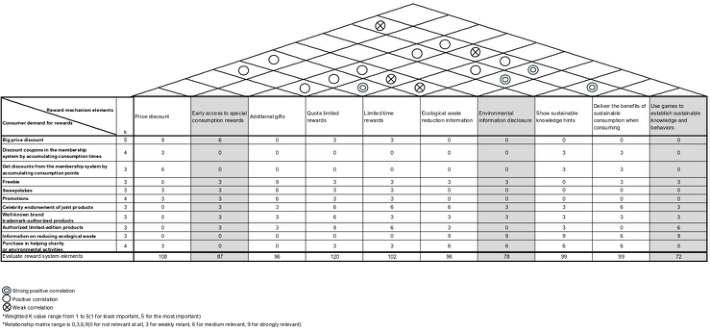
This article takes the advantage that QFD translates consumer needs into effective reward mechanisms for promoting sustainable consumption. The quality house was established through Tables 1 and 2, and the weighted calculation of the relationship matrix identified key reward mechanisms.
Questionnaire The questionnaire was used to investigate consumer interest in reward factors at three consumption stages: before consumption, during consumption, and after consumption. Understanding each reward factor can most arouse consumer interest in which consumption stage, and how to obtain rewards that are more in line with consumers’ expectations. A five-point Likert scale examined the acceptance of different rewards and acquisition methods: consumption amount, number of consumptions, random selection, and games. Finally, objective averages were then used to establish a complete reward mechanism based on the findings.
RESULTS AND DISCUSSION
The matrix relationship operation results in Figure 1 indicate that higher- scoring factors meet consumer demand for rewards, particularly economic rewards like quotas limited rewards and price discounts. It is understood that the stimulation of reward restrictions and discounts brings awareness of good value for money. Additionally, three moral reward factors in Figure 1 also show related to sustainable information scored above 100 points. Consumers receive the benefits of sustainable knowledge and actions that can reduce ecological waste, and the sense of achievement and satisfaction they generate boosts their willingness to engage in sustainable practices. Besides, factors with lower scores will be excluded from the reward mechanism.
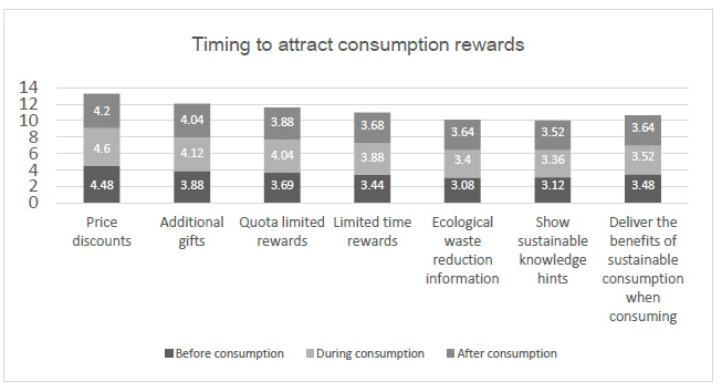
Figure 2 depicts questionnaire statistics from 25 participants regarding reward timing. Results show that reward awareness during or after consumption increases consumer interest. Factors like additional gifts and limited time rewards attract equal interest during and after consumption. In addition, delivering benefits of sustainable consumption when consuming has higher attraction scores before consumption, identifying them as key before consumption factors, and the price discount has a higher comprehensive attractiveness score after consumption than other items, which is listed as an after consumption reward factor.
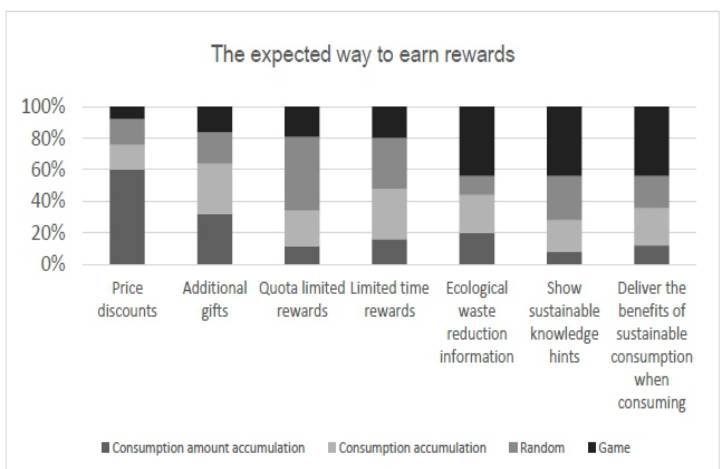
Moreover, the data illustrating suitable ways to earn rewards is presented in Figure 3. From the chart, consumers favor the economic rewards such as price discounts and additional gifts, compared with the uncertainty caused by random and games, they prefer to ensure obtaining rewards from consumption amount accumulation and consumption accumulation. Meanwhile, consumers are uncertain about receiving quota limited and limited time rewards, preferring random. The moral factor informing about the reduction of ecological waste is obtained by consumption accumulation,
Establishing a Reward Mechanism Based on Quality Function Deployment 193
presenting that consumers want to get a sense of achievement and satisfaction from the action of sustainable consumption. In comparison, showing sustainable knowledge hints provides information with low feedback, often through engaging games. The character of delivering the benefits of sustainable consumption lies between receiving sustainable information and encouraging consumers, to consider it can be received from consumption accumulation or games.
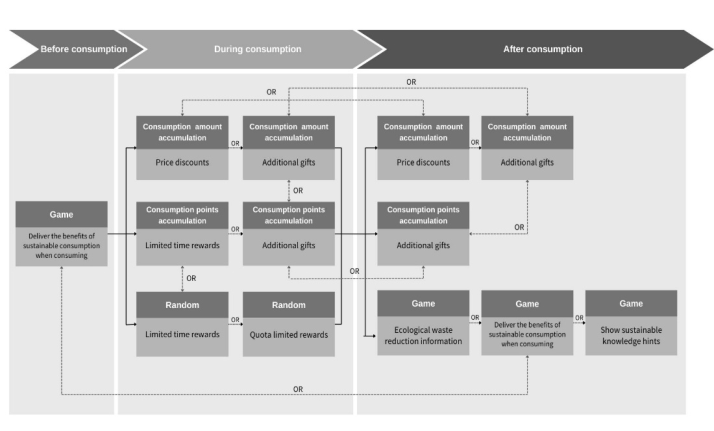
The research aims to create a reward mechanism that meets consumer needs and attracts them, based on QFD and questionnaires. This mechanism is integrated into the service process of sustainable consumption, as illustrated in Figure 4.
Figure 1: The quality house for evaluating reward system factors.Figure 2: Consequences of participants choosing attractive reward timings.
194 Liu and Ding
Figure 3: Participants choose the expected way to earn reward outcomes.Figure 4: Establish the reward mechanism for sustainable consumer service design.
CONCLUSION
This article explored methods for encouraging sustainable consumption. It examines how the psychology behind human reward pursuit can influence consumers to modify their consumption patterns based on the perceived value of rewards. The use of QFD helps identify reward factors that can effectively meet consumer expectations and facilitate a shift from their current
Establishing a Reward Mechanism Based on Quality Function Deployment 195
consumption habits. By employing questionnaires, the research reveals that various stages of consumption and the acquisition of both economic and moral reward factors can significantly enhance consumer interest. Moreover, reward mechanisms not only foster sustainable consumption but also demonstrate that when individuals are stimulated by the value of rewards, they are more likely to adapt their lifestyles and consumption choices. After establishing that rewards can indeed drive sustainable consumption, a practical reward system is crafted to integrate into the consumer service process. Ultimately, this designed reward mechanism aims to enhance the passive state of sustainable consumption. And gradually raise awareness of responsible consumption to promote sustainable development with active consumer engagement.
REFERENCES
Bijleveld, E., Custers, R. & Aarts, H. (2010). Unconscious reward cues increase invested effort, but do not change speed–accuracy tradeoffs. Cognition, 115(2): 330–335. Chan, L.-K. & Wu, M.-L. (2002). Quality function deployment: A literature review.
European Journal of Operational Research, 143(3): 463–497. Griffin, A. & Hauser, J. R. (1992). Patterns of Communication Among Marketing, Engineering and Manufacturing—A Comparison Between Two New Product Teams. Management Science, 38(3): 360–373. Hu, M., Li, X. & Shi, M. (2015). Product and Pricing Decisions in Crowdfunding.
Marketing Science, 34(3): 331–345. Jaeger-Erben, M., Rückert-John, J. & Schäfer, M. (2015). Sustainable consumption through social innovation: A typology of innovations for sustainable consumption practices. Journal of Cleaner Production, 108: 784–798. Keh, H. T. & Lee, Y. H. (2006). Do reward programs build loyalty for services?:
The moderating effect of satisfaction on type and timing of rewards. Journal of Retailing, 82(2): 127–136. Lorek, S. (2016). Sustainable Consumption. In Handbook on Sustainability Transition and Sustainable Peace: 559–570. Edited by Brauch, H. G. et al. Cham: Springer International Publishing. Nishitani, K. & Kokubu, K. (2020). Can firms enhance economic performance by contributing to sustainable consumption and production? Analyzing the patterns of influence of environmental performance in Japanese manufacturing firms. Sustainable Production and Consumption, 21: 156–169. Papamichael, I., Voukkali, I., Stylianou, M., Naddeo, V., Ksibi, M., Zarra,
T. & Zorpas, A. A. (2024). Sustainable production and consumption. Euro- Mediterranean Journal for Environmental Integration, 9(4): 2003–2008. Rebolledo-Leiva, R., Angulo-Meza, L., Iriarte, A. & González-Araya, M. C. (2017).
Joint carbon footprint assessment and data envelopment analysis for the reduction of greenhouse gas emissions in agriculture production. Science of The Total Environment, 593-594: 36–46. Sheth, J. N. (1991). Consumption values and market choices: Theory and applications. South-western Publishing co. Wathieu, L., Muthukrishnan, A. V. & Bronnenberg, B. J. (2004). The Asymmetric Effect of Discount Retraction on Subsequent Choice. Journal of Consumer Research, 31(3): 652–657.
196 Liu and Ding
Whittaker, L., Russell-Bennett, R. & Mulcahy, R. (2021). Reward-based or meaningful gaming? A field study on game mechanics and serious games for sustainability. Psychology & Marketing, 38(6): 981–1000. Yang, L., Wang, Z. & Hahn, J. (2020). Scarcity Strategy in Crowdfunding: An
Empirical Exploration of Reward Limits. Information Systems Research, 31(4): 1107–1131.
LISTED IN THE AHFE DIGITAL BOOKSTORE CATALOGUE
Explore the complete digital volume
Interdisciplinary Practice in Industrial Design
Read this individual research paper free through the original publisher, or explore the full digital proceedings book.
ISBN 978-1-964867-59-5
Explore this ISBN in the AHFE Bookstore ↗Listed in the July 2026 bookstore catalogue; search by ISBN to confirm current availability · Digital book purchase optional