Shuo-Fang Liu, Chien Sheng Fei (2023). Augmented Reality in Heat Stroke Emergency Medical Developing Design. In: Healthcare and Medical Devices. AHFE Open Access, vol. 79, pp. 21–26. https://doi.org/10.54941/ahfe1003469
Global temperature extremes have increased both the incidence and fatality rate of heat stroke, and the majority of cases take place outside of hospitals, without the assistance of medical personnel. People who work in manual labour ignore vital physiological signals and are unaware that heat stroke is happening, losing the crucial 30 minutes for rescue and risking permanent physical harm or death.The general public is unaware of the proper treatment for heat stroke, even though medical specialists can frequently recognize labour-related heat stroke rapidly. With the development of technology, augmented reality (AR) technology has been incorporated into a variety of industries, providing the medical sector with cutting-edge applications in the area of emergency care. Medical practitioners can swiftly and repeatedly exercise their medical skills by using the advantages of visual medicine when augmented reality technology is used in conjunction with applications for clinical training and practice. Numerous studies have adapted augmented reality technology into applications to help first responders make crucial ambulance decisions in increasingly complicated situations with a visual aid interface, improving the effectiveness of emergency care. In conclusion, this study focuses on how augmented reality technology may be used to create an interface that enables members of the general public to obtain care for heat stroke victims most quickly and effectively possible. This project adopts a Quality function Deployment to develop a user interface for heatstroke first aid that will satisfy users' demands and design criteria. The user interface is meant to give them a quick and easy way to understand how to manage heat stroke victims before they seek medical attention.
The worldwide population’s health has been impacted by the severity of the extreme greenhouse effect (Chen et al., 2017). However, because athletes, employees, and others are continuously exposed in high temperatures, there is a rise in the morbidity and mortality of disorders connected to heat stroke (Howe & Boden, 2007). People who work in manual labour frequently dis- regard crucial physiological warnings and are unaware that heat stroke is happening (Lin et al., 2018), losing the critical 30 minutes (Liu et al., 2020) of rescue time. Heat stroke occurs most frequently when medical personnel are not around (Kenny et al., 2010; Lee et al., 2022). Death or severe physical harm may ensue from this.Pre-hospital heatstroke treatment and ambulance
treatment for heatstroke in labour are both feasible and potentially life-saving (Sonenthal et al., 2022). The general people are not aware of the proper the- rapy for heat stroke. In many circumstances, cold water immersion is not used for emergency treatment of labour heat stroke. Medical specialists can frequently immediately detect labour heat stroke (Altman, 2020). In conclu- sion, the primary cause of heat stroke is that workers often disregard physical warning signs; the majority are uninformed of appropriate and qualified heat stroke care; and some even use the diffe incorrect first aid. Many people must be informed of the right ways to treat heatstroke.The purpose of this project is to employ a smartphone as a teaching and practice tool for heatstroke ambulance, utilizing augmented reality technology to enable users to follow the AR interface prompts and instructions. The study is a tool for heat stroke first aid and focusing on the usability of the general public. It will increase public access to the expertise and abilities of heat stroke ambulances and contribute to a higher incidence of heat stroke patients surviving outside of hospitals. A wider audience can learn first aid care in a unique way thanks to the integration of first aid and augmented reality technologies.
USING QUALITY FUNCTION DEPLOYMENT TO DESIGN AUGMENTED REALITY HEAT STROKE EMERGENCY SYSTEM INTERFACE Quality Function Deployment (QFD), a user-driven strategy that transforms consumer wants into appropriate technical requirements at each stage of pro- duct development and production, was developed in Japan in the late 1960s to assist the product design process (Lai-Kow Chan, 2002). To increase custo- mer satisfaction at a price the company can afford, numerous businesses in Europe, the US, and Japan have built on QFD using various techniques (John J. Cristiano, 2001). QFD has also been used in schools to create digital learning systems for students on mobile devices and to meet the expecta- tions of users of the learning devices (Xiaosong Zheng, 2007). This study served as a pre-development research study for the AR Heatstroke Ambu- lance using the Quality Functioning Development (QFD) methodology. The system’s interface is created after identifying prospective user needs through literature research and expert interviews.
Utilizing Augmented Reality in Medical Visualization Augmented Reality (AR) technology was created by Caudell and used in com- mercial settings. After more than ten years of rapid technological advance- ment, which successfully transitioned virtualization from the lab to industry (Arena et al., 2022), AR technology has changed from serving a single, nar- row purpose to serving multiple purposes, with the proliferation of wearable technology, electronic devices, and high-speed internet elevating the inter- face and user experience. The medical industry has also been touched by technological advancements, with doctors employing devices like smart glas- ses and tablets to inform clinical training and practice (Klemenc-Ketis et al., 2021). In response to the development of AR technology, which will play a significant role in the future of nursing, clinical training for nurses is also
Augmented Reality in Heat Stroke Emergency Medical Developing Design 23
expanding quickly (Mendez et al., 2020). The widespread use of electronics is progressively coming to the attention of healthcare professionals, which has boosted interest in incorporating augmented reality technology into learning and new opportunities for doing so in nursing education and practice (Sural, 2017). The learning environment are no longer restricted to a fixed location, and AR technology allows rapid adaptation to existing environments with visualised assistive interfaces for learning (Beck, 2019). Globalising nursing education through the introduction of AR technology increases the oppor- tunities for students to learn new skills and knowledge and promotes more effective and detailed learning (Martlı & Ünlüsoy Dinçer, 2021). Therefore, this study is based on the application of AR technology to nursing education, which allows the general public to learn how to be trained in the treatment of patients with heat stroke.
METHODOLOGY
This study used AR technology and mobile devices as a vehicle to construct an AR heat stroke ambulance system. The measures for heatstroke emerge- ncy rescue were established from the user’s perspective. A relationship matrix between the user requirements and the design requirements was established based on preliminary data collection and survey results. The interface model of the AR heat stroke emergency rescue system was designed by using a qua- lity machine to develop a research method to rank the importance of the user requirements.
Expert Interview For a semi-structured interview lasting 10 to 30 minutes with pertinent experts, the AR heat stroke emergency development medical system created for this study tried to better comprehend the information and procedures nee- ded to established the application. To determine the usefulness of the system’s heatstroke ambulance procedure and the interface setup of the AR-imported ambulance learning environment, nursing specialists spoke with two experts from the nursing field. In order to improve learner comfort and satisfa- ction and to make the application more user-friendly, three specialists with design-related backgrounds developed the AR-combined heatstroke ambula- nce visualization in the ambulance environment. A specialist with engineering experience could offer ideas on how to improve the system’s logic.
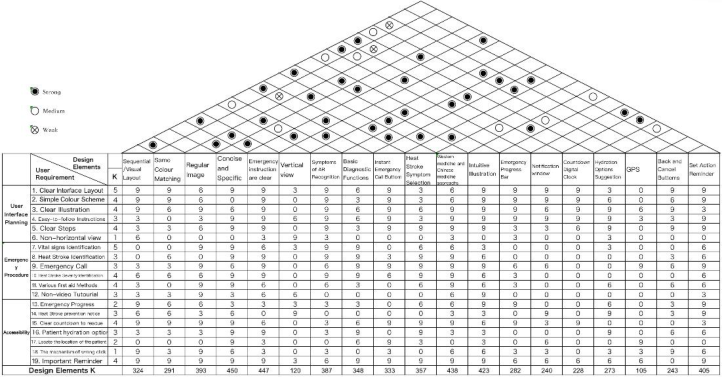
Quality Function Deployment The QFD team synthesized the information from the aforementioned lite- rature and expert interviews, categorized it using the KJ technique and then rank the user requirements for the left wall of the Quality House according to their priority. The QFD team listed the design requirements for the user requi- rements based on the ranking of the user requirements and the discussion of the design requirements, and then selected the design requirements for the ceiling of the quality house. The design requirements and the related matrix (ceiling and roof) were first established. The degree of relationship between
24 Liu and Fei
Figure 1: Augmented reality heat stroke emergency system interface user require- ments of the house of quality.
the design needs is then calculated by adding the relationships between the components in the design requirement.
RESULT AND DISCUSSION
The three most important design elements were clear Emergency Instructions (447), Western medicine and Chinese medicine approaches (438) and Concise and Specific content (450). The other design elements scoring above 400 were Intuitive Illustrations (423) and Set Action Reminders (405).In terms of functionality, the system offers the general public options for relief according to the severity of heat stroke by Western and Chinese medicine practitioners and aids the rescuer in administering first aid with illustrations and remin- ders. It was discovered that the layout of the interface and the steps of first aid measures were the main design focus of this study system.The results from the aforementioned studies are comparable to those from studies in the literature, such as Rometsch (2022), in which learning from simulated training of astro- nauts performing Extravehicular Activity (EVA) work was incorporated into Augmented Reality, and the user-centred design approach was adapted to the user’s vision, usability, and operability, enabling (Rometsch et al., 2022); Her- skovi (2014) used AR technology as a visual interface to assist firefighters in selecting the best (Herskovi, 2014); To ensure that the general people could appropriately administer CPR to treat patients, Hou (2022) used AR techno- logy as a visual assistance for the CPR operation. The findings of this study demonstrated that using AR in conjunction with CPR allowed the user to appropriately do chest compressions and complete the CPR cycle more reli- ably than conventional CPR alone (Hou et al., 2022). As a result, the design components of this study’s qualitative function are comparable to those in the literature in that they are focused on the user requirements and employ a visual aid interface to help them make quick and arduous judgments.
Augmented Reality in Heat Stroke Emergency Medical Developing Design 25
CONCLUSION
Through the use of a quality functional development approach, the study has created an interface for the development toward an AR heat stroke ambula- nce system, enabling the general public to increase the survival rate of patients suffering from heat stroke in the pre-hospital setting without the assistance of specialists. The system could be developed to support additional platforms in the future, increasing accessibility and minimizing platform constraints. The study could be used to learn more about emergency treatment and lower the price of medical services.
REFERENCES
Altman, J., Stern, E., Stern, M., Prine, B., Smith, K. B., & Smith, M. S. (2020). Current paradigms in the prehospital care of exertional heat illness: A review. CURRENT ORTHOPAEDIC PRACTICE, 31(1), 1–7. Arena, F., Collotta, M., Pau, G., & Termine, F. (2022). An Overview of Augmented
Reality. Computers, 11(2). doi: 10.3390/computers11020028. Beck, D. (2019). Special Issue: Augmented and Virtual Reality in Education: Immersive Learning Research. Journal of Educational Computing Research, 57(7), 1619–1625. doi: 10.1177/0735633119854035. Booher, H. R., Minninger, J. (2003) “Human systems integration in army systems
acquisition”, in: Handbook of human systems integration, Booher, Harold (Ed.). pp. 663–698. Booher, Harold, ed. (2003). Handbook of human systems integration. New Jersey: Wiley. Chapanis, A. (1996). Human factors in systems engineering. Wiley Series in Systems
Engineering and Management. Andrew Sage, series editor. Hoboken, NJ: Wiley. Chen, K., Horton, R. M., Bader, D. A., Lesk, C., Jiang, L., Jones, B.,... Kinney, P. L.
(2017). Impact of climate change on heat-related mortality in Jiangsu Province, China. Environ Pollut, 224, 317–325. doi: 10.1016/j.envpol.2017.02.011. Folds, Dennis. Gardner, Douglas and Deal, Steve. (2008). Building Up to the Human Systems Integration Demonstration, INCOSE INSIGHT Volume 11 No. 2. Friedenthal, S. Moore, A. Steiner, R. (2008) A Practical Guide to SysML: The Systems
Modeling Language, Morgan Kaufmann; Elsevier Science. Herskovi, T. S. a. V. (2014). Mobile Augmented Reality and Context-Awareness for Firefighters. IEEE LATIN AMERICA TRANSACTIONS, 12(1). Honour, Eric C. (2006) “A Practical Program of Research to Measure Systems Engi-
neering Return on Investment (SE-ROI)”, proceedings of the Sixteenth Annual Symposium of the International Council on Systems Engineering, Orlando, FL. Hou, L., Dong, X., Li, K., Yang, C., Yu, Y., Jin, X., & Shang, S. (2022). Comparison of Augmented Reality-assisted and Instructor-assisted Cardiopulmonary Resuscitation: A Simulated Randomized Controlled Pilot Trial. Clin Simul Nurs, 68, 9–18. doi: 10.1016/j.ecns.2022.04.004. Howe, A. S., & Boden, B. P. (2007). Heat-related illness in athletes. Am J Sports Med,
35(8), 1384–1395. doi: 10.1177/0363546507305013. John J. Cristiano, J. K. L., and Chelsea C. White. (2001). Key Factors in the Successful Application of Quality. Kenny, G. P., Yardley, J., Brown, C., Sigal, R. J., & Jay, O. (2010). Heat stress in
older individuals and patients with common chronic diseases. CMAJ, 182(10), 1053–1060. doi: 10.1503/cmaj.081050.
26 Liu and Fei
Klemenc-Ketis, Z., Poplas Susic, A., Ruzic Gorenjec, N., Mirosevic, S., Zafosnik, U., Selic, P., & Tevzic, S. (2021). Effectiveness of the Use of Augmented Reality in Teaching the Management of Anaphylactic Shock at the Primary Care Level: Protocol for a Randomized Controlled Trial. JMIR Res Protoc, 10(1), e22460. doi: 10.2196/22460. Lai-Kow Chan, M.-L. W. (2002). Quality function deployment: A literature review.
European Journal of Operational Research, 143(3), 463–497. Lee, J. K. W., Tan, B., Ogden, H. B., Chapman, S., & Sawka, M. N. (2022). Exertional heat stroke: nutritional considerations. Exp Physiol. doi: 10.1113/EP090149. Lin, S. S., Lan, C. W., Hsu, H. Y., & Chen, S. T. (2018). Data Analytics
of a Wearable Device for Heat Stroke Detection. Sensors (Basel), 18(12). doi: 10.3390/s18124347. Liu, S. Y., Song, J. C., Mao, H. D., Zhao, J. B., Song, Q., Expert Group of Heat Stroke, P.,... People’s Liberation Army Professional Committee of Critical Care, M. (2020). Expert consensus on the diagnosis and treatment of heat stroke in China. Mil Med Res, 7(1), 1. doi: 10.1186/s40779-019-0229-2. Martlı, E. P., & Ünlüsoy Dinçer, N. (2021). Technology in nursing education:
Augmented reality. Pamukkale University Journal of Engineering Sciences, 27(5), 627–637. doi: 10.5505/pajes.2020.38228. Meilich, Abe. (2008) INCOSE MBSE Initiative Status of HSI/MBSE Activity (Presentation). Mendez, K. J. W., Piasecki, R. J., Hudson, K., Renda, S., Mollenkopf, N.,
Nettles, B. S., & Han, H. R. (2020). Virtual and augmented reality: Impli- cations for the future of nursing education. Nurse Educ Today, 93, 104531. doi: 10.1016/j.nedt.2020.104531. Rometsch, F. A. A. S. D. T., Casini, A. E. M., Drepper, A., Cowley, A., de Winter, J. C. F., & Guo, J. (2022). Design and evaluation of an Augmented Reality tool for future human space exploration aided by an Internet of Things architecture. Advances in Space Research, 70(8), 2145-2166. doi: 10.1016/j.asr.2022.07.045. Sonenthal, P. D., Kachimanga, C., Komba, D., Bangura, M., Ludmer, N., Lado, M.,...
Rouhani, S. A. (2022). Applying the WHO-ICRC BEC course to train emergency and inpatient healthcare workers in Sierra Leone early in the COVID-19 outbreak. BMC Health Serv Res, 22(1), 197. doi: 10.1186/s12913-022-07556-8. Sural, I. (2017). Mobile Augmented Reality Applications in Education. In Mobile Technologies and Augmented Reality in Open Education (pp. 200–214). Taubman, Philip. (June 25, 2008) Top Engineers Shun Military; Concern Grow. The
New York Times Website: http://www.nytimes.com/2008/06/25/us/25engineer. html. Xiaosong Zheng, P. P. (2007). IMPROVING MOBILE SERVICES DESIGN: A QFD APPROACH. Computing and Informatics, 26, 369–381.
LISTED IN THE AHFE DIGITAL BOOKSTORE CATALOGUE
Explore the complete digital volume
Healthcare and Medical Devices
Read this individual research paper free through the original publisher, or explore the full digital proceedings book.
ISBN 978-1-958651-55-1
Explore this ISBN in the AHFE Bookstore ↗Listed in the July 2026 bookstore catalogue; search by ISBN to confirm current availability · Digital book purchase optional