Cheng Ming, Yanchen Du, Ao Jiang, Meng Xin, Hongliu Yu (2023). Knowledge Model for Interactive Safety Performance Indicators for Wearable Rehabilitation Robot: Uniform Standards for Interaction Safety Testing. In: Healthcare and Medical Devices. AHFE Open Access, vol. 79, pp. 113–122. https://doi.org/10.54941/ahfe1003479
Wearable rehabilitation robot (WRR) has become an important tool in the clinical application of rehabilitation medicine, and as WRR is usually attached to the patient's body and in close contact with the therapist, the safety of interaction during rehabilitation is an important consideration for device developers. As the WRR is still in its early stages of development, there is still a gap in international safety standards or technical standards for WRR. As more and more research is conducted on WRR and the technology is gradually improved, the corresponding safety test methods and indicators should be gradually improved. In order to gain a comprehensive understanding of the research hotspots and frontier areas in the field of WRR interactive safety performance, this study analyses the annual distribution of literature, distribution of journals, distribution of research power, important literature, research hotspots and frontiers based on bibliometric methods, and constructs a knowledge model of WRR interactive safety performance indicators. It is found that the research hotspots in WRR safety performance research are mainly focused on four areas: clinical reliability testing, safety performance testing equipment development, mechanical structure optimization and control algorithm optimization. Based on the above research, the knowledge model of interactive safety performance indicators is drawn, and the unified standard for interactive safety testing in the field of WRR safety performance is analyzed and summarized to provide reference for the construction of testing methods for the unified standard for WRR safety testing.
Exercise rehabilitation is a type of physical therapy and an important rehabi- litation tool in current rehabilitation medicine. Stroke, hemiplegia, cerebral
palsy, spinal cord injury, and other resulting dysfunctions are mainly reh- abilitated through scientific exercise. At present, there are three main forms of exercise rehabilitation: therapist-manual exercise therapy, patient-directed exercise training, and equipment-assisted exercise training. Among them, intelligent device-assisted movement is an increasingly used tool in modern clinical rehabilitation medicine.
With the emergence of new technologies and the increasing demand for motor rehabilitation, the application of wearable rehabilitation robots for rehabilitation training has become an important tool for clinical applications in rehabilitation medicine, and WRR technology has become a hot topic of research in academic circles both at home and abroad. The development of WRRs has also proven their effectiveness and importance in many clinical studies and commercial activities. Since WRRs are usually rigid, attached to the patient’s limb, and set up and operated by the therapist, the safety of the accompanying interaction is an important indicator that researchers and product developers must consider. Research on WRRs is gradually increa- sing both domestically and internationally, and the vast majority of the main reference indicators on the safety performance of rehabilitation robots are obtained through adverse reactions in clinical trials with subjects. Because the function of WRR has assistive, collaborative, and other roles. Existing relevant standards such as ISO 13482 (General safety requirements for per- sonal care robots) and IEC 80601 (Medical electrical equipment - Part 2-78: Particular requirements for basic safety and essential performance of medical robots for rehabilitation, assessment, compensation or alleviation) can play a reference role in optimizing and evaluating the interaction safety perfor- mance of WRR product design process, but for its The specific metrics and specific techniques for interaction safety performance have yet to be explored and refined.
In this paper, we use the bibliometric method to analyze the literature on the safety performance of wearable rehabilitation robots in the Web of Scie- nce database and combine VOSviewer visual analysis software to summarize the development trajectory, research hotspots, and cutting-edge trends in this field, and focus on the unified standard of risk detection indicators related to interaction safety, to provide a reference for the research on the safety performance of wearable rehabilitation robots.
DATA SOURCES AND RESEARCH METHODS
1. Data sources This paper selects the Web of Science database as the data source, using the subject keyword search = “(rehabilitation robot) AND (safety)” (the search date is December 07, 2022), with an unlimited time range, and selects the lite- rature type as Article; removing unrelated subjects yielded 750 documents as a valid sample for this paper. Document information included author(s), title, source (journal title), country, document type, number of citations, keywords, address, and subject category. All journals were published in English. 2. Methods VOSviewer software is based on the principle of co-citation and co-citation of literature to construct and display bibliometric mapping with the
Knowledge Model for Interactive Safety Performance Indicators 115
difference of distance, size and density between nodes, which can be used for clustering view, overlay view and density view of literature to assess the research direction and hotspot of literature. This study uses bibliome- tric analysis to construct a key citation network consisting of 750 papers, which is measured and visualized from multiple perspectives in terms of the chronological distribution, journals, research power distribution, research hotspots and frontiers of the literature, so as to present a comprehensive picture of the research hotspots, directions and development status in the field of safety performance of wearable rehabilitation robots. The parame- ters of citation journal analysis were set as Type of analysis (Citation), Unit of analysis (Sources), and the minimum number of journal articles (5), excluding non-field core journals. The parameters of keyword analysis were set to Type of analysis (Co-occurrence), Unit of analysis (Keywords Plus) and Counting method (Fractional counting), etc. The frequency of keyword co-occurrence was greater than 5 times as high-frequency words to show the hot spots of research.
RESULT
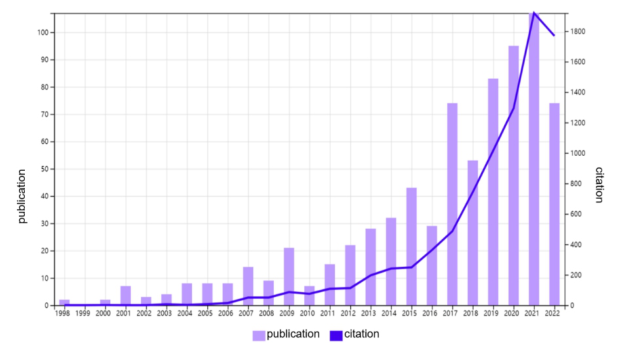
1. Time Distribution The volume of literature is one of the most important indicators of research hotspots in the literature. In the Web of Science database, the first article related to the field of WRR safety performance appeared in 1998, with a total of 750 articles by December 7, 2022. The growth of the research literature in this field has roughly gone through four periods. The first period, from 1998 to 2006, is the beginning of research in the field of WRR safety performance, with the annual number of literature remaining basically within 10 articles. In the second phase, starting from 2007, the research in the field of WRR safety performance entered the first period of rapid growth, and the number of publications exceeded 40 by 2015. The third phase started from 2016 to the research fluctuation period in 2018, and the annual number of literature in this period remains around 50 articles. The fourth phase from 2018 to present enters another high growth phase and the number of literature exceeds 100 articles in 2021.
As can be seen, researchers have begun to take a relatively strong interest in the field of WRR as the problems of an aging population and the growth in the number of people with functional impairments deepen. The popula- rity of modern technologies, such as robotics and artificial intelligence, has also contributed to the rapid development of WRR. Along with the rapid development of WRR, problems and challenges related to human-machine interaction and human factors are also increasing, and issues related to safety performance in the application of WRR are gradually becoming a hot topic of research for related researchers. 2. Publication Distribution Most of the journals have their publication areas and disciplinary back- grounds, and analysis of the literature sources covered in this study helps to understand the disciplines involved in the field of the safety performance of WRR research. In this paper, we analyze the literature in the field of the
Figure 1: Publication and citation time distribution.
safety performance of WRR in terms of the number of articles and citations. Analysis of the available data, as shown in Table. 1, reveals that the top five journals in terms of the number of publications account for 11.06% of the total literature, and these journals are APPLIED SCIENCES BASEL, JOUR- NAL OF NEUROENGINEERING AND REHABILITATION, IEEE ASME TRANSACTIONS ON MECHATRONICS, SENSORS, ROBOTICA.
From the citation analysis as shown in Table 2, the top five cited journals in terms of citations are JOURNAL OF NEUROENGINEERING AND REHA- BILITATION, IEEE ASME TRANSACTIONS ON MECHATRONICS, IEEE TRANSACTIONS ON The betweenness centrality of these journals is grea- ter than 0.1, which indicates that these journals are more important in the field of the safety performance of wearable rehabilitation robots and are an important vehicle for academic communication in this field.
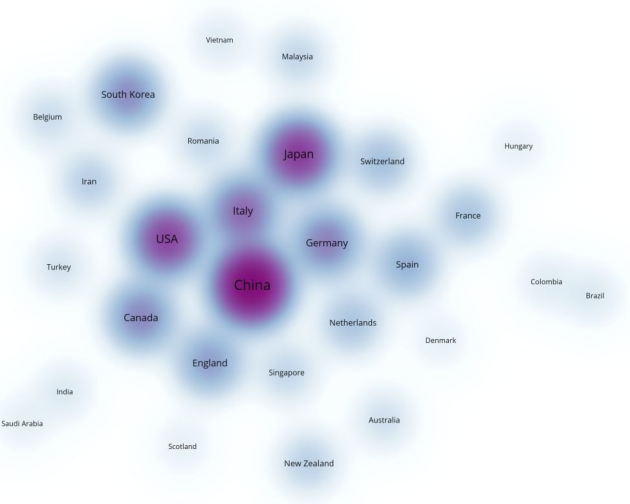
A comprehensive analysis of the issuing journals and citation index ranked journals reveals that journals in the fields of rehabilitation medicine, biomedi- cal engineering, mechanics, automation, and robotics publish more literature related to the safety performance of WRR with greater influence. 3. Regional Distribution of Research Forces In terms of the distribution of researchers by country, the research insti- tutions related to the safety performance of rehabilitation robots are mainly concentrated in China, Japan, and the United States, with 212 articles publi- shed by Chinese scholars, 111 articles published by Japanese scholars, and 100 articles published by American scholars. The remaining countries and regions with more than 50 articles include Italy, Germany and Canada. The density of research power distribution is shown in Figure 2. The research institutions with the largest number of publications include University of Chi- nese Academy of Sciences, Huazhong University of Science and Technology, University of Leeds, Osaka University, and Swiss Federal Institute of Techno- logy in Zurich. Swiss Federal Institute of Technology in Zurich, University of Auckland, University of Alberta, Florida State University, etc.
Knowledge Model for Interactive Safety Performance Indicators 117
Table 1. Number of publications in each journal.
Table available in the original PDF paper.
Source Count % of 750
18 2.400
APPLIED SCIENCES BASEL 22 2.93 JOURNAL OF NEUROENGINEERING AND REHABILITATION
15 2.0
IEEE ASME TRANSACTIONS ON MECHATRONICS
8 1.07
SENSORS 15 2.00 ROBOTICA 13 1.73 IEEE ACCESS 12 1.60 IEEE TRANSACTIONS ON ROBOTICS 11 1.47 IEEE ROBOTICS AND AUTOMATION LETTERS 9 1.20 ROBOTICS AND AUTONOMOUS SYSTEMS 9 1.20 WORK A JOURNAL OF PREVENTION ASSESSMENT REHABILITATION
Table 2. Citation volume of each journal.
Table available in the original PDF paper.
Source Frequency BC
978 0.12
JOURNAL OF NEUROENGINEERING AND REHABILITATION
208 0.11
IEEE ASME TRANSACTIONS ON MECHATRONICS 402 0.23 IEEE TRANSACTIONS ON ROBOTICS 360 0.11 MECHATRONICS 315 0.14 IEEE TRANSACTIONS ON AUTOMATION SCIENCE AND ENGINEERING
135 0.09
SENSORS 195 0.15 APPLIED SCIENCES BASEL 173 0.14 INTERNATIONAL JOURNAL OF ADVANCED ROBOTIC SYSTEMS
127 0.16
IEEE TRANSACTIONS ON NEURAL SYSTEMS AND REHABILITATION E ROBOTICA 122 0.14 *BC: Betweenness Centrality
4. Keywords analysis This study uses the titles and abstracts of publications as the source of keywords, and 924 relevant terms have been extracted from the sample. A total of 86 keywords satisfy the threshold value by setting 5 occurrences. After the deletion and combination of duplicate terms and irrelevant terms as well as some synonymous terms, a total of 75 keywords have been obtai- ned. High-frequency keywords refer to keywords with high co-occurrence frequency. A keyword that appears at high frequency in a certain period of time is probably a research hotspot or research focus in the field at that time, and the high-frequency keywords obtained by co-occurrence analysis of keywords in WRR safety performance field literature through visualiza- tion software are beneficial to our comprehensive analysis of the research
Figure 2: Density map of research force distribution.
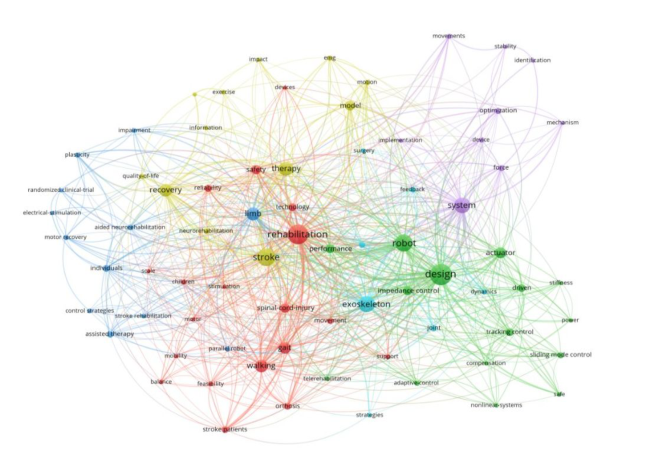
hotspots in WRR safety performance field. Table. 3 shows the top 20 high- frequency keywords in the literature on WRR safety performance. The results show that the current research technology in the field of WRR safety per- formance is mainly focused on system design and algorithm research, with the mechanical structure optimization design of actuators and control algo- rithms as the main research hotspots. And the research objects mainly focus on exoskeleton type WRR, especially the lower limb exoskeleton clinical gait training experiment-related research is more popular. Figure. 3 shows the term co-occurrence diagram, which consists of six clusters, and shows that the research hotspots are mainly focused on four aspects, such as clinical reli- ability testing, safety performance test equipment development, mechanical structure optimization, and control algorithm optimization.
The first cluster (“G1”) brings together keywords related to the evaluation of clinical trials, including keywords such as balance, feasibility, mobility, reli- ability, scale, and stimulation. Cluster 4 (“G4”), on the other hand, contains terms related to clinical trials, including keywords such as EMG, information, quality-of-life, recovery, stroke, and therapy. The two clusters of keywords reflect some clinical trial studies of WRR conducted by researchers to provide an objective basis related to the safety performance of the device by collecting corresponding physiological data from patients and monitoring the occurre- nce of adverse events during use, as well as the subjective assessment scales of subjects after the experiments to laterally reflect the evaluation indexes of reliability, safety and comfort of the device. The adverse events measured in the clinical trial are used to provide feasible optimization directions and evaluation indicators for the safety performance parameters of the wearable
Knowledge Model for Interactive Safety Performance Indicators 119
Table 3. The top 20 co-appearance frequencies of keywords.
Table available in the original PDF paper.
Keywords Frequency Keywords Frequency Design 118 Gait 36 Rehabilitation 99 Actuator 31 Stroke 83 Model 25 Robot 76 Spinal-cord-injury 23 Exoskeleton 66 Safety 23 System 63 Impedance control 21 Therapy 51 Performance 21 Limb 45 Tracking control 16 Walking 41 Driven 16 Recovery 40 Individuals 13
Figure 3: Keywords co-occurrence diagram.
rehabilitation robot. Relevant adverse events and indicators include (1) inte- raction force, (2) structural stability, (3) subject’s blood pressure, pulse and ECG, (4) skin irritation or abrasion, (5) subjective evaluation questionnaire, (6) spine and joint condition, etc. and the physical recovery of users after the experiment to verify the feasibility of the WRR device.
The second cluster (“G2”) represents the various aspects of rehabilita- tion robot control algorithms that researchers explore to improve the safety performance of WRR device control systems. Related keywords include adaptive-control, compensation, impedance control, nonlinear-systems, sli- ding mode control, stiffness, and tracking control. The researchers improve the safety, reliability and flexibility of WRR devices by improving the control algorithms and control strategies. This is one of the current research hotspots related to WRR safety performance.
The third cluster (“G3”) and the sixth cluster (“G6”) mainly represent keywords of terms about WRR structural optimization and its related con- tents, including the parallel robot, plasticity, assisted therapy, assistance, dynamics, exoskeleton, joint, and other keywords. Researchers are also keen to optimize the mechanical parameters to improve the stability of the device, such as O’Sullivan et al. have made corresponding specifications for the safety indicators of the relevant mechanical parameters of the device, and the mech- anical parameters of medical robots that fit the human body should also conform to physiological, biomechanical and ergonomic data to standardize the mechanical parameters of the device.
The fifth cluster (“G5”) mainly represents the beginning of researchers’ development of targeted test equipment to standardize metrics and visualize data for the corresponding safety performance parameters of WRR devices. Yasuhiro Akiyama et al. have designed and developed an instrumented cuff to measure the relative displacement, slip, interaction forces, and moments of the cuff during patient movement with a rehabilitation robot as an indicator to quantify the risk of adverse events such as skin damage. As an indicator to quantify the risk of adverse events such as skin damage, measures can be taken to prevent such losses. Crea et al. instead have used two force- measuring load cells to estimate the force of interaction between the device and the user as a way to ensure the safety of human-robot interaction. Toth et al. have developed a safety detection scheme that includes an anthropo- metric adjustable and sensing prosthesis and a software tool for offline risk assessment and reporting of safety features of the rehabilitation robot.
CONCLUSION
The main aim of this paper is to consolidate the academic research field of WRR safety performance through a bibliometric study of the literature in the field of WRR safety performance, providing a comprehensive under- standing of the research hotspots, frontier areas, disciplines involved and the distribution of major research forces in the field of WRR interactive safety performance based on bibliometric indicators, which provide a general view of the knowledge structure. This study analyzes the literature in the Web of Science database on research related to the field of safety performance of wearable rehabilitation robots with the help of the bibliometric visualization software VOSviewer. The keywords set in the research area was quantified in the form of a visual network and presented in the form of co-occurrence mapping to summarize the main research directions in the field and to analyze the high frequency keywords accordingly. The annual distribution and gro- wth scale of the literature are also investigated. The influential journals in the field are identified by centrality and volume of publications. The regional distribution of major research forces in the field of WRR safety performa- nce is analyzed and presented in the form of a density map. The following conclusions are drawn from the analysis: (1) The trend and changes in the field of publications are understood through literature issuance, and the analysis shows that the research in the
Knowledge Model for Interactive Safety Performance Indicators 121
field of WRR safety performance has been in the process of continuous development since 2007.
(2) Through the analysis of high centeredness and the analysis of the num- ber of articles, it can be found that the important journals in the field of re-WRR safety performance are JOURNAL OF NEUROENGINEERING AND REHABILITATION, IEEE ASME TRANSACTIONS ON MECHA- TRONICS, IEEE TRANSACTIONS ON ROBOTICS, MECHATRONICS, etc.
(3) The country distribution of research power is found that China, Japan, USA, Italy, Germany, and Canada are the main issuing countries. The main research institutions are the University of Chinese Academy of Sciences, Hua- zhong University of Science and Technology, University of Leeds, Osaka University, Swiss Federal Institute of Technology in Zurich, University of Auckland, University of Alberta, Florida State University, etc.
(4) The keywords co-occurrence analysis in the field of WRR safety per- formance, and the keywords with higher co-occurrence frequency in the field were obtained to reflect the research hotspots and trends in the field of WRR safety performance to a certain extent. By summarizing the keywords of its six clusters, it is found that the current research hotspots are mainly concen- trated in four directions: clinical reliability testing, safety performance testing equipment development, equipment mechanical structure optimization, and rehabilitation training control algorithm optimization.
Intelligent rehabilitation engineering devices have gained the attention of many scholars in the field in recent years and have developed to a certain extent. Because their effectiveness has been proved in clinical trials, many hospitals are already using them extensively for clinical treatment. Howe- ver, at the same time, the safety and reliability of mechanical, control, and human-machine interaction aspects of rehabilitation equipment use deserve our attention. This study focuses on the Keywords network and disciplinary distribution of the papers related to the field of WRR safety performance, but does not analyze the citation links and important literature accordin- gly. Because the field of WRR safety performance is still in the early stage of development, its corresponding technical indicators and standards are not yet perfect, such as the methods and specific indicators of WRR safety per- formance assessment, actuator structure optimization standards, and so on. Therefore, the purpose of this paper is to analyze and summarize the keyw- ord network in the knowledge system of WRR safety performance field, so as to have a clearer understanding of the research points involved in the field. Some of the high-frequency keywords involved can also provide references for the construction of a unified standard for WRR safety testing.
REFERENCES
Akiyama, Y., Okamoto, S., Yamada, Y., and Ishiguro, K. (2016). Measurement of contact behavior including slippage of cuff when using wearable physical assistant robot. IEEE Trans. Neural Syst. Rehabil. Eng. 24, 784–793. Alrabghi, L, ed. (2018). Stroke types and management. Int. J. Community Med.
Public Health, 5, 3715.
Crea, S., Nann, M, ed. (2018). Feasibility and safety of shared EEG/EOG and visionguided autonomous whole-arm exoskeleton control to perform activities of daily living. Scientific Reports 8. International Organization for Standardization (2014). Robots and robotic devices
— safety requirements for personal care robots. ISO 13482:2014. Available at: https://www.iso.org/standard/53820.html (Accessed Dec. 20, 2021). International Organization for Standardization (2019b). Medical electrical equipment — Part 2-78: particular requirements for basic safety and essential per- formance of medical robots for rehabilitation, assessment, compensation or alle- viation. IEC 80601-2-78:2019. Available at: https://www.iso.org/standard/68474. html. (Accessed Dec. 20, 2021). Neziha Akalin, ed. (2022). Do you feel safe with your robot? Factors influencing
perceived safety in human-robot interaction based on subjective and objective measures, International Journal of Human-Computer Studies, 158, 102744, 1071–5819. O’Sullivan, L., Nugent, R., Van Der Vorm, J. (2015). Standards for the Safety of Exoskeletons Used by Industrial Workers Performing Manual Handling Activities: A Contribution from the Robo-Mate Project to their Future Development. Procedia Manufacturing 3, 1418–1425. Toth, A., Pilissy, T, ed. (2022). Testing the Limit Range of Motion Safety Function of
Upper Limb Rehabilitation Robots with an Anthropometrically Adjustable and Sensorized Dummy Limb*, in:. van Eck NJ, Waltman L. (2010). Software survey: VOSviewer, a computer program for bibliometric mapping[J]. Scientometrics, 84(2): 523–538.
LISTED IN THE AHFE DIGITAL BOOKSTORE CATALOGUE
Explore the complete digital volume
Healthcare and Medical Devices
Read this individual research paper free through the original publisher, or explore the full digital proceedings book.
ISBN 978-1-958651-55-1
Explore this ISBN in the AHFE Bookstore ↗Listed in the July 2026 bookstore catalogue; search by ISBN to confirm current availability · Digital book purchase optional