Ao Jiang, Guangxu Li, Tian Ye, Haoling Yang, Jinglin Zhang, Yuhuan Deng, Rui Yang, Can Chen, Shangdong Xu, Xiaocheng Li, Bernard Foing, Stephen Westland (2026). Multi-Parameter Optimization of Augmented Reality Display Interfaces for Lunar Extravehicular Activities: Impacts of Area, Shape, and Transparency. In: Advances in Human Factors of Transportation. AHFE Open Access, vol. 224, pp. 201–211. https://doi.org/10.54941/ahfe1007847
The lunar surface presents a challenging visual environment characterized by high glare, extreme dynamic range, and achromatic conditions, which severely compromise the visibility of augmented reality (AR) information overlays. This study systematically examines the synergistic effects of geometric (area and shape) and optical (transparency) parameters on AR display interfaces, assessing their impact on task performance and cognitive load in a simulated lunar setting. The investigation consists of two experimental series: Experiment 1 utilized a digit-matching paradigm to manipulate display area and shape, while Experiment 2 employed omnidirectional pointing and cube placement tasks to vary interface transparency. Conducted in a controlled laboratory replicating the low solar elevation angle illumination typical of the lunar south pole, the experiments incorporated the optical filtering properties of a manned lunar helmet visor to bolster ecological validity. Multidimensional analyses demonstrated that larger display areas led to prolonged reaction times, decreased accuracy, and reduced usability, indicative of an "area penalty effect." Conversely, lower interface transparency markedly improved task completion times, diminished subjective cognitive load, and enhanced emotional valence (pleasantness) and dominance. This research constitutes the inaugural comprehensive evaluation of multi-parameter AR interface optimization in a simulated lunar context, furnishing essential human factors insights for the parametric design and adaptive refinement of future AR helmet displays in lunar extravehicular activities (EVAs).
The principal aims of modern crewed lunar missions have transitioned from brief sojourns in near-Earth orbit to prolonged on-site exploration and the development of enduring lunar habitats (Smith, 2020). Prospective lunar Received February 21, 2026; Revised April 8, 2026; Accepted April 22, 2026; Available online July 20, 2026
extravehicular activities (EVAs) will involve sophisticated tasks, such as infrastructure assembly, geological investigations, and resource exploitation (Rometsch, 2022), placing extraordinary requirements on astronauts’ sensory perception, decision-making, and operational proficiency in harsh settings. Lunar polar areas, notably the south pole as a focal exploration site, pose unique lighting difficulties: minimal solar elevations yield nearly horizontal rays, producing extended shadows and an extreme dynamic range across lit and shaded zones. Astronauts must repeatedly switch focus between glare exceeding 100,000 lux and deep shadow, inducing notable visual adaptation lags, terrain assessment challenges, and increased cognitive strain (Litaker, 2025; Jiang, 2022). Traditional tools like printed guides or portable screens exhibit poor legibility in these scenarios, with recurrent gaze shifts posing considerable safety risks (Peña-Asensio, 2024).
Optically see-through augmented reality (OST-AR) systems, overlaying essential digital data onto the real-world vista, present a viable remedy by reducing visual transitions and preserving continuous awareness. This approach is progressively acknowledged as a crucial facilitator for sophisticated lunar EVAs (Rometsch, 2022). However, OST-AR faces substantial hurdles in the lunar high-glare context: the optical combiner’s failure to produce absolute black hinders background light blocking, leading to faded, low-contrast virtual elements against bright scenes and thus hindering readability and access speed (Kim, 2021; Jiang, 2023).
To bolster AR display effectiveness under strong ambient disruption, earlier studies have systematically explored interface parameter adjustments. Display region’s geometric features—size and form—directly shape visual scanning paths and target identification accuracy. Data indicate that excessive areas may prolong latencies via crowding effects (Jiang, 2022), while aspect ratios (e.g., landscape vs. portrait) might influence data integration due to visual field asymmetries. Meanwhile, optical traits like transparency regulate virtual-real overlay strength, serving as a key factor in salience and attention guidance (Yoon, 2023). In lunar settings with juxtaposed bright and dim regions, transparency tuning must balance glare-induced data masking prevention with shadow depth cue preservation (Herbeck, 2024).
Despite these progresses, prevailing inquiries have mainly evaluated AR factors such as area, shape, or transparency in earthly or broad high- light contexts, lacking thorough, unified empirical studies in simulations replicating lunar visual extremes, including spacesuit visor filtration. Two critical questions persist: In modeled high-glare lunar conditions, (1) how do AR display area and shape collectively affect task execution and cognitive burden? and (2) how does transparency alteration impact task efficiency and user perception?
METHOD AND MATERIALS This investigation encompassed two independent within-subjects experiments, both executed under a unified simulated lunar visual environment framework. Experiment 1 targeted the geometric attributes of the display field, whereas Experiment 2 emphasized the optical properties of the interface. The experiments shared analogous environmental configurations, hardware
Multi-Parameter Optimization of Augmented Reality Display Interfaces 203 platforms, and select measurement protocols; however, each incorporated unique tasks and manipulations of independent variables to holistically address critical facets of AR interface design. Each experiment enlisted 50 graduate students specializing in aerospace engineering disciplines in China (25 males and 25 females per experiment). Participants in Experiment 1 had a mean age of 22.3 years, while those in Experiment 2 averaged 23.7 years. All participants were right-handed, possessed normal or corrected-to- normal vision, exhibited no color vision impairments, had no prior history of neurological or psychiatric conditions, and refrained from consuming caffeine or alcohol for 24 hours preceding the sessions. Informed consent was obtained from all participants. To mitigate potential confounding factors, Experiment 1 participants reported no history of severe motion sickness and lacked extensive prior experience with OST-AR systems, thereby minimizing learning biases.
Both experiments were performed in a sealed laboratory devoid of natural light contamination, engineered to emulate the low solar elevation angle, pronounced glare, and protracted shadow patterns emblematic of the lunar south pole (e.g., the Shackleton crater rim vicinity) (Wei, 2023). Terrain Simulation: Adhering to established lunar surface sandbox modeling protocols, a 4 m × 4 m × 0.3 m enclosure was employed, incorporating a blend of basaltic sand and gravel to fabricate undulating topography, dispersed boulders, and miniature craters. The surface texture was deliberately roughened to replicate lunar regolith (albedo ≈ 0.12) and attenuate specular reflections (Engelschiøn, 2020). Illumination System: A 2000 W xenon lamp functioned as the principal light source (Tawfik, 2018). Essential illumination parameters were uniformly maintained and rigidly controlled throughout both experiments. To more accurately approximate authentic EVA visual constraints, analogs of China’s manned lunar spacesuits were integrated into the protocols. Simulated coated visors were positioned at the helmet aperture, sustaining a consistent visible light transmittance (τ) of approximately 0.10 (Park, 2023). During testing, extraneous light sources were deactivated, save for the specified primary illuminant and the AR device’s intrinsic emission, to regulate stray light and preserve the integrity of pupillometric and perceptual assessments.
Both experiments utilized the Microsoft HoloLens 2 as the OST-AR display apparatus, leveraging its integrated hand-tracking capabilities for user interaction. All AR task prototypes were engineered within the Unity 3D (version 2019.4.30f1) development environment. Experiment 1 incorporated a Tobii Pro Glasses 3 head-mounted eye tracker (sampling at 60 Hz) for pupillary diameter recordings. In contrast, Experiment 2 omitted eye-tracking but adopted an expanded subjective questionnaire battery.
Experiment 1 featured 16 distinct display areas arranged in a 4 × 4 factorial configuration. These were classified by aspect ratio into three shapes: square, portrait, and landscape. Display perimeters remained imperceptible, with numeric stimuli positioned at the four vertices of each area. Dependent measures encompassed task accuracy, reaction time, mean pupil diameter (computed as the average within the interval from stimulus onset to response, serving as an index of cognitive exertion (Castanheira, 2020)), and usability evaluations (via a 5-point Likert scale gauging perceived task difficulty).
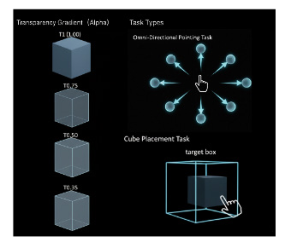
Experiment 2 adopted a 4 (transparency levels: T1, T0.75, T0.5, T0.35, aligned with RGBA Alpha channel values of 1.00, 0.75, 0.50, and 0.35, respectively) × 2 (task types: omnidirectional pointing, cube placement) design. Transparency was modulated through Unity’s native Alpha parameter, with all other interface visual characteristics held constant. Dependent variables included task completion duration, subjective cognitive load (quantified using the 9-point Paas mental effort scale (Gog, 2012)), and affective responses (appraised via the 9-point Self-Assessment Manikin scale for valence pleasantness, arousal, and dominance (Bradley, 1994)).
(a) (b)
Figure 2: Schematic diagram of experimental materials and design for Experiment 1 (a) and Experiment 2 (b).
The experimental protocols and tasks proceeded as follows: Before commencing the primary trials, participants underwent 5 minutes of training and practice with the AR apparatus. Subsequently, they donned the device and ambulated freely within the simulated lunar terrain for an additional 5 minutes to facilitate visual acclimation. Thereafter, the core experiments ensued.
Multi-Parameter Optimization of Augmented Reality Display Interfaces 205 Experiment 1 implemented a digit same-different matching paradigm (Snodgrass, 1972). In each trial, the numerals “6” or “9” appeared at the four corners of the display area. Participants determined whether the digit pairs along the two diagonals were congruent, responding via mid-air taps on “Same” or “Different” options. Stimuli persisted for 5 seconds, interspersed with 5-second inter-trial intervals. Each participant executed 128 trials (4 horizontal FOV levels × 4 vertical FOV levels × 8 repetitions), with condition sequences randomized and counterbalanced. Usability assessments were administered following each condition block.
In Experiment 2, the omnidirectional pointing task entailed participants sequentially fixating upon and grasping 18 randomly illuminated spheres arrayed in a circular formation, with total elapsed time recorded from initial to final grasp (Jang, 2017). The cube placement task required dragging cubes from predetermined origins to occupy 27 arbitrarily designated slots in a 3D matrix, capturing aggregate completion time (Ho, 2024). Task sequence was standardized across participants. Within each task, the four transparency conditions were presented in randomized order. SAM and Paas questionnaires were completed promptly after each task-transparency combination. Sufficient inter-experimental rest intervals were allocated to attenuate residual effects and ocular strain. Participants maintained a stationary standing posture at a designated locus, oriented consistently toward a reference marker zone to standardize the background visual field.
Post-experimental data were analyzed independently for each study. Reaction times and task durations were subjected to outlier excision (±3 SD) and logarithmic transformation where warranted (Experiment 2). Repeated- measures analyses of variance (ANOVAs) evaluated main effects and interactions for all variables, incorporating Greenhouse-Geisser adjustments for sphericity violations. Significant main effects prompted Bonferroni- corrected post-hoc pairwise contrasts. All statistical computations were performed using SPSS.
RESULT
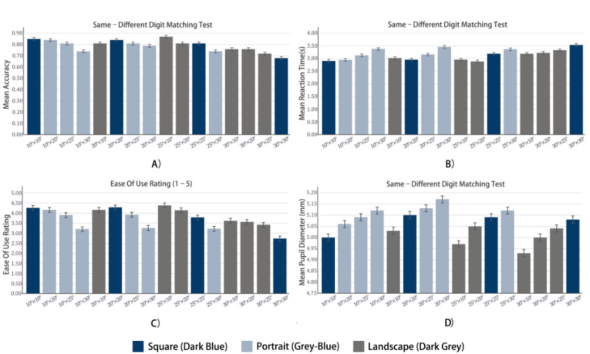
Experiment 1: Effects of Area and Shape on Performance and Load Owing to the incomplete factorial crossing between area and shape factors, analyses were performed separately for the square group and the non-square group (encompassing portrait and landscape orientations). For accuracy, in the square group, the main effect of area was significant (F(2.66, 130.35) = 7.85, p < .001, η_p² = 0.138). The accuracy rate for the 900 deg² area (0.68) was significantly lower than for areas of 100, 400, and 625 deg² (p ≤ .015). In the non-square group, neither the main effect of shape nor its interaction with area reached significance; however, the main effect of area was significant (F(4.24, 207.66) = 4.52, p = .001, η_p² = 0.084). Post-hoc comparisons indicated that accuracy for the 250 deg² area (0.84, averaged across shapes) was significantly higher than for the 300 deg² (0.75) and 750 deg² (0.73) areas. Regarding reaction time, in the square group, the main effect of area was significant (F(2.72, 133.42) = 12.68, p < .001, η_p² =
0.206), with the 900 deg² area yielding significantly longer reaction times (M = 3.54 s) compared to the other areas (p ≤ .019). In the non-square group, the main effect of shape was significant (F(1, 49) = 7.27, p = .010, η_p² = 0.129), wherein portrait orientations elicited longer reaction times (M = 3.28 s) than landscape orientations (M = 3.10 s). The main effect of area was also significant, with smaller areas (200, 250, and 500 deg²) producing significantly shorter reaction times than larger areas (300, 600, and 750 deg²). For usability ratings, in the square group, the main effect of area was significant (F(2.73, 133.92) = 37.24, p < .001, η_p² = 0.432), with ratings declining as area increased; the 900 deg² area received significantly lower ratings (M = 2.74) than the others. In the non-square group, the main effect of shape was significant (F(1, 49) = 10.02, p = .003, η_p² = 0.170), with landscape orientations garnering higher usability ratings (M = 3.88) than portrait orientations (M = 3.61). The main effect of area was likewise significant, with smaller areas (200, 250, and 500 deg²) yielding higher ratings than larger areas (300, 600, and 750 deg²). Regarding mean pupil diameter, in the square group, the main effect of area approached but did not achieve significance (p = .062). In the non-square group, the main effect of shape was significant (F(1, 49) = 28.28, p < .001, η_p² = 0.366), with portrait orientations associated with larger mean pupil diameters (M = 5.12 mm) than landscape orientations (M = 5.00 mm), suggesting elevated physiological cognitive load in portrait configurations. Although the main effect of area was significant (p = .030), post-hoc comparisons disclosed no pairwise differences.
Figure 3: Accuracy (A), reaction time (B), subjective score (C), and left eye pupil diameter (D) of the same/different digit matching test under different areas and shapes (The data in the figure are the mean of 50 subjects under different shape conditions, and the error bar represents the standard error of the mean).
Multi-Parameter Optimization of Augmented Reality Display Interfaces 207 Experiment 2: Effects of Transparency on Performance, Emotion, and Load
Analyses revealed a significant main effect of transparency on task completion time (F(2.54, 124.46) = 19.91, p < .001, ηp² = 0.289), a significant main effect of task type (F(1, 49) = 7.13, p < .05, ηp² = 0.127), and a significant transparency × task type interaction (F(3, 147) = 3.77, p < .05, ηp² = 0.071). Simple effects analyses indicated that, across both tasks, the T1 (fully opaque) and T0.75 conditions produced the shortest completion times, with no significant difference between them. As transparency increased to T0.5 and T0.35, completion times lengthened significantly (p < .05), with this adverse effect more evident in the cube placement task. For affective experience (as measured by the SAM scale), a significant main effect of transparency emerged on the pleasantness dimension (F(3, 147) = 32.05, p < .001, ηp² = 0.395), with T1 yielding the highest pleasantness ratings, significantly surpassing all other conditions. The T0.75 and T0.5 conditions did not differ from each other but both exceeded T0.35 significantly. Neither the main effect of task type nor its interaction with transparency was significant. On the dominance dimension, a significant main effect of transparency was observed (F(3, 147) = 34.83, p < .001, ηp² = 0.416), accompanied by a significant transparency × task type interaction (F(3, 147) = 3.38, p < .05, ηp² = 0.065). Overall, T1 evoked the strongest sense of dominance. In the omnidirectional pointing task, dominance ratings declined progressively with increasing transparency (i.e., decreasing Alpha values). In the cube placement task, T1 and T0.75 elicited comparable dominance levels, both significantly higher than T0.5 and T0.35. For the arousal dimension, effects of transparency, task type, and their interaction were all nonsignificant (p > .05). Regarding subjective cognitive load, a significant main effect of transparency was found (F(3, 147) = 19.63, p < .001, ηp² = 0.286), with the lowest load scores at T1, which did not differ significantly from T0.75. Both were significantly lower than T0.5 and T0.35 (p < .005), with T0.35 producing the highest load ratings. The main effect of task type and its interaction with transparency were nonsignificant.
DISCUSSION
Through two meticulously designed experiments conducted in a high-fidelity simulation of the lunar visual environment, this study elucidates, for the first time, the intricate influences of geometric parameters (area and shape) and optical parameters (transparency) on the performance and cognitive load associated with OST-AR display interfaces. The findings coalesce to delineate a coherent framework for AR interface optimization under severe visual constraints.
Common Challenges in Lunar Visual Environments and Unified Mechanisms of Parameter Effects Both experiments substantiate that the intense glare and stark contrast inherent to lunar visual environments constitute a rigorous benchmark for AR information rendering. The underlying mechanism driving the “area
penalty effect” observed in Experiment 1 and the “high transparency cost” in Experiment 2 originates from the pervasive interference of background illumination, which attenuates and disperses virtual overlays. When display areas become excessively expansive (Experiment 1) or transparency levels escalate (Experiment 2), virtual elements are more susceptible to diffusion across peripheral vision or assimilation into intricate background patterns (such as lunar regolith textures and shadows). This intensification of visual crowding effects (Andriamanalina, 2025) and contrast degradation culminates in protracted search and identification processes, manifesting as extended reaction times or task durations and compromised subjective evaluations. These outcomes resonate with prior observations of diminished AR legibility in high-luminance settings (Buchner, 2021). Furthermore, pupillometric data from Experiment 1 intimate that portrait configurations may necessitate amplified attentional resources, potentially due to incongruence with the predominantly horizontal structures of lunar landscapes, thereby engendering heightened physiological cognitive load (Jiang, 2022).
Specific Effects of Parameters and Design Implications Display Area: Pursue Optimal Rather Than Maximum. The results unequivocally demonstrate that unbridled expansion of AR display areas in lunar contexts yields counterproductive outcomes. The largest area condition (900 deg²) uniformly elicited the most inferior performance metrics and usability perceptions. Accordingly, designers should prioritize compact display areas that suffice for essential information conveyance, thereby focalizing attention and curtailing visual search demands.
Display Orientation: Prioritize Landscape Layout. Landscape orientations consistently surpassed portrait counterparts across reaction efficiency, perceived usability, and physiological load indicators. This superiority may derive from the human visual system’s enhanced proficiency in processing horizontal arrays (Deng, 2016), coupled with landscape formats’ superior alignment with intrinsic scene geometries—such as the lunar horizon’s lateral expanse and horizontally protracted shadows—thereby expediting informational synthesis and spatial navigation.
Interface Transparency: Establish an “Opaque” Lower Limit. Experiment 2 compellingly illustrates that reduced transparency (elevated opacity, with Alpha ≥ 0.75) optimizes holistic performance. In the face of the lunar surface’s extreme luminance, adequate opacity is indispensable for delineating crisp virtual boundaries and bolstering contrast. The equivalence in efficacy between T1 (fully opaque) and T0.75 affords design latitude; nonetheless, transparencies dipping below 0.5 precipitate marked declines in performance and experiential quality.
Modulating Effects of Task Complexity and Adaptive Design Requirements Experiment 2 disclosed that the cube placement task exhibited greater susceptibility to transparency variations than the omnidirectional pointing task. This disparity underscores how task demands in cognitive and motor
Multi-Parameter Optimization of Augmented Reality Display Interfaces 209 intricacy moderate parameter sensitivities. For EVA operations entailing precise spatial manipulations and sustained visual feedback—such as apparatus servicing or specimen collection—interfaces must exhibit superior stability and clarity, with diminished resilience to suboptimal parameters (e.g., elevated transparency). These insights robustly advocate for adaptive AR display architectures: systems engineered to dynamically modulate display area, orientation (landscape/portrait), and transparency in response to instantaneous task exigencies (e.g., navigation versus fine manipulation) and environmental illuminance (e.g., transitioning between shadowed and glare-dominated zones). Such adaptability would sustain interfaces within parameter envelopes that minimize cognitive demands and maximize operational proficiency (Jiang, 2023).
Research Limitations and Future Prospects Notwithstanding its contributions, this study is not without constraints: (1) Although spacesuit visor simulations were incorporated, the experiments were confined to a static laboratory milieu, omitting considerations of astronaut locomotion, postural encumbrances, and authentic lunar gravitational influences; (2) The participant cohort comprised specialized students rather than seasoned astronauts; (3) The parameters across the two experiments lacked full factorial integration, precluding exhaustive quantification of interactions among area, shape, and transparency. Prospective inquiries should prioritize: (1) investigations in augmented-fidelity lunar analogs or neutral buoyancy facilities encompassing dynamic tasks; (2) recruitment of astronauts or EVA-trained individuals; (3) multifactorial designs incorporating area, shape, and transparency, alongside explorations of additional optimizations such as chromaticity and luminance contrast; (4) the prototyping and empirical validation of adaptive AR display systems tailored for lunar EVAs, informed by these empirical foundations.
CONCLUSION
This investigation methodically examined the ramifications of three pivotal parameters on OST-AR display interfaces within a simulated rendition of extreme lunar visual conditions, culminating in the following inferences: Display area manifests a penalty effect, wherein oversized areas detrimentally affect task performance and subjective usability; ergo, designs ought to eschew gratuitous expansions of the field of view. Landscape layouts confer multifaceted benefits: Relative to portrait orientations, landscape configurations facilitate swifter information assimilation, augmented user satisfaction, and attenuated cognitive demands. Interfaces with diminished transparency exhibit superior efficacy: Upholding elevated opacity levels (recommended Alpha ≥ 0.75) constitutes a potent countermeasure against the lunar surface’s intense glare, thereby safeguarding informational legibility and manipulative dominion. Task exigencies modulate parameter susceptibilities: Intricate spatial manipulation endeavors necessitate augmented interface lucidity, underscoring the imperative for adaptive display architectures.
ACKNOWLEDGMENT
We acknowledge funding and in kind support of National Key Laboratory of Human Factors Engineering, China Astronaut Research and Training Center. This work was also supported by the National Social Science Fund of China [No. 23FYSB049]; National Natural Science Foundation of China [No. 52405276; No. 52375269]; the Foundation of National Key Laboratory of Human Factors Engineering [No. 2025-JCJQ-LB-091-06W].
REFERENCES
Andriamanalina, R., Larabi, M., & Moan, S. (2025). Visual crowding reduces blur sensitivity in peripheral vision: A study using natural textures in virtual reality. Journal of the Optical Society of America. A, Optics, image science, and vision, 42 10, pp. 1598–1610 . Bradley, M., & Lang, P. (1994). Measuring emotion: The Self-Assessment Manikin
and the Semantic Differential. Journal of behavior therapy and experimental psychiatry, 25 1, pp. 49–59 . https://doi.org/10.1016/0005-7916(94)90063-9. Buchner, J., Buntins, K., & Kerres, M. (2021). The impact of augmented reality on cognitive load and performance: A systematic review. J. Comput. Assist. Learn., 38, pp. 285–303. Da Silva Castanheira, K., LoParco, S., & Otto, A. (2020). Task-evoked pupillary
responses track effort exertion: Evidence from task-switching. Cognitive, Affective, & Behavioral Neuroscience, 21, pp. 592–606. Deng, X., Kahn, B., Unnava, H., & Lee, H. (2016). A “Wide” Variety: Effects of Horizontal versus Vertical Display on Assortment Processing, Perceived Variety, and Choice. Journal of Marketing Research, 53, pp. 682–698. Engelschiøn, V., Engelschiøn, V., Eriksson, S., Cowley, A., Fateri, M., Meurisse, A.,
Kueppers, U., & Sperl, M. (2020). EAC-1A: A novel large-volume lunar regolith simulant. Scientific Reports, 10. Gog, T., Kirschner, F., Kester, L., & Paas, F. (2012). Timing and Frequency of Mental Effort Measurement: Evidence in Favour of Repeated Measures. Applied Cognitive Psychology, 26, pp. 833–839. Herbeck, S., Murdoch, M., & Thorstenson, C. (2024). Adjusting Transparency
Toward Optimizing Face Appearance in Optical See-Through Augmented Reality. J. Percept. Imaging , 7, pp. 1–12. https://doi.org/10.2352/j.percept. imaging.2024.7.000404. Ho, Y., Li, K., & Peng, L. (2024). Movement and positioning of a virtual cuboid in 3d space in an augmented reality environment. Ergonomics, 68, pp. 1309–1319. Jang, Y., Jeon, I., Kim, T., & Woo, W. (2017). Metaphoric Hand Gestures for
Orientation-Aware VR Object Manipulation With an Egocentric Viewpoint. IEEE Transactions on Human-Machine Systems, 47, pp. 113–127. Jiang, A., Fang, W., Liu, J., Foing, B., Yao, X., Westland, S., & Hemingray, C. (2023).
The effect of colour environments on visual tracking and visual strain during short-term simulation of three gravity states. Applied ergonomics, 103994 . Jiang, A., Schlacht, I., Yao, X., Foing, B., Fang, Z., Westland, S., Hemingray, C., & Yao, W. (2022). Space Habitat Astronautics: Multicolour Lighting Psychology in a 7-Day Simulated Habitat. Space: Science & Technology. Jiang, A., Yao, X., Schlacht, I., Musso, G., Tang, T., & Westland, S. (2020). Habitability
Study on Space Station Colour Design. , 507–514.
Multi-Parameter Optimization of Augmented Reality Display Interfaces 211 Jiang, A., Yao, X., Westland, S., Hemingray, C., Foing, B., & Lin, J. (2022). The Effect
of Correlated Colour Temperature on Physiological, Emotional and Subjective Satisfaction in the Hygiene Area of a Space Station. International Journal of Environmental Research and Public Health, 19. Jiang, A., Zhu, Y., Yao, X., Foing, B., Westland, S., & Hemingray, C. (2022). The effect of three body positions on colour preference: An exploration of microgravity and lunar gravity simulations. Acta Astronautica. Kim, J., Oh, S., Choi, J., Park, S., & Kim, W., 2021. Optical see-through head-
mounted display including transmittance-variable display for high visibility. Journal of Information Display, 23, pp. 121–127. Litaker, H., Beaton, K., Bekdash, O., Crues, E., Paddock, E., Rohde, B., Reagan, M., Van Velson, C., & Everett, S. (2025). South Pole Lunar Lighting Studies for Driving Exploration on the Lunar Surface. 2025 IEEE Aerospace Conference, pp. 1–16. Park, J., Lim, S., Amirzhan, A., Kang, H., Karrfalt, K., Kim, D., Leger, J., Urbas, A.,
Ossiander, M., Li, Z., & Capasso, F. (2023). All-Glass 100 mm Diameter Visible Metalens for Imaging the Cosmos. ACS Nano , 18, pp. 3187–3198. Peña-Asensio, E., Sutherland, J., Tripathi, P., Mason, K., Goodwin, A., Bickel, V., & Kring, D. (2023). Automated astronaut traverses with minimum metabolic workload: Accessing permanently shadowed regions near the lunar South pole. Acta Astronautica. Rometsch, F., Casini, A., Drepper, A., Cowley, A., De Winter, J., & Guo, J.(2022).
Design and evaluation of an Augmented Reality tool for future human space exploration aided by an Internet of Things architecture. Advances in Space Research. Smith, M., Craig, D., Herrmann, N., Mahoney, E., Krezel, J., McIntyre, N., & Goodliff, K., 2020. The Artemis Program: An Overview of NASA’s Activities to Return Humans to the Moon. 2020 IEEE Aerospace Conference, pp. 1–10. Snodgrass, J. (1972). Matching patterns vs matching digits: The effect of memory
dependence and complexity on “same”-“different” reaction times. Perception & Psychophysics, 11, pp. 341–349. Tawfik, M., Tawfik, M., Tonnellier, X., & Sansom, C. (2018). Light source selection for a solar simulator for thermal applications: A review. Renewable and Sustainable Energy Reviews. Wei, G., Li, X., Zhang, W., Tian, Y., Jiang, S., Wang, C., & , J. (2023). Illumination
conditions near the Moon’s south pole: Implication for a concept design of China’s Chang’E−7 lunar polar exploration. Acta Astronautica. Yoon, B., Shin, J., Kim, H., Oh, S., Kim, D., & Woo, W. (2023). Effects of Avatar Transparency on Social Presence in Task-Centric Mixed Reality Remote Collaboration. IEEE Transactions on Visualization and Computer Graphics, 29, pp. 4578–4588.
LISTED IN THE AHFE DIGITAL BOOKSTORE CATALOGUE
Explore the complete digital volume
Advances in Human Factors of Transportation
Read this individual research paper free through the original publisher, or explore the full digital proceedings book.
ISBN 979-8-950676-00-0
Explore this ISBN in the AHFE Bookstore ↗Listed in the July 2026 bookstore catalogue; search by ISBN to confirm current availability · Digital book purchase optional