1 The Future Laboratory, Tsinghua University, Beijing, 100084, China; School of Design and Art, Beijing Institute of Technology, Beijing, 100081, China ↗
2 Department of Industrial Engineering, Tsinghua University, Beijing, 100084, China ↗
In lunar exploration, astronauts' cognitive load critically impacts the efficacy of Human-Computer Collaboration (HCC). Effective management of cognitive load is essential for lunar mission success. Current research on HCC cognitive load primarily focuses on post-hoc evaluation, failing to leverage real-time assessment and quantitative outcomes, thus misaligning with actual mission demands. Given the interdependence between machine intelligence levels and astronauts' cognitive states, this study proposes an innovative Virtual Reality (VR)-based training system. Centered on three prototypical lunar missions, the system dynamically adjusts task difficulty and machine intelligence levels based on real-time cognitive load monitoring, deliberately exposing astronauts to varying cognitive stress levels. State-of-the-art sensors continuously capture multimodal physiological data (e.g., GSR, HR, SpO₂), enabling real-time task reallocation through an adaptive system. This VR framework holistically addresses multifactorial influences on astronauts' HCC performance in complex lunar environments, establishing a closed-loop integration of physiological data acquisition, cognitive load evaluation, intelligence level modulation, and task difficulty adjustment. By advancing a novel paradigm for optimizing HCC efficiency, this work lays a critical foundation for future lunar exploration in high-demand settings.
As lunar exploration missions continue to advance, Human-Computer Collaboration (HCC) in complex tasks is becoming increasingly critical (Xie et al., 2022; Ortega et al., 2021). Lunar exploration operations, encompassing surface sampling, equipment maintenance, and scientific experiments, are inherently high-risk activities that demand exceptional
cognitive and operational competencies from astronauts (Lin et al., 2024). Research has highlighted the challenges of managing cognitive load in such high-stakes environments (Sewell et al., 2018), emphasizing the need for adaptive systems to manage workload in complex tasks (Wickens et al., 2021). Despite these advancements, astronauts frequently encounter high cognitive loads during task execution, which can lead to decreased task performance and operational errors (Endsley et al., 2016; Chen et al., 2014). Therefore, effectively managing astronauts’ cognitive load and optimizing HCC efficiency have become urgent challenges for current lunar exploration missions.
In recent years, virtual reality (VR) technology has emerged as a highly immersive simulation tool, widely used in human factors engineering research. Studies have explored VR’s potential in creating realistic training environments, demonstrating its ability to simulate complex operational scenarios with high fidelity (Aylward et al., 2021). Further research has emphasized VR’s role in enhancing user immersion and engagement, making it an ideal platform for studying human-computer interaction (Han et al., 2017). The integration of VR into human systems has been discussed, particularly in military and aerospace applications, where it has been used to improve task performance and reduce training costs (Pirker et al., 2022). Additionally, VR has been highlighted as a tool for simulating high-stress environments, such as space missions, where real-world training is impractical (Finseth et al., 2022). Despite these benefits, existing VR systems still face limitations in cognitive load management, including the lack of dynamic task allocation mechanisms and real-time load adjustment capabilities (ElGibreen et al., 2019). This underscores the urgent need to develop an adaptive task allocation system based on VR, which has both significant research value and practical importance.
Cognitive Load Theory (CLT) provides a theoretical framework for task allocation and human-computer collaboration. CLT was introduced to understand how cognitive load affects learning and performance, categorizing it into intrinsic, extraneous, and germane loads (Schnotz et al., 2007). The theory initially proposed that intrinsic load relates to task complexity, extraneous load to the task’s presentation, and germane load to the learning process (Bannert et al., 2002). Subsequent research has expanded this framework, demonstrating how CLT can optimize instructional design and task performance (Haji et al., 2015). In lunar exploration tasks, astronauts’ cognitive load primarily results from task complexity, environmental stress, and information processing demands (Nasrini et al., 2020). Therefore, real-time monitoring and classification of cognitive load, combined with dynamic task allocation strategies, can effectively reduce astronauts’ cognitive burden and improve task performance (Gutiérrez et al., 2023). However, most of the existing research on HCC cognitive load mainly focuses on the assessment of cognitive load after the task, lacking the monitoring of cognitive load during the task and the utilization of relevant data (Longo et al., 2019). Real-time cognitive load feedback is of crucial
Adaptive Task Reallocation for Lunar Exploration: Cognitive Load Management 35
importance in critical and high-risk missions like lunar missions (Kyriaki et al., 2024).
Despite progress in human-computer collaboration research, most studies have focused on controlled environments, such as cockpit and aircraft cabin settings. Research has shown that while automation can reduce workload, it can also lead to complacency and skill degradation (Endsley et al., 2016). Similarly, studies on HCC in military operations have found that effective communication and task allocation are critical for mission success (Li et al., 2021). However, there is a significant gap in research addressing the complexities of lunar exploration environments, where human-computer collaboration must contend with unique challenges such as low gravity, limited communication, and high-stakes decision-making. Furthermore, while VR has been used as a tool to experience unknown environments, it has not yet been fully utilized as a quantitative tool for assessing cognitive load in these complex scenarios. Recent developments have demonstrated the potential of VR-based cognitive training systems for real-time cognitive load monitoring, and the ability of VR to capture physiological data in immersive environments has also been explored (Shen et al., 2021). However, these studies have not addressed the specific needs of lunar exploration tasks, underscoring the urgency of developing a robust framework for cognitive load management in these scenarios.
This study makes two significant contributions: 1) It proposes a three- level cognitive load classification system for adaptive task allocation, enabling real-time monitoring and adjustment of intelligence level based on multimodal physiological data. 2) It designs and develops a VR-based Lunar mission simulation environment, providing a high-fidelity experimental platform for cognitive load reallocation research.
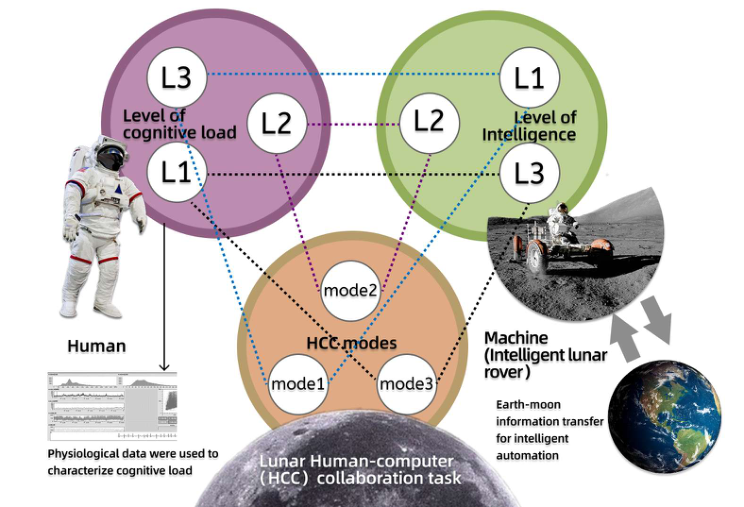
SYSTEM DESIGN Human-machine task allocation directly affects astronauts’ cognitive load. A task allocation system based on real-time cognitive load data allows dynamic adjustments between humans and machines, optimizing cognitive load and enhancing performance. The machine’s intelligence level is inversely related to astronaut cognitive load: as machine intelligence increases, cognitive load decreases, collectively forming different HCC modes (see Figure 1). Traditionally, machine intelligence is classified into 5 or 10 levels (Endsley et al., 1987), ranging from fully human-executed tasks to fully machine- executed tasks. However, this complexity hinders system design, particularly in lunar exploration, where tasks are multifaceted. Therefore, this study simplifies the classification to three levels (see Table 1), corresponding to three levels of human cognitive load (see Table 2).
Level of Intelligence Feature Level 1 Providing device information perception, no environmental awareness, and the machine does not perform any automated tasks. Level 2 Provides device information perception and basic
environmental awareness and analysis, but cannot execute or make decisions. Level 3 Autonomous perception and analysis, offers operational suggestions, execute and make decisions.
Table 2: Human cognitive load level settings.
Table available in the original PDF paper.
Feature
Level of Cognitive Load
Level of Intelligence Level 1 Level 3 Human’s psychological and physiological state is relaxed, and the task execution proceeds smoothly. Level 2 Level 2 Human’s cognitive load is at a moderate level;
although the task can still be completed, some small errors may begin to occur. Level 3 Level 1 Huaman’s cognitive load is extremely high, task performance may be noticeably affected, and the error rate is higher.
Adaptive Task Reallocation for Lunar Exploration: Cognitive Load Management 37
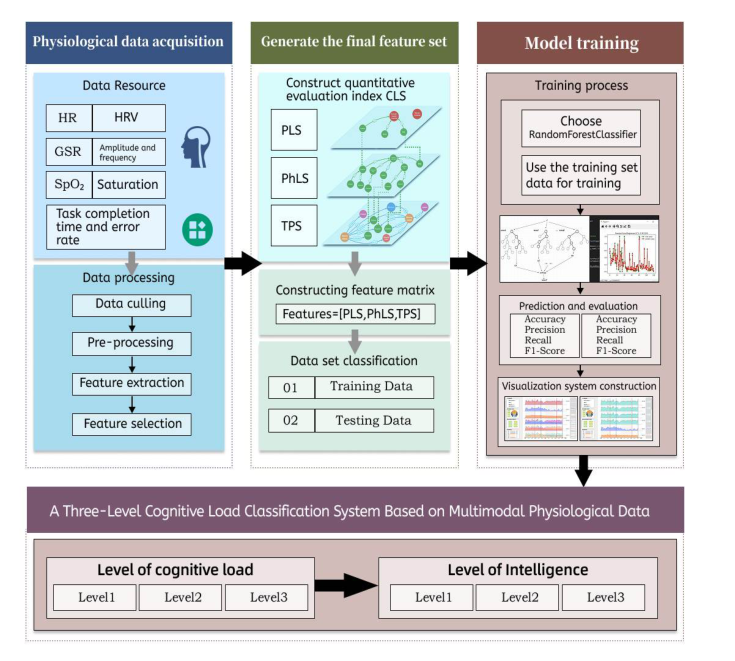
Figure 2: System construction and model training.
In terms of cognitive load classification and quantification, the study adopted a multimodal data fusion approach, combining psychological, physiological, and task execution indicators to form a comprehensive Cognitive Load Score (CLS). As shown in Figure 2, we developed a Three- Level Cognitive Load Classification System, which utilized a Random Forest Classifier trained on the ASCERTAIN dataset to classify cognitive load levels in real time. The dataset, which includes physiological signals such as GSR, HR, and SpO2, was used in this study. The raw data was preprocessed by removing noise, normalizing the signals, and addressing any missing values. The relationship between these physiological signals and cognitive load is as follows: GSR reflects psychological load, with greater fluctuations indicating increased mental effort or stress. HR variability (SDNN, RMSSD) and SpO2 levels were used to assess physiological load, as elevated HR and decreased SpO2 generally indicate higher physiological strain. The Task Performance Score (TPS) was derived from task completion time and error rate, with longer completion times and higher error rates corresponding to greater cognitive load. The three key scores—PLS, PhLS, and TPS—formed the feature set:
Features = [PLS, PhLS, TPS]
This feature set was used as input to train a Random Forest Classifier. The model’s performance was evaluated using metrics such as accuracy, precision, recall, and F1 score, ensuring the accurate classification of cognitive load into three levels: Low (L1), Medium (L2), and High (L3). Finally, to facilitate real- time monitoring during subsequent training or experiments, a visualization system was developed. This system displays the real-time cognitive load status of the user by using the trained model to classify cognitive load levels, while also visualizing the physiological data (HR, GSR, SpO2) over time. The interface provides immediate feedback on the user’s cognitive load, enabling adaptive task allocation and optimizing human-computer collaboration, thus improving task performance and safety. By integrating multimodal physiological data with machine learning, this system provides an efficient solution for cognitive load classification and real-time monitoring.
METHOD
Virtual Task Design The Virtual HCC training task design is conducted entirely using VR, with participants wearing VR headsets throughout the process. The primary means of interaction are through the use of controllers and hand gestures to control the Machine (Intelligent lunar rover). Additionally, in Task 2 and Task 3, voice interaction is incorporated to to control the lunar rover to enhance the user experience. The VR interface displays complex information, providing a comprehensive and immersive environment for task execution. This design allows for an integrated evaluation of human- machine collaboration under different levels of intelligence, utilizing advanced interactive technologies to ensure smooth task completion in lunar exploration scenarios.
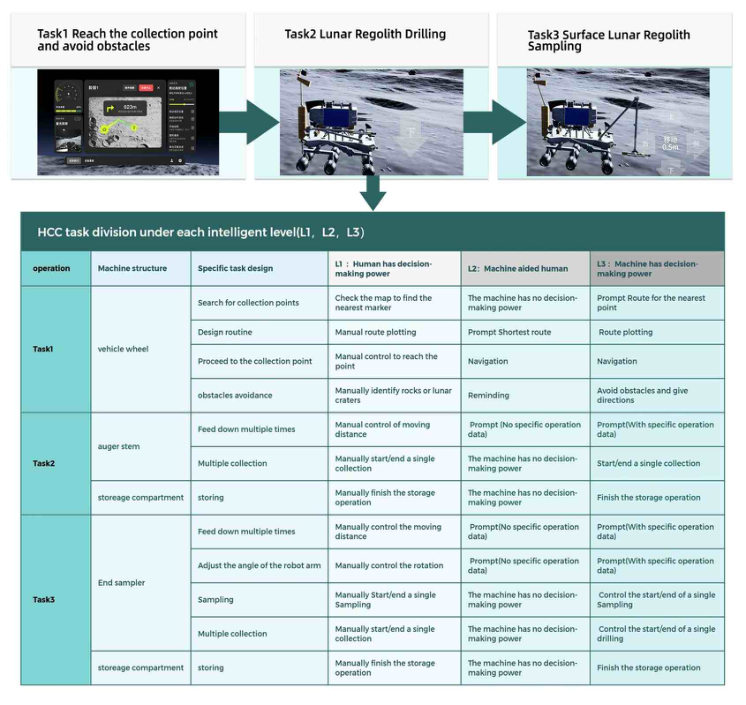
Specifically, as shown in Figure 3, these tasks are not only exemplary but also thoroughly exhibit the cooperation modalities and efficiencies between humans and machines at diverse intelligence levels, all made possible within the immersive VR environment. According to a three-level cognitive load classification system, as the cognitive load (L1, L2, L3) varies, the machine’s intelligence level correspondingly adjusts to match the grade. Concurrently, the tasks assigned to users under different intelligence levels are also adapted accordingly. This is to alleviate the task complexity for users under high cognitive load and reduce the cognitive burden. Task1 is reaching the collection point while circumventing obstacles. The objective is to guarantee the vehicle’s smooth arrival at the lunar surface collection point and steer clear of impediments en route. Varied intelligence levels entail distinct operational approaches. In the L1 stage, where humans hold the decision-making authority, the operator manually charts the route and maneuvers the vehicle. When transitioning to the L2 stage, with the machine lending assistance to humans, the system offers cues for the nearest available route. Advancing to the L3 stage, where the machine assumes decision- making power, it autonomously plans the route and undertakes navigation. The lunar soil drilling task mandates drilling operations on the lunar surface. As the intelligence level ascends, control progressively transfers from humans
Adaptive Task Reallocation for Lunar Exploration: Cognitive Load Management 39
to machines. At the L1 level, the operator manually governs the drilling depth and angle. By the L2 stage, the system prompts the operator to make requisite adjustments. Come the L3 stage, the system seizes full control of the drilling process, automatically calibrating the drill bit’s angle and depth based on real-time data. The lunar soil surface sampling task zeroes in on sampling the lunar soil surface. Mirroring other tasks, the operation gradually transforms from manual control to automated system control. In the L1 stage, the operator dictates the commencement and conclusion of sample collection. In the L2 stage, the system proffers prompts for sampling maneuvers. Finally, in the L3 stage, the machine assumes complete responsibility for fulfilling the collection and storage procedures.
Figure 3: Design of lunar surface missions based on the level of intelligence.
VR Training System Design and Development The system is deployed on the Meta Quest 2 and developed using Unreal Engine (UE), providing an immersive virtual reality (VR) environment that supports multiple modes of user interaction, including controller- based input, gesture recognition, and voice commands. Controller-based interaction allows users to intuitively manipulate the virtual environment and
perform tasks, while the gesture recognition system, which utilizes advanced hand tracking technology, enables natural, touch-free input, enhancing user engagement. Additionally, voice interaction capabilities are integrated, enabling users to issue commands or receive feedback through speech, further improving accessibility and usability.
For physiological data acquisition, the system utilizes the Neuracle multimodal data collection tool, which facilitates real-time monitoring of key physiological signals, including heart rate (HR), electrodermal activity (GSR), and blood oxygen saturation (SpO2). These physiological signals play a pivotal role in quantifying cognitive load, allowing for continuous, real-time assessment of the user’s mental and physical workload during task execution.
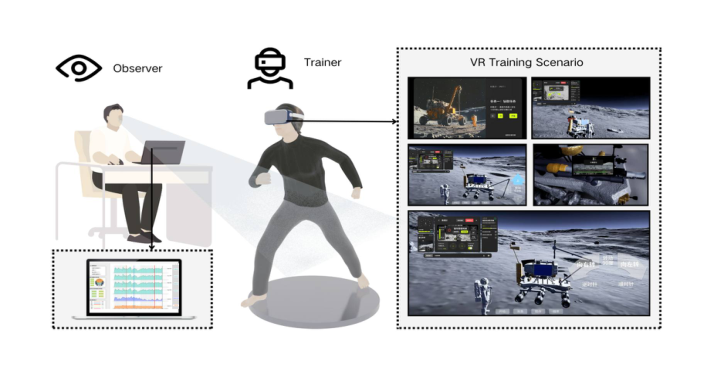
As shown in Figure 4, in the training scenario, one observer monitors the system to ensure accurate experimental records, while the trainee, equipped with the VR headset, sequentially performs three distinct tasks within the VR environment. The system integrates these task performances with the Three-Level Cognitive Load Classification System, leveraging real- time physiological data to evaluate and classify cognitive load into three distinct levels: low, medium, and high. Based on this classification, the system dynamically adjusts the automation level of the intelligent lunar rover, providing personalized feedback on task load. This adaptive mechanism ensures that the rover’s automation is in sync with the user’s cognitive state, enhancing task performance and user safety by optimizing human- machine collaboration. The continuous feedback and adjustment of cognitive load also facilitate real-time decision-making, thereby improving the overall efficacy and safety of the training process.
Figure 4: Specific training scenario.
CONCLUSION AND FUTUREWORK This study has made notable progress in handling HCC challenges for lunar exploration. The three-level cognitive load classification system and
Adaptive Task Reallocation for Lunar Exploration: Cognitive Load Management 41
VR-based lunar task simulation environment are crucial steps towards optimizing astronaut-machine cooperation and reducing cognitive load. By combining multimodal psychological, physiological, and task performance data, we’ve enabled efficient task allocation between humans and machines. The VR training system offers a great platform for HCC research with task reallocation.
Looking ahead, future efforts will focus on key aspects. Firstly, we’ll expand our multimodal physiological data collection. Incorporating brainwave and eye-tracking data will deepen our understanding of astronauts’ cognitive states, especially during complex lunar tasks. This addition will enhance the precision of our cognitive load classification, providing more accurate support for task redistribution. Secondly, more diverse and challenging mission scenarios will be designed. From handling equipment malfunctions at lunar bases to conducting long-distance sample collections, these scenarios will better equip astronauts for the uncertainties of actual lunar exploration. This will not only test the adaptability of our HCC systems but also improve astronauts’ practical skills. Most importantly, we’ll conduct full-scale system validation experiments. By testing our HCC frameworks in analog space environments replicating lunar conditions, we can identify and address potential issues. This real-world verification is essential for the application of our technologies in upcoming lunar base construction and long-duration missions. We look forward to the fact that our research will play a significant part in facilitating the training of astronauts for future long-term lunar assignments.
ACKNOWLEDGMENT
This work was supported by the Beijing Natural Science Foundation of China (Grant No. 3254040), and National Key Laboratory of Human Factors Engineering.
REFERENCES
Aylward, K., Dahlman, J., Nordby, K., & Lundh, M. (2021). Using Operational Scenarios in a Virtual Reality Enhanced Design Process. Education Sciences, 11(8), 448. https://doi.org/10.3390/educsci11080448 Bannert, M. (2002). Managing cognitive load—recent trends in cognitive load
theory. Learning and instruction, 12(1), 139–146. https://doi.org/10.1016/S0959- 4752(01)00021-4 Chen, J. Y. C., Barnes, M. J. (2014) “Human–agent teaming for multirobot control: A review of human factors issues”, IEEE Transactions on Human-Machine Systems, 44(1), pp. 13–29. https://doi.org/10.1109/THMS.2013.2293535 ElGibreen, H., & Youcef-Toumi, K. (2019). Dynamic task allocation in an
uncertain environment with heterogeneous multi-agents.Autonomous Robots,43, 1639–1664. https://doi.org/10.1007/s10514-018-09820-5 Endsley, M. R. (1987). The Application of Human Factors to the Development of Expert Systems for Advanced Cockpits. Proceedings of the Human Factors Society Annual Meeting, 31(12), 1388–1392. https://doi.org/10.1177/ 154193128703101219
Endsley, M. R. (2016). From Here to Autonomy: Lessons Learned From Human– Automation Research. Human Factors, 59(1), 5–27. https://doi.org/10.1177/ 0018720816681350 Finseth, T., Dorneich, M. C., Keren, N., Franke, W. D., & Vardeman, S. B.
(2022). Manipulating Stress Responses during Spaceflight Training with Virtual Stressors. Applied Sciences, 12(5), 2289. https://doi.org/10.3390/app12052289 Gutiérrez, Á., Blanco, P., Ruiz, V., Chatzigeorgiou, C., Oregui, X., Álvarez, M., Navarro, S., Feidakis, M., Azpiroz, I., Izquierdo, G., Larraga-García, B., Kasnesis, P., Olaizola, I. G., & Álvarez, F. (2023). Biosignals Monitoring of First Responders for Cognitive Load Estimation in Real-Time Operation. Applied Sciences, 13(13), 7368. https://doi.org/10.3390/app13137368 Haji, F. A., Rojas, D., Childs, R., de Ribaupierre, S., & Dubrowski, A.
(2015). Measuring cognitive load: Performance, mental effort and simulation task complexity. Medical education, 49(8), 815–827. https://doi.org/10.1111/ medu.12773 Han, S., & Kim, J. (2017). A Study on Immersion of Hand Interaction for Mobile Platform Virtual Reality Contents. Symmetry, 9(2), 22. https://doi.org/10.3390/ sym9020022 Kyriaki, K., Koukopoulos, D., & Fidas, C. A. (2024). A comprehensive survey of EEG
preprocessing methods for cognitive load assessment. IEEE Access, 12, 23466– 23489. https://doi.org/10.1109/ACCESS.2024.3360328 Li, N., Chen, X., Feng, Y., & Huang, J. (2021). Human–computer interaction cognitive behavior modeling of command and control systems. IEEE Internet of Things Journal, 9(14), 12723–12736. https://doi.org/10.1109/ JIOT.2021.3138247 Lin, Y., Yang, W., Zhang, H., Hui, H., Hu, S., Xiao, L.,... & Li, X. (2024). Return to the Moon: New perspectives on lunar exploration. Science Bulletin. https:// doi.org/10.1016/j.scib.2024.04.051 Longo, L., Orru, G. (2019). An Evaluation of the Reliability, Validity and
Sensitivity of Three Human Mental Workload Measures Under Different Instructional Conditions in Third-Level Education. In: McLaren, B., Reilly, R., Zvacek, S., Uhomoibhi, J. (eds) Computer Supported Education. CSEDU 2018. Communications in Computer and Information Science, vol 1022. Springer, Cham. https://doi.org/10.1007/978-3-030-21151-6_19 Nasrini, J., Hermosillo, E., Dinges, D. F., Moore, T. M., Gur, R. C., & Basner, M.
(2020). Cognitive performance during confinement and sleep restriction in NASA’s human exploration research analog (HERA). Frontiers in physiology, 11, 394. https://doi.org/10.3389/fphys.2020.00394 Ortega, M. (2021). Computer-Human Interaction and Collaboration: Challenges and Prospects. Electronics, 10(5), 616. https://doi.org/10.3390/ electronics10050616 Pirker, J. (2022, March). The potential of virtual reality for aerospace applications.
In 2022 IEEE Aerospace Conference (AERO) (pp. 1–8). IEEE. https://doi.org/ 10.1109/AERO53065.2022.9843324 Schnotz, W., & Kürschner, C. (2007). A reconsideration of cognitive load theory. Educational psychology review, 19, 469–508. https://doi.org/10.1007/ s10648-007-9053-4 Sewell, J. L., Maggio, L. A., ten Cate, O., van Gog, T., Young, J. Q., & O’Sullivan, P. S.
(2018). Cognitive load theory for training health professionals in the workplace: A BEME review of studies among diverse professions: BEME Guide No. 53. Medical Teacher, 41(3), 256–270. https://doi.org/10.1080/0142159X.2018.1505034
Adaptive Task Reallocation for Lunar Exploration: Cognitive Load Management 43
Shen, Z. H., Liu, M. H., Wu, Y., Lin, Q. Q., & Wang, Y. G. (2022). Virtual-realitybased social cognition and interaction training for patients with schizophrenia: A preliminary efficacy study. Frontiers in Psychiatry, 13, 1022278. https://doi.org/ 10.3389/fpsyt.2022.1022278 Wickens, C. D., Helton, W. S., Hollands, J. G., & Banbury, S. (2021). Engineering
Psychology and Human Performance (5th ed.). Routledge. https://doi.org/ 10.4324/9781003177616 Xie, Y., Tang, Z., & Song, A. (2022). Motion Simulation and Human–Computer Interaction System for Lunar Exploration. Applied Sciences, 12(5), 2312. https:// doi.org/10.3390/app12052312
LISTED IN THE AHFE DIGITAL BOOKSTORE CATALOGUE
Explore the complete digital volume
Neuroergonomics and Cognitive Engineering
Read this individual research paper free through the original publisher, or explore the full digital proceedings book.
ISBN 978-1-964867-43-4
Explore this ISBN in the AHFE Bookstore ↗Listed in the July 2026 bookstore catalogue; search by ISBN to confirm current availability · Digital book purchase optional