Text-to-image generation supports rapid concept exploration in design sprints, but improvisational prompts often cause two failures: priority dilution (critical improvement foci are buried) and weak input structure (mixed information in one sentence), which reduces stability and traceability. This study proposes a needs-priority–driven prompt framework that links decision documentation to generative ideation. Universal-Design-derived need items (C1–C6) are weighted using AHP with consistency checking (CR ≤ 0.10). QFD, integrated with AHP weights, translates weighted needs (WHATs) into engineering characteristics (HOWs/ECs) and yields a ranked Top-6 EC set. The ranked ECs are rewritten into a fixed-field structured prompt to guide Midjourney exploration and improve auditability from priorities to visible design cues. The contribution is a transferable “ranked ECs to structured prompt” specification for requirement-aligned generative exploration under short-cycle constraints.
Universal design is a suitable needs basis for older-adult assistive products, yet sustaining multi-criteria needs throughout sprint-based studio work remains challenging. Text-to-image generation can accelerate early concept visualization, but without a requirements-linked prompting scheme, exploration may drift and become difficult to justify. This study therefore examines a needs-driven workflow that derives ranked engineering characteristics and encodes them into structured prompts for more traceable generative ideation.
LITERATURE REVIEW
Universal Design and Inclusive Needs: Needs-Driven and Defensible Decision-Making Universal Design (UD) aims to ensure that products are understandable, operable, and safe for use across diverse abilities and contexts, supported
Keeping Text-to-Image Generation Aligned With Requirements: Need-Priority 41 by principles intended to foster fair and non-exclusionary user experiences (The Center for Universal Design, 1997; Story et al., 1998). With rapid global population ageing, accessibility and dignity in older adults’ everyday activities have become increasingly important (World Health Organization, 2025). Assistive products that appear overly “medicalized” may heighten concerns about being labeled or observed, potentially reducing willingness to use the device and participate in public life; related work links assistive device use with shame, stigma, and social-identity risk (Park & Kim, 2023; Kordrostami et al., 2025). Accordingly, adopting UD as the needs focus for assistive product design has methodological value by extending design objectives beyond single-group optimization toward cross-context usability and acceptability (Steinfeld & Maisel, 2012; Persson et al., 2015). However, UD implementation typically involves multi-dimensional requirements and trade-offs. In sprint-based settings (e.g., design education or short-cycle projects), prioritization can be displaced by subjective preference or salient visual features, weakening needs orientation and the defensibility of decisions. Decision-support methods can mitigate this risk: the Analytic Hierarchy Process (AHP) derives relative need weights to establish priorities (Saaty, 1980), while Quality Function Deployment (QFD) maps needs (WHATs) to engineering characteristics (HOWs) to create a traceable need–technology linkage and ranked improvement targets (Akao, 1990; Chan & Wu, 2002). In this study, AHP and QFD provide the structured basis for prioritizing UD-derived needs and translating them into actionable engineering foci, which subsequently supports prompt construction with reduced risk of aesthetic-driven drift.
Integrating Generative Images into Design: Prompt Biases and the Need for Structured Inputs Diffusion-based text-to-image models enable rapid concept visualization through natural-language prompts (Ramesh et al., 2022; Rombach et al., 2022), which is particularly attractive in sprint-based design. Yet because generation is stochastic, prompts function as the critical control interface (Tan & Luhrs, 2024; Hwang & Wu, 2025), and practical use often requires iterative trial-and-error that is difficult to stabilize or reconstruct (Mahdavi Goloujeh et al., 2024). While keyword recommendations and interactive guidance have been proposed to improve alignment (Brade et al., 2023; Feng et al., 2024; Huang & Xie, 2025), common style- and rendering-heavy practices may steer exploration toward preference-driven outcomes rather than requirement-driven intent (Oppenlaender, 2024). When prioritized engineering characteristics (from QFD×AHP) are rewritten into prompts without a structured convention, three biases are likely: semantic drift (engineering meaning collapses into vague adjectives, weakening the link to needs), priority distortion (high-priority content is diluted by stacked descriptors, increasing goal drift and reducing diagnosability across iterations) (Mahdavi Goloujeh et al., 2024), and visualizability distortion, where the model more readily
responds to appearance-, composition-, and style-related cues, but struggles to reliably represent non-visual performance attributes (e.g., material properties, strength, and stability). Therefore, transforming natural language into a more operational, inspectable, and traceable input representation is regarded as a key direction for improving output consistency and controllability (Mehrabi et al., 2023). Interactive interfaces for prompt structuring have also been introduced to improve controllability and input–output alignment (Kim et al., 2023; Huang & Xie, 2025). These converging findings support the necessity of structured prompting to govern inputs and sustain a needs-oriented exploration path.
Research Aim A replicable prompt formulation framework is proposed for generative ideation. It uses systematically translated needs—specifically, prioritized engineering characteristics derived from QFD×AHP—as the basis for prompt construction and applies a fixed-field rewriting scheme to express these characteristics in actionable terms. The framework targets reduced semantic drift and priority dilution, while rendering non-visual properties in more visualizable forms to improve decision traceability.
METHOD
Research Setting and Study Design This study used a four-week, course-based design sprint as the methodological validation setting, delivered as one three-hour class per week. Each week followed a consistent routine: feedback on the prior assignment, then introduction of new tasks and release of the next assignment, enabling iteration across the four weeks. Students were organized into three groups addressing older-adult assistive products: a shopping trolley, a tableware assistive device, and a vehicle transfer aid. The study adopted a two-level design: (1) a cross- case assessment to verify the process could be completed within the same time frame across groups, and (2) an in-depth focal-case presentation of the shopping trolley group to strengthen methodological clarity and replicability.
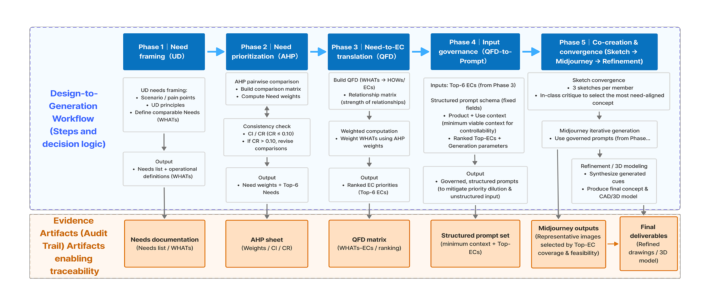
Process Overview: UD–AHP–QFD–Prompt Structuring and Generative Convergence A five-stage process was used to translate inclusive needs into structured inputs for text-to-image generation while preserving a traceable decision-evidence chain (Fig. 1). UD was used to define comparable need statements (WHATs), which were weighted using AHP with consistency checking (CR ≤ 0.10). QFD then mapped the weighted needs to engineering characteristics (HOWs/ ECs) and produced a ranked Top-6 EC list. These ECs were rewritten into a fixed-field structured prompt to reduce priority dilution and unstructured input. Representative images were obtained through sketch screening and iterative Midjourney generation, and subsequently developed into refined drawings and 3D models.
Figure 1: Workflow and audit trail of the UD–AHP–QFD-to-Prompt co-creation process.
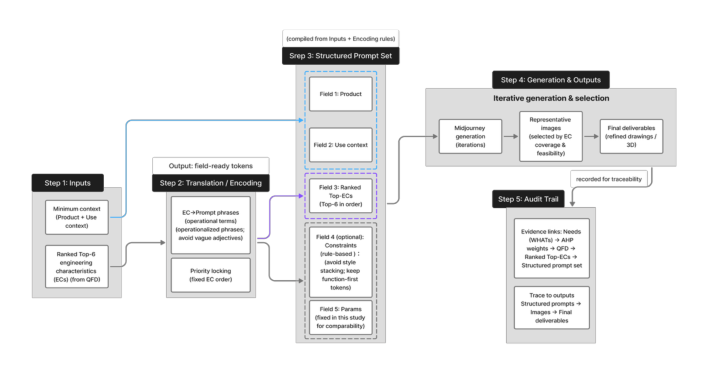
Structured Prompt Specification for QFD-to-Prompt This study proposes a QFD-to-Prompt structured prompt template as a prompt formulation framework for integrating generative imagery, addressing two recurrent issues in prompting practice: priority dilution and unstructured input. The template operationalizes the Top-N engineering characteristics (ECs) and their rankings derived from QFD×AHP by rewriting them into actionable generation inputs, while adding minimum context to reduce contextual drift. The template uses fixed fields: Product, Use context, Ranked Top-ECs, (optional) Constraints, and generation parameters (Fig. 2).
Figure 2: A traceable UD–AHP–QFD-to-Prompt pipeline for text-to-image co-creation.
Data Sources and Analysis This study relied primarily on artifact-based data, including the needs list (WHATs), AHP weights and consistency metrics, the QFD matrix and
Top-EC rankings, templated prompts, representative generated images, and final design outputs. Together, these materials constitute a traceable audit trail (Fig. 2). Analysis proceeded at two levels: (1) a cross-case check examining whether the process consistently produced a comparable evidence chain across Groups 1–3, and (2) a focal-case mapping (shopping trolley) linking inputs (Top-ECs and template fields) to observable visual cues in generated outputs and to corresponding design features in the final deliverables. Detailed mappings are reported in the Results section.
RESULT
Results are reported for three groups across two outputs: UD need prioritization (AHP) and need-to-EC translation (QFD). The reporting focuses on (1) priority usability, assessed via CR, and (2) the extent to which the Top-6 prioritized ECs (weighted by AHP) define clear improvement targets. Given that subsequent prompts are built primarily from the Top-6 ECs, presentation is centered on weights and rankings.
Need Prioritization Using AHP The AHP was used to derive the relative weights of the six need items (C1–C6) defined by each group (Groups 1–3, abbreviated as G1–G3). The resulting weights were subsequently used as the need-weighting inputs for the QFD analysis. The consistency ratios (CR) for all three cases were within the acceptable threshold, indicating satisfactory judgment consistency (G1: 0.093; G2: 0.099; G3: 0.100) (Table 1).
Table 1: AHP need weights (C1–C6) and consistency ratios by group.
Table available in the original PDF paper.
Group C1 C2 C3 C4 C5 C6 CR
0.093
G1 Shopping trolley
Poor storability (0.084)
Aesthetics not appealing (0.018)
High push/ pull effort (0.281)
Lack of flexible use (0.278)
Finger pinch risk during folding (0.056)
Alternative pushing/ pulling method (0.284)
0.099
Equitable use (0.041)
Flexibility in use (0.141)
Tolerance for error (0.133)
Appropriate size and space (0.053)
G2 Tableware assistive device
Low physical effort (0.328)
Simple and intuitive use (0.204)
0.100
G3 Vehicle transfer aid
Simple and intuitive use (0.315)
Tolerance for error (0.179)
Lighting support (0.028)
Low physical effort (0.077)
Appropriate size and space (0.066)
Overall convenience of use (0.334)
Keeping Text-to-Image Generation Aligned With Requirements: Need-Priority 45 Prioritized Engineering Characteristics Derived From QFD Integrated With Need Weights
Building on the need weights obtained in Section 4.1 (Table 1), each group conducted QFD to translate the weighted needs (need items) into engineering characteristics and to compute their priority ranking. The resulting Top-6 prioritized engineering characteristics (Table 2) provide the decision basis for the subsequent text-to-image prompting stage: the generation inputs were constructed primarily from the ranked engineering characteristics together with minimal contextual information (product type and use context). Overall, the weight-integrated rankings yielded clear and case-specific improvement foci across the three groups: the shopping trolley case emphasized effort reduction and mobility mechanisms; the tableware assistive device case emphasized intuitive interaction, reduced usage complexity, and grip- related usability; and the vehicle transfer aid case emphasized ergonomics, a lightweight and portable structure, and adjustability.
Table 2: Ranked top-6 ECs used for structured prompt inputs.
Table available in the original PDF paper.
EC6 (score)
Group EC1 (score) EC2 (score) EC3 (score) EC4 (score)
EC5 (score)
G1 Shopping trolley
Adjustable- height handle (3.745)
Pull-assist mode for effort reduction (7.587)
Electric- assist wheels (7.587)
Swivel wheels / casters (4.233)
Reduced friction / low rolling resistance (5.919)
Four-wheel luggage- style handling (5.919)
Personalization (6.336)
Special grip design (4.386)
Single-piece simplification (4.360)
G2 Tableware assistive device
Curved & rounded form (5.778)
Reduced complexity of use (5.584)
Intuitive & visually salient operation (5.584)
Ergonomic design (7.128)
Lightweight material (5.841)
Adjustable height (4.644)
Stable base/ chassis (2.633)
G3 Vehicle transfer aid
Easy storage / compactness (5.841)
Optimal force application point (4.530)
Structured Prompt Inputs and Generated Image Outputs Based on the EC prioritization results reported in Section 4.2, the top six prioritized ECs were used as the core inputs for text-to-image prompting. Only minimal contextual information—product type and use context— was added to reduce contextual drift. Notably, the prompts did not directly include the need items; instead, the ranked Top-6 ECs were treated as a proxy for needs to maintain alignment with the preceding decision documents. Across the three groups, multiple rounds of generation and refinement were conducted using fixed settings (aspect ratio 3:2; model version 5.1). Each group ultimately retained one representative image, which served as a visual intermediary for subsequent refined sketching and 3D modeling (Table 3).
Table 3: Structured prompt format and representative input (G1).
Product design for an assistive shopping trolley for older adults, grocery shopping in indoor/outdoor public walkways; easier to push and pull; electric-assist wheels; four-wheel luggage-style handling; reduce friction; foot-activated assistive storage mechanism; swivel wheels – ar 3:2 – v 5.1
Final Design Outcomes (Representative Case): Refined Drawings and 3D Models To converge the concepts after the generative exploration, each group used the representative generated image as a visual intermediary and further developed it into the final refined drawing and a 3D model. This step operationalized the prioritized engineering improvement foci derived from the need-weighted QFD analysis. Due to space limitations, Group 1 (shopping trolley) is reported as the representative case, presenting its final refined drawing and 3D model to illustrate the convergence from generated imagery to a realizable design outcome (Fig. 3).
Figure 3: From generation to realization: Midjourney concept draft, student refined design, and 3D prototype model (from left to right).
Results Summary and Audit-Trail Boundary Conditions Across Sections 4.1–4.4, all three cases produced a consistent set of outputs spanning need weighting, EC prioritization, and generation inputs with a representative image, indicating that the proposed workflow can establish a traceable decision audit trail under time-constrained design-sprint conditions. A key boundary condition should be noted: the Midjourney prompts in this study were centered on the Top-6 prioritized ECs and did not directly include the need items. This EC-centered prompting strategy may reduce priority dilution and unstructured inputs at the prompt level; however, it also makes the methodological question of how inclusive needs are preserved through EC translation and carried into the generation inputs central to interpretation. Its benefits, limitations, and reinforcement strategies are addressed in the following section.
DISCUSSION
Rationale and Applicability Conditions for Using Engineering Characteristics as Need Proxies The findings indicate that, in sprint-based design settings, using the top six prioritized engineering characteristics (ECs) as the core inputs for text-to- image generation can maintain alignment between concept exploration and the need priority structure without imposing a substantial additional authoring burden. Compared with prompting directly from need statements, ECs are closer to actionable design language and are more readily translatable into form configurations, mechanism features, and interaction cues. As a result, EC-centered prompting can function as a clearer set of constraints during generation and can reduce the likelihood that exploration is driven primarily by aesthetic preference.
The effectiveness of this strategy, however, depends on two conditions: (1) whether the ECs can retain the key semantics of the target needs, and (2) whether they possess sufficient explicit representability (i.e., whether the intended attributes can be reliably externalized in the generated imagery). For needs that are primarily socio-psychological—such as acceptability, stigma risk, and dignity—ECs alone may be insufficient as proxies. In such cases, incorporating a minimal set of value-oriented constraints into the use context field (e.g., avoid medicalized appearance; support natural use in public settings) can mitigate semantic attenuation during translation and help preserve intent through the generation stage.
Operationalizing Generative Inputs: Translating Prioritized Engineering Characteristics into Structured Prompts This study does not aim to improve individual prompt-writing skill; it operationalizes QFD×AHP–derived prioritized engineering characteristics into a reusable input format. The structure addresses two common failures in text-to-image generation: priority dilution (key foci being overridden by non-critical descriptors) and context drift with weak traceability under unstructured, sentence-like prompts. Prompts are therefore encoded in fixed fields—product, use context, Top-6 prioritized engineering characteristics, essential constraints, output specifications, and parameters—supporting cross-case comparability and allowing revisions to be localized to specific fields for better reproducibility and traceability (Table 4).
The ordering of engineering characteristics externalizes the designer’s prioritization rather than presuming the model interprets numeric weights or rank semantics. Where characteristics conflict (e.g., foldability vs. structural stability), future work can compare single-round prompting with staged constraint strategies to assess feature retention in generated outputs.
Table 4: Structured prompt format and representative input (G1).
Table available in the original PDF paper.
Field Purpose Filling rules (concise) Example (optional; one line) assistive shopping trolley for older adults Product Anchor the generation target and prevent category drift
Use a noun phrase for product type + target group if needed; avoid style descriptors
Use context Provide minimum context to reduce context drift
grocery shopping in indoor/outdoor public walkways
One sentence describing activity + setting/surface/ constraints; do not expand rationales
Ranked Top-6 ECs Convert prioritized decisions into core constraints and reduce priority dilution
List ECs from highest to lowest based on QFD×AHP; express each EC as a visualizable configuration/action; keep one concept per EC
Add necessary constraints without disrupting the ranked core
Include only must-have constraints (size/safety/ foldability); avoid aesthetic stacking
product design concept rendering
Output spec Improve comparability and usability of outputs
Specify output type (concept sketch / product design rendering); avoid excessive detail --ar 3:2 --v 5.1 Fix aspect ratio and model version; omit parameters not controlled
Parameters Support comparability and minimal reproducibility (at least within cases)
Visualizability Gap and Cross-Media Translation Strategies Even with EC-centered structured prompting, text-to-image generation exhibits a visualizability gap: form, configuration, and operating posture are readily depicted, whereas performance attributes (e.g., friction, strength, stability) are not reliably represented. This study frames the gap as a cross-media translation issue and addresses it via visual proxy cues(Table 5), rewriting performance-oriented ECs into indirectly depictable design descriptors, such as (1) geometry/proportion (wheel diameter, track width, low center of gravity), (2) structure/support (support points, locking nodes, anti-tip features), and (3) interaction/operation (force posture, push– pull path, brake location). Accordingly, generated images are treated as visual intermediates for exploring configurations rather than evidence of performance fulfillment; performance requirements should be instantiated and checked in subsequent refinement and 3D modeling through explicit dimensions, structures, materials, and mechanisms.
Table 5: Structured prompt format and representative input (G1).
Image models respond more consistently to posture/ operation cues
Electric-assist wheels
Specify component + placement/ integration
integrated electric-assist wheels at rear axle
Mechanism / configuration (ground needs in components)
Placement and integration increase output consistency and design usability
Swivel wheels / four-wheel trolley mode
front swivel casters; four- wheel trolley mode
Mobility / wheel geometry (ground needs in layout)
Specify wheel type + locomotion mode (wheel position/type/ mode)
Highly visual cues; quickly converge to interpretable configurations
Reduced friction / improved stability
Performance attribute (requires visual proxies)
Rewrite performance intent into indirectly depictable structural cues
larger wheel diameter; wider wheelbase; low center of gravity; brake/anti-tip features
Performance properties are hard to depict directly; proxy cues improve interpretability
CONCLUSION, LIMITATIONS, AND FUTURE WORK This study proposes a needs-driven text-to-image co-creation workflow for sprint contexts. UD-based needs are weighted with AHP and translated via QFD into prioritized engineering characteristics (ECs); the Top-6 ECs then structure prompts to reduce priority dilution and unstructured input, supporting more focused exploration and more defensible convergence under time constraints.
Limitations point to future work. The current validation relied on educational design artifacts; subsequent studies should add user-based task evaluation and basic engineering feasibility checks (e.g., stability and structure) to strengthen external validity. Prompt iterations were not version-tracked; prompt version control and automated logging would improve reproducibility while reducing documentation burden. EC-centered prompting may under-represent psychosocial UD concerns (e.g., acceptability and stigma risk); comparing “EC-only” with “EC + compact needs/context constraints” prompting can clarify trade-offs in alignment, stability, and convergence efficiency and support transferable rewriting guidelines.
ACKNOWLEDGMENT
The author acknowledges the co-instructors for their support during the course implementation and thanks the participating students for contributing the project outputs analyzed in this paper.
REFERENCES
Akao, Y. (ed.) (1990) Quality function deployment: Integrating customer requirements into product design. Productivity Press. Brade, S., Wang, B., Sousa, M., Oore, S. and Grossman, T. (2023) ‘Promptify: Text-
to-image generation through interactive prompt exploration with large language models’, arXiv (arXiv:2304.09337). Available at: https://doi.org/10.48550/ arXiv.2304.09337 Chan, L.-K. and Wu, M.-L. (2002) ‘Quality function deployment: A literature review’, European Journal of Operational Research, 143(3), pp. 463–497. Feng, Y., Wang, X., Wong, K.K., Wang, S., Lu, Y., Zhu, M., Wang, B. and Chen,
W. (2024) ‘Interactive prompt engineering for text-to-image creation’, IEEE Transactions on Visualization and Computer Graphics. Available at: https://doi. org/10.1109/TVCG.2023.3327168 Huang, B. and Xie, H. (2025) ‘PromptNavi: Text-to-image generation through interactive prompt visual exploration’, Computers & Graphics, 132, 104417. Available at: https://doi.org/10.1016/j.cag.2025.104417 Hwang, Y. and Wu, Y. (2025) ‘Graphic design education in the era of text-to-image
generation: Transitioning to contents creator’, International Journal of Art & Design Education, 44(1), pp. 239–253. Available at: https://doi.org/10.1111/ jade.12558 Kim, S., Ko, T., Kwon, Y. and Lee, K. (2023) ‘Designing interfaces for text-to-image prompt engineering using stable diffusion models: A human-AI interaction approach’, in De Sainz Molestina, D., Galluzzo, L., Rizzo, F. and Spallazzo, D. (eds.) IASDR 2023: Life-Changing Design, Milan, Italy, 9–13 October. Available at: https://doi.org/10.21606/iasdr.2023.448 Kordrostami, A., Esmailpour, J., Aghabayk, K. and Shiwakoti, N. (2025) ‘Promoting
social sustainability: Psychological and contextual factors influencing mobility scooter adoption among older adults in a developing country’, Sustainable Futures, 10, 100878. Available at: https://doi.org/10.1016/j.sftr.2025.100878 Mahdavi Goloujeh, A., Sullivan, A. and Magerko, B. (2024) ‘Is it AI or is it me?
Understanding users’ prompt journey with text-to-image generative AI tools’, in Proceedings of the CHI Conference on Human Factors in Computing Systems. Association for Computing Machinery, pp. 1–13. Available at: https://doi. org/10.1145/3613904.3642861 Mehrabi, N., Goyal, P., Verma, A., Dhamala, J., Kumar, V., Hu, Q., Chang, K.-W., Zemel, R., Galstyan, A. and Gupta, R. (2023) ‘Resolving ambiguities in text-to- image generative models’, in Rogers, A., Boyd-Graber, J. and Okazaki, N. (eds.) Proceedings of the 61st Annual Meeting of the Association for Computational Linguistics (Volume 1: Long Papers). Toronto, Canada: Association for Computational Linguistics, pp. 14367–14388. Available at: https://doi. org/10.18653/v1/2023.acl-long.804 Oppenlaender, J. (2024) ‘A taxonomy of prompt modifiers for text-to-image
generation’, Behaviour & Information Technology, 43(15), pp. 3763–3776. Available at: https://doi.org/10.1080/0144929X.2023.2286532 Park, H. and Kim, J. (2023) ‘The use of assistive devices and social engagement among older adults: Heterogeneity by type of social engagement and gender’, GeroScience, 46(1), pp. 1385–1394. Available at: https://doi.org/10.1007/s11357- 023-00910-6
Keeping Text-to-Image Generation Aligned With Requirements: Need-Priority 51 Persson, H., Åhman, H., Yngling, A.A. and Gulliksen, J. (2015) ‘Universal design,
inclusive design, accessible design, design for all: Different concepts—One goal? On the concept of accessibility—Historical, methodological and philosophical aspects’, Universal Access in the Information Society, 14, pp. 505–526. Available at: https://doi.org/10.1007/s10209-014-0358-z Ramesh, A., Dhariwal, P., Nichol, A., Chu, C. and Chen, M. (2022) ‘Hierarchical text-conditional image generation with CLIP latents’, arXiv (arXiv:2204.06125). Rombach, R., Blattmann, A., Lorenz, D., Esser, P. and Ommer, B. (2022) ‘High-
resolution image synthesis with latent diffusion models’, in Proceedings of the IEEE/CVF Conference on Computer Vision and Pattern Recognition (CVPR), pp. 10684–10695. Saaty, T.L. (1980) The analytic hierarchy process: Planning, priority setting, resource allocation. McGraw-Hill. Steinfeld, E. and Maisel, J. (2012) Universal design: Creating inclusive environments.
John Wiley & Sons. Story, M.F., Mueller, J.L. and Mace, R.L. (1998) The universal design file: Designing for people of all ages and abilities. NC State University, The Center for Universal Design. Tan, L. and Luhrs, M. (2024) ‘Using generative AI Midjourney to enhance divergent
and convergent thinking in an architect’s creative design process’, The Design Journal, 27, pp. 677–699. Available at: https://doi.org/10.1080/14606925.2024 .2353479 The Center for Universal Design (1997) The principles of universal design (Version 2.0). North Carolina State University. World Health Organization (2025) Ageing and health [Fact sheet]. World Health
Organization, 1 October.
LISTED IN THE AHFE DIGITAL BOOKSTORE CATALOGUE
Explore the complete digital volume
Universal Design and Design for Inclusion
Read this individual research paper free through the original publisher, or explore the full digital proceedings book.
ISBN 978-1-964867-85-4
Explore this ISBN in the AHFE Bookstore ↗Listed in the July 2026 bookstore catalogue; search by ISBN to confirm current availability · Digital book purchase optional