3 Data Science Design Team, ADSP, R-IH, RIKEN, Wako, 3510198, Japan; Shirakawa Hospital, Omuta, 8370926, Japan ↗
4 Data Science Design Team, ADSP, R-IH, RIKEN, Wako, 3510198, Japan; Faculty of Fukuoka Medical Technology, Teikyo University, Omuta, 8368505, Japan ↗
5 Data Science Design Team, ADSP, R-IH, RIKEN, Wako, 3510198, Japan; Faculty of Health and Welfare, Prefectural University of Hiroshima, Mihara, 7230053 Japan ↗
6 Data Science Design Team, ADSP, R-IH, RIKEN, Wako, 3510198, Japan; Department of Civil Engineering and Architecture, Tohoku University, Sendai 9808579, Japan ↗
This paper introduces a case study of work improvement conducted with care workers on site as well as discussions on their motivation of the improvement. For a sustainable service based on work improvements, not only user-centered but also service-provider-centered design is important. However, a co-creation project with on-site workers has a difficulty in designing a successful work improvement due to both their busy daily care work and their psychological burden to accept and launch the designed improvement. Thus, workshop designers should effectively motivate them so that they could join the design project and make a decision to launch the improvement. As for motivation in service design, Bisset introduced differing levels of motivation of a service user[1]. Bisset's framework is useful to understand and analyze each level of motivation though a target of the framework is mainly a service user, not a service provider. For motivating on-site workers, a study with a viewpoint of a service provider is necessary. We conducted 17 co-creation workshops for a year in order to design a work improvement which would be served as a sustainable service. The workshops were designed based on design thinking and focused on solving an environmental problem of their nursing facility. A manager at the facility expected the workers to think and act on their own initiative to improve their work autonomously. Though the workers tried to design a solution for safe and comfortable aisles where a wheelchair does not hit tables or chairs, the trial resulted in failure to launch the solution. A review workshop, which was conducted to analyze the reason why the workshops failed, revealed that they are too cautious to step forward although they learned the importance of understanding users, paying more attention to users and information sharing among workers. They were concerned about disadvantages by the solution such as complaints from users about table layout changes. They were also concerned about the lack of preparation to implement the solution. The review result suggests a design of intrinsic motivation for putting ideas into actions based on what they have learned. We think the intrinsic motivation could be enhanced by both a design of work improvement workshops and a design of their work style changes. As for the former, we included in the workshop design functions for extracting assumed problems during solution operation and devising ideas for problem solving, but the effects were insufficient. As Lockton mentioned[2], the latter depends on both behavior change of the workers and a design of the work environment. Future work will include a better workshop design that raises the motivation level of the workers step by step and exploring effective motivation of the workers to change their work style and workplace.[1] Bisset, F. et al: Designing motivation or motivating design? Exploring Service Design, motivation and behavioural change, Touchpoint: The Journal of Service Design, Vol.2, No.1, pp.15-21, 2010[2] Lockton, D. et al: Modelling the User: How design for sustainable behaviour can reveal different stakeholder perspectives on human nature, Brunel University Research Archive, 2010
Work improvements are important but troublesome for workers on site because daily tasks must change to implement the improvements, which may cause confusion on site, and this is a cause of worry for workers. This paper introduces a case study of a work improvement designed with care work- ers on site. We conducted 17 co-creation workshops for a year in order to design a work improvement for sustainable service. Unfortunately, the work- shops failed in designing one that care workers could accept. This paper reports the result of our review workshop, which was conducted to analyze why the work improvement designed through the 17 workshops was not implemented.
On-Site-Worker-Centered Design for Work Improvements 11
ISSUES ADDRESSED In the nursing domain, work improvements are expected due to a labor shortage problem. For service sustainability achieved through work improve- ments, not only user-centered but also service-provider-centered design is important (Bodenheimer et al., 2014). For service-provider-centered design, care workers on site should join a design project from the early stage and should co-create a design that they can accept. However, a co-creation project done with on-site workers can face difficulties with designing successful work improvements because workers are busy with daily tasks and must also deal with the psychological burden of accepting and implementing the designed improvement. Workers do not passively accept the results of co-creation projects (Nielsen, 2013). Thus, workshop designers should effectively moti- vate them so that they can join a design project and decide to implement improvements. That is, those involved in the design project should focus on what changes from work improvements are feasible and appropriate in their workplace (Storkholm et al., 2019). As for motivation in service design, Bisset introduced differing levels of the motivation of a service user (Bisset et al., 2010). Bisset’s framework is useful for understanding and analyzing each level of motivation, though the target of the framework is mainly ser- vice users, not service providers. For motivating on-site workers, study done from the viewpoint of a service providers is necessary. At the nursing facil- ity where the third author of this paper serves as a director, he expected not only effective work improvements but also effects on staff education that lead to improvements to the organizational culture. This is because on-site care workers pay too much attention to their daily tasks and do not notice prob- lems, or they do not try to improve their work even though they are aware of problems. As Batalden mentioned (Batalden et al., 1993), work improve- ments need to be continually implemented, for which workers’ motivation is essential. Our case study provides a discussion on the motivation of on- site workers through experiences in workshops involving the design of work improvements.
WORK IMPROVEMENT WORKSHOPS Workshop Overview
To design work improvements at the nursing facility, we conducted 17 co-creation workshops with care workers. The workshops were held every two weeks from July 2021 to August 2022 (suspended for 3 months due to covid-19). All on-site workers at the facility were targeted for par- ticipation in the workshops, and the average number of participants was 15.3, with an average age of 31. None of the participants had design work- shop experience. Each workshop was held during working hours as part of the work, and all workers were requested to participate by the direc- tor of the facility. The workshop was held in a hall of the facility for 30 minutes just before the closing time, and no extension of time was allowed.
Workshop Flow The workshops were designed on the basis of design thinking. Table 1 shows the contents and outputs of each workshop. They started with an explanation of the purpose of the project in the first workshop, and the participants then extracted problems regarding their work environment, decided on a problem to be solved, and tried and evaluated ideas devised to solve it. We repeated the stages of empathy, definition, ideation, prototyping, and test of design think- ing. In the 4th to 6th workshops, to give the participants the experience of a small success, although it was not related to the main topic, we asked them to prototype a leaflet introducing the facility (Ihara et al., 2022). After that, in the 7th workshop, a questionnaire was conducted to ask them to answer the questions regarding the workshop experience such as their willingness to cooperate with the project, and the results were used to improve the design of subsequent workshops. In the 8th workshop, an issue with aisles in the hall was identified as a significant problem because wheelchairs hit chairs and tables in the hall. To solve this problem, in the 9th and 10th workshops, the idea of changing the layout of the tables to a hexagonal one throughout
Table 1. Contents and outputs of each workshop.
Table available in the original PDF paper.
# Stage Contents Outputs Rapport building
1 - Introduction and explanation of purpose of project
2 Empathize and define
Extraction of problems and strengths of work environment
Organized data for issue definition 3 Ideate and test Selecting an issue, and creating and testing ideas to solve it
Idea of table layout change
Decision to solve issue with aisles 4 - Leaflet workshop: Empathize Evaluation of current version of leaflet 5 - Leaflet workshop: Define and ideate Defined problems of current version of leaflet and ideas to solve them 6 - Leaflet workshop: Prototype and test Leaflet prototypes and evaluation results 7 - Informed consent and questionnaires Evaluation results on workshop design 8 Define Identifying target aisle and problem Detailed information on issue to solve 9 Ideate and test Ideating to solve target issue and voting on favorite idea
10 Ideate and test Ideating for concrete table placement and voting on favorite idea
Idea of hexagonal table arrangement 11 Prototype Creating concrete layout with paper prototypes
List of preparation tasks and consensus on implementation
Idea of placing table slightly off hexagon 12 Test Analyzing problems with hexagon layout List of problems 13 Ideate and test Ideating to solve problems List of solutions to solve problems 14 Prototype Trial and error of table placement in hall List of lessons learned from trial and error 15 Test Analyzing necessary preparations to implement layout change and confirmation of workers’ acceptance
16 Prototype and test
Trying rearrangement using designated test table
Workers’ own successful experiences 17 Prototype and test
Determining specific table layouts and organizing solutions to solve problems
Table layouts and list of solutions
On-Site-Worker-Centered Design for Work Improvements 13
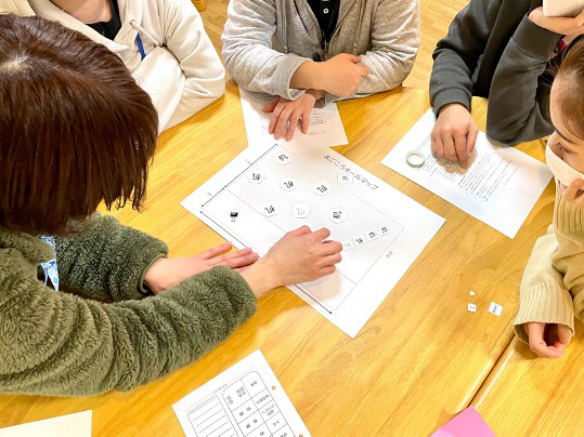
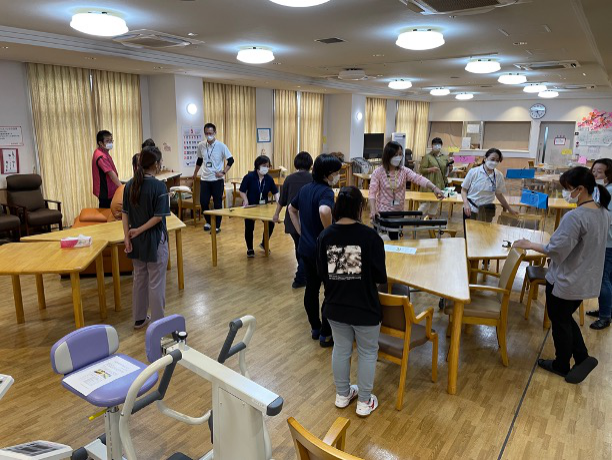
the hall was adopted (note that there exists long island tables that cause the problem of narrow aisles). The participants experienced both a paper proto- typing (Figure 1) and trial and errors in the hall (Figure 2) regarding the table layout change. In the 12th, 13th, and 15th workshops, they analyzed possible problems and necessary preparations to implement the change. In the 17th workshop, they determined the table layouts with solutions for the possible problems; however, they decided not to implement the layout change.
Figure 1: Paper prototyping of table layout change.Figure 2: Trial and error of table layout change.
REVIEW WORKSHOP After the 17 workshops were completed, a review workshop was conducted to investigate why the workers gave up on changing the table layout and how they changed their mindset through the workshop experience. In the review workshop, 13 participants answered for the following two questions using sticky notes.
Q1. What made you decide not to change the table layout finally? What do you think could have changed the layout?
Q2. What did you learn from the workshop experience? Write down changes in yourself, such as what you have learned and changes in your mind.
A sticky note with each participant’s answer was posted on a board, and all participants voted for which sticky note they agreed with. Answers and voting results for Q1 and Q2 are shown in Table 2 and Table 3, respectively.
Table 2. Reasons table layout change was not adopted (answers to Q1).
Table available in the original PDF paper.
Category Answer Vote
0
Disadvantage Currently, there are more disadvantages than advantages. 9 Preparation Lack of planning (need to notify patients early) 3 Insufficient time for layout study 2 Transition period required 1 Insufficient time for table placement and patient briefing 0 Physical space Size of hall should match number of tables. 0 Lack of aisles and placement space for wheelchairs 0 Change placement of rehabilitation equipment to create space for table
0
Patient care Considerations to avoid patient confusion 2 Confusion among patients who think their current seat is good 0 Detailed analysis
Number and condition of wheelchair users should be confirmed. 0 Restrictions to decide seat due to compatibility between patients and wheelchair use
0
Process Should consider patient’s flow line before considering seating arrangement.
Necessity Current table layout is enough. 0
DISCUSSION
According to the results in Table 2, workers were concerned about the disad- vantages of changing the table layout and the lack of sufficient preparation. The facility director’s expectations for the workshops were that each worker would become more aware of their work and recognize the importance of “trying” through trial and error, and that the workers would encourage each other to improve their work based on their own decision even if they make a few mistakes. The workshops were designed so that advance preparations could be made by identifying problems that could arise if the designed work improvement was implemented and so that the workers could think about solutions to the problems. However, the workers gave up on the implemen- tation due to lack of preparations. Changing the overall table layout to widen
On-Site-Worker-Centered Design for Work Improvements 15
the aisles would have required modifying patient seating, which was decided based on various considerations such as wheelchair use and the flow line to the rehabilitation equipment. It is also necessary for the workers to give explanations to patients so as not to confuse them. It may have been neces- sary to design a workshop that could clearly convey the aim of the facility director to the participants who were concerned that “failure is a bad thing and should be avoided.”
On the other hand, regarding worker education, the workshop experience was effective in terms of mindset and behavior in daily tasks (see Table 3). The participants learned the importance of understanding patients and paying more attention to them. In particular, many participants voted in agreement with the need for workers to share opinions among each other, suggesting that they learned various opinions from other participants at the workshop. At the workshop, we intentionally had more discussions in groups of about 5 people, and we posted the results of individual work on a whiteboard for voting. These workers work collaboratively day-to-day, and task skills can be learned through this. However, it is difficult for the knowledge and viewpoints of workers to be shared in busy daily work.
Table 3. What the workers have learned through workshop experiences (answers to Q2).
Table available in the original PDF paper.
Category Answer Vote Understanding patients
1
Being aware of patient behavior 2 Understanding patient activity areas 1 Knowing relationships between patients 1 Knowing more about patients 0 Knowing patient’s movements 0 Attention Securing a walkable flow line before guiding patient 3 Now that I know where the problem is, I always pay attention to it and guide the patient.
0
Carefully watching patient’s movement 1 Observing patient’s movement and looking for any inconvenience or anxiety
0
In narrow aisles, talking to sitting patients and putting away chairs 0 Thinking more about better use of hall and wheelchairs when guiding patients to their seats
5
Necessity of sharing opinions among workers to know what they miss
0
Information sharing among workers
It is important to know the other person’s point of view and communicate one’s own point of view.
0
It was good to post other people’s opinions on the board and vote. 0 Importance of trial
Discussions and exchange of information are necessary, but nothing will change if no action is taken.
In the workshops, the facility director expected work improvements to be made through worker independence, but in the Bisset framework, this corre- sponds to “autonomy,” which is the highest level of intrinsic motivation. It is not easy for workers who are too used to routine work to suddenly reach the highest level. In fact, the effects of the workshops were limited to understand- ing the relationship between the content of improvements and the workers
themselves (“relatedness” in the Bisset framework) and the motivation of the workers’ ability level (“competence”). As for the design of the workshops, it is necessary to gradually improve the level of motivation.
We think the intrinsic motivation could be enhanced by both the design of the work improvement workshops and the design of work style changes. As for the former, we included in the workshop design functions for extracting assumed problems during giving care services with the implemented solution and devising ideas for problem solving, but the effects were insufficient. In the future, workshop design should involve designing the interaction between workers and improvement content, in addition to having workers create work improvements themselves. In other words, it is expected that workers’ autonomy will be enhanced by promoting a deeper understanding of both the advantages and disadvantages of work improvements and the effect that changes in worker behavior will have on the implementation of the improve- ments. As for the latter, work style changes depend on both behavior changes of workers and the design of the work environment (Lockton et al., 2010). Regarding the work environment, there is a workplace model called activity based working (ABW) that provides employees with different work environ- ments for different types of work. ABW is generally considered unsuitable for nursing facilities, but from a functional point of view, these facilities have separate spaces for different purposes such as a place for bathing assistance and one for rehabilitation. However, a characteristic of nursing facilities is the presence of patients and the lines of movement between various dedi- cated spaces and patient seats. Since the flow lines in nursing facilities are complicated, the concept of public space design could be used as a refer- ence. In addition, since both users and providers of a care service coexist in the same nursing facility space, the design of educational facilities such as schools could be a good reference. Workshops should be designed where par- ticipants are intrinsically motivated to create work improvements using those references. Furthermore, to utilize worker motivation to improve work, it is important to analyze workers’ well-being and performance from the per- spective of workplace resources (Nielsen et al., 2017). Finally, in terms of designing a co-creation project, it is important to consider various princi- ples (von Thiele Schwarz et al., 2020) and intervene in nursing facilities as cooperative organizations.
CONCLUSION
This paper introduced the result of work improvement workshops con- ducted with care workers as well as discussions on their motivation toward the improvement. We believe that the contributions of this paper are as follows. First, we presented a case study analyzing work improvement work- shops conducted with on-site care workers, although they resulted in failure. Second, we analyzed the motivation of the on-site care workers, who are important as service providers in the field, in order to improve the workshop design. Future work will include a better workshop design that raises the motivation level of the workers step by step and exploring how to effectively motivate workers to change their work style and workplace.
On-Site-Worker-Centered Design for Work Improvements 17
ACKNOWLEDGMENT
We thank the care workers at the outpatient rehabilitation facility “Magokoro”in Omuta city, Japan who cooperated in the co-creation project.
REFERENCES
Batalden, Paul and Stoltz, Patricia K. (1993). A framework for the continual improvement of health care: building and applying professional and improve- ment knowledge to test changes in daily work, The Joint Commission Journal on Quality Improvement, Vol. 19, No. 10, pp. 424–47; discussion 448–52. Bisset, Fergus and Lockton, Dan. (2010). Designing motivation or motivating design?
Exploring Service Design, motivation and behavioural change, Touchpoint, The Journal of Service Design, Vol. 2, No. 1. pp. 15–21. Bodenheimer, Thomas and Sinsky, Christine. (2014). From triple to quadruple aim: Care of the patient requires care of the provider, Annals of Family Medicine, Vol. 12, No. 6, pp. 573–576. DOI: 10.1370/afm.1713. Ihara, Masayuki, Murakami, Hiroki, Tokunaga, Hiroko, Saruwatari, Shinpei,
Takeshita, Kazuki, Koga, Akihiko, Yukihira, Takashi and Hisano, Shinya. (2022). “A case study of motivating care workers for cooperation with a long-term co- creation project,” in: Proceedings of Human Interaction & Emerging Technologies (IHIET 2022): Artificial Intelligence & Future Applications, Vol. 68, pp. 84–91. DOI: 10.54941/ahfe1002716. Lockton, Dan, Harrison, David and Stanton, Neville A. (2010). “Modelling the user: How design for sustainable behaviour can reveal different stakeholder per- spectives on human nature,” in: Proceedings of the ERSCP-EMSU 2010, Delft, Netherlands, October 25–29, 2010, TU Delft. Nielsen, Karina, Nielsen, Morten B., Ogbonnaya, Chidiebere, Känsälä, Marja, Saari,
Eveliina and Isaksson, Kerstin. (2017). Workplace resources to improve both employee well-being and performance: A systematic review and meta-analysis, Work & Stress, 31:2, pp. 101–120, DOI: 10.1080/02678373.2017.1304463. Nielsen, Karina. (2013). Review Article: How can we make organiza- tional interventions work? Employees and line managers as actively craft- ing interventions. Human Relations, Vol. 66, No. 8, pp. 1029–1050. DOI: 10.1177/0018726713477164. Storkholm, Marie Höjriis, Savage, Carl, Tessma, Mesfin Kassaye, Salvig, Jannie Dalby and Mazzocato, Pamela. (2019). Ready for the Triple Aim? Per- spectives on organizational readiness for implementing change from a Danish obstetrics and gynecology department, BMC Health Service Research 19:517. DOI: 10.1186/s12913-019-4319-3. von Thiele Schwarz, Ulrica, Nielsen, Karina, Edwards, Kasper, Hasson, Henna,
Ipsen, Christine, Savage, Carl, Simonsen Abildgaard, Johan, Richter, Anne, Lor- nudd, Caroline, Mazzocato, Pamela and Reed, Julie E. (2021). How to design, implement and evaluate organizational interventions for maximum impact: the Sigtuna Principles, European Journal of Work and Organizational Psychology, 30:3, pp. 415–427. DOI: 10.1080/1359432X.2020.1803960.
LISTED IN THE AHFE DIGITAL BOOKSTORE CATALOGUE
Explore the complete digital volume
Human Systems Engineering and Design (IHSED 2023): Future Trends and Applications
Read this individual research paper free through the original publisher, or explore the full digital proceedings book.
ISBN 978-1-958651-88-9
Explore this ISBN in the AHFE Bookstore ↗Listed in the July 2026 bookstore catalogue; search by ISBN to confirm current availability · Digital book purchase optional