Jingwen Xie, Bei zhang, Mengxiu Wang (2023). Color matching research of electronic maps based on deep cognitive judgment. In: Human Systems Engineering and Design (IHSED 2023): Future Trends and Applications. AHFE Open Access, vol. 112, pp. 107–112. https://doi.org/10.54941/ahfe1004119
At present, people are paying more and more attention to the study of the display effect of electronic maps. It has been proved that the color matching of electronic maps could affect users' search performance. This study is based on the actual user needs, to further explore the influence of electronic map color matching on the user's depth cognitive judgment. This study designed 4 kinds of color matching schemes, using ergonomics experiments to measure the operating time and accuracy rate, to study the impact of map color schemes on user perception and judgment. The experiment result shows that the electronic map color matching has an impact on the user's deep cognitive judgment, the result can provide reference and basis for the color design of electronic maps.
As a common function of modern information systems, electronic maps are often operated on electronic maps. As an effective influencing factor in the electronic map display effect, color has the effect of guiding attention, and different colors can produce different distance feelings and visual feelings (Yao et al., 2022). Some scholars have studied the color design of electronic maps (Yang et al., 2020), and experiments have proved that different color designs affect the accuracy of color recognition, and both perceptual and cognitive factors affect people’s ability to complete visual search tasks (Xue, 2018). Some scholars have also experimented with the perspective of visual perception layering and proved that the color of the search target on the map affects the user’s operational performance (Wang, 2019).
Based on the former experiment (Zhang et al., 2019), this experiment pro- poses four color scheme designs for the human factors problems existing in the existing map color scheme, investigates the differences in the operating performance of different map color schemes under dark lighting conditions, further studies the influence of map color scheme on users’ deep cognitive judgment, and provides objective data basis for proposing interface design optimization suggestions.
EXPERIMENTAL DESIGN Experimental Object and Variables
The experiment was designed with four color schemes: Scheme 1, Scheme 2, Scheme 3, scheme 4 (see Table 1). The different color schemes were presented randomly.
Table 1. Four color schemes in the experiment.
Table available in the original PDF paper.
Scheme 1 Scheme 2 Scheme 3 Scheme 4
Experimental metrics are the participant’s search response, notice of new color targets and click time to complete, task completion rate, and even comparison selection score.
Experimental Participants A group of 26 males participated in this experiment, all of whom were not color blind or color weak, and had vision or corrected vision of more than 5.0. All the participants were right-handed and were between the ages of 20 and 25.
Experimental Materials and Tasks The experimental material is a map with 4 color schemes, and the map is displayed on full screen under the dark light source. There are four differ- ent color-calibrated targets on the map, the target consists of two parts, symbols and batch numbers, of which there are 4 types of symbols, batch numbers consist of 7 digits, the first 3 digits are 000, and the last 4 digits are 1001 to 1020. In the experiment, the participant needs to determine whether the new target number is between 0001001-0001010, if it was in this interval, the participant needs to click on the target immediately; if it is not within this interval, the participant should ignore the target and continue to complete the search click task.
On the map, the number of targets of all four colors is 5, and the locations of different targets are random. But ensure that there are no overlapping areas for each of the two targets. The new color target type in each task is completely random, and the new target appears completely randomly, but the latest time is immediately after the 9th target is clicked.
Color Matching Research of Electronic Maps Based on Deep Cognitive Judgment 109
Experimental Process After the participants entered the room, they adjusted their sitting posi- tion and the seat height to keep their eye height was about 105cm, and the distance between the eyes and the display was 70-75cm. Before the formal experiment, the practice experiment was conducted under instruction.
In the experiment, the guidance was presented in the middle of the screen at the first. After the participants pressed the Enter key, a white fixation “+” was presented in the center of the display for 300ms, and then the screen presented the map in full screen. During the click, a new color tar- get was presented at a random time and placed on the map, requiring the participant to judge according to the batch number on the new icon. If the batch number was in the range of 0001001-0001010, the participant needs to click on the new icon immediately. Otherwise, the participant continued to search for the target already on the screen. After clicking the end of this task, the center of the screen continued to present the white gaze and map and repeated the above steps until the experiment is completed. Each experiment task had 40 seconds to complete, if the task was uncompleted within 40 seconds, the next task would automatically present.
In the experiment, the participant needs to complete 8 judgment reactions in each map context. The total number of judgments completed by each par- ticipant is 32 (4*8). The order of the different map schemes was completely random.
After the experiment, the dual comparison task was conducted. The par- ticipant needs to choose the comfort level of the two different map color schemes presented in the left and right areas of the screen. Once clicked, the program automatically presents the next set of two color collocations that need to be compared.
A total of 4 color schemes were designed, and there were 32, 64, 128 target color distribution samples under each color scheme. The differences among the 4 color schemes under a certain target color distribution sample map were compared. The number of times each participant needs to be compared is 18 (3*6).
DATA ANALYSIS Performance Analysis of Clicking New Target
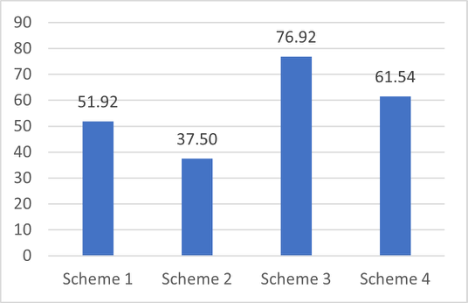
Correct Rate The main effect of the map color scheme is significant, F = 12.881, p = 0.000 < 0.001. Multiple comparative analysis (see Figure 1) found that Scheme 3 was significantly higher than Scheme 4 (p = 0.040 < 0.05), Scheme 2 (p = 0.000 < 0.001), Scheme 1 (p = 0.001 <‘0.01), Scheme 4 was not significantly different from Scheme 1 (p = 0.115‘>‘0.05), and Scheme 2 was significantly lower than Scheme 4 (p = 0.003 < 0.01), Scheme 1 (p = 0.000 < 0.001).
Figure 1: The correct rate in the different color schemes.
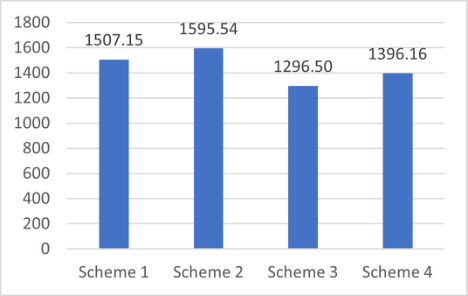
Reaction Time The main effect of the map color scheme is significant, F = 7.692, p = 0.000< 0.05. Multiple comparative analyses (see Figure 2) showed that There was no significant difference between Scheme 3 and Scheme 4 (p = 1.000 > 0.05), Scheme 2 was not significantly different from Scheme 1 (p = 1.000 > 0.05), And Scheme 4 responded significantly lower than Scheme 2 (p = 0.021 < 0.05) and Scheme 1 (p = 0.007 < 0.01), and Scheme 3 was significantly lower than Scheme 2 (p = 0.022 < 0.05) and Scheme 1 (p = 0.013 < 0.05).
Figure 2: The reaction time in the different color schemes.
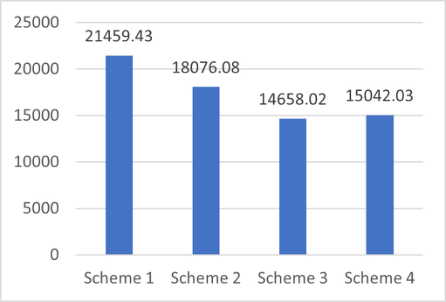
Task Completion Performance Analysis When No New Targets The main effect of the map color scheme is significant, F = 30.350, p = 0.000 < 0.001. Multiple comparative analysis (see Figure 3) found that Scheme 3 was not significantly different from Scheme 4 (p = 1.000 > 0.05), and that the two color schemes were significantly lower than Scheme 1 (p = 0.000< 0.001), And Scheme 2 was significantly higher than Scheme 4 (p = 0.001 < 0.01) and Scheme 3 (p = 0.009 < 0.01), and Scheme 2 was significantly lower than Scheme 1 (p = 0.001 < 0.05).
Color Matching Research of Electronic Maps Based on Deep Cognitive Judgment 111
Figure 3: The task completion time when different map color schemes have no targets.
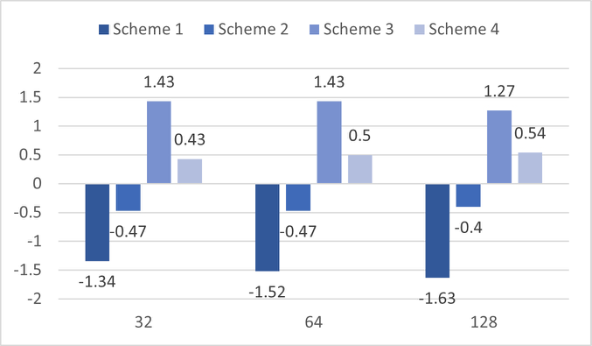
Dual Comparative Analysis Calculate the number of choices under each color scheme, convert it into percentages (for statistical convenience, 0 times are recorded as 0.01, 3 times are recorded as 2.99), and then through the normal distribution table, the percentage is converted to Z values, and the results of the number of icons are 32, 64, and 128 are shown in Figure 4.
Figure 4: Task completion time when different map color schemes have no targets.
Multiple comparative analyses found that regardless of whether the num- ber of icons is 32, 64, or 128, it shows that Scheme 3 was significantly higher than Scheme 4, Scheme 2, Scheme 1, and Scheme 1 is significantly lower than Scheme 4, and Scheme 2.
DISCUSSION
From the data analysis results, it is found that from the correct rate of new clicks, the correct rate of Scheme 3 is significantly better than that of other
schemes, and Scheme 4 is also relatively good. In terms of the reaction time of new clicks, Scheme3 and Scheme 4 are superior to Scheme1 and Scheme 2.
From the perspective of the task completion time when there is no new target, Scheme 3 is significantly better than other options, With Scheme 4 being relatively superior and Scheme 1 being the worst.
From the subjective evaluation point of view, regardless of whether the number of icons is 32, 64, or 128, it shows the trend of the optimal Scheme 3, the second Scheme 4, the third Scheme 2, and the worst trend of Scheme 1.
Combining performance analysis results with subjective evaluation results, Schemes 3 and 4 are recommended and Schemes 2 and 1 are not recom- mended. This result is consistent with the conclusion that Schloss et al. demonstrated that encoding larger quantities in darker colors is beneficial (Schloss et al., 2018).
CONCLUSION
This paper takes color matching of the electronic map as the main research object and designs an ergonomics experiment of search and judgment task in different color matching schemes of the electronic map to study the effect of map color matching on users’ deep cognitive judgment. Experimental results show that scheme 3 and scheme 4 are recommended for the dark light source. The conclusion provides some feasible suggestions for color scheme design of electronic maps, which not only considers the overall color coordination of the map as much as possible but also improves user task performance.
ACKNOWLEDGMENT
This study was supported by project No. 50912020105.
REFERENCES
Jie Yang, Yun Chen, Stephen Westland & Kaida Xiao. (2020). Predicting visual similarity between colour palettes. Color Research & Application (3). Schloss, K. B., Gramazio, C. C., Silverman, A. T., Parker, M. L., & Wang, A. S. (2018).
Mapping color to meaning in colormap data visualizations. IEEE transactions on visualization and computer graphics, 25(1), 810–819. Wei Xue. (2019). Research on situation command interface color matching nased on ERP experiment, Southeast University. (In Chinese). Xiangyu Yao, Lina Huang, Yang Yu. (2022). Suitability analysis of graded color
schemes for area feature rendering in digital environment, Acta Geodaetica et Cartographica Sinica. (In Chinese). Xinyue Wang. (2019). Color coding research of complex information system interface, Southeast University. (In Chinese). Zhange, B., Zhou, T., & Zhou, Y. (2019). Study on the Effect of Electronic Map
Color Scheme on Operation Performance. In International Conference on Human Systems Engineering and Design: Future Trends and Applications (pp. 90–95). Springer, Cham.
LISTED IN THE AHFE DIGITAL BOOKSTORE CATALOGUE
Explore the complete digital volume
Human Systems Engineering and Design (IHSED 2023): Future Trends and Applications
Read this individual research paper free through the original publisher, or explore the full digital proceedings book.
ISBN 978-1-958651-88-9
Explore this ISBN in the AHFE Bookstore ↗Listed in the July 2026 bookstore catalogue; search by ISBN to confirm current availability · Digital book purchase optional