Qiuyu Liu, Li Bing, Bei Zhang, Shuang Liu, Yuqing Dang (2024). Comparative Experiment of Context-Awareness-Based Visualization Schemes for Focused Information on Target Search Mission Posture. In: Human Factors in Design, Engineering, and Computing. AHFE Open Access, vol. 159, pp. 693–699. https://doi.org/10.54941/ahfe1005636
The reasonableness of the recommendation of the situational focus information visualization scheme has an important impact on the operator's performance of the target search task under the three conditions of high, medium, and low situational awareness. In particular, under the conditions of medium and low situational awareness, it is necessary to adopt different recommendations for the visualization of situationally focused information in order to ensure the operator's task performance and task correctness.Based on the visualization design requirements of situational display key information, this study proposes two-dimensional enhancement and three-dimensional enhancement scheme designs for the existing schemes, and examines the differences in the operational performance of different situational display key information visualization design schemes under the situations of high, medium, and low situational awareness by means of the target searching task so as to provide optimization suggestions for the visualization of situational display key information. objective data basis.
A total of 22 experimental operators were recruited to measure the SA of the original scheme, 2D enhancement, and 3D enhancement of the three display scheme designs in three typical situations: adequate situational awareness (high situational awareness scenario), medium (medium situational awareness scenario), and low (low situational awareness scenario), by capturing the correctness rate and reaction time of the target searching tasks, the task completion time, and the subjective evaluation, respectively. The results were completed for comparison and validation analysis.
EXPERIMENTAL SETUP The experiment was conducted in a semi-physical simulation platform, using the experimental process and recording the operator’s experimental data, and
the monitor was a liquid crystal display (size, resolution of 1920 * 1080, refresh frequency of 60Hz).
Experimental Variables and Design The experiment was designed using a 3 (task scenarios: high situational awareness, medium situational awareness, low situational awareness) × 3 (display schemes: original scheme, 2D enhancement, 3D enhancement) group design.
The ambient illuminance of the simulated cabin was 30lx. The experimental metrics are the operator’s search reaction time, and task completion rate.
Operator According to G*Power calculations, for the one-way three-level ANOVA applied in this experiment, the total sample size required to predict a level of statistical power of 80% at the significance level α = 0.05 and effect size f = 0.40 was at least 22 participants. Twenty-two participants were actually recruited for this experiment, 17 males and 5 females, aged between 21 and 24 years (M = 22.68 years, SD = 0.78 years). All subjects were in good physical health, right-handed, had no color deficiency or color blindness problems, had no hearing impairment, had normal visual acuity or corrected vision, and were well rested the day before the experiment. All subjects received experimental training and signed a written informed consent form before the formal experiment.
Experimental Materials and Tasks The experimental materials are different scenario situational maps: original scenario situational map, 2D augmented situational map, and 3D augmented situational map.
The experiment is divided into target search. Under the high scenario of situational awareness, the target search task: observe the region X of the situational map and click on the region target X region target.
Target search task in the scenario in Situational Awareness: observe area X in the situational map and click on the target with the target lot number XXXX in that area.
Target search task for low situational awareness scenarios: observe area X in the situational map and click on a target of type XXXX with a target lot number of XXXX in that area.
Table 1. Experimental tasks in three scenarios.
Table available in the original PDF paper.
Contextually Aware Low Situational Awareness
Take High Situational Awareness Five types of targets of same sea area Common design elements
Original program
Five types of 2D abstract targets & raw nautical charts
Five types of 2D abstract targets & raw nautical charts
Five types of 2D abstract targets & raw nautical charts (Continued)
Comparative Experiment of Context-Awareness-Based Visualization Schemes 695
Table 1. Continued
Table available in the original PDF paper.
Contextually Aware Low Situational Awareness
Take High Situational Awareness Two-dimensional enhancement Five types of 2D solid targets &2D dark-colored charts
Five types of 2D solid targets,semi- transparent,small-size velocity display, 2D dark-colored charts,grid range lines are large and solid
Five types of 2D solid targets, opacity, large size and speed display, two-dimensional dark chart, small grid range line and dotted line realization combination Three- dimensional enhancement
Five types of 3D abstract target three-dimensional models, three-dimensional satellite charts
Five types of 3D abstract real scale targets, semi-transparent s, small size velocity display,3D satellite charts,grid range lines are large, solid lines
Five types of 3D abstract uniform scale targets, opaque, large size and speed display, 3D satellite charts,small grid range lines and dotted line realization
Experimental Procedure After the operator enters the laboratory, the first sitting position adjustment, adjust the height of the seat to keep the operator’s eye height of about 105cm, the distance between the eyes and the display screen is 70-75cm, the body away from the edge of the seat distance is 10cm.
Then under the guidance of the experimental staff, practice experimental assessment according to the experimental requirements, the assessment is divided into two stages, the first is the rules of the assessment, the subjects are required to be familiar with the experimental tasks under the three scenarios of high situational awareness, medium situational awareness, and low situational awareness, and the assessment of the correct rate of 100%. The subjects then practiced the tasks on the software, practicing three questions under each scenario, and as long as one question was correct, they passed the test. Subjects passed all the tests to wear the eye-tracking and electrocardiographic equipment, and entered the formal experiment.
In the experiment, the operator was required to complete the target search task 20 times for each context and each scenario, and the order of the different contexts and different scenarios was balanced according to the Latin square.
RESULTS
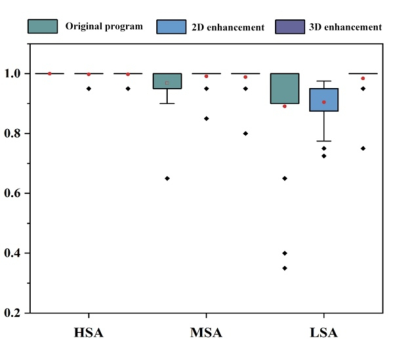
Target Search Task Correctness Participants were considered to have searched correctly when they searched for and clicked on the corresponding target within the time limit of 20s. The ratio of the number of correct search attempts to the total number of attempts under each scenario was calculated to obtain the correct target search rate, as shown in Fig. 1 for the correct target search rate of the different scenarios under the three scenarios.
The Shapiro-Wilk test was used to test the normality of the correct rate of the target search task, and its results showed that none of them conformed
to the normal distribution (p<0.05), and the Friedman test was used to conduct a nonparametric analysis of the correct rate of the target search task at, and the results showed that there was no significant difference in the correct rate of the search task in the different scenarios in the context of high situational awareness (HSA) (p = 0.607), and in the context of medium situational awareness (MSA) (p = 0.013) and low situational awareness (LSA) (p<0.001), there was a significant difference in the correct rate of the search task under different scenarios. The results of two-by-two pairwise comparisons which are not significant between the original, 2D- enhanced, and 3D-enhanced schemes in the MSA context, and in the LSA context, the 3D-enhanced scheme was significantly better than the original (p = 0.050) and 2D-enhanced schemes (p<0.001) in terms of correctness, and the 2D-enhanced scheme was significantly better than the original scheme (p = 0.004).
Figure 1: Correctness of target search for different scenarios in three contexts.
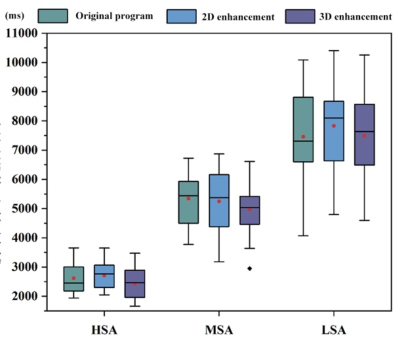
Average Completion Time of Targeted Search Tasks The mean completion time of the participants to complete the goal search task is shown in Figure 2. The Shapiro-Wilk test was used to test the normality of the mean completion time of the goal search task, and the results showed that they all conformed to a normal distribution (p>0.05). Repeated measures ANOVA was used to analyze the average completion time of the target search task, which indicate that in the HSA context, the differences in the average completion time of the search task between the different schemes are significant, and the average completion time of the search task of the 3D enhancement scheme is significantly lower than that of the 2D enhancement scheme (p<0.001). In the MSA context, the average completion time of search tasks in different schemes showed a trend of difference, which was manifested by the fact that the average completion time of search tasks in the 3D- enhanced scheme was significantly lower than that in the original scheme
Comparative Experiment of Context-Awareness-Based Visualization Schemes 697
(p = 0.048). In the LSA context, the difference in the average completion time of the search task between the different schemes was not significant.
Figure 2: Average completion time of target search for different scenarios in three contexts.
Combined Performance of Targeted Search Tasks Set the subjects’ rate of completing the target search task correctly as Rs and the average time for completing the target search task as Ts. Calculate the ratio of the rate of correctness of the target search task to the average time of the target search task for each scenario in each situation as the composite performance of the target search task, Ps, denoted as:
Ps = Rs
Ts (1) The Shapiro-Wilk test was used to test the normality of the comprehensive performance Ps of the target search task, and the comprehensive performance of the target search task of the different scenarios was not significant, and all of them conformed to the normal distribution. Repeated-measures ANOVA was used to analyze the comprehensive performance of the target search task, which indicate that the differences in the comprehensive performance of the search task of the different schemes of are significant in all scenarios, as shown in the following: in the HSA scenario, the comprehensive performance of the 3D enhancement scheme is significantly higher than that of the 2D enhancement scheme (p<0.001), and at the same time, the comprehensive performance of the 3D enhancement scheme has a higher than that of the original program (p = 0.099); in the MSA context, the combined performance of the 3D-enhanced program is significantly higher than that of the original program (p = 0.007); in the LSA context, the combined performance of the 3D-enhanced program is significantly higher than that of the 2D-enhanced program (p<0.001) and the original program (p = 0.046).
CONCLUSION
The main purpose of this experiment is to investigate the effects of different gestalt focused information display schemes on the performance of a goal search task under three scenarios of high, medium, and low situational awareness. The results show that both 2D enhancement and 3D enhancement have different degrees of significant effects on situational awareness enhancement, especially in low situational awareness scenarios. In terms of objective performance results: the 3D enhancement scheme showed significantly better enhancement during the goal search task. From the subjective evaluation results: in the low context awareness scenario, the 3D enhancement scheme showed significantly better performance in SA enhancement than the other schemes, but the 2D enhancement scheme showed significantly better performance in workload than the other schemes. In summary, it can be seen that both 2D and 3D enhancement schemes are superior to the original scheme to a certain extent, especially in low contextual awareness scenarios.
Based on the experimental results, the correct rate, completion time, comprehensive performance, and subjective evaluation results of different types of tasks in each scenario are comprehensively analysed as follows: (a) High situational awareness scenarios: in terms of objective measurements, there was no significant difference between the scenarios in terms of correctness, there was no significant difference in terms of task completion time in all areas, and the combined performance of the 3D enhancement scenario for the search task was significantly higher than that of the other scenarios; in terms of subjective measurements, there was no significant difference between the scenarios in terms of load, and the 2D enhancement was significantly higher than the 3D enhancement in terms of situational awareness.
(b) In the context-awareness scenario: in terms of objective measurements, the 3D-enhanced scenario is better than the 2D-enhanced scenario in terms of task completion time, and the 3D-enhanced scenario is significantly higher than the original scenario in terms of comprehensive performance on the target search task; in terms of subjective measurements, the 2D-enhanced scenario scores significantly lower than the original scenario in terms of loading, and the 2D-enhanced scenario is better than the 3D-enhanced scenario in terms of context-awareness, and the 2D-enhanced scenario is better than the original scenario in terms of self-performance assessment. The 2D-enhanced program outperformed the 3D-enhanced program and the original program in terms of self-assessment of performance.
(c) Low situational awareness scenarios: in terms of objective measurements, the 3D-enhanced scenario is superior to the 2D-enhanced scenario in terms of correctness, the 3D-enhanced scenario is superior to the 2D-enhanced scenario in terms of task completion time, and the 3D-enhanced scenario is superior to the 2D-enhanced scenario in terms of overall performance; and in terms of subjective measurements, the 2D-enhanced scenario and the 3D-enhanced scenario are superior to the original scenario in terms of loading, and the 2D-enhanced scenario and the
Comparative Experiment of Context-Awareness-Based Visualization Schemes 699
3D-enhanced scenario are significantly better than the original scenario in terms of contextual awareness, the 2D-enhanced and 3D-enhanced programs significantly outperformed the original program, and the 2D-enhanced and 3D-enhanced programs outperformed the original program in terms of self-assessment of performance.
In summary, there was no difference between the scenarios in terms of task correctness and completion time for the high contextual awareness scenario, but in other indicators, 2D-3D enhancement was superior to the original scenario, with each of the 2D-3D enhancements having its own strengths; for the medium contextual awareness scenario, the objectively measured 3D enhancement results were better, and the subjectively measured 2D-3D enhancement was better; and for the low contextual awareness scenario, the objectively measured 3D enhancement results were better, and the subjectively measured 2D-3D were both better than the original scenario. The results are better than those of the original scheme. Therefore, it is proved that the enhancement design of gesture display information can improve the user’s operation performance, and the above results can fully support the work of visualization design of gesture display information based on situational awareness.
REFERENCES
C. D. Wickens, Display formatting and situation awareness model (DFSAM): an approach to aviation display design, Aviation Human Factors Division: Moffat Field, CA, USA, (2005). H. Wei, D. Zhuang, X. Wanyan, Q. Wang, An experimental analysis of situation
awareness for cockpit display interface evaluation based on flight simulation, Chinese Journal of Aeronautics. 26 (2013) 884–889. https://doi.org/10.1016/j. cja.2013.04.053. Jiang Zhao. (2016), Research on Information Coding Method Based on Visual Cognition Theory for Helmet Display Interface, Southeast University, Ph.D. dissertation. Y. Wang, C. Liu, Study on Flight Crew’s Team Situation Awareness Based on
Team and Task Process, in 2019 5th International Conference on Transportation Information and Safety (ICTIS): IEEE, 2019: pp. 653–658.
LISTED IN THE AHFE DIGITAL BOOKSTORE CATALOGUE
Explore the complete digital volume
Human Factors in Design, Engineering, and Computing
Read this individual research paper free through the original publisher, or explore the full digital proceedings book.
ISBN 978-1-964867-35-9
Explore this ISBN in the AHFE Bookstore ↗Listed in the July 2026 bookstore catalogue; search by ISBN to confirm current availability · Digital book purchase optional