Kazuyoshi Shimada (2026). Human Judgment in Democratic Service Systems: A Knowledge–Values–Thinking Capability Framework. In: The Human Side of Service Engineering. AHFE Open Access, vol. 221, pp. 23–29. https://doi.org/10.54941/ahfe1007705
Service systems in democratic societies fundamentally depend on human judgment, yet the mechanisms through which such judgments are formed remain insufficiently understood. In pluralistic societies, actors often hold different interpretations of benefit, fairness, and social good. Under such conditions, service provision and acceptance cannot be fully determined by predefined procedures or centralized coordination; instead, service interactions rely on judgments formed by both providers and receivers. This paper proposes a conceptual framework that places human judgment at the center of service co-creation. The framework assumes that judgment emerges from the interaction of three fundamental human resources: knowledge, values, and thinking capability. The paper also outlines a research program consisting of (1) analytical research based on oral-history interviews with key participants who have initiated service innovations and (2) constructive modeling of judgment formation at individual and organizational levels. By clarifying how knowledge, values, and thinking capability interact to shape human judgment, this study aims to contribute to a democratic foundation for service innovation and to the design of service systems that rely on responsible human judgment.
Last year, we examined AI challenges to global democracy and explored the complex intersection between artificial intelligence and democratic governance, identifying several key questions for future service science research (Shimada, Leitner, Carroll, 2025). While this discussion addressed fundamental issues underlying democratic governance in the age of AI, it did not explicitly examine the role of human judgment within service systems.
Service systems in democratic societies fundamentally depend on human judgment, yet the mechanisms through which such judgments are formed remain insufficiently understood. In pluralistic societies, actors often hold different interpretations of benefit, fairness, and social good. Under these conditions, service interactions cannot be fully determined by predefined procedures or centralized coordination. Instead, outcomes depend on judgments exercised by both providers and receivers.
24 Shimada Service science has developed influential frameworks for understanding value creation in complex environments, conceptualizing service systems as networks of interacting actors who integrate resources to generate mutual benefit (Maglio & Spohrer, 2008; Spohrer & Maglio, 2008, Yoshikawa, 2008). Similarly, service-dominant logic defines service as the application of resources for the benefit of another and emphasizes value co-creation among multiple actors (Vargo & Lusch, 2004, 2008). However, while interaction mechanisms have been extensively studied, the cognitive and normative processes through which actors interpret situations and form judgments in service interactions remain underexplored.
Decision research provides insights into how individuals evaluate information and choose actions, including bounded rationality and experience-based reasoning (Simon, 1947; Tversky & Kahneman, 1974; Kahneman, 2011; Gigerenzer, 2021; Klein, 1998).
Democratic theory likewise emphasizes the importance of reflective judgment in collective problem solving (Dewey, 1927; Habermas, 1984). In philosophy, similar ideas appear in Aristotle’s concept of phronesis, or practical wisdom, referring to the capacity to determine appropriate actions in particular contexts.
Despite these developments, little work has integrated service research, decision science, and democratic theory to explain how human judgment shapes service interactions. This study therefore addresses the following research question: “How is human judgment formed in service interactions, and how does it contribute to value co-creation in democratic service systems?”
Democratic service systems fundamentally rely on distributed human judgment rather than centralized decision making. Understanding how such judgments are formed therefore represents a central challenge for service science. Addressing this question requires a clearer understanding of how human judgment is formed and how it functions within service interactions.
To address this question, the paper proposes a conceptual framework in which judgment emerges from the interaction of three fundamental human resources: knowledge, values, and thinking capability.
The paper also outlines a research program combining analytical research based on oral-history interviews with constructive modeling of judgment formation at individual and organizational levels. By clarifying how knowledge, values, and thinking capability interact in shaping human judgment, this study aims to contribute to the theoretical foundations of service science and to the design of service systems capable of functioning effectively in democratic societies.
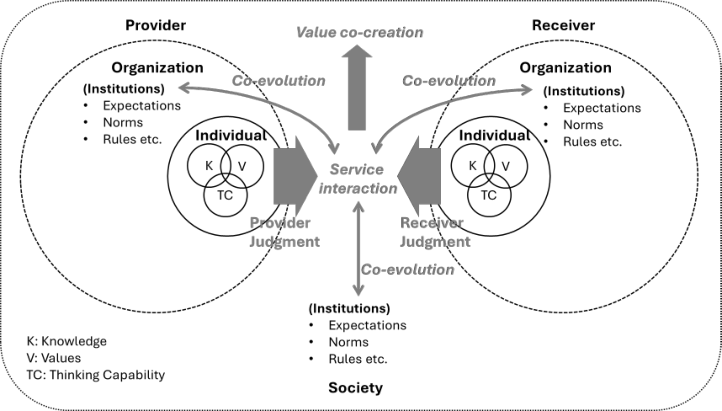
CONCEPTUAL FRAMEWORK This study proposes a framework that places human judgment at the center of service interactions in democratic societies (Figure 1). In this framework, human judgment is conceptualized as emerging from the interaction of three fundamental human resources: knowledge, values, and thinking capability.
Figure 1: Human judgment and the co-evolution of service interactions and institutions. The figure illustrates the conceptual framework proposed in this study. Service interactions occur between a provider (left) and a receiver (right), through which value may be co-created in society (dotted line). Providers and receivers may be individuals (solid line) or organizations (dashed line) composed of multiple individuals. At the individual level, human judgment emerges from the interaction of three fundamental human resources: knowledge (K), values (V), and thinking capability (TC). These judgments guide actions in service interactions between providers and receivers. Over time, repeated service interactions may contribute to the emergence of institutions such as expectations, norms, and rules. In turn, these institutions shape subsequent service interactions, creating a co-evolutionary process between service interactions and institutions across organizational and societal levels.
Knowledge is defined as a structured and retrievable cognitive system composed of information that has been evaluated for its truth, selectively retained as valid, weighted by personal values, and organized through relationships among its elements. This definition reflects discussions with Professor Toshiaki Ikoma, Professor Emeritus of the University of Tokyo. While various definitions of knowledge exist in philosophy and knowledge management research, this study adopts a functional definition focusing on the role of knowledge as a structured cognitive resource supporting judgment formation. Knowledge has also been studied in knowledge management research, where Nonaka and Takeuchi (1995) conceptualize knowledge as justified belief that increases the capacity for effective action.
Values refer to the criteria individuals use to judge what is desirable or worthwhile. They are shaped through reflection on personal experiences and may also be influenced by institutions such as norms, rules, shared knowledge, narratives, and expectations.
Thinking capability refers to cognitive capacities that enable individuals to analyze information, evaluate credibility, integrate perspectives, and interpret situations. It includes reasoning, critical evaluation, and the ability to reframe problems at different levels of analysis. In this paper, the term thinking capability is used as an integrative concept referring to reasoning,
26 Shimada evaluation, and perspective integration, which have been discussed in cognitive science and decision research (Kahneman, 2011; Gigerenzer, 2021; Klein, 1998).
Together, these three elements represent cognitive resources (knowledge), normative orientation (values), and reasoning capability (thinking capability) that shape human judgment in particular situations. Because knowledge, values, and thinking capability differ across individuals, judgments may vary even when actors face similar situations. In democratic societies characterized by plural values, the quality of service systems therefore depends significantly on the quality of human judgment.
The importance of judgment in human action has long been emphasized in philosophy, from Aristotle’s concept of phronesis, or practical wisdom, to Dewey’s notion of reflective judgment in democratic problem solving. In this sense, the framework proposed in this study can be interpreted as a contemporary representation of such practical judgment in service systems.
Within service ecosystems, judgments formed by providers and receivers guide intentional actions. Through these actions, actors exchange information, interpret needs, negotiate expectations, and coordinate activities. Successful interactions lead to the co-creation of value. Over time, repeated interactions may generate shared understandings that become institutionalized as organizational norms, rules, shared knowledge, narratives, and expectations. In this way, individual judgments contribute to the formation of collective structures that shape future service interactions.
FUTURE RESEARCH PROGRAM This study adopts a two-part research approach combining analytical research and constructive modeling. The objective is both to understand how judgments have been formed in past service innovations and to develop conceptual models that may guide future service design.
Analytical Research: Oral-History Interviews The first component investigates past judgment processes through oral- history interviews with individuals who have initiated or implemented service innovations, as well as with service receivers.
Service innovations often arise in complex environments involving multiple stakeholders and institutional constraints and evolving social expectations. In such contexts, judgments cannot be fully understood through experimental or survey-based methods alone. Oral-history interviews are particularly useful for revealing how actors interpreted situations and formed judgments within their historical and institutional contexts.
The analytical process consists of three steps. First, in-depth interviews are conducted with key participants to identify the knowledge used, the values underlying their evaluations, and the thinking capabilities involved in their judgment formation. Second, documentary analysis of policy documents, organizational records, and related materials is conducted to clarify the institutional and historical context in which these judgments occurred. Third,
Human Judgment in Democratic Service Systems 27 follow-up interviews are carried out to refine interpretations and reconstruct the overall judgment process.
Through this iterative analytical process, the study aims to systematically examine how knowledge, values, and thinking capability interact in the formation of human judgment.
Table 1: Analysis steps for oral history study.
Table available in the original PDF paper.
Steps Study Step 1 In-depth interviews
Identify knowledge used in judgment
Identify underlying values
Identify the thinking capabilities involved in the judgment process
Refine the holistic view of the judgment process under the framework of Knowledge (K), Values (V), and Thinking Capability (TC).
Constructive Modeling of Judgment Formation Understanding past judgment processes alone is not sufficient for advancing service science. Beyond revealing past judgment processes, this research aims to develop conceptual models that may inform the design of future service systems.
Two complementary levels of modeling are proposed. Microscopic Modeling focuses on the internal cognitive and normative processes through which individuals form judgments. It aims to clarify how knowledge, values, and thinking capability interact within individuals. This microscopic model highlights the importance of understanding individual differences in the cognitive and normative resources that shape judgment formation. This approach will further enhance the resolution of the conceptual framework especially in the Individual level illustrated in Figure 1.
Macroscopic Modeling examines how judgments formed by multiple actors interact within organizations and service ecosystems. This perspective addresses how individual judgments influence institutions collectively in organizations and society. This approach will further enhance the resolution of the conceptual framework shown in Figure 1.
Together, these models extend the conceptual framework by linking individual cognition with system-level dynamics.
IMPLICATIONS FOR SERVICE SYSTEM DESIGN The proposed models suggest that the design of service systems should not focus solely on processes, technologies, or institutional rules.
In democratic societies characterized by plural values, effective service systems also depend on the human capacities that support judgment
28 Shimada formation. Service system design should therefore consider environments that foster knowledge sharing, reflective dialogue, and the development of thinking capabilities. By supporting these human resources, service systems may better enable responsible and reflective judgments among participants.
Integrating microscopic and macroscopic perspectives on judgment formation provides a foundation for designing service systems that function effectively in democratic contexts.
CONCLUSION
This paper has proposed a conceptual framework that places human judgment at the center of service systems in democratic societies characterized by plural values. The framework conceptualizes judgment as emerging from the interaction of three fundamental human resources: knowledge, values, and thinking capability.
By integrating perspectives from service research, decision science, and democratic theory, the study highlights the importance of human judgment in shaping service interactions and value co-creation. It also outlines a research program combining oral-history analysis with constructive modeling of judgment formation at individual and organizational levels.
The present paper is intended as a conceptual foundation for future empirical research. Future research will be needed to empirically validate and refine the proposed framework. In particular, further studies may explore how educational practices and organizational environments contribute to the cultivation of diverse knowledge, values, and thinking capability for responsible judgment. Despite these limitations, the framework provides a starting point for understanding how service systems can function effectively in democratic societies where decision making is distributed among diverse actors. Ultimately, understanding human judgment may be essential not only for advancing service science but also for sustaining democratic service systems in complex societies.
ACKNOWLEDGMENT
The author is deeply grateful to Prof. Toshiaki Ikoma, Professor Emeritus of the University of Tokyo, for his insightful guidance on the essential roles of knowledge, values, and thinking capability in the formation of judgment. Drawing on his extensive experience in both academia and industry, Prof. Ikoma also shared with us his original and highly distinctive definition of knowledge, which has greatly influenced the development of this work.
REFERENCES
Dewey, J. (1927). The Public and Its Problems. Holt. Gigerenzer, G. (2021). What is bounded rationality? In R. Viale (Ed.), Routledge handbook of bounded rationality (pp. 55–69). Routledge/Taylor & Francis Group. Habermas, J. (1984). The Theory of Communicative Action. Beacon Press. Kahneman, D. (2011). Thinking, Fast and Slow. Farrar, Straus and Giroux.
Human Judgment in Democratic Service Systems 29 Klein, G. A. (1998). Sources of power: How people make decisions. Cambridge: MIT
Press. Maglio, P. P., & Spohrer, J. (2008). Fundamentals of Service Science. Journal of the Academy of Marketing Science, 36, 18-20. https://doi.org/10.1007/s11747-007- 0058-9 Nonaka, I., & Takeuchi, H. (1995). The Knowledge-Creating Company. Oxford
University Press. Shimada, K., Leitner, C., Carroll, M. (2025). Key Findings of the ISSIP White Paper on “AI Challenges to Global Democracy”. In: Christine Leitner, Clara Bassano and Debra Satterfield (eds) The Human Side of Service Engineering. AHFE (2025) International Conference. AHFE Open Access, vol 182. AHFE International, USA. http://doi.org/10.54941/ahfe1006410 Simon, H. A. (1947). Administrative Behavior: A Study of Decision-Making Processes
in Administrative Organization. Macmillan. Spohrer, J. & Maglio, P. P. (2008). The Emergence of Service Science: Toward Systematic Service Innovations to Accelerate Co-Creation of Value. Production and Operations Management, Volume 17, Issue 3. https://doi.org/10.3401/ poms.1080.0027 Tversky, A., & Kahneman, D. (1974). Judgment under uncertainty: Heuristics
and biases. Science, 185(4157), 1124–1131. https://doi.org/10.1126/ science.185.4157.1124 Vargo, S. L., & Lusch, R. F. (2004). Evolving to a new dominant logic for marketing.
Journal of Marketing, 68(1), 1–17. https://doi.org/10.1509/jmkg.68.1.1.24036 Vargo, S. L., & Lusch, R. F. (2008). Service-dominant logic: Continuing the evolution. Journal of the Academy of Marketing Science, 36(1), 1–10. https://doi. org/10.1007/s11747-007-0069-6 Yoshikawa, H. (2008). Introduction to theory of service engineering. Synthesiology,
Read this individual research paper free through the original publisher, or explore the full digital proceedings book.
ISBN 978-1-964867-97-7
Explore this ISBN in the AHFE Bookstore ↗Listed in the July 2026 bookstore catalogue; search by ISBN to confirm current availability · Digital book purchase optional