Yusuke Hatano, Keiichi Watanuki, Kazunori Kaede (2022). Effects of Scent Presentation on Choice and Judgment. In: Affective and Pleasurable Design. AHFE Open Access, vol. 41, pp. 218–223. https://doi.org/10.54941/ahfe1001800
In recent years, scents have been increasingly used in various situations as stimulants in addition to content, such as in 4DX movie screenings and as original aromas to enhance brand images. Research on scents has also garnered interest; a study conducted at a casino in Las Vegas reported that creating specific scents around the slot machines increased the input number of coins by approximately 45%, and research on the effects of lighting or scent have suggested that scents may influence purchase motivations. The olfactory brain that is responsible for the sense of smell overlaps with the emotional brain that is responsible for emotions and is believed to contribute greatly to its development. The sense of smell is considered to have stronger connections to emotions than the other senses, and there is growing interest in the use of scents to manipulate psychological states into desired states. We experimentally evaluated the relationships between emotional changes caused by scents and image evaluations. Further, we obtained the image evaluation impressions and quantified the influences of scent on selection and evaluation. In order to evaluate the differences in selection, we focused on the categories of images. We prepared five categories of images: sweets, fruits, flowers, nature, and indoor images, and asked the participants to select images that did not overlap the categories. An evaluation index was created based on the harmony of the fragrance with the impression of the image. The results showed that there was a positive correlation between the change in the selection rate and the harmony with the fragrance in each category. This suggests that the presentation of scents gives a better impression to images that have a high degree of harmony with scents. To assess the effects of emotion induction by scent presentation on evaluation of image impressions, we conducted experiments for image impression evaluations by presenting scents to 10 healthy male participants in their 20s (22.3±1.3 years) with no known olfactory abnormalities. The ambient air was scented using a bubbling method and supplied through a nasal cannula. We used peppermint essential oil, which has different pleasant and unpleasant emotion associations depending on participant experiences and presented it at a concentration of 1%. The Japanese version of the POMS2 (short version) assessments were used for subjective evaluations of emotion induction, and the emotion changes was evaluated from the differences in scores before and after the experiments. To objectively evaluate emotions, we used a measure the volumetric pulse waveforms from the participant fingertips as well as sweating characteristics. Subjective evaluations of the scent were conducted after completion of the impression evaluations for two items, namely "pleasant-unpleasant" and "arousing-sedating". Two pleasant images, one neutral image, and two unpleasant images were selected based on subjective emotional valences. In the impression evaluation experiment that focused on changes in emotions, a positive correlation was observed between changes in images and scent sensitivity evaluations for positive images, and a negative correlation was similarly identified for negative images.
In recent years, scents have been increasingly used in various situations as stimulants in addition to content, such as in 4DX movie screenings and as original aromas to enhance brand images. Research on scents has also gar- nered interest; a study conducted at a casino in Las Vegas (Nevada, USA) reported that creating specific scents around the slot machines increased the input number of coins by approximately 45% (Hancock, 1995), and research on the effects of lighting or scent have suggested that scents may influence purchase motivations (Yokoi, 2015). The olfactory brain that is responsible for the sense of smell overlaps with the emotional brain that is responsible for emotions and is believed to contribute greatly to its deve- lopment. The sense of smell is considered to have stronger connections to emotions than the other senses, and there is growing interest in the use of scents to manipulate psychological states into desired states. We expe- rimentally evaluated the relationships between emotional changes caused by scents and image evaluations. Further, we obtained the image evalua- tion impressions and quantified the influences of scent on selection and evaluation.
Effects of Scent Presentation on Choice and Judgment 219
SELECTION TASK TO EVALUATE RELATIONSHIPS BETWEEN SCENTS AND IMAGES Six healthy male participants in their 20s (22.0±1.0 years) with no known olfactory abnormalities were given a selection task focusing on the categories of images, and six additional healthy male participants in their 20s (23.5±1.9 years) were given scores to evaluate associations between images and scents. Aromatic sprays of grapefruit and rose, which have stimulating and calming effects, respectively, were sprayed according to their directions for use; the experiments were conducted in a room filled with odors. For comparison, the same experiments were conducted in another room without scents. The scores of the associations between images and scents were evaluated on a four-point scale based on previous studies (Miura, 2011), and these scores were allocated as 3, 2, 1, and 0 points.
Challenges in Selecting Images of Different Categories The images were divided into five categories, namely sweets, fruits, flowers, nature, and interior. Twenty images were prepared for each category, and pairs of images were presented randomly so that the categories are not cove- red. The participants intuitively selected images based on their preferences among the presented images. Image selections were performed 60 times for the same odor presentation.
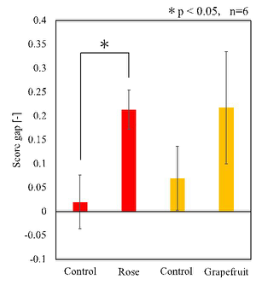
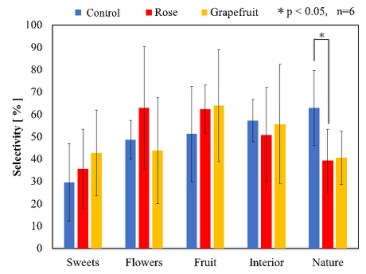
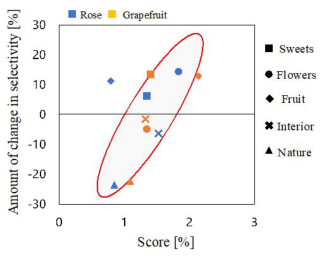
Experimental Results Results of the relationships between each of the categories and scents sho- wed that the scores for “flower” and “room” were high for the rose scent while the scores for “nature” and “fruit” were low; for the grapefruit scent, the scores for “fruit” were high while scores for “nature” were low. For the selection task, two evaluation methods were used, namely score differences based on harmonicity and changes in the selection categories. Further, we evaluated the differences in scores based on harmonicity and changes in sele- ction categories. The results of the evaluations based on score differences are shown in Figure 1, where significant differences are observed between the “Control” and “Rose” conditions. The results of evaluations based on the selected categories are shown in Figure 2; the Steel–Dwass method was used to test for differences in scent at the 5% level of significance, and signifi- cant differences were found between the “Control” and “Rose” conditions in the category of natural images. There were significant differences in the selection rates between the “Control” and “Rose” conditions for images in the “nature” category, i.e., the selection rates decreased when presented with the rose scent compared to the “Control” condition. Figure 3 shows a graph of the relationships between selection and harmony; in each category, there were positive correlations between changes in selection rates and harmonies of the scents.
Considerations There were significant differences in the scores of associations between scents and categories depending on the presence or absence of scents, which suggests
Figure 1: Score gaps.Figure 2: Probability for each category.
that scent presentation evokes better impressions of images that are more in harmony with the scent. There were also significant differences in the cate- gory relevance scores between images presented with and without scents; this was attributed to a Proustian effect (Chu, 2000). The Proust phenomenon is one in which a specific scent evokes certain memories and emotions associ- ated with it. The fact that we unconsciously select images evoked by scents suggests that images with strong connections to scents are selected, whereas images in the “nature” category with weak connections are less likely to be selected. The fact that connections between scents and images affect selection rate is suggested by correlations between the changes in the selection rates and harmonies of the scents.
EFFECTS OF SCENT PRESENTATIONS ON IMPRESSION EVALUATIONS To assess the effects of emotion induction by scent presentation on evalua- tion of image impressions, we conducted experiments for image impression evaluations by presenting scents to 10 healthy male participants in their 20s (22.3±1.3 years) with no known olfactory abnormalities. The ambient air was scented using a bubbling method and supplied through a nasal can- nula. We used peppermint essential oil, which has different pleasant and
Effects of Scent Presentation on Choice and Judgment 221
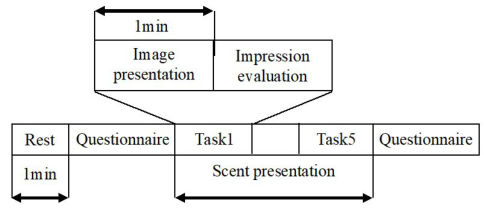
Figure 3: Relationship between selection and harmony.Figure 4: Experimental protocol.
unpleasant emotion associations depending on participant experiences, and presented it at a concentration of 1%. The experimental protocol is illustrated in Figure 4. Two trials were conducted with and without scent presentation. The Japanese version of the POMS2 (short version) assessments were used for subjective evaluations of emotion induction, and the emotion changes was evaluated from the differences in scores before and after the experiments. To objectively evaluate emotions, we used a multisensor physiological mea- surement system (NeXus-10 MKII, MindMedia) to measure the volumetric pulse waveforms from the participant fingertips as well as sweating characte- ristics. Subjective evaluations of the scent were conducted after completion of the impression evaluations for two items, namely “pleasant-unpleasant” and “arousing-sedating”. Two pleasant images, one neutral image, and two unpleasant images were selected based on subjective emotional valences.
Impression Evaluations Five images were selected from the Geneva Affective Picture Database (Dan- Glauser, 2011), a dataset of images used for visual emotional stimulations. Fourteen adjective-pairs commonly used in visual research were selected as the impression evaluation items and assessed using the Visual Analog Scale.
Experimental Results The skin conductance values used to evaluate sweating characteristics were standardized to calculate the Z-scores, and the differences between the values at the beginning and end of each task were calculated and compared. The
Figure 5: “Pleasantness” of the images.
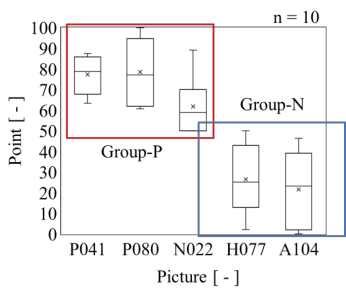
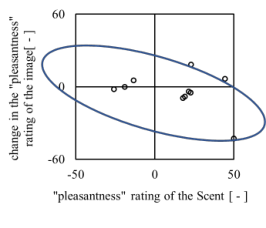
impression evaluation items, LF/HF, skin conductance, and POMS2, were compared among the control and scent conditions. Wilcoxon’s signed rank- sum test was performed at the 5% level of significance, and no significant differences were observed for any of the images. The LF/HF value, which indicates balance between the sympathetic and parasympathetic nerves, was used to evaluate the apex volumes of the pulse waves. Figure 5 shows the results of pleasant and unpleasant responses to the images under the control condition. The images P041, P080, and N022 were designated under the P- group and images H077 and A104 were designated under the N-group. The amount of changes in the “pleasantness” ratings of the images and results of the “pleasantness” ratings of the scents are shown in Figure 6. The three images in the P-group were positively correlated, whereas the two images in the N-group were negatively correlated.
Considerations Positive correlations were found between the amount of changes in “plea- santness” based on images and evaluations of “pleasantness” based on scents for the P-group, which contains positive images; further, negative correlations were observed for the N-group, which contains negative images. These results were attributed to the priming effect, in which the processing of a prece- ding stimulus promotes or inhibits processing of the following stimulus. The impression evaluations of images without relationships between scents and images were considered to have large influences on the individuals and were not reflected in the biometric measurements. In this study, we experimentally determined the influences of scents on images. However, upon completion of the experiments, some participants reported that their perceptions of scents had changed after viewing the images.
CONCLUSION
The purpose of this study was to quantify the differences in intuitive selection results between the presence or absence of scent presentation and different types of scents, evaluate how scents affect preferences and judgments, and
Effects of Scent Presentation on Choice and Judgment 223
Figure 6: Correlations between scents and images.
assess the relationships between emotional changes caused by scents and image impression evaluations. The results suggest that scent presentation affects intuitive selection, and subjective evaluations of scents are correlated with evaluations of image impressions. In addition, it is necessary to evaluate the effects of both images and scents because scents influence images and the images also affect perceptions of scents.
REFERENCES
Chu, S. Downes, J.J. (2000) ‘Odour-evoked autobiographical memories: Psychological investigations of Proustian phenomena’, Chemical Senses, 25(1) Dan-Glauser, E.S., Scherer, K.R. (2011) ‘The Geneva Affective PicturE Database
(GAPED): A new 730 picture database focusing on valence and normative significance’ Hancock, G.D. (1995) ‘Effects of ambient odors on slot-machine usage in a Las Vegas casino’, Psychology & Marketing, 12(7) Miura, K. Saito, M. (2011) ‘Harmony between color and fragrance’, Journal of Japan
Association on Odor Environment, 42(5) Yokoi, T. Oiri, Y. Suto, H. Nakajima, M. (2015) ‘Impression of the photographs and purchasing intention considering lighting in product photographs and odor effect’, Transactions of Japan Society of Kansei Engineering, 14(1)
LISTED IN THE AHFE DIGITAL BOOKSTORE CATALOGUE
Explore the complete digital volume
Affective and Pleasurable Design
Read this individual research paper free through the original publisher, or explore the full digital proceedings book.
ISBN 978-1-958651-17-9
Explore this ISBN in the AHFE Bookstore ↗Listed in the July 2026 bookstore catalogue; search by ISBN to confirm current availability · Digital book purchase optional