Takashi Yukihira, Hiroko Tokunaga, Masayuki Ihara, Hiroki Murakami, Akihiko Koga, Ryoichi Maeda, Shinpei Saruwatari, Kazuki Takeshita, Shinya Hisano, Masashige Motoe (2023). Toward an online rehabilitation exercise service based on personal independent living goals and risk management. In: Human Systems Engineering and Design (IHSED 2023): Future Trends and Applications. AHFE Open Access, vol. 112, pp. 187–194. https://doi.org/10.54941/ahfe1004129
In a nursing care domain, labor shortage is a significant problem. Information communication technologies (ICT) are expected as a tool to solve it. Care services, that value “personhood” of individuals, should be designed based on a person-centered principle[1]. We aim to develop an online rehabilitation exercise service that utilizes the ICT but is based on the principle. This paper reports a trial of intervention experiment of the online rehabilitation exercise, which was conducted as a 12-time event for three months. A subject, a female in 78 years old with left hemiplegia who desires more rehabilitation opportunities, joined about 45-minute online exercise sessions in addition to regular outpatient rehabilitations. She exercised by watching a model exercise on a tablet screen that is connected to the nursing facility. The model exercises were performed by an occupational therapist for the first four times and by on-site care workers for the rest. A manual with notes on exercise instruction was distributed to the workers. The instructor change and the manual are for the future regular operation of the service. The exercises were designed for not only the recovery of her arm and fingers on the affected side but also her rehabilitation goal of being able to cook again since a goal setting is important[2]. For risk management, the exercises were limited to those performed in a sitting position and her burden was confirmed before, during, and after the exercise. The exercise design was tentatively determined based on information from a manager of the nursing facility and from an interview with her. After that, the exercise load was adjusted according to her response in trial sessions by the occupational therapist. As a result of physical function measurements, questionnaires, and interviews, there was no improvement in physical functions, but an effect of her self-disclosure was confirmed.[1] Kitwood, T. and Bredin, K. (1992) Towards a theory of dementia care: Personhood and well-being, Ageing and Society, Vol.12, No.3, pp.269-287.[2] Smit EB, Bouwstra H, Hertogh CM, Wattel EM, van der Wouden JC. (2019) Goal-setting in geriatric rehabilitation: a systematic review and meta-analysis, Clin Rehabil., Vol.33, No.3, pp.395-407.
In the nursing care domain, information communication technologies (ICT) are expected to be used as a tool to solve problems with labor shortages or complicated work. In addition, since nursing care is a service that confronts each patient, the concept of “person-centered” is important when designing and operating nursing care services using ICT. In this study, we started a co-creation project between a national research institute in Japan, RIKEN, and a rehabilitation center at Shirakawa Hospital in Japan. The project aims to develop an online rehabilitation exercise service that utilizes ICT but is
based on the person-centered principle. As the first stage of designing the service, we conducted a trial of an intervention experiment involving online rehabilitation exercises using a preliminary version of the design. This paper introduces the intervention design and results of physical function measure- ments, questionnaires, and interviews that were conducted for a subject who joined 45-minute online exercise sessions for three months.
ISSUES ADDRESSED The labor shortage problem makes it necessary to perform many compli- cated tasks within a limited time, which places a burden on care workers. Thus, it is not easy for care workers to understand the demands of each patient, set care goals, and practice nursing care to achieve those goals. In providing nursing care services, it is desirable to consider not only the physi- cal functions but also the mental aspects of each patient, to deeply understand their backgrounds, and to set goals for independent living rather than mere assistance with daily activities (Smit et al., 2019). As one principle to deeply understand each patient, person-centered care was introduced by Kitwood (Kitwood, 1992). The principle is derived from the context of dementia care but can be applied to other health care domains. The notion of personhood in the principle means that each person should be accepted as his/her being in terms of the social relationship.
In addition, ICT is expected to be utilized in the nursing care domain. Online rehabilitation is one of the services expected to utilize it. Being able to participate in rehabilitation not only at a nursing facility but also in one’s own home will make more care services possible under the current labor shortage situation. Online rehabilitation is relatively safe if implemented under risk management, as a previous study reported that there were 2 adverse events out of 1937 patients in 22 cases and no serious adverse events (Laver et al., 2020). There are also reports of remote upper extremity rehabilitation for hemiplegic stroke patients with similar results to face-to-face rehabilitation (Lum et al., 2004, Taub et al., 2005). In another report, remote physiotherapy was provided three times a week for 10 weeks to a hemiplegic stroke patient in the chronic phase, and the use of the paretic hand in daily life improved after the intervention (Page et al., 2007). In all of these case studies, therapists performed rehabilitation on a one-to-one basis.
Online rehabilitation services are expected to be designed that can be used by patients at home through ICT and that consider the patient’s independent living goals based on the person-centered principle.
EXPERIMENT We designed a rehabilitation intervention that considered the patient’s inde- pendent living goals and factored in the person-centered principles, risk management, and service operations performed by care workers in the future. This design is based on an assessment framework that is data-driven and person-centered (Ihara et al., 2023). A preliminary experiment was conducted
Toward an Online Rehabilitation Exercise Service Based on Personal Independent 189
for the purpose of confirming the effect of the intervention and extracting issues for improving the service design.
Subject The subject in this experiment was a female 78 years old with left hemiplegia due to a stroke in 2020 who receives outpatient rehabilitation once a week but desires more rehabilitation opportunities. We assessed her status with the FIM, the Functional Independence Measure (Granger et al., 1992), which scores a total of 18 items on motor and cognitive scales related to activities in daily life on a seven point ordinal scale, including complete independence, modified independence, minimal assistance, etc. Her FIM score for 2021 was 117/126. Items deducted were cleaning (6/7), changing clothes (upper and lower body: 6/7), toileting (6/7), transferring to the toilet/bathtub (6/7), and social interaction (6/7). The reasons for choosing her as a subject were her acceptance of ICT devices, her home Wi-Fi environment, and her willingness to cooperate based on an understanding of the purpose of the experiment. The experiment was conducted with informed consent, and a reward was paid after the experiment.
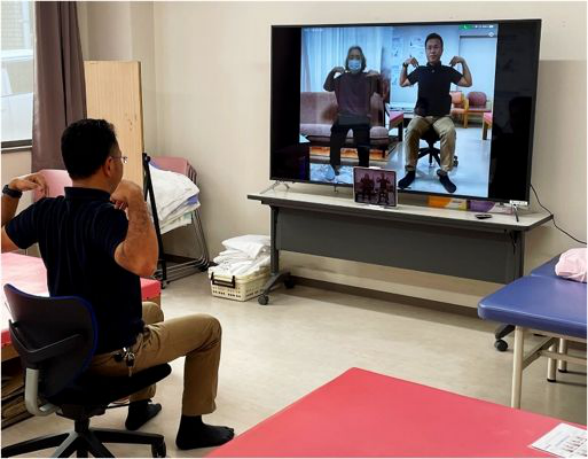
Design of Rehabilitation Exercise In this experiment, an instructor performed model exercises in front of a large display at the nursing facility, and the subject could exercise by watching on a tablet screen at home that was connected to the facility (Figure 1). At the start time of the exercises, the facility called the video communication application on the subject’s tablet, and she could connect with the instructor by responding to it.
Figure 1: Online rehabilitation exercise.
In this experiment, risk management was prioritized, and exercises were limited to ones that could be performed in a sitting position. Each 45-minute exercise session consisted of a 20-minute first exercise, a 5-minute break, and a 20-minute second exercise. In addition to a brief medical interview, blood pressure and saturation of percutaneous oxygen were measured before and after each exercise session. Once a week, a total of 12 exercise sessions were performed for three months. Note that during this experiment, the subject continued to receive outpatient rehabilitation.
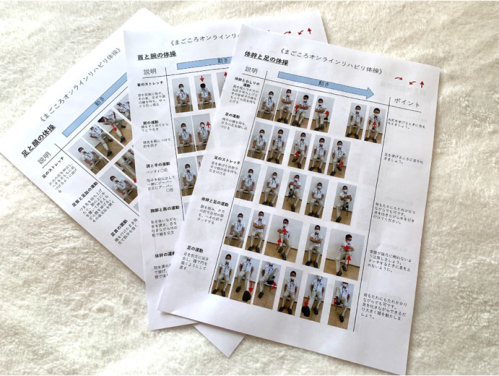
In defining the contents of the exercise, first, based on preliminary infor- mation obtained from interviews with the subject and information sharing from the director of the facility, goals for independent living, such as being able to travel again and being able to cook again, were set. After that, the body movement of the subject was checked in person, and the content of the exercises was tentatively determined. An occupational therapist served as an instructor for the first to fourth session in order to adjust the load appropri- ately while observing the subject’s condition. For example, in an exercise that involved raising the upper extremities, we noticed that her upper left extrem- ity remained lowered after several repetitions of the exercise, so the instructor took a short break or informed her that her upper left extremity was low- ered. For exercises that seemed to overload her as seen from her movements and facial expressions, we reduced the number of repetitions per set from 10 to 5, and for those that seemed too easy, we doubled the number of sets. We reviewed the exercises using her fatigue level estimated from breathing and speaking and the speed of movement as criteria for judgment of revis- ing the exercises in addition to her movements and facial expressions. From the 5th to the final session, on-site staff of the facility acted as an instruc- tor in order to experience the service in operation. We created a manual that describes points, notes, and muscles to be moved for various exercises, and we distributed it to the staff (Figure 2). The manual was also provided to the subject as requested by her.
Figure 2: Exercise manual.
Toward an Online Rehabilitation Exercise Service Based on Personal Independent 191
RESULTS
To evaluate the effects of the intervention, physical function measurements, questionnaires, and interviews were conducted.
Physical Function Measurements The physical function measurements in this experiment were based on the Cardiovascular Health Study frailty index, which considers weight loss, slow gait speed, low physical activity, exhaustion, and low grip strength. We also referred to the index by Yamada (Yamada et al., 2015) and added BMI (body mass index), TSF (triceps skinfold thickness), TUG (timed up and go test), etc. The measurements were taken monthly during the 3-month experi- ment, including at the beginning and end. As shown in Table 1, no significant change was observed in the results for each index.
Table 1. Results of physical function measurements.
Questionnaires The subject was given a questionnaire at the beginning and end of the experiment. As for the questions, we referred to the ICF, the International Classification of Functioning, Disability and Health (World Health Organiza- tion, 2001), and we set eight items: recent body function, fatigue, motivation, number of recent outings, daily activities, role at home, hobbies, and social connection. Regarding the questionnaire at the end of the experiment, free- text items were added for answering whether participating in the online rehabilitation made daily life colorful or not and whether it was good to participate or not. Comparing her responses before and after the experiment on a 5-point Likert scale, her response score on the recent body function decreased slightly from “moderately good” to “neither,” and motivation decreased slightly from “very motivated” to “moderately motivated.” On the other hand, her score on social connection increased from “want to try” to “doing regularly.” Her response on whether the rehabilitation made her own daily life colorful or not was “moderately, yes.”
Interviews To get details on the questionnaire responses, the second author of this article conducted a semi-structured interview with the subject. We transcribed the
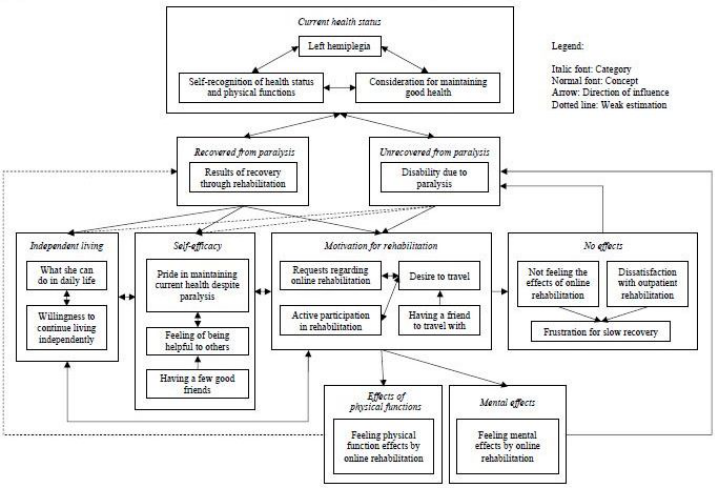
recorded interview data and conducted a qualitative analysis using M-GTA, the Modified Grounded Theory Approach (Kinoshita, 2007). The results were checked by the ninth author, who is familiar with GTA analysis, and we confirmed that excessive subjectivity was not included in the analysis. As a result, we obtained 19 concepts and 9 categories: current health status, recovered/unrecovered from paralysis, independent living, self-efficacy, moti- vation for rehabilitation, effects of physical functions, mental effects, and no effects (Figure 3).
Figure 3: Result of M-GTA analysis.
DISCUSSIONS Although there was almost no change in the measured values regarding physi- cal functions, the values did not decrease, and there were no falling accidents during the experiment, so it can be said that there was a certain effect in terms of safely maintaining functions. From the results of the questionnaires, the subject’s own recognition changed negatively regarding physical func- tions and positively regarding social connection. It seemed that the subject accepted her current physical functions as a fact and was willing to partic- ipate in society despite being dissatisfied with the lack of physical function improvements. She also seemed to have expectations for future rehabilita- tion exercises. This is because she wrote on the questionnaire constructive comments on improving exercise sessions such as how to count numbers when exercising or requesting a short break in order to continue doing hard exercises. In general, it is said that dramatic recovery of physical func- tions is difficult after 6 months have passed since stroke hemiplegia occurred (Nakayama et al., 2004). It is important to consider how the patient can
Toward an Online Rehabilitation Exercise Service Based on Personal Independent 193
be motivated in the case where recovery of physical functions is limited. The instructor commenting during the exercises that her arm was properly raised and the experience of being able to easily steer a car may have led to the above constructive comments. The subject spends time alone during the daytime when her family goes to work, and her role in the family is to do housework during that time. This role has the effect of creating a social con- nection, which leads to the specific rehabilitation goal of “being able to cook again.”
A guideline for online rehabilitation, including risk management, has been published (Said et al., 2020). We used this as a reference to design exercises that take into consideration the subject’s disease and disability and then con- ducted the experiment. In this experiment, there were many opportunities to obtain information from the subject because her outpatient rehabilitation was also being continued and because this trial was done with only one sub- ject. Thus, we could carefully respond to the subject’s demands and changes in her condition. In a future experiment, in which more subjects will partici- pate, the challenge will be to find an appropriate balance between efficiency in dealing with a large number of subjects and careful handling of individual subjects.
In addition, staff involved in the experimental visited the subject’s home several times during the preparation and exercise days, and she treated them with tea and sweets and began wearing make-up to participate in the exer- cise sessions. It is suggested that participating in this experiment may have had a positive impact on her self-efficacy and independent living in the sense that her mindset regarding social contact improved. In an interview after the experiment, she expressed her anxiety about not being covered by long-term care insurance in a few years. This seems to be a proof that her true feeling has been revealed through stronger self-disclosure achieved through rapport building.
The results of this experiment could not be statistically analyzed because there was only one subject, but through careful intervention design based on the person-centered principle and qualitative analysis of the results, valuable issues could be identified for future improvements to service design.
CONCLUSION
This paper introduced a trial of an intervention experiment involving online rehabilitation exercises. The exercises were designed not only for the recovery of physical functions but also for achieving the subject’s independent living goals in consideration of risk management. The contribution of this paper is to introduce the initial steps of the service design process based on the person-centered principle and to introduce a case study of an interventions that took into account rapport building and the motivation of the subject. Future work will include improving the service design for online rehabil- itation exercises as well as developing a methodology for person-centered service design.
ACKNOWLEDGMENT
We thank the subject and care workers at the outpatient rehabilitation facility “Magokoro” in Omuta city, Japan who cooperated in the experiment.
REFERENCES
Granger, C. V. and Hamilton, B. B. (1992). UDS report: The uniform data system for medical rehabilitation report of first admissions for 1990, American Journal of Physical Medicine & Rehabilitation, Vol. 71, No. 2, pp. 108–113. Ihara, M., Tokunaga, H., Murakami, H., Saruwatari, S., Takeshita, K., Koga,
A., Yukihira, T., Hisano, S., Maeda, R. and Motoe, M. (2023). A data-driven but person-centered assessment framework for sustainable rehabilitation services, Proc. of Intelligent Human Systems Integration (IHSI 2023): Integrating People and Intelligent Systems, Vol. 69, pp. 408–416. Kinoshita, Y. (2007). Modified grounded theory approach, https://m-gta.jp/en/. Kitwood, T. and Bredin, K. (1992). Towards a theory of dementia care: Personhood and well-being, Ageing and Society, Vol. 12, No. 3, pp. 269–287. Laver, K. E., Adey-Wakeling, Z., Crotty, M., Lannin, N. A., George, S. and Sher-
rington, C. (2020). Telerehabilitation services for stroke, Cochrane Database Systematic Reviews 2020, Issue 1, Art. No.: CD010255. Lum, P. S., Taub, E., Schwandt, D., Postman, M., Hardin, P. and Uswatte, G. (2004).
Automated Constraint-Induced Therapy Extension (AutoCITE) for movement deficits after stroke, Journal of Rehabilitation Research and Development, Vol. 41, No. 3A, pp. 249–258. Nakayama, H., Jørgensen, H. S., Raaschou, H. O. and Olsen, T. S. (1994). Recovery of upper extremity function in stroke patients: The Copenhagen stroke study, Archives of Physical Medicine and Rehabilitation, Vol. 75, No. 4, pp. 394–398. Page, S. J. and Levine, P. (2007). Modified constraint-induced therapy extension:
using remote technologies to improve function, Archives of Physical Medicine and Rehabilitation, Vol. 88, No. 7, pp. 922–927. Said, C. et al. (2020). Risk assessment guide for stroke survivors with moderate to severe disability, https://healthsciences.unimelb.edu.au/__data/assets/pdf_fi le/0004/3550576/StrokeTelerehab_RiskAssessmentGuide_LAUNCHv1_18.11. 2020.pdf Smit, E. B., Bouwstra, H., Hertogh, C. M., Wattel, E. M. and van der Wouden, J.
C. (2019). Goal-setting in geriatric rehabilitation: a systematic review and meta- analysis, Clinical Rehabilitation, Vol. 33, No. 3, pp. 395–407. Taub, E., Lum, P. S., Hardin, P., Mark, V. W. and Uswatte, G. (2005). AutoCITE: Automated delivery of CI therapy with reduced effort by therapists, Stroke, Vol. 36, No. 6, pp. 1301–1304. World Health Organization (2001). International Classification of Functioning,
Disability and Health, Geneva, https://www.who.int/classifications/icf/en/. Yamada, M. and Arai, H. (2015). Predictive value of frailty scores for healthy life expectancy in community-dwelling older Japanese adults, Journal of American Medical Directors Association, Vol. 16, No. 11, pp. 1002.e7–1002.e11.
LISTED IN THE AHFE DIGITAL BOOKSTORE CATALOGUE
Explore the complete digital volume
Human Systems Engineering and Design (IHSED 2023): Future Trends and Applications
Read this individual research paper free through the original publisher, or explore the full digital proceedings book.
ISBN 978-1-958651-88-9
Explore this ISBN in the AHFE Bookstore ↗Listed in the July 2026 bookstore catalogue; search by ISBN to confirm current availability · Digital book purchase optional