Satoshi Okuda, Naoshi Uchihira (2023). Digital Transformation Classification Types and Evolution Process for Established Companies. In: The Human Side of Service Engineering. AHFE Open Access, vol. 108, pp. 224–233. https://doi.org/10.54941/ahfe1003124
This paper propose that digital transformation (DX) can be classified into three types: DX1.0, DX2.0, and DX3.0. DX1.0 is defined as “institutional optimization”, where internal data is integrated across the company divisions. DX2.0 represents “value chain optimization” where the number of actors such as partners and supplier’s increased, optimization is achieved in providing value to the end users. DX3.0 represents “new business value creation” where new value is created through new business models (for example, servitization, and platform business). This paper further clarifies the method used by companies for updating their business models by utilizing the data, working with other actors, and defining digital transformation classification types and the evolution processes. Digital transformation classification types evolve incrementally when their operation and systems are based on data-centric.
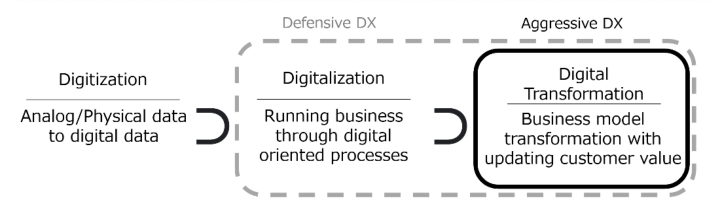
With the development of Artificial Intelligence (AI) and cloud technology, handling big data has become much more manageable. This caused a signi- ficant impact on corporate management, where companies realize faster decision-making and labor-savings by analyzing Internet of Things (IoT) data from factories and logistics facilities and customer activity histories at sales and marketing sites. These are called digital transformations (Stolterman, 2004). On the other hand, there are many issues, such as how to acquire digital data, improve the digital literacy of staff due to the digitization of ope- rations, and breaking away from dependence on vendors. The steps, which are leading up to digital transformation, are often divided into digitization, digitalization, and digital transformation (Figure 1).
These practical steps are few examples from a company management perspective. Analyzing the company’s value chain from the management per- spective and applying it to digital technology is essential instead of starting digitization which is in technical aspects. This paper illustrates the appro- ach to digital transformation that should be taken from a management perspective, focusing on the customer’s viewpoint. The research questions of this study.
Digital Transformation Classification Types and Evolution Process 225
Figure 1: Digitization, digitalization, digital transformation.
RQ1: How can companies working on DX be classified? RQ2: How is DX promotion evolving?
LITERATURE REVIEW
(1) Digital Transformation Digital transformation has been the subject of much research attention in recent years. Focusing on company’s own data and utilizing it for bet- ter management is essential step these days. Govindarajan & Immelt (2019) focused their research on data unique to large companies and argued that the survival of the manufacturing industry serve customers by integrating the brand power, customer base, industry knowledge, and assets of large companies into the software (Govindarajan & Immelt 2019). These often involve major corporate transformations, the misconception is that in pro- moting digital transformation, large companies tend to make decisions such as imitation or acquisition of start-ups or large-scale system infrastructure replacement, however these are only sometimes correct. Digital transforma- tion does not necessarily have to be disruptive; it should be shaped by what can be done by focusing on the data (Furr & Shipilov 2019).
It is essential to quickly discover a model that can scale by simply trying processes and operations using established companies’ resource strength. Mcgrath & Mcmanus (2020) presents several practical methods for digitizing business processes. Starting with what can be done and transformed using digital platforms. It is also important to classify the system infrastructure in promoting digital transformation. Sebastian et al. (2017) organized the system into two areas, the SoR area centered on Operational Excellence and the SoE area centered on Rapid Innovation. They also pointed out that the systems in the SoR and SoE domains are independent, and the development process is different.
(2) Digital Transformation Classification Types Several papers explored various types of digital transformation, including Industry 4.0 in Germany, digital transformation in factories, and the use of AI in offices. Muller et al. (2018) categorized the impact of Industry 4.0 on the business model innovation of SMEs from three aspects: value creation, value capture, and value offer. Ibarra et al. (2018) divided the DX of manufacturing
226 Okuda and Uchihira
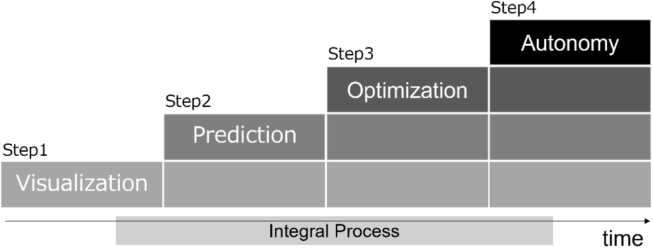
companies into four stages. Ismail et al. (2022) proposed six steps for exploi- ting DX from previous research. Uchihira (2022) divided the value of the Smart factory into Defensive DX and Offensive DX and presented their cha- racteristics and challenges. Okuda et al. (2021) presented a four-step process (see Figure 2) to exploit the work in order to be autonomous in a machine- learning application system, and Porter and Heppelmann (2014) proposed a product exploitation model. Both focus on the systems for data utilization. Berghaus and Back (2016) discovered the digital maturity model, including its criteria, difficulties, and maturity stages. Vrana & Singh (2021) summarized the characteristics of Digitization, Digitalization, and Digital transformation by industry. The authors suggested that internal transformation through digi- tal technologies is necessary, but previous studies need to address the evolving business models. In this paper, the authors emphasize the significance of data in digital transformation, and propose a definition of this process as a form of business model innovation that relies on data exploitation. By leveraging data, companies can create new value propositions, enhance customer expe- riences, and optimize their operations, leading to a competitive advantage in the digital era.
Research Methods This paper aims to clarify the digital transformation classification and its evolution process. Hence, the business model innovation in the case discus- sed in this study was not apparent. To explore the evolutionary process of the business model from the interviewees, the author adapted unstructured interviews as a data collection method. Based on Waseda University’s alum list, the author negotiated companies promoting digital transformation and researched from eight cases that agreed on the interview (see Table 1). The authors interviewed executives of Japanese companies or people promoting digital transformation.
For the survey respondents, the authors were asked in lecture format to present the business and conducted a deep dive into interviews to discuss business characteristics and DX cases. To better understand this case, authors conducted additional interviews for four samples (see Figure 3). Lectures and interviews were transcribed and qualitatively analyzed. Through this analysis,
Figure 2: Exploitation patterns for machine learning systems.
Digital Transformation Classification Types and Evolution Process 227
Table 1. Interviewee information.
Table available in the original PDF paper.
Interviewees ID Projects Industry Role of interviewee e-Commerce CDxO Interviewees 1 Inventory allocation optimization system
SaaS provider CXO
Interviewees 2 Sales planning system Advertising CEO/IT strategy Dept. Interviewees 3 Disaster prevention system Disaster prevention CEO Interviewees 4 Web application firewall system
Real estate CXO
Interviewees 5 Rent yield calculation system Real estate CEO, CTO Interviewees 6 Driving assistant system Mobility CXO Interviewees 7 Parking inventory management system Interviewees 8 Health care service Manufacturing R&D Manger
Figure 3: Research flow.
the authors led three types of digital transformation. Transcripts were proce- eded by qualitative data analysis. The software used was MAXQDA (version 22.1). Using a software which allow for changing the relationship between Codes and analyzing the correlation.
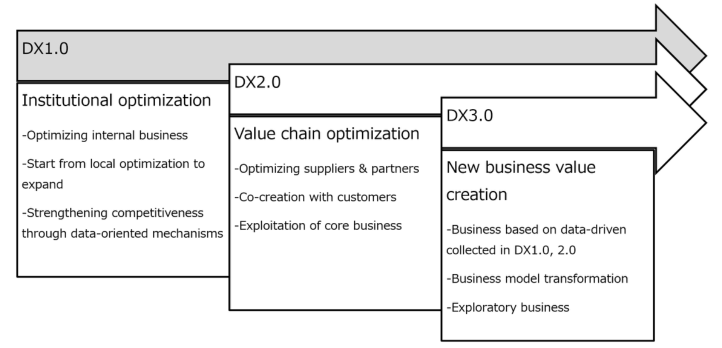
Digital Transformation Classification Types Digital transformation can be classified into the following three types (see Figure 4). DX1.0 Institutional optimization, which consists of optimizing the data in the company. DX2.0 Value chain optimization is strengthening the model by involving outside parties DX3.0 new business value creation refers to building a new business model.
DX1.0: Institutional Optimization According to the interview, DX1.0 involves the digitization and accumulation of data through business operations. (see Figure 1). Intervening in the process and gathering data is a significant undertaking that should be disseminated throughout the company. To ensure success, it is advisable to proceed in sta- ges, starting with local optimization and gradually scaling it throughout the organization. Pay attention to the fact that the company is systematized by digitization. These were manifested in various ways, such as improved speed, accuracy, and predictive accuracy of business processes. Data acquisition at this stage is essential for DX2.0 value chain optimization and DX3.0 new business value creation. Large companies face many barriers when expanding
228 Okuda and Uchihira
Figure 4: Digital transformation classification types.
from local optimization to other departments, and one of the challenges is cre- ating data silos between departments. Data definition, data pre-processing, and unifying processes requires significant resources and investments. DX1.0 is often promoted based on marketing and sales. In recent years, with the advent of CDP (customer data platforms), there has been a trend to inte- grate customer data, and along with this, data linkage between departments is promoted. In this research, the authors can recognize that much data is integrated based on points of contact with customers.
Interviewee 2: Dispatching sales staff to stores. “It was about 18 years ago when I was a manager of a convenience store, and since that time, I have had a strong sense of the problem that the work in the field is a treasure trove of information, but it is being neglected. -omission (of the middle part of the interview) - We started our company with the business of undercover research. From the beginning, we built a system called “System M(Provisional)” to create a data- base of retail store information, believing that if data is accumulated, it should become valuable. This system has finally been recognized as valuable over the past two to three years.”
Interviewee3: Disaster prevention SaaS. “When the Great East Japan Earthquake struck, detailed information by region was not being conveyed through the traditional mass media, so I loo- ked at Twitter and saw that there were quite lots of tweets saying things like, “There is a shortage of supplies here,” or “We are looking for volunteers here. At the time, there were not many Twitter users, but organizing this information on SNS and putting it together by region would be useful. This was the starting point of the business. Currently, the company is not only working with SNS, but also with weather data, driving data from car navi- gation systems, human flow data, and satellite data, and combining data for analysis.”
Digital Transformation Classification Types and Evolution Process 229
DX2.0: Value Chain Optimization One of the features of DX2.0 is to involve suppliers and partners in the insti- tutional optimization system built in DX1.0. Realizing in-house optimization with DX1.0, and expand the scope of optimization by involving suppliers and partners in these mechanisms. Here, suppliers and customers are invo- lved, and with an appropriate value to customers, it is possible to collect data through co-creation with them. These activities do not allow changes in the business model, and the company is at the stage of exploiting the existing business model. The premise of DX2.0 is that DX1.0 has built a mechanism that allows suppliers, partners, and sometimes customers to be included in the optimization process.
Interviewee 1: Major e-commerce for office supplies. “We consist of our business model as data-driven oriented from the start-up stage. Therefore, silo problems between departments have not occurred com- pared to old companies. We have achieved data-driven optimization in many processes, such as purchasing logistics, inventory management, and shipping logistics. DX1.0 started smoothly from the above background. By integra- ting suppliers’ inventory information, it is possible to prevent shortages and achieve improved user benefits and increased sales. Appropriate inventory allocation and shipping logistics optimization require a large amount of data, and they are operated autonomously by a machine-learning applica- tion system. We are optimizing logistics and sales in a data-driven manner, but we classified it as DX2.0 because it does not meet the requirements of DX3.0.”
Interviewee 8: Shoe manufacturer. “The problem was that it was difficult to obtain user information. Because we sell the shoes through retail sales, we cannot know how the users use the products. We made a path to the runner community by acquiring the run- ner app. We are promoting the business with the vision of creating a runner ecosystem, including its applications.”
Since this is an apparel manufacturer, there are still many issues in the transition to services, so the authors classified interviewee eight as DX2.0.
DX3.0: New Business Value Creation DX3.0 has two essential requirements. The first involves a transformation of the business model, and the second to provide data-driven value. The first business model change is the change in the value provided from the custo- mer’s point of view between DX1.0 and DX2.0, which often changes the charging system for customers. As for the second data-driven value, the new value is created by data-driven based on the data generated by DX1.0 or DX2.0. DX3.0 can be classified as an exploratory business and is a business that is distinct from conventional businesses.
Interviewee 2: Dispatching sales staff to stores. “We compile data on how many products were sold at which store through the sales staff. As a result, we shifted from a sales staff dispatch type to a
230 Okuda and Uchihira
promotion using digital signage, partly because of the COVID-19 response. The strength is that we can predict from past data which sales floors will lead to results by digital signage. We can say that prediction by the data made it possible to launch the DX3.0 digital signage business quickly.”
Interviewee 6: Taxi business. “Due to the business characteristics of the taxi business, the difference in sales between veteran drivers and new drivers is remarkable. Also, how to run a taxi was accumulated by veteran drivers’ tacit knowledge, and it could not be easily conveyed to newcomers. The company stored the movement information of taxis in a database, investigated the characteristics of high- selling drivers, and provided them as a navigation system for new drivers. This contributed to a 1.6% increase in sales for using the area search function and a 1.9% increase in sales for viewing detailed demand information compared to new drivers who relied on conventional experience and intuition. We are currently providing this to other companies as well.”
Features of Digital Transformation Classification Types The authors classified the digital transformation into DX1.0: Institutional optimization, DX2.0: Value chain optimization, and DX3.0: New business value creation. The authors summarized these features according to the fea- tures provided in Table 2. Features of DX classification types. See Table 3 where DX classification types by interviewees show the arrangement of DX types and features for interviewees.
DX starts with value chain optimization. Promoting data integration across departments makes it possible to optimize internal business proces- ses. Data-driven companies from the outset have an advantage in that they can avoid the issue of data silos between departments. Usually, while perfor- ming local optimization from a specific department, data-based optimization is carried out for related departments. Doing this will result in faster business processes, better accuracy, and better forecasting accuracy.
DX 2.0 and DX 3.0 have different characteristics, such as exploring and exploit types. In DX 2.0, by incorporating suppliers and partners into the system built in DX 1.0, the benefits can be enjoyed in a broader range. As
Table 2. Features of digital transformation classification types.
Table available in the original PDF paper.
No. DX types Features 1-1 DX1.0 Optimizing internal business 1-2 DX1.0 Start from local optimization to expand 1-3 DX1.0 Strengthening competitiveness through data-oriented mechanisms 2-1 DX2.0 Optimizing suppliers & partners 2-2 DX2.0 Co-creation with customers 2-3 DX2.0 Exploitation of core business 3-1 DX3.0 Business based on data-driven collected in DX1.0, 2.0 3-2 DX3.0 Business model transformation 3-3 DX3.0 Exploratory business
Digital Transformation Classification Types and Evolution Process 231
Table 3. DX classification types and features by interviewees.
Table available in the original PDF paper.
Interviewees ID Pjt ID Projects DX types 1-1 1-2 1-3 2-1 2-2 2-3 3-1 3-2 3-3 DX2.0 Y Y Y Y N Y N N N Interviewees 1 Pjt 1 Inventory allocation optimization system
DX3.0 Y Y Y Y Y Y Y Y Y
Interviewees 2 Pjt 2 Sales planning system DX3.0 Y Y Y Y N Y Y Y Y Interviewees 3 Pjt 3 Disaster prevention system DX3.0 Y Y Y Y Y Y Y Y Y Interviewees 4 Pjt 4 Web application firewall system
DX3.0 Y Y Y Y N Y Y Y Y
Interviewees 5 Pjt 5 Rent yield calculation system
DX3.0 Y Y Y Y Y Y Y Y Y
Interviewees 6 Pjt 6 Driving assistant system
DX3.0 Y Y Y Y Y Y Y Y Y
Interviewees 7 Pjt 7 Parking inventory management system Interviewees 8 Pjt 8 Health care service DX2.0 Y Y Y Y Y Y N Y Y
shown in Interviewees 3, 6, 7, and 8 provided in Table 3, we can find the co-creation processes with customers. However, these are not essential, and whether or not they can be adopted depends on the business characteristics of the company. Since DX 2.0 is the orthodox evolution of DX 1.0, it will shift to DX 2.0 once the company completes the DX 1.0 requirements.
DX 3.0 needs to proceed with a much clear intention compared above. A process different from DX 1.0 and DX 2.0 is required, such as exploring the direction while experimentally acquiring data, preparing for utilization, and providing new value to customers. Sebastian et al. (2017) suggested that agility and rapid innovation are required to manage in-house data and gather new information, such as user purchase data and social media information. They use agile and DevOps methods in DX3.0, familiar with new business creation methods ( Rise 2011, Osterwalder 2004, Blank & Dorf 2020).
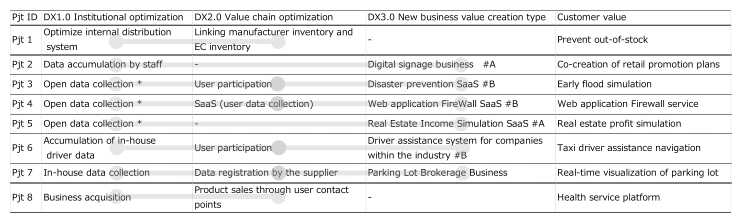
Digital Transformation Evolution Process The evolution process starts with DX 1.0 and progressing to DX2.0 and DX3.0 (see Table 4). However, the six cases that led to DX3.0 had the follow- ing characteristics. First, for the two cases of Interviewees 2 and 5, the DX2.0 step was skipped, and DX3.0 was performed first. The authors suggest that to realize DX3.0 is information fully prepared with the data accumulated in the company. From the value chain perspective, it is not necessarily practi- cal to cooperate with suppliers to obtain information, and they have done everything independently.
Second, interviewees 3, 4, and 6 proceed with DX3.0 and DX2.0 in paral- lel. These characteristics were seen in new industries with fewer industry ties and in SaaS-type businesses that have completed data collection. This type of business often starts in the SaaS (software as a service) business models to utilize user data to enhance service levels. Interviewee 7 is progressing smoothly with DX1.0, DX2.0, and DX3.0. This case is characteristic of a mature business model with many external collaborations. This is the case for the Operation Excellence type business, which requires time for partner collaboration due to national regulations and the need to keep pace with the industry.
232 Okuda and Uchihira
Table 4. Digital transformation evolution process.
DISCUSSION AND CONCLUSION There has been much research on digital transformation in recent years. There are many discussions on utilizing digital transformation in corpo- rate management, such as digital innovation and business model innovation, which is close to digital transformation research. Areas such as innovation management and digital platforms, since research areas cover technology management and ecosystem areas, which are closely related but different from this research area. This paper clarified the classification of digital transformation from the viewpoint of business model innovation and its exploitation. Creating new business value is essential when realizing digi- tal transformation, however the new business theory also comes into play in this context. Furr & Shipilov (2019) and Mcgrath & Mcmanus (2020), featured in this article, are also prominent researchers in the new business fields. In terms of utilizing digital technology in management, it is neces- sary to examine it from a multifaceted perspective, such as management and new business creation aspects. The authors hope that this paper will help in clarifying this relationship.
ACKNOWLEDGEMENT
The authors would like to thank all interviewees for sharing their valua- ble information and time to support our research. This work was supported by JSPS KAKENHI Grant Number 19K12234 and JST-Mirai JPMJMI20B8 Engineerable AI (eAI).
REFERENCES
Berghaus, S., and Back, A. (2016) “Stages in digital business transformation: results of an empirical maturity study”, In MCIS. pp. 22. Dorf, B., Blank, S. (2020). The Start-up Owner’s Manual: The Step-By-Step Guide
for Building a Great Company. United States: Wiley. Furr, N. and Shipilov, A. (2019) “Digital doesn’t have to be disruptive: the best results can come from adaptation rather than reinvention”. Harvard Business Review, 97(4). Govindarajan, V., and Immelt, JR (2019) “The only way manufacturers can survive”,
MIT Sloan Management Review, 60(3). pp. 24–33. Ibarra, D., Ganzarain, J., and Igartua, JI (2018) “Business model innovation through Industry 4.0: A review. Procedia manufacturing”. 22. pp. 4–10. Ismail, MH, Khater, M., & Zaki, M. (2017). “Digital Business Transformation and
Strategy: What Do We Know So Far?”.
Digital Transformation Classification Types and Evolution Process 233
McGrath, R. and McManus, R. (2020) “Discovery-Driven”. Harvard Business Review, 98(3). pp. 124–133. Müller, JM, Buliga, O., and Voigt, KI (2018) “Fortune favors the prepared: How
SMEs approach business model innovations in Industry 4.0”. Technological Forecasting and Social Change. 132. pp. 2–17. Okuda, S., Nemoto, G., Mori, T., Ishitani, N., Nishimura, K., and N. Uchihira. (2021) “Exploitation Pattern for Machine Learning Systems”, 2021 36th International Technical Conference on Circuits/ Systems, Computers and Com- munications (ITC-CSCC), Jeju, Korea (South). pp. 1–4. Osterwalder, A. (2004) “The business model ontology a proposition in a design
science approach: PhD Dissertation, University of Lausanne,” no. Ix. pp. 172. Porter, ME, and Heppelmann, JE (2014). “How smart, connected products are transforming competition”. Harvard Business Review, November. Ries, E. (2011). The Lean Start-up: How Today’s Entrepreneurs Use Continuous
Innovation to Create Radically Successful Businesses. England: Crown. Sebastian, IM, Ross, JW, Beath, C., Mocker, M., Moloney, KG and Fonstad, NO (2020) “How big old companies navigate digital transformation”, In Strategic information management, Routledge. pp. 133–150. Stolterman, E., and Fors, AC (2004) “Information technology and the good life”, In
Information systems research, Springer, Boston, MA. pp. 687–692. Uchihira, N. (2022) “Success Mechanisms of Smart Factories in Small and Medium- Sized Enterprises”, 2022 IEEE Technology & Engineering Management Confere- nce - Asia Pacific (TEMSCON-ASPAC). pp. 067–074. Vrana, J., & Singh, R. (2021) “Digitization, digitalization, and digital transforma-
tion”, Handbook of Nondestructive Evaluation 4.0. pp. 1–17.
LISTED IN THE AHFE DIGITAL BOOKSTORE CATALOGUE
Explore the complete digital volume
The Human Side of Service Engineering
Read this individual research paper free through the original publisher, or explore the full digital proceedings book.
ISBN 978-1-958651-84-1
Explore this ISBN in the AHFE Bookstore ↗Listed in the July 2026 bookstore catalogue; search by ISBN to confirm current availability · Digital book purchase optional