Taketo Yato, Naoshi Uchihira (2023). Design Method Using Extended Business Model Canvas for IoT Platforms Considering Platform and Service Value. In: The Human Side of Service Engineering. AHFE Open Access, vol. 108, pp. 234–243. https://doi.org/10.54941/ahfe1003125
This paper proposes a Platform and Service Business Model Canvas (PSBMC). The proposed method will help design an IoT platform business model that includes devices in the physical space (called edge devices). Manufacturing companies are selling and maintaining devices, e.g., home security devices and fire alarm devices, and seeking ways to utilize those devices effectively and create new value by adding IoT functions. Since data measured by those devices can be used to improve various services, these devices with IoT functions serve as IoT platforms for these services. It is necessary to identify customers and their requirements in order to improve the value of services. Fahmideh and Zowghi (2020) noted the lack of requirements analysis for IoT platform design. Also, previous studies proposed extensions to the business model canvas (Osterwalder and Pigneur 2010) for platform businesses. These studies focused on the value of the entire platform and did not separate the value of the services built on the platform from the value of the entire platform. Because the proposed canvas can describe service user requirements, service value, and platform value, it is possible to overcome the problem of the lack of requirements analysis in IoT platform business design. The IoT platform will be able to provide the basic function of edge devices and valuable services using devices' data.
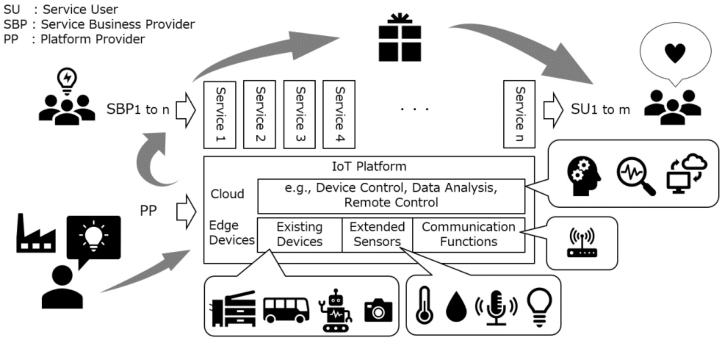
By adding IoT functions to conventional devices, manufacturers can create value not only from the functions of the devices but also from the sensor data that the devices offer. Other companies’ services can use this sensor data effectively by building an IoT platform. Figure 1 illustrates an IoT platform ecosystem that includes existing devices. The IoT platform has an edge device side and a cloud side. The edge device side consists of existing devices, exten- ded sensors, and communication functions. The cloud side has device-control functions, data analysis, and remote-control functions. Platform Provider (PP) provides data collected by the IoT platform to Service Business Provider (SBP). SBP uses the data to realize their service businesses and provide value to Service User (SU). To improve the value of the IoT platform business, it is
Design Method Using Extended Business Model Canvas for IoT Platforms 235
Figure 1: IoT platform ecosystem that includes existing devices.
necessary to design a business that focuses on the service business side and the value of the provided data by the platform.
In order to improve the value of services, it is necessary to identify custo- mers and their requirements. Fahmideh and Zowghi (2020) pointed out the lack of requirements analysis for IoT platform design. The Business Model Canvas (BMC) (Osterwalder and Pigneur 2010) is a method for business model design that clarifies the business model in terms of nine building blocks (“Value Proposition”, “Customer Relationships”, “Channels”, “Customer Segments”, “Key Activities”, “Key Resources”, “Key Partners”, “Revenue Streams” and “Cost Structure”). Previous studies proposed extending BMC and described platform businesses and service businesses. This paper surveys and analyses previous studies that have introduced methods that extend BMC. Based on the analysis and results of the previous studies, a design method for IoT platform business that includes edge devices is proposed. The proposed method is applied to an example and analysed the results found.
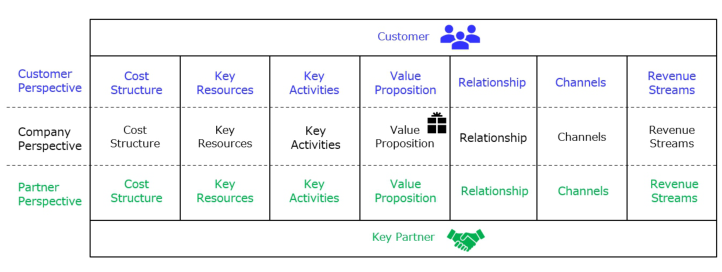
Previous Studies on Business Model Canvas for Platforms, Smart Cities, and Services This section describes previous studies that extended BMC for designing service businesses. Zolnowski et al. (2014) proposed “Service Business Model Canvas” for analysing service business models. As shown in Figure 2, the canvas has partner and customer perspectives to understand the entire service business logic. Multiple perspectives allow for analysing the relationships among actors in the service business. Rose et al. (2019) proposed “Digital Service Innovation Canvas”, which focuses on service value delivery. This method has “Key Innovations” and “Triggers” building blocks to drive inno- vation. “Key Innovations”block identifies elements necessary for innovation, such as new technologies. “Triggers” block can describe triggers such as political pressure or citizen demands. These studies analysed the actors’ per- spectives on services and the new technologies needed to innovate. However,
236 Yato and Uchihira
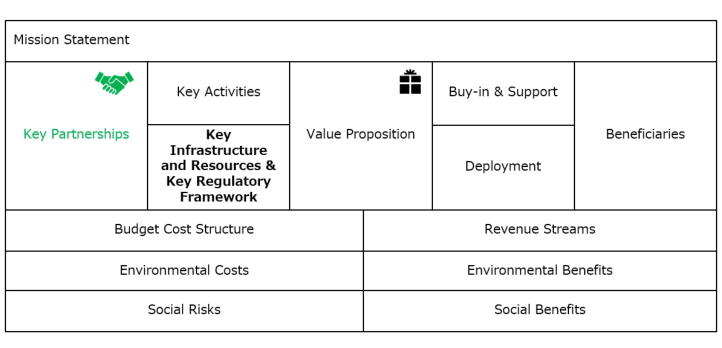
Figure 2: Service business model canvas (own illustration based on Zolnowski et al. 2014).Figure 3: City model canvas (own illustration based on Timeus et al. 2020).
these studies assumed a single service and cannot represent the value flow of multiple actors on the platform.
There are several studies proposed extending BMC for designing smart city businesses. Timeus et al. (2020) proposed “City Model Canvas”, which is based on the BMC for companies and adapted for cities. As shown in Figure 3, the Key Resources block includes infrastructure and regulatory framework. Giourka et al. (2019) proposed “Smart City Business Model Canvas” to address urban environments’ growing smartness and complexity. “Data” block allows for a clear use of the data acquired from the sensors. “Key Resources” block includes infrastructure, the physical assets of a smart city. In previous studies, building blocks with physical infrastructure allo- wed for analysis of sensors and data, which are key elements of smart cities. The method of describing value in a single value proposition block made it difficult to express value propositions for multiple actors.
There are a few previous studies proposed extending BMC for designing platform for businesses. Eisape (2019) proposed “Platform Business Model
Design Method Using Extended Business Model Canvas for IoT Platforms 237
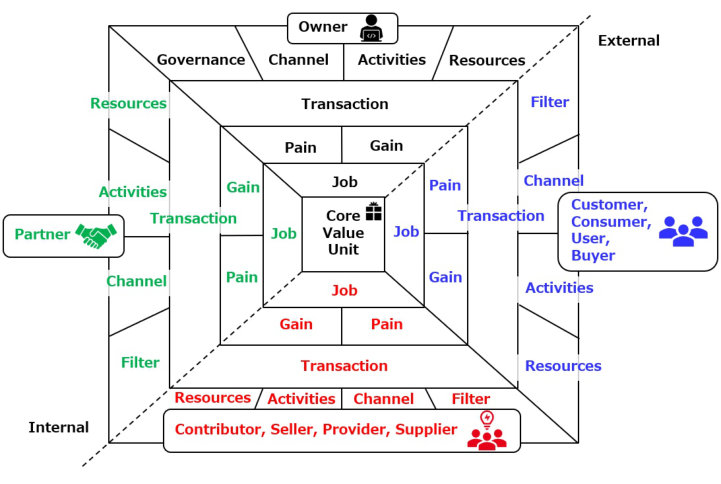
Canvas” to support shifting from a pipeline to a platform business. As shown in Figure 4, it is composed of building blocks from the actor’s perspective on four sides, with the core values of the platform placed at the center of the canvas. Sorri et al. (2019) proposed “Platform Canvas” to support busi- ness model innovation and development in platform ecosystems. The canvas represents a two-sided marketplace of producers and users, with the plat- form value placed at the center of the canvas. Wecht et al. (2021) proposed “Platform-Based Ecosystem Business Model Canvas” to describe platforms and business ecosystems. The platform was placed in the center of the canvas and the actors are placed on the four sides. The value that each actor provides and receives for the platform can be clearly defined. These previous studies did not focus on the value of the services built on the platform because the main focus was on the value of the platform.
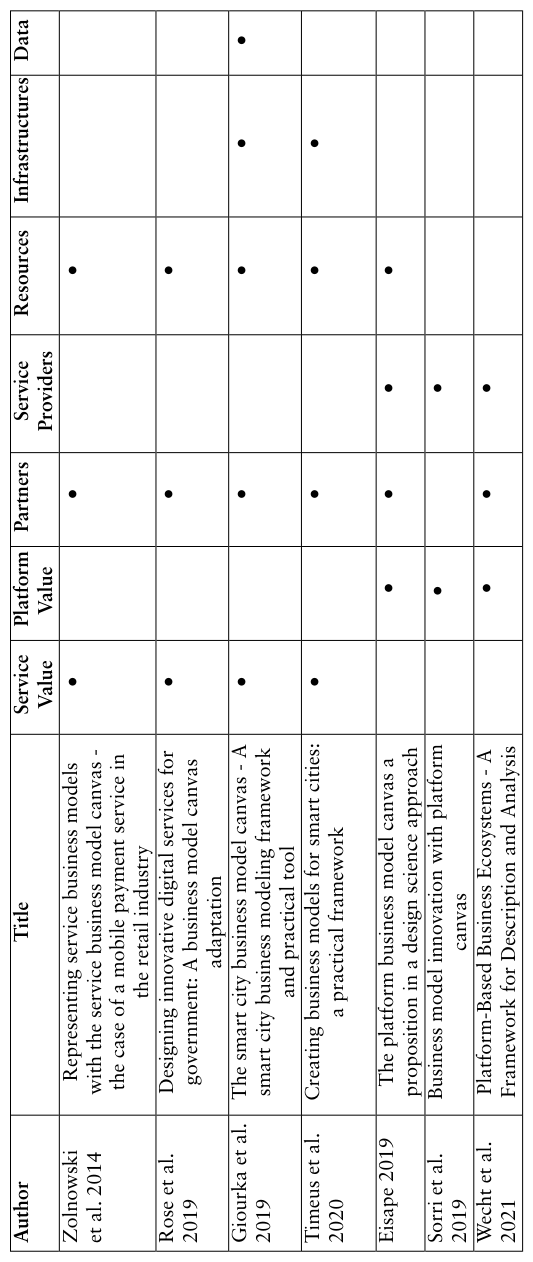
Table 1 summarizes the significant building blocks (service value, plat- form value, partners, service providers, resources, infrastructure, and data) for IoT platform design included in the canvases of previous studies. Other building blocks in the BMC were omitted because they do not differ signifi- cantly from those in previous studies. These studies that have extended BMC included proposals for platforms, smart cities, and service businesses, but none describe both platform and service value. This paper proposes a canvas that describes these values.
Proposal of Platform and Service Business Model Canvas In this section, an extended BMC to a business model for IoT platforms that includes edge devices is proposed. Figure 5 shows the flow of value and
Figure 4: Platform business model canvas (own illustration based on Eisape 2019).
238 Yato and Uchihira
Table 1. Significant building blocks in previous studies.
Design Method Using Extended Business Model Canvas for IoT Platforms 239
Figure 5: CVCA for IoT platform that includes edge devices.
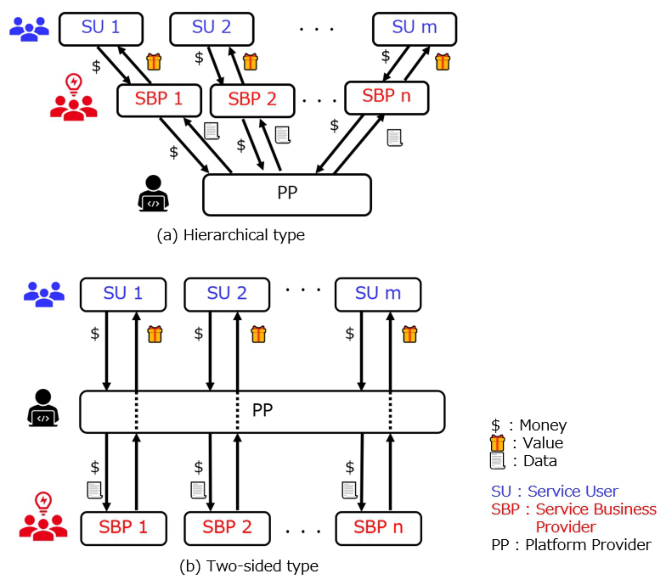
money in the IoT platform that includes edge devices shown in Figure 1 using the Customer Value Chain Analysis (CVCA) (Donaldson et al. 2004). As shown in Figure 5, there are three main actors: PP, SBP, and SU. Figure 5(a) shows a hierarchical type. PP provides SBP with sensor data acquired by the edge device. SBP provides SU with service value. SU pays money to SBP, and SBP pays money to PP. One actor could be in the role of SBP and SU, in which case the SBP would convert the data into value and provide it to itself. Figure 5(b) shows a two-sided type. PP provides SBP with sensor data. PP provides SU with service value that SBP makes. SU pays money to PP for service fees. PP pays money to SBP for a part of service fees.
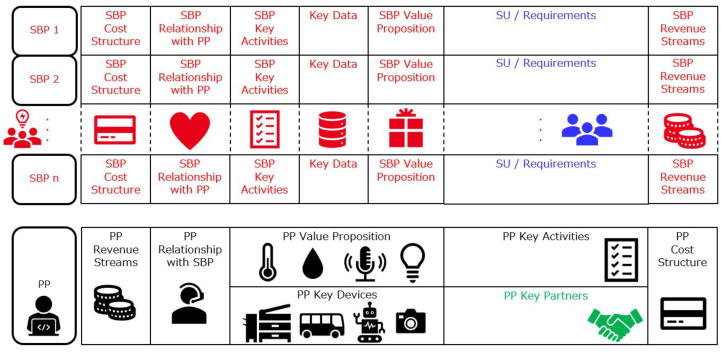
Although the canvases of previous studies are able to a single service platform, focusing multiple SUs and SBPs as shown in Figure 5 is difficult. This paper proposes Platform and Service Business Model Canvas (PSBMC), which describes the platform value and the service value of each service business, as a method to solve the above problem (Figure 6).
PP and SBP are placed separately on the top side and bottom side. The platform value provided by PP and the service value provided by SBP can be described on a single canvas. SBP can be stacked in any number of layers. This is a feature similar to a smart city, and this canvas includes physical edge devices and data.
Table 2 shows the building blocks of the PP side. “PP Value Proposition” is primarily the value of the platform provided to SBP. “PP Relationship with
240 Yato and Uchihira
Figure 6: Platform and service business model canvas.Table 2. Building block for PP in PSMBC.
Table available in the original PDF paper.
Building Block Description PP Value Proposition The Value proposition of IoT platform. PP Relationship with SBP Relationship between PP and SBP. PP Key Devices Edge devices in IoT platform. PP Key Activities PP’s primary activities. PP Key Partners Partners around IoT platform. PP Revenue Streams IoT platform business revenue. PP Cost Structure IoT platform development and maintenance cost. Service usage fee (two-sided type).
SBP” is a relationship to SBP, including the method of providing data. “PP Key Devices” are physical edge devices that collect sensor data within the IoT platform. “PP Key Activities”are the main activities of PP, including platform construction and edge device development. “PP Key Partners” help build and operate the platform. “PP revenue stream” is the revenue of the platform. “PP Cost Structure” is the cost of developing and maintaining the platform. If it is a two-sided type, The cost includes service usage fees.
Table 3 shows the building blocks of the SBP side. “SBP Value Proposition” is the value of the service business provided to SBP. “SU / Requirements” are SU and SU’s requirements. “Key Data” is the data obtained from the IoT platform, which is used to generate service value. “SBP Key Activities” are the main activities of SBP, such as service development and operation. “SBP Relationship with PP” is a relationship to PP and the way to access the data. “SBP revenue stream” is the revenue of the service business. “SBP cost structure” is the cost required to develop and maintain the service business. If it is a hierarchical type, The cost includes platform usage fees.
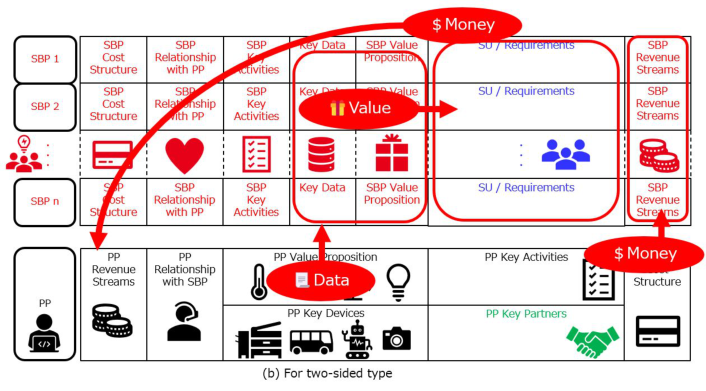
Figure 7 shows the value flow of the PSBMC. The canvas describes the value flow of the three actors in Figure 5. The data acquired from the PP’s edge devices is provided to the SBP. The value is provided to the SUs by the
Design Method Using Extended Business Model Canvas for IoT Platforms 241
Table 3. Building block for SBP in PSBMC.
Table available in the original PDF paper.
Building Block Description SBP Value Proposition The Value proposition of service business. SU / Requirements SU and SU’s requirements. Key Data Data required for service realization. SBP Key Activities SBP’s primary activities. SBP Relationship with PP Relationship between PP and SBP. SBP Revenue Streams Service business revenue. SBP Cost Structure Service development and maintenance cost. Platform usage fees (hierarchical type).
Figure 7: Value flow in PSBMC.
services built by SBP. In Figure 7 (a), SU pays SBP for the service business, and SBP pays PP for using the platform. In Figure 7 (b), SU pays PP for the service business on the platform, and PP pays SBP for the service usage. The canvas can create a revenue cycle for this business model.
242 Yato and Uchihira
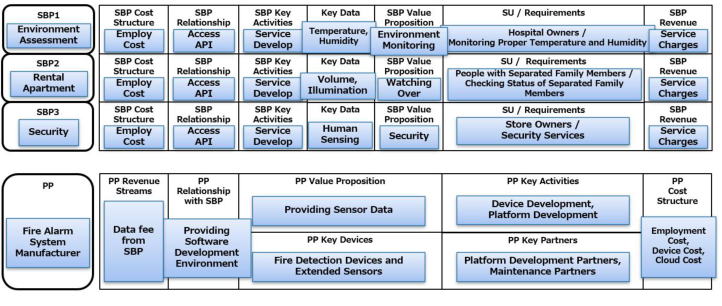
Figure 8: PSBMC for fire alarm system manufacturer example.
The example offered in this paper is a fire alarm manufacturer building an IoT platform (Figure 8). The PP is the fire alarm manufacturer. The SBPs are an environment assessment company, a rental apartment company, and a security company. PP uses a fire alarm device as an edge device. By atta- ching extended sensors to this device, the system will be able to provide the necessary data for this platform. PP provides a development environment and API access to the sensor data needed for SBP. In this example, SUs are medical providers, people with families living apart, and store owners. The SU’s requirements and service value are described on the canvas. Then, the data required to realize the service value will be clarified. For example, store owners (SU) use a security service (SBP’s service). Security company (SBP) provides service using human sensing data acquired from an IoT platform. Each building block of the PSMBC can be described and validated to clarify the IoT platform business, including edge devices.
DISCUSSION AND CONCLUSION This paper has proposed PSBMC, an extended BMC (Osterwalder and Pigneur 2010), as a method for designing an IoT platform business that inclu- des edge devices. The platform can provide the basic function of edge devices (e.g., fire detection devices) and valuable services (e.g., watching over and security) using devices’ data. Previous studies proposed extending BMC for service businesses, smart cities, and platforms. However, none of the previ- ous researchers described both platform and service value. The PSBMC is a canvas that can clearly describe both platform value and service value. There are three types of actors: PP, SBP, and SU. “Platform Key Device” and “Key Data”building blocks specify edge devices and their sensor data. “SU / Requi- rements” building block describes customer requirements. This canvas was able to describe the entire ecosystem and the IoT platform business which includes edge devices. In manufacturing companies with existing devices, building an IoT platform, it is possible to maximize the value of data acquired by sensors. However, it takes work to consider the IoT platform’s complex ecosystem and business model. Using PSBMC, an IoT platform business that includes edge devices can be clarified in a single canvas.
Design Method Using Extended Business Model Canvas for IoT Platforms 243
Because this canvas was able to describe SU’s requirements, it is possible to overcome the problem of the lack of requirements analysis in IoT platform design identified by Fahmideh and Zowghi (2020). In addition, the proposed canvas was capable to describe the value flow and revenue stream for PP, SBP, and SU. The edge devices can be considered according to the value flow in the canvas and the requirements of SU.
It is necessary to evaluate and improve the PSBMC for various cases. In the future, actual case studies of IoT platform business that includes edge devices should be conducted, and used to evaluate and improve the practicality of the proposed canvas. Also, more experimentation is needed to determine whether the PSBMC has the potential to be applied to other platforms.
REFERENCES
Donaldson, K. M., Ishii, K., and Sheppard, S. D. (2004). Customer value chain analysis. In International Design Engineering Technical Conferences and Computers and Information in Engineering Conference, 46962, 993–1001. Eisape, D. (2019). The platform business model canvas a proposition in a design sci-
ence approach. American Journal of Management Science and Engineering, 4(6), 91–107. Fahmideh, M., and Zowghi, D. (2020). An exploration of IoT platform development.
Information Systems, 87, 101409. Giourka, P., Sanders, M. W., Angelakoglou, K., Pramangioulis, D., Nikolopoulos, N., Rakopoulos, D., Tryferidis, A., and Tzovaras, D. (2019). The smart city business model canvas - A smart city business modeling framework and practical tool. Energies, 12(24), 4798. Osterwalder, A., and Pigneur, Y. (2010). Business model generation: a handbook for
visionaries, game changers, and challengers, John Wiley & Sons. Rose, J., Holgersson, J., and Söderström, E. (2019). Designing innovative digital services for government: A business model canvas adaptation. In 27th European Conference on Information Systems (ECIS), Stockholm & Uppsala, Sweden, June 8-14, 2019. Association for Information Systems. Sorri, K., Seppanen, M., Still, K., and Valkokari, K. (2019). Business model
innovation with platform canvas. Journal of Business Models, 7(2), 1–13. Timeus, K., Vinaixa, J., and Pardo-Bosch, F. (2020). Creating business models for smart cities: A practical framework. Public Management Review, 22(5), 726–745. Wecht, C. H., Demuth, M., and Koppenhagen, F. (2021). Platform-Based Business
Ecosystems - A Framework for Description and Analysis. In Smart and Sustainable Collaborative Networks 4.0: 22nd IFIP WG 5.5 Working Conference on Virtual Enterprises, Proceedings 22 92–100. Zolnowski, A., Weiß, C., and Böhmann, T. (2014). Representing service business models with the service business model canvas - the case of a mobile payment service in the retail industry. In 2014 47th Hawaii International Conference on System Sciences, 718–727.
LISTED IN THE AHFE DIGITAL BOOKSTORE CATALOGUE
Explore the complete digital volume
The Human Side of Service Engineering
Read this individual research paper free through the original publisher, or explore the full digital proceedings book.
ISBN 978-1-958651-84-1
Explore this ISBN in the AHFE Bookstore ↗Listed in the July 2026 bookstore catalogue; search by ISBN to confirm current availability · Digital book purchase optional