Cuiping Zhai, Xin Hu (2024). Sustainable Business Model Design for Generative AI. In: Human Factors in Design, Engineering, and Computing. AHFE Open Access, vol. 159, pp. 1673–1683. https://doi.org/10.54941/ahfe1005735
As the future commercial development direction of digital art, AI painting provides designers with creative auxiliary functions. At the same time, it also raises a series of issues in the operation of business models, such as: How to make the generative AI industry sustainable in the domestic market? Business model? How does generative AI take root in Chinese society? What sustainability-oriented generative AI operations can be applied in bottom-up business models in the market?This study analyzes how the concept of sustainability is scientifically applied in the generative AI business model in the Chinese market. First, it conducts user research from the perspective of professional users in the creative design field who use generative AI the most. Divide users into three categories based on their usage behavior and needs: senior users, general users, design art students and other potential users. Conduct in-depth interviews, questionnaire surveys, and live interactive data collection for these three categories of users respectively, and process them through analysis From the above data, we can derive the corresponding needs of different users. Then the business model canvas proposed by Ostwald & Pinel (2009) was used as the theoretical basis of the research, and a customer (user)-centered semantic replacement of various elements related to the entire business model was constructed. , and automatically screened out influential variables through a stepwise regression model, and improved the design of the business model based on this business model structure. In this way, the demand analysis of three types of people for generative AI and the relationship model between user factors and business impact of generative AI were constructed. Based on the O2O development model, we integrate the existing resources of generative AI and drive continuous iteration and innovation at all levels such as product design, service model and user experience according to customer (user) needs, thus promoting the development of generative AI in China. Sustainable development, this research has certain reference value for the future development of AI industry business models in China in other fields.
Research Background As problems such as global warming, air pollution, frequent disasters, and energy crises intensify, and the ecological environment deteriorates day by day, sustainable design has gradually emerged, becoming an emerging discipline and attracting widespread attention. Sustainable design is a strategic design activity that balances economic, environmental, moral and
social issues, meets consumer needs with rethinking design, and maintains continuous satisfaction (Li Jie, 2023). Its scope covers environment, economy, society, ecology, culture and other aspects. China CCSL proposes to focus on sustainable lifestyles and business models to promote ride-sharing, group purchasing, shared rental, mutual aid communities, shared bicycles and other models, through cooperation with local governments, public welfare institutions, enterprises, local people, scientific research teams and online platform users. Establish connections and promote cultural and industrial development (Gong Miaosen, Xie Chenchen, Dong Yumei, 2011; Cao Yuan, He Renke, Zhang Jun, 2019). The report “Our Common Future” first interpreted sustainable development as “meeting the needs of future generations while ensuring the development of the present generation” (1987). Design that emphasizes the harmonious coexistence between man and nature and improves income and quality of life is sustainable design.
LITERATURE REVIEW
History of the Development of Sustainable Business Model “Sustainable design” refers to the process of solving sustainable development problems by creating new things (Simon, 1968) (Manzini, 2009; Papanek, 1971), which originated in the 1960s (Carson, 1962; Hardin, 1968). The United Nations defines it as “development that meets the needs of the present without compromising the capabilities of future generations” (Brundtland, 1987). Sustainable business models aim to create long-term value in economic, social and environmental aspects, and solve problems of resource depletion, environmental damage and social injustice (IPCC, 2019; United Nations, 2015). Some companies incorporate sustainability into their strategies and adopt models such as circular economy and sharing economy. Sustainable design theory helps understand how to achieve transformation through changes in products, behaviors and business services (Gaziulosoy and Oztekin, 2019; Ceschin and Gaziulusoy, 2016). These theories need to be combined with business reality (Baldassarre et al., 2019a; Dobers and Strannegård, 2005). Evidence shows that sustainable design needs to be rooted in organizational goals and operations (Baldassarre et al., 2017; Ceschin, 2013). Regulations push companies to develop sustainable models, and cross-industry and cross-border cooperation is key. “Sustainable business models” (Bocken et al., 2014) and “circular innovation ecosystems” (Konietzko et al., 2020) are used to describe how business organizations can achieve competitive advantage when solving social and environmental problems. Sustainable business models are conducive to the long-term survival and prosperity of companies, and are also conducive to the sustainable development of global society and the environment.
Development of AI in Painting and Creativity Artificial intelligence has been widely used in all walks of life in recent years. In 2022, the illustration “Space Opera” generated by Midjourney won an award in the United States (Yang Yuhe, 2023), and in February
Sustainable Business Model Design for Generative AI 1675
2023, the winning works of the Australian photography competition were entirely created by AI. AI-produced paintings were sold at high prices at Christie’s auction house. Throughout history, humans have always debated new technologies and art. In 1840, when the silver plate photography method appeared, French painters predicted that painting was dead, but it turned out that photography art was born (Tracey Spicer, 2023). In 1960, Ivan Sutherland of MIT wrote the first drawing program Sketchpad, leading design into the CAD tool era and greatly simplifying the design steps (Xu Jiachen, 2017). Today, the development of AI has once again sparked a debate between art and technology. AI is widely used in animation, games, fashion, and product design. For example, ChatGPT can generate copywriting, novels, scripts, and papers, and Midjourney 5.2 introduces new features such as object locking (Wahid, R., Mero, J. Ritala, P. 2023; Huyin, Zhangzipeng, LiuYuanyuan, 2023). Consumers recognize the value of AI-created artworks. Obvious’s works are sold at high prices (Anantrasirichai & Bull, 2022; Christie’s, 2018), and Mario Klingemann’s AI artworks are sold at Sotheby’s auction house (Schwab, 2019). AI has become an important tool for the creative industry (Anantrasirichai & Bull, 2022; Deahl, 2018; Tubadji, Huang, and Webber, 2021), optimizing production processes and achieving faster, cheaper, and scalable output. In the past decade, AI has developed the ability to “see”, “listen”, “speak”, “move” and “write”, and has been applied to audio, image and video analysis, games and other fields (Machado, Romero and Greenfield, 2021). Companies such as Tommy Hilfiger and H&M use AI to cater to market trends (Fashion Network, 2018; Kotorchevikj, 2020; Stitchfix.com, 2021). Midjourney is an AI program developed by a research laboratory in San Francisco, USA, that generates images based on text (Bu, Shuqing, 2023). ChatGPT was launched by OpenAI in 2022 and uses a large language model to analyze a large text corpus and respond to user requests (Kurian, N., Cherian, J., Sudharson, N. et al., 2023).
The Current Status and Problems of AI Development in China In China, AI tools are widely used in artistic creation, capable of generating paintings, illustrations, pattern designs, etc., with unique styles and themes. Intelligent painting software is used for image processing, such as photo editing, image enhancement, and style transfer. AI paintings are generated by training models through machine learning, using a large number of art data sets, and commonly using generative adversarial networks (GANs) and variational autoencoders (VAEs) (Yang Yuhe, 2023). Studies have shown that AI has simplified the work of the design industry and is more of a catalyst for enhancing human creativity (Persson R, Wernersson J., 2023).
Many scholars in China have conducted diversified research on AI to explore the relationship between AI and art. Fei Jun, Wu Hongliang and others from the Central Academy of Fine Arts believe that AI is not only a tool, but also a new aesthetic, but the view that AI completely replaces human painting is too extreme (Bellaiche L, Shahi R, Turpin M H, et al. 2023). With the development of AI painting technology, the creative process may change
1676 Cuiping and Xin
in the future, and computer-generated images and videos are often mistaken for works created by humans.
Adobe’s research shows that most graphic designers are not worried that AI will replace their jobs, but believe that AI can make their work more efficient. Research participants believe that AI will play a greater role in the creative field (Persson R, Wernersson J, 2023). Creators need to have their own original style and train AI to generate original works. Ron Cheng of Yale University pointed out that AI is a tool, not a substitute. It raises the threshold for illustration, but it will not replace human art. Architect Brennan Buck believes that AI coloring or upgrading images in the conceptual stage of the project has no effect on the creative part. Alex Taranto believes that AI has changed the way art is created, but it will not replace the entire design process (Kayla Yup, 2023). Under the irreversible development trend, generative AI in China needs to build a sustainable business model, take root in local society, and explore market application methods.
Generative AI’s Business Model Dominated by Sustainability The Operation Process of Generative AI Generative AI is different from analytical AI in the past. The latter can complete few tasks independently and cannot generate new content. It mainly plays an auxiliary role. Generative AI not only has predictive functions, but also can make independent judgments and generate content (Chen Yongwei, 2023). In the field of creative design, generative AI can easily interact with users and complete tasks such as information retrieval, data organization, and image generation in a way that is similar to interpersonal communication. For example, the usage modes of Chat-GPT and Midjourney are as follows: 1. Completed entirely by Midjourney; 2. Humans come up with ideas, and Chat-GPT and Midjourney assist in drawing; 3. Chat- GPT comes up with ideas, humans modify keywords, set color matching, and Midjourney assists in drawing; 4. Chat-GPT comes up with ideas, Midjourney draws pictures, and humans modify and layout; 5. Chat- GPT comes up with ideas, and humans modify and complete the creation. This study designed experiments based on these modes, generated and classified 900 illustration images according to the degree of participation of Midjourney and Chat-GPT in the creation, and invited experts to evaluate and grade them. The experimental results show that AI can produce drawings quickly and improve work efficiency, but when human participation is high, the color matching, modeling, completion, accuracy and creativity are better. Illustrations completely dominated by AI rely on material libraries and lack creativity. The conclusion is that good creative illustrations need to balance the advantages and disadvantages of AI painting and human painting, that is: painter’s imagination + accurate natural language description + AI quick drawing. The solution is to combine human creativity and AI painting to quickly produce concept drawings, make human modifications, and combine the advantages of both. Unexpected creativity generated by AI can also enhance human creativity, and the two complement each other (Ali Elfa MA, Dawood ME T, 2023). It is particularly important to balance generative AI and human creativity and form a sustainable business model.
Sustainable Business Model Design for Generative AI 1677
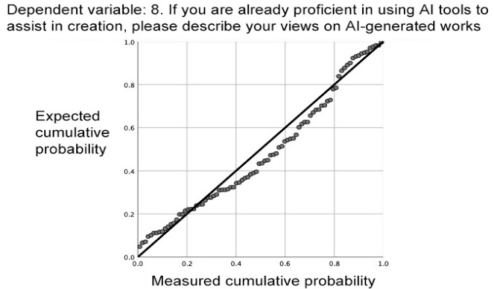
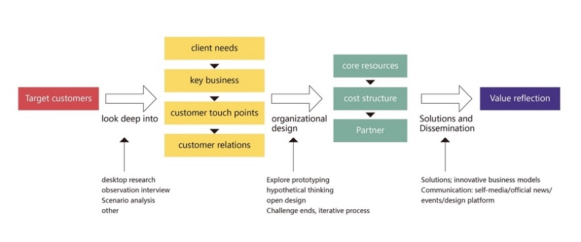
Generative AI Sustainable Business Model Based on the comparative analysis of domestic and foreign sustainable business model cases and literature, this paper attempts to design a sustainable business model suitable for generative AI in China. Since the late 1990s, due to the shortage of resources, the shortening of product and technology cycles, and the development of the globalization process, the design-driven innovation method has gradually grown, and enterprises have begun to focus on user needs (Hribar M Š, Bole D, Pipan, P2015). This study takes the business model canvas proposed by Ostwald Pinel (2009) as the theoretical basis of the study, and semantically replaces the various elements related to the entire business model with the user as the center, sorts the effect time and importance of different elements of generative AI, and uses a linear structure to present the relationship between users and elements (see Figure 3). To build a sustainable business model for generative AI, we first need to determine the main reasons that prompt users to purchase and use generative AI. This study automatically screened out influential variables through a stepwise regression model to determine the decisive factors that affect user purchase and use, such as whether they have used generative AI and their views on AI-generated works. This data regression first sets the dependent variable as: “1. If you are already proficient in using AI tools to assist in creation, please describe your views on AI-generated works”, and sets 6 independent variables (respectively: 2. What industry are you in? 3. Have you used AI tools to assist in creation? 4. What are the main AI tools you have used? 5. What do you use AI tools for? 6. What are your favorite features of AI tools?). Import it into SPSS for linear regression analysis. Statistics setting, estimated values of regression coefficients, model fitting and DW value (Durbin-Watson) to test the goodness of fit of the model and whether there is autocorrelation in the residuals. First, observe the normal P-P plot of the standardized residuals. It can be seen that the data are concentrated on a straight line, indicating that the data residuals follow a normal distribution and meet the assumptions of stepwise regression analysis (see Figure 2).
Figure 1: Normal P-P plot of regression standardized residuals (Zhai Cuiping, Huxin, 2024).
1678 Cuiping and Xin
From the input/removed variable table, we can see that this stepwise regression analysis has two inputs or removals (see Table 4). The adjusted R-square of Model 2 is relatively high, indicating that the model has a relatively good fit (see Table 1).
Model Variables Entered Variables Removed 1 7. How do you evaluate the impact of AI tools on creators?
. Step (condition: probability of F to be input <=.050, probability of F to be removed >=.100). 2 3. Have you ever used AI tools to assist in creation?
. Step (condition: probability of F to be input <=.050, probability of F to be removed >=.100).
a Dependent variable: 8. If you are already proficient in using AI tools to assist in creation, please describe your views on AI-generated works
Table 2. Model summary c(Zhai Cuiping, Huxin, 2024).
a Predictor variable: (constant), 7. How do you evaluate the impact of AI tools on creators? b Predictor variable: (constant), 7. How do you evaluate the impact of AI tools on creators?, 3. Have you ever used AI tools to assist in creation? c Dependent variable: 8. If you are already proficient in using AI tools to assist in creation, please describe your views on AI-generated works
In the ANOVA analysis, the significance value of the two stepwise regression models is 0.00 and less than 0.05, which means that there is a 95% probability of rejecting the null hypothesis. In other words, there is a significant difference between the independent variables and the dependent variables in each equation. Correlation (see Table 3).
Table 3. ANOVAa(Zhai Cuiping, Huxin, 2024).
Table available in the original PDF paper.
F Significance
Model Sum of Square Degrees of Freedom
Mean Square 1 Regression 31.321 1 31.321 23.026 .000b Residual 114.261 84 1.360 Total 145.581 85 total 2 Regression 38.967 2 19.483 15.168 .000c Residual 106.614 83 1.285 total 145.581 85
a Dependent variable: 8. If you are already proficient in using AI tools to assist creation, please describe your views on AI-generated works b Predictor variable: (constant), 7. How do you evaluate the impact of AI tools on creators? c Predictor variable: (constant), 7. How do you evaluate the impact of AI tools on creators?, 3. Have you used AI tools to assist creation?
Sustainable Business Model Design for Generative AI 1679
From the above analysis, we know that the two equations obtained by the stepwise regression analysis in this example are both significant, and from the perspective of the goodness of fit of the model, equation 2 has a better goodness of fit (see Table 4). According to the coefficient test results, the constant coefficient of Equation 2 is not significant, so its stepwise regression equation can be written as follows based on the B value of the unstandardized coefficient: Equation 2 = 8. If you are already proficient in using AI tools to assist creation, please describe What are your views on AI-generated works = 0.249*7. How do you evaluate the impact of AI tools on creators? +0.210* 3. Have you ever used AI tools to assist creation?
Table 4. Coefficient a(Zhai Cuiping, Huxin, 2024).
Table available in the original PDF paper.
Unstandardized Coefficients
Standardized Coefficients Beta t Significance Model B Standard Error
.294 .061 .464 4.798 .000
1 (constant) 2.263 .210 10.778 .000 7. How do you evaluate the impact of AI tools on creators?
.249 .062 .393 3.996 .000
2 (constant) 1.655 .322 5.140 .000 7. How do you evaluate the impact of AI tools on creators?
.210 .086 .240 2.440 .017
3. Have you ever used AI tools to assist in creation?
a Dependent variable: 8. If you are already proficient in using AI tools to assist in creation, please describe your views on AI-generated works
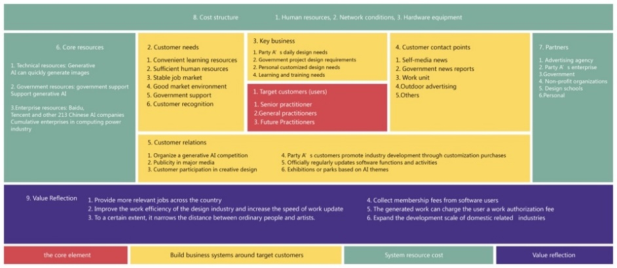
The data proves that the hypothesis of this study is valid, that is, the decisive factors affecting users’ purchase and use are whether they have used generative AI and their views on AI-generated works. The reasons for this phenomenon may be: first, only users who have used generative AI software can maintain an open attitude towards its powerful functions and promote subsequent long-term purchase and use; second, only users who have used generative AI software can maintain an open attitude towards its powerful functions and promote subsequent long-term purchase and use. Only users who maintain a positive attitude towards AI-generated works can further promote purchases and usage. Therefore, the generative AI industry can design products around users to make AI-generated works more perfect and promote a positive view of potential users, thereby expanding the user base. Based on this result, the content of the business model is improved (see Figure 3). Among them, the red module represents the core of the entire business model. The O2O business system built around core customer needs is represented by the yellow module. The green module is composed
1680 Cuiping and Xin
of resources and costs in the business model. The purple module is the embodiment of the value of the entire business model (see Figure 4).
Figure 2: Innovative structure of generative AI business model (Zhai Cuiping, Huxin, 2024).Figure 3: Content of generative AI business model (Zhai Cuiping, Huxin, 2024).
CONCLUSION
The contribution of this paper is to design a sustainable business canvas for generative AI based on user needs, which can fill the gap in this field. Based on the survey results of the above three types of users, a classification experiment was conducted on the creative process of generative AI, and the hypothesis was as follows: good creative AI painting = artist’s imagination and basic painting skills + accurate natural language descriptors + AI rapid drawing production. Therefore, building a generative AI sustainable business model can be based on balancing the relationship between AI generation and humans, designing with user needs as the center, and using stepwise regression models to analyze and verify to determine the two factors that promote user use and purchase. The decisive factors are the views on generative AI works and whether they have used generative AI: only users who maintain a positive attitude towards the works generated by generative AI can promote their purchase and use. Only users who have used generative AI software can Maintain an open attitude towards its own powerful functions to promote
Sustainable Business Model Design for Generative AI 1681
subsequent long-term purchase and use; based on this result, use the business model canvas proposed by Ostwald Pinel (2009) as the theoretical basis of the research, based on the user Semantically replace the various elements related to the entire business model as the center, sort the role time and importance of different elements of generative AI, and use a linear structure to present the association between users and elements, based on the user Demand drives business model innovation, builds business systems around target users, integrates existing resources of generative AI, and drives continuous iteration and innovation at all levels such as product design, service model, and user experience based on customer (user) needs, thereby Promote the sustainable development of generative AI in China.
But this study also has some limitations. First of all, from a research perspective, this study is only a series of studies centered on user needs. It does not involve other perspectives such as universities, governments, enterprises, etc., and may not be comprehensive enough. Future research can increase research perspectives. Secondly, in terms of direction, this research is a bottom-up research method. In the future, researchers can try research in various directions, such as top-down or horizontal research in similar departments.
In short, we hope that more and more researchers can pay attention to this field, promote a virtuous cycle in the fields of interest related to generative AI, and promote the sustainable development of generative AI.
ACKNOWLEDGMENT
The authors would like to acknowledge.
REFERENCES
Ali Elfa MA, Dawood ME T. Using Artificial Intelligence for enhancing Human Creativity [J]. Journal of ARrt, Design & Music, 2023, 2(2):3. Bellaiche L, Shahi R, Turpin M H, et al. Humans versus AI: whether and why we
prefer human-created compared to AI-created artwork[J]. Cognitive Research: Principles and Implications, 2023, 8(1): 42. Baldassarre, B., Keskin, D., Diehl, J. C., Bocken, N., & Calabretta, G. (2020). Implementing sustainable design theory in business practice: A call to action. Journal of cleaner production, 273, 123113. Caires, C. S., Estadieu, G., & Olga Ng Ka Man, S. (2023). Design Thinking Methodology and Text-To-Image Artificial Intelligence: A Case Study in the Context of Furniture Design Education. In Perspectives on Design and Digital Communication IV: Research, Innovations and Best Practices (pp. 113–134). Cham: Springer Nature Switzerland. Cao Yuan, He Renke, Zhang Jun (2019). Design practice of Ya’an sandware business
model oriented towards sustainability. Packaging Engineering. 2019, 40(06): 206–212. Chen Ruoxuan, Zhang Chi (2023). Hot spots and trends in sustainable design research based on bibliometrics - a survey centered on “Design and Culture”. Design and Design History Research. pp. 89–94.
1682 Cuiping and Xin
Chen Xinghai, He Renke, Yang Huan (2014). Research on business model innovation system under design thinking - taking MIUI as an example. Decoration. (08) Pages 80–82. Chen, Yongwei (2023). Beyond ChatGPT: Opportunities, risks and challenges of
generative AI[J]. Journal of Shandong University (Philosophy and Social Sciences), 2023(3): 127–143. Chen Guoqiang, Xu Li, Yu Lei, Tu Weilong, Yang Zhiwen. A review of the current status and development trend of design evaluation of Chinese artificial intelligence products [J]. Packaging Engineering. 2023, 44(12) Cobb P J. Large Language Models and Generative AI, Oh My!: Archaeology in
the Time of ChatGPT, Midjourney, and Beyond[J]. Advances in Archaeological Practice, 2023, 11(3): 363–369. Dehouche, N.; Dehouche, K. What’s in a text-to-image prompt? The potential of stable diffusion in visual arts education. Heliyon 2023, 9, e16757. [Google Scholar] [CrossRef]. Harsha Gangadharbatla. The Role of AI Attribution Knowledge in the Evaluation
of Artwork[J]. Empirical Studies of the Arts, February 16, 2021. Jonathan Wernersson, Rickard Persson Persson, R., & Wernersson, J. (2023).
Exploring the potential impact of AI on the role of graphic content creators: Benefits, challenges, and collaborative opportunities. Kayla Yup, What AI art means for society, according to Yale experts[J].yale news, 2023, 1. Kim, Y. K., & Sullivan, P. (2019). Emotional branding speaks to consumers’ heart:
the case of fashion brands. Fashion and textiles, 6(1), 1–16. Kurian, N., Cherian, J., Sudharson, N.et al. AI is now everywhere. Br Dent J 234, 72, 2023, 1. Li Jie (2023). Sustainable design: leading the future design trend. China Academic
Journal Electronic Publishing House. Persson R, Wernersson J. Exploring the Potential Impact of AI on the Role of Graphic Content Creators: Benefits, Challenges, and Collaborative Opportunities[J]. 2023. Phillips, Connor. (2024). Jiao, Junfeng; Clubb, Emmalee. Testing the Capability of AI
Art Tools for. Urban Design. (2024); IEEE Computer Graphics and Applications, 44 (2), pp. 37–45. Svanes, E., Vold, M., Møller, H., Pettersen, M. K., Larsen, H., & Hanssen, O.
J. (2010). Sustainable packaging design: a holistic methodology for packaging design. Packaging Technology and Science: An International Journal, 23(3), 161–175. Tan Ping. New opportunities for painting in the era of artificial intelligence [J]. Art Observation, 2023, (08): 11–12. Xu Jiachen. He enables humans to draw with computers and completely creates a
new world [EB/OL]. Excellent Design, Design Articles, 2017 Wahid, R., Mero, J.and Ritala, P. (2023), “Editorial: Written by ChatGPT, illustrated by Midjourney: generative AI for content marketing”, Asia Pacific Journal of Marketing and Logistics, Vol. 35 No. 8, pp. 1813–1822. Wahid, R., Mero, J.and Ritala, P. (2023), “Editorial: Written by ChatGPT, illustrated
by Midjourney: generative AI for content marketing”, Asia Pacific Journal of Marketing and Logistics, Vol. 35 No. 8, pp. 1813–1822. Wang Wenfeng, Zhang Rong. Application of intelligent technology in interactive design painting design and research on its creation mechanism [J]. Packaging Engineering, 2022, (S1): 89–95.
Sustainable Business Model Design for Generative AI 1683
Wu Hongliang, Fei Jun, Tang Keyang, Gou Mengyuan. Painting in the AI era: Are artists the last line of defense between humans and machines? [J]. Art Observation, 2023, (8): 05–10. Yin, Hu, Zipeng Zhang, and Yuanyuan Liu. 2023. “The Exploration of Integrating
the Midjourney Artificial Intelligence Generated Content Tool into Design Systems to Direct Designers towards Future-Oriented Innovation” Syst. Yang Yuhe. The evolution, influence and speculation of AI painting [J]. Media, 2023, (9): 52–55.
LISTED IN THE AHFE DIGITAL BOOKSTORE CATALOGUE
Explore the complete digital volume
Human Factors in Design, Engineering, and Computing
Read this individual research paper free through the original publisher, or explore the full digital proceedings book.
ISBN 978-1-964867-35-9
Explore this ISBN in the AHFE Bookstore ↗Listed in the July 2026 bookstore catalogue; search by ISBN to confirm current availability · Digital book purchase optional