Yi Jing Wang, Xin Hu (2024). Exploring the Impact of Artificial Intelligence Generated Content (AIGC) on Game Design and User Experience. In: Human Factors in Design, Engineering, and Computing. AHFE Open Access, vol. 159, pp. 129–138. https://doi.org/10.54941/ahfe1005575
With the rapid development of artificial intelligence-generated content (AIGC) technology, the gaming industry is undergoing major changes. This study explores the application of AIGC in game design and analyzes its impact on art, music, text, interaction and user experience. The innovation of this study is the integration of AIGC to enhance the creativity, quality, and interactivity of game design while proposing solutions to current industry challenges. This study uses methods such as literature review, case analysis, and user surveys to evaluate the effectiveness of AIGC by comparing traditional and AIGC-enhanced game design methods. Follow user-centered design principles and analyze data from case studies, user questionnaires, and designer feedback to identify key issues in user experience. The results show that AIGC significantly increases user engagement by creating personalized, immersive experiences and provides new development opportunities for the gaming industry. In summary, AIGC technology has demonstrated the potential to revolutionize game design by solving creative and technical challenges, paving the way for future innovation and prosperity in the gaming industry.
With the rapid development of information technology such as the Internet, big data computing and artificial intelligence, artificial intelligence-generated content (AIGC) is gradually coming into public view. This emerging technology has not only had a profound impact on the future of the web and media, but also set off a huge wave of change in the field of game design. AIGC has developed rapidly with its multi-modal, high degree of freedom, low operational difficulty and other characteristics, bringing new creative tools and ways of thinking to game development. In this new revolution in game design, game designers face significant challenges and opportunities. They need to re-examine their role to accommodate the rise of AIGC technology. Compared with traditional game design methods, the emergence of AIGC technology provides game designers with a broader creative space and more diversified creative ways. Game designers are no longer working alone, but working with AIGC technology to explore new ideas and innovative ways of designing games.
DEVELOPMENT STATUS AND TRENDS OF AIGC TECHNOLOGY Artificial intelligence generated content (AIGC) is a new production method that uses artificial intelligence technology to automatically generate content after professional generated content (PGC) and user generated content (UGC). With the improvement of deep learning models and the popularization of open source models, AIGC technology has developed rapidly, covering multimodal content services such as interactive virtual people, AI painting, text generation and sound cloning, bringing new technical support to the traditional game industry.
At present, AIGC technology is developing rapidly, thanks to breakthroughs in deep learning and multimodal technology. The AIGC market size is rapidly expanding, providing creators with efficient creation tools, while bringing huge business opportunities and economic value to related industries. The AIGC industry ecosystem is in an explosive period, and the generated content covers various forms such as text, images, and videos, promoting the emergence of new applications such as automated creation and virtual reality.
AIGC technology is accelerating the lead of multiple industries into a new era of AI, especially in the digital cultural industry. In the next few years, the application of AIGC in media, e-commerce, film and television, and entertainment will become more mature, and the market size is expected to reach US$110 billion. AIGC not only promotes the development of chatbots and virtual humans, but also plays a key role in the construction of the metaverse, bringing more intelligent, interactive and personalized experiences to game design, and bringing more possibilities to game design.
APPLICATION OF AIGC IN EMPOWERING GAME DESGIN AIGC (artificial intelligence generated content) is widely used in game design, improving the efficiency from creativity to implementation. AIGC technology provides strong support in text, images, music and special effects. For example, text generation tools such as ChatGPT can assist in game script creation, and image generation tools such as Midjourney can lower the threshold of art and improve the efficiency of visual creativity. In addition, AIGC has also demonstrated its potential in sound and special effects generation, and automated testing has further improved the quality of games and user experience.
The advancement of AIGC technology has made it possible for NPCs (non-player characters) in games to interact intelligently. Intelligent NPCs can break the limitations of traditional fixed scripts and provide a more free and realistic interactive experience. This not only enhances the immersion of the game, but also enriches the player’s experience. AIGC technology can support the real-time generation of interactive plots, making each player’s gaming experience more unique and personalized.
AI technology also plays a key role in anti-cheating and marketing of games. For example, advanced AI anti-cheating technology can accurately detect improper behavior and ensure the fairness of the game. In terms of marketing, AIGC technology accurately locates target users through data
Explore the Impact of Artificial Intelligence-Generated Content (AIGC) 131
analysis, optimizes delivery strategies, reduces costs, and improves ROI. At the same time, AIGC is also involved in the generation of creative content, such as providing inspiration for game fashion design, enhancing players’ sense of participation and the market appeal of the game.
CONSTRUCTION OF GAME DESGIN USER EXPERIENCE MODEL BASED ON AIGC TECHNOLOGY With the rapid development of artificial intelligence generated content (AIGC) technology, the game industry has ushered in a new revolution. User experience (UX), as a key factor in improving the attractiveness of game products and user satisfaction, has become an important part of game design. This study aims to build a user experience model for game design based on AIGC technology, and to reveal its multi-faceted impact on user experience by deeply analyzing the application of AIGC technology in game design.
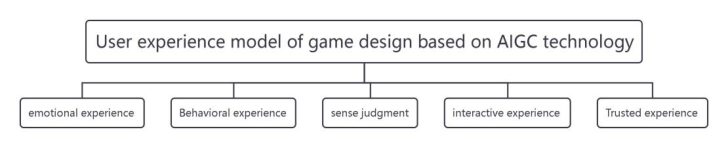
User experience refers to the overall psychological feeling of users in the process of using products or enjoying services, covering multiple aspects such as emotions, cognition, and behavior involved in the process of interacting with products, programs or systems. In order to comprehensively evaluate the impact of AIGC technology on game user experience, the user experience model constructed in this study includes five first-level elements: emotional experience, behavioral experience, sensory experience, interactive experience, and credible experience. These elements respectively contain several second- level elements (see Table 1), such as immersion and emotional resonance in emotional experience, and operational convenience and response speed in behavioral experience.
In the literature review, we draw on previous research on user experience, including Schmidt’s user experience evaluation system, which analyzes the composition of user experience from the perspectives of senses, emotions, thinking, behavior, and association. At the same time, we also referred to the research results of other scholars on game user experience, especially in terms of game storytelling, expectations, rhythm, immersion, attractiveness, usability and challenge. These literatures provide a theoretical basis for our model, making it more scientific and applicable.
This study evaluates the effect of AIGC technology in practical applications by comparing traditional game design methods with application cases of AIGC technology. We follow the principles of user-centered design (UCD) and divide users into four categories according to their age and needs: children, teenagers, adults and the elderly. We also collect feedback from game designers and players through questionnaires and focus group discussions. The survey results show that AIGC technology performs well in improving the personalization and immersion of game content, and significantly improves user engagement and satisfaction.
Finally, the user experience model constructed in this study not only provides a systematic framework for game designers to help them make full use of the advantages of AIGC technology, but also provides new ideas and methods for solving the challenges in the current field of game design.
132 Yijing and Xin
Through this model, we hope to promote innovation and development in the game industry and create a more colorful and engaging game experience.
Figure 1: Game design user experience model based on AIGC technology.Table 1. Elements of a user experience model for game design based on AIGC technology.
Table available in the original PDF paper.
Element Description
Primary Element
Secondary Element Emotional Experience immersion Use AIGC to generate high-quality graphics, sound and plot, allowing players to deeply immerse themselves in the game world and feel the integration of the real and the virtual. Personalized emotional resonance
AIGC dynamically adjusts plot and character interactions based on player choices and behavior to produce personalized emotional experiences. Challenge and achievement
Through the AIGC dynamically adjust the difficulty of the game, provide moderate challenges, so that players continue to progress in the game and get a sense of accomplishment. Narrative experience
AIGC generates unique storylines and developments that allow players to feel deep storylines and emotional resonance. Emotional arousal
Through the elements such as plot inversion and tense moments generated by AIGC, it can stimulate players’ emotional responses and enhance the emotional depth of the game. Behavioral Experience
Dynamic content generation AIGC dynamically adjusts the game difficulty to suit the needs of different types of players based on their skills and performance.
AIGC generates a rich variety of missions, enemies, and scenarios to keep the game fresh and challenging. Intelligent difficulty adjustment Customize roles and equipment AIGC offers a highly customized selection of characters and equipment to meet the preferences and personalization needs of different players. Diversified play AIGC offers a variety of game modes and gameplay options, such as competitive, cooperative, exploration, etc., to meet the interests and needs of different players. Learning and adaptation
AIGC dynamically adjusts game content and strategies by learning from player behavior and strategies to make the game experience more targeted and personalized. Sensory Experience
Visual effects AIGC produces high-quality images and animations that provide visual enjoyment and immersion. Sound effects and music
AIGC generates sound effects and music that match the context of the game to enhance the emotional atmosphere and sense of engagement with the game.
(Continued)
Explore the Impact of Artificial Intelligence-Generated Content (AIGC) 133
Table 1. Continued
Table available in the original PDF paper.
Element Description
Primary Element
Secondary Element In a VR/AR environment, AIGC generates interactive content that enhances immersion and interactivity.
Virtual reality and augmented reality integration Multi-sensory Integration AIGC uses multi-sensory technologies such as haptic feedback, smell, etc., to enhance the sensory experience of the game and provide richer sensory stimulation. Interactive Experience
AIGC supports natural language processing to make in-game dialogue more intelligent and natural.
Natural Language interaction Situational response AIGC dynamically adjusts NPCS and environments based on player behavior and game context to provide a responsive interactive experience. Multi-player interaction
AIGC supports personalized multi-player interaction experiences to enhance the depth and quality of social interactions. Real-time feedback
AIGC provides real-time game feedback and advice to help players better understand and master the game content. Multi-platform support
AIGC supports seamless interaction across multiple platforms (e.g. PC, mobile, VR devices) to enhance cross-platform experiences. Trusted Experience
Data privacy and security
AIGC ensures the privacy and security of player data, enhancing trust. Fairness and transparency The AIGC detects and prevents cheating and ensures a fair gaming environment.
AIGC ensures that the rules and mechanics of the game are fair and transparent, so that players do not feel unfair. Anti-cheating and security measures Transparent data use AIGC clarifies how and for what purpose player data is used, ensuring players’ right to know and data sovereignty. Continuous Improvement
AIGC continuously improves and optimizes game content and experience based on player feedback and data analysis.
STUDY DESIGN AND CONDUCT Questionnaire Design and Pre-Survey
In order to ensure the comprehensiveness and effectiveness of the user experience model of game design based on AIGC technology, the author designed a comprehensive research method that combines expert discussion and questionnaire survey methods. In order to determine the user experience evaluation dimensions and characteristics of AIGC technology in game design, a preliminary evaluation model was constructed. Eight industry experts from the fields of game design and AIGC were invited to participate. They came from well-known game companies and academic institutions, aged between 33 and 45 years old, and had rich industry experience and innovation capabilities. Through online group discussions and brainstorming meetings, experts discussed the application of AIGC technology in game design and its impact on user experience. Finally, the main evaluation dimensions and components of AIGC game design were summarized. Before the formal survey, a Likert five-level scale questionnaire containing preliminary evaluation dimensions and characteristics was designed and distributed to 30 college students from the City University of Macau for a
134 Yijing and Xin
pre-survey. Based on the pre-survey, the questionnaire was optimized and revised to form the final questionnaire. The questionnaire contains 24 user experience elements, covering the key dimensions in game design.
Data Acquisition and Sample Description During the formal survey, a total of 155 questionnaires were distributed and 139 valid questionnaires were collected. The survey subjects covered four groups: children, teenagers, adults and the elderly, and collected data on their gaming experience, gaming time and gaming preferences. Among them, there were 85 male users and 54 female users, with a male ratio of 61.15% and a female ratio of 38.85%. Age distribution: Children (0–12 years old): 15 people, accounting for 10.79%; Teenagers (13–17 years old): 40 people, accounting for 28.78%; Adults (18–59 years old): 75 people, accounting for 53.96%; Elderly (60 years old and above): 9 people, accounting for 6.47%. Game experience distribution (years): No game experience: 10 people, accounting for 7.19%; 1 year or less: 30 people, accounting for 21.58%; 1–3 years: 50 people, accounting for 35.97%; 3–5 years: 35 people, accounting for 25.18%; More than 5 years: 14 people, accounting for 10.07%
Data Analysis As shown in Table 2, the Cronbach’s Alpha of each factor in the questionnaire data of this study is above 0.8. The Cronbach’s Alpha value of the total scale is 0.932>0.7, indicating that the reliability is very high, that is, the reliability of the questionnaire data is very high.
Table 2. Questionnaire reliability test.
Table available in the original PDF paper.
Variable Cronbach’s Alpha Number of Terms Emotional experience 0.85 5 Behavioral experience 0.88 5 Sense judgment 0.83 4 Interactive experience 0.87 5 Trusted experience 0.82 5 Total schedule 0.86 24
Factor Analysis This factor analysis aims to identify the potential common factors in the game design user experience questionnaire based on AIGC technology, and analyze the influence of each factor on its corresponding user experience elements. The principal component analysis (PCA) method is used to extract common factors, and factors with eigenvalues greater than 1 are selected. The cumulative variance contribution rate is 68.74%, indicating that these five common factors can explain most of the variance in the questionnaire.Factor naming and explanation:
Explore the Impact of Artificial Intelligence-Generated Content (AIGC) 135
1. Emotional experience (Factor 1) Main load variables: Emotional resonance, immersion, satisfaction, user emotions, emotional investment.
Naming reason: These variables together describe the emotional state and psychological feelings experienced by users during the game, so they are named emotional experience.
2. Behavioral experience (Factor 2) Main load variables: User behavior habits, control convenience, reaction speed, game mechanism, operation fluency.
Naming reason: These variables mainly involve the actual operation and behavior performance of users in the game, so they are named behavioral experience.
Reason for naming: These variables involve the user’s trust in the gaming platform, hence the name Trusted Experience.
Table 3. Factor load analysis.
Table available in the original PDF paper.
Divisor Loading Value Divisor Loading Value Emotional resonance 0.78 Environmental Settings 0.79 Immersion 0.76 Picture definition 0.77 Satisfaction 0.75 Interaction 0.85 Emotion 0.74 Feedback speed 0.83 Engagement 0.72 User engagement 0.80 User behavior 0.82 User social 0.78 Ease of control 0.80 Multi-player interaction 0.76 Reaction speed 0.79 Security 0.79 Game mechanics 0.77 Privacy protection 0.77 Fluency 0.75 Trust 0.76 Visual effects 0.84 Transparency 0.74 Sound effects 0.81 Fairness 0.72
According to the data in Table 3, the total variance of the variables explained by factor analysis can show the contribution of each component to the overall experience. Since the first factor explains the most total variance of the original variables, followed by the second factor, it can be concluded
136 Yijing and Xin
that the importance of game players to the user experience elements of game design based on AIGC technology is in the following order: emotional experience, behavioral experience, sensory experience, interactive experience, and reliability experience.
From the factor loading values of each variable in factor analysis, it can be seen that the influence of each factor on the corresponding common factor, namely the user experience element, is ranked from large to small as follows: emotional experience - emotional resonance, immersion, satisfaction, user emotions, emotional investment; behavioral experience - user behavior habits, control convenience, reaction speed, game mechanism, operation fluency; sensory experience - visual effects, sound effects, environmental settings, picture quality clarity; interactive experience - interaction mode, feedback speed, user participation, user social interaction, multi-player interaction; reliability experience - security, privacy protection, credibility, transparency, fairness.
CONCLUSION
This article explores the impact of artificial intelligence generated content (AIGC) on game design and user experience. By analyzing the current development trends of AIGC technology and its application in game design, the study found that AIGC technology has significantly improved game creativity and development efficiency. AIGC can not only automatically generate high-quality images, text and sound effects, but also dynamically adjust game content and difficulty to provide a personalized and immersive gaming experience.
In terms of user experience, AIGC technology significantly enhances the emotional resonance, behavioral experience, sensory experience, interactive experience and credible experience of the game. These improvements include:
1. By generating personalized storylines and character settings, AIGC can trigger deeper emotional resonance and involvement in players. Immersion and emotional resonance are key factors in the emotional experience, greatly improving the overall user satisfaction.
2. AIGC technology optimizes user operation behavior and response speed. Intelligent interface design and interaction methods make it easier for players to learn and master game operations, slowing down the steepness of the learning curve. Operation convenience and response speed are the most important influencing factors in behavioral experience.
3. AIGC technology provides a wealth of materials in terms of visual and auditory senses, greatly improving the artistic expression of the game. The quality of visuals and sound effects enhances player immersion and sensory enjoyment.
4. AIGC technology enhances the interactivity of the game, making the interaction between players and the game world more dynamic and interesting. Real-time generated interactive content and personalized feedback mechanisms improve game playability and user engagement.
5. Although AIGC technology has shown great potential in innovation and creativity and also played an important role in anti-cheating and data privacy
Explore the Impact of Artificial Intelligence-Generated Content (AIGC) 137
protection, increasing players’ trust in the fairness and security of the game. However, improvements still need to be made in data security and privacy protection. Security and privacy protection are key factors in a trustworthy experience and directly affect users’ trust in the game.
In short, AIGC technology brings new possibilities and challenges to game design. It not only promotes the diversity and innovation of game content, but also improves player participation and satisfaction. In the future, with the continuous development of AIGC technology, it is expected that its application in the game industry will be further expanded, promoting the overall improvement of the game experience.
ACKNOWLEDGMENT
We would like to thank all the experts and students who participated in this study. Their valuable comments and feedback were crucial to the completion of the study. Special thanks to the School of Innovation and Design of City University of Macau for their support and resources. In addition, we are also grateful to all anonymous reviewers and peers whose suggestions helped us improve the quality of the article. Finally, we thank our family and friends for their support, who gave us great encouragement during the research process.
REFERENCES
Cao Lei & Yu Jianhong. (2023). Innovative application of AIGC technology in film digital creation and production platform. Journal of Beijing Film Academy (11), 80–91. Gong Yunan & Bo Yihang. (2024). Research progress and application analysis
of AIGC technology to create three-dimensional digital content. Modern Film Technology (02), 26–34. Hu Xiaomeng. (2023). AIGC technology and industrial ecology usher in the fast lane of development. Digital Economy (03), 40–45. Li Mingxuan & Wen Jirong. (2023). Legal governance of network information
content in the AIGC era - taking the large language model as an example. Journal of Beijing Institute of Technology (Social Sciences Edition) (06), 83–92. Wang Zhishan. (2024). Script-killing games open up new online business opportunities. Business Observation (06), 6–9. Wang Jianing & Chen Weidong. (2024). Research on game design under AIGC empowerment. Beauty and Times (Part 1) (03), 117–119. Wang Qining, Zhang Chengchen, Li Zixi & Wei Yangyang. (2024). Opportunities
and challenges of agricultural e-commerce content marketing under the AIGC model. China Collective Economy (07), 82–85. Xu Bingtao & Lin Xiaoyong. (2024). Application status and practical path of AIGC driving the digital transformation of mainstream media. Audiovisual World (01), 28–33. Xu Xuechen, Tian Kan & Li Wenjun. (2023). New generation of artificial intelligence
technology (AIGC): development and evolution, industrial opportunities and prospects. Industrial Economic Review (04), 5–22. Zhai You & Li Juan. (2022). Thinking about the development path of AIGC: the popularization of large model tools brings new opportunities. Internet World (11), 22–27.
Deep integration: AIGC leads the intelligent transformation of media. Radio and Television Network (11), 9–18. Zhan Xini, Li Baiyang & Sun Jianjun. (2023). Scenario-based application and development opportunities of AIGC in the digital intelligence integration environment. Library and Information Knowledge (01), 75–85+55. Zhai You. (2022). Is AIGC the next outlet for artificial intelligence? Zhangjiang Science and Technology Review (05), 8–11. Zhao Zizhong, Guo Xiaorong, Lu Haibo, Peng Jian & Feng Hongsheng. (2023).
Deep integration: AIGC leads the intelligent transformation of media. Radio and Television Network (11), 9–18.
LISTED IN THE AHFE DIGITAL BOOKSTORE CATALOGUE
Explore the complete digital volume
Human Factors in Design, Engineering, and Computing
Read this individual research paper free through the original publisher, or explore the full digital proceedings book.
ISBN 978-1-964867-35-9
Explore this ISBN in the AHFE Bookstore ↗Listed in the July 2026 bookstore catalogue; search by ISBN to confirm current availability · Digital book purchase optional