Xin Hu, Po Hsun Wang (2024). Virtual Reality in Museum: Exploring the User Experience of Exhibition Narrative. In: Intelligent Human Systems Integration (IHSI 2024): Integrating People and Intelligent Systems. AHFE Open Access, vol. 119, pp. 656–664. https://doi.org/10.54941/ahfe1004530
The exhibition narrative of traditional museums is “artifact- centered”, while the modern virtual museum is “people- centered”. The paper first analyzes the current typical VR narrative cases, summarizes the relevant elements and basic characteristics of virtual space narrative, and finds that there are many similarities with the narrative methods in traditional movies, but the relationship between storytelling in the virtual world and the audience The interactive relationship is closer. How to attract the audience's attention to the exhibits to enhance the VR exhibition experience is particularly important in the narrative design of virtual exhibitions. As we all know, the audience's line of sight in the three-dimensional space is not restricted because the audience has the freedom to distribute the line of sight.This research first confirmed the categories of points of interest that affect attention through expert interviews, including the physical layer, behavioral layer, and application layer of the VR system. Through 57 questionnaires, the behavioral characteristics, and psychological needs of audience for VR exhibition narratives were collected, Sample analyses were also conducted for this. Taking the design of China's virtual cultural relics exhibition as an example, the author mainly uses clues of points of interest in the design space to guide the audience to focus or distract their attention. During the narrative process of the exhibits, it was discovered that the connections between the points of interest are not isolated but have Continuous. Based on the narrative theory of "story and discourse", 7 points of interest were selected to explore the feasibility of point-of-interest narratives from three aspects: type combination, spatial arrangement, and interaction method. By comparing the attention-guiding effects of two different sets of interest points in linear narratives and non-linear narratives in two testing groups, a contextual correspondence between the audience's attention selection and points of interest was established. Through evaluation tests, we found that narrative methods that use points of interest to guide the audience's attention are feasible. Non-linear narratives have more opportunities than single-line narratives, such as increasing the application of interactive methods that guide the audience's attention. The conclusions have certain implications for the narrative design of VR exhibition.
In the context of an exhibition, The interpretation of the exhibition typi- cally forms a relatively self-contained and cohesive system. On the one hand, it is responsible for explaining the meaning of the exhibits to the audience. On the other hand, the exhibition design needs to adopt a relatively hid- den or low-key posture to avoid unnecessary interference with the audience’s appreciation of the exhibits. In traditional museums, the information inter- action between visitors and exhibits is cantered on the exhibits, and the method of information transmission is instilled output. The exhibit infor- mation obtained by the audience is one-sided and scattered. Such a form of display in traditional museums makes the audience feel museum fatigue (Greenhill and Eileen Hooper, 1992). Transmitting the information about exhibits through the ontology of cultural relics is challenging, as it may not perfectly align with the exhibition style. It is necessary to increase the inter- action of multi-dimensional information carriers in response to the needs of the audience, and create information interaction methods of “people and objects”, “objects and objects” and “people and people” (Gengchao et al. 2018).
Virtual Reality in Museum: Exploring the User Experience of Exhibition Narrative 657
Digital technology is a kind of simulation, in which the display is no longer the real objects, digital technology cannot replace the reality (Park, J. O, 2019). With the widespread adoption of 5G, virtual museum exhibition modes have diversified in their forms of expression. Presenting cultural relics through VR narration represents an innovative approach to the display for- mat of virtual museums. John H. Falk’s study of the audience of museums and satisfaction with their identity shows that their selection and enjoyment of the museum experience are based on their perception of thinking about and reinforcing self-concept (Falk, 2016).
Cultural relics have their origins in real-life settings, having once existed in tangible environments. Museum exhibitions typically fall into categories structured along vertical historical contexts, encompassing displays like porcelain exhibitions, jade exhibitions, calligraphy, and painting exhibitions, among others. From such exhibitions, people can see the details of a period of history, but it is difficult to clearly restore the stereo-vivid times at that time. Therefore, modern technology is used to restore the scene, so that inde- pendent cultural relics are no longer individuals, and the narrative mode of the exhibition enables the audience to have a connection with cultural relics.
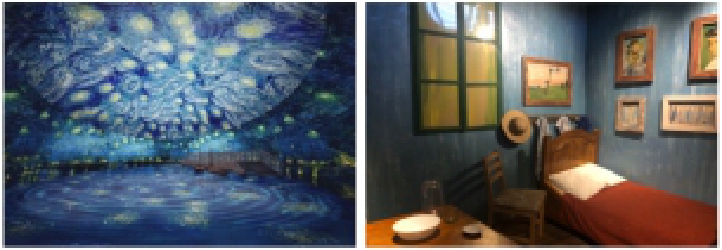
DEVELOPING VR SYSTEMS THE STRUCTURE OF EXHIBITION Virtual museum is a form of museum presented through the Internet and digital technology, which can provide various exhibition forms and interac- tive experiences. However, the display form of virtual museum in 3D does not blindly copy traditional museum exhibitions intact. From the point of view of expression, which are generally divided into three categories accord- ing to exhibition functions. The first category is the virtual exhibition hall, which is the most common form of virtual museum exhibition, simulating the exhibition hall space of a traditional museum. Visitors can browse the virtual showroom via computer or mobile device to view exhibits, panels, artwork and more. Virtual exhibition halls are usually presented through var- ious media such as panoramic pictures, videos, audio and text descriptions, such as the Tsinghua University Museum that has such an online exhibition hall. The second category is 3D model display, which mainly uses 3D mod- elling technology to create realistic object models. Visitors can rotate, zoom in, and zoom out objects in the virtual environment to better observe and understand the details of the exhibits; the third category is virtual reality (VR) exhibition, where audience can enter a completely virtual museum environ- ment by wearing VR where you can browse exhibits, interact and experience virtual exhibit events. For example, the immersive experience exhibition of the National Museum of China-Van Gogh Special Exhibition, through VR technology, The audience can immerse themselves in Van Gogh’s daily life and the iconic painting scenes of his classic works, offering a more immersive museum experience, as show in Figure 1.
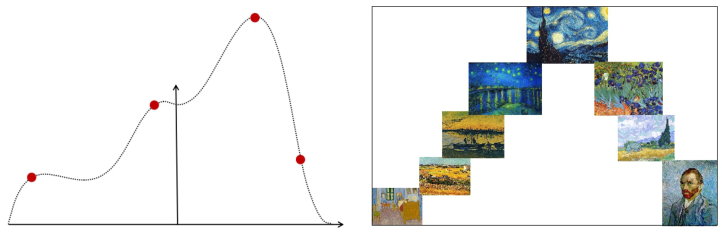
Traditionally, museums form a framework between exhibits and visitors to control the visit process and imply a closely intertwined narrative process (Janet, 2008). This narrative method using time clues is considered to be uni- linear. As the story progresses, paintings at different time points will gradually
658 Xin and Hsun
appear in front of the audience. Although the exhibition at this time is immer- sive, the audience’s experience is passive, the audience cannot skip any work. This VR narrative method is very common in VR exhibitions. The exhibition effect is like the audience watching a movie. There is no interaction between the audience and the exhibits, so the communication between the audience and the exhibits is passive. As shown in Figure 2.
Figure 1: The immersed experience of Van Gogh exhibition.Figure 2: Linear narrative with time as clue.
Whether it is a traditional museum or a virtual museum exhibition, whether it is a small exhibition in a noble family hundreds of years ago or a large-scale exhibition of our time. From the basic elements, it mainly includes: exhibits, exhibition hall, audience and narrative. The so-called narration is to properly handle the relationship between these four elements, in a space, how the exhibits and the audience are connected. Among the four elements of the exhibition, the exhibits, the exhibition hall and the audience are all intuitive. Only the narrative is not intuitive. Its function is to connect the relationship between the first three. As it is not limited to time and space, virtual exhibi- tions will also create more possibilities. The exhibition method has also been redefined.
Theoretical Research on VR Narrative In terms of theoretical basis, VR can be expressed and presented in a variety of multidimensional ways (Lin, Y. C., Wu, K. C., & Tsau, S. Y. 2019). Theories
Virtual Reality in Museum: Exploring the User Experience of Exhibition Narrative 659
related to VR exhibitions are mainly manifested in three aspects: First, immer- sive experience, VR exhibition create an immersive feeling through VR, so that audience are completely immersed in the virtual environment. Immersive experience can provide a more in-depth and realistic perception and emo- tional experience; second, virtual presence refers to the audience’ feeling in the virtual environment, they feel that they exist in the virtual environment rather than the real world. The enhancement of virtual presence can improve participation and cognitive effect on exhibition content; third, interactivity, VR exhibitions usually provide various interactive methods, such as touch, gesture, voice recognition, etc., so that audience can interact with virtual environment in real time.
VR Exhibition in China Taking the exhibition of the Chinese History Museum as an example, we try to design that the interactivity and storytelling of VR are closely related in VR exhibition, interacting and jointly shaping the audience’s experience. Par- ticipation and autonomy, interactivity provides visitors with a higher degree of participation and autonomy. Among the widely used VR game engines, the participation function is a feature of its application in virtual museums (Nina, 2018). Audience can freely choose the elements they are interested in to interact with, explore different angles and paths, and change the dis- play content according to their own wishes, thereby personally shaping their experience.
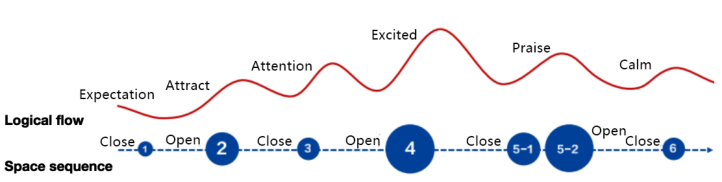
In this practical project, we first broke the linear narrative method men- tioned earlier. The digital advantages of VR exhibitions should be more diverse. Through non-linear narrative methods, the emotional flow of the audience’s viewing experience can be designed. Following the story clues, the spatial functions of the VR exhibition are designed like a non-linear narrative as shown in Figure 3.
Figure 3: Audience emotion flow.
The interactivity of the storyline can drive the development of the storyline. Visitors’ interactions can trigger specific events, plot twists, or messaging that drive the story forward. Visitors’ decisions and actions affect their experience in the virtual environment and the story information they receive. Diverse narrative paths: Interactivity makes storytelling non-linear and diverse. Audi- ence can explore different narrative paths and plot developments according to
660 Xin and Hsun
their own choices and interaction methods and get a personalized story expe- rience. This personalized narrative path can enhance the audience’s sense of investment and participation. Non-linear narrative, non-single clue structure, breaks the single main line mode of linear narrative, and allows multiple or parallel or intersecting narrative clues to appear in VR films. Undoubtedly, the order, distribution, hanging, positioning, or even lighting and wall colours of artworks, in short, the way they are displayed, are the basic prerequisites for them to represent something (David Carrier, 2009).
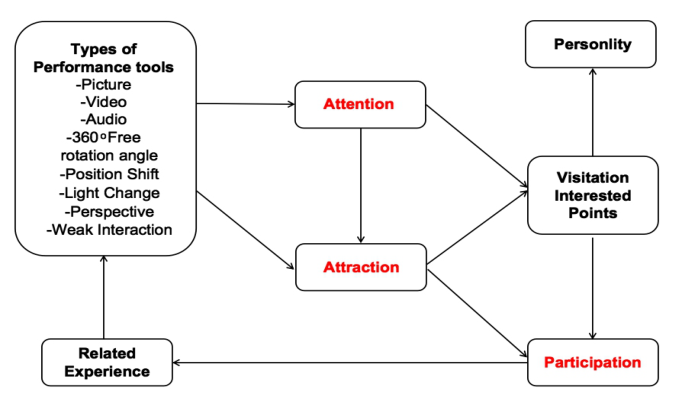
The project selects culture relic’ story clips to discuss the construction of interest points sequence from the combination of arrangement and interest point location. There are many forms of expression that match vision and hearing, such as video, audio, free rotation, etc., as shown in the figure 4. On the interaction axis, systems may be classified in three main categories: “non-interactive”, “using mediated interaction”, “using natural interaction” (Nambisan et al., 2017). The narrative skills in virtual reality are in the pro- cess of exploration, combined with the past narrative cases of the museum, through the arrangement of the location of the points of interest (concentra- tion, dispersion, and overlap), the type of points of interest and the synergy of the layout of points of interest form different points of interest sequence. This is critical to maintaining story continuity and user presence. Different types of interest points have an impact on users’ attention choices due to their varying degrees of guidance.
Figure 4: Application tool set in VR exhibition.
In the storytelling of VR, since users have the freedom to distribute their gaze, they mainly guide users to focus or distract by setting points of interest in the space. If “objects” in museums are revealed from different perspec- tives, “recording”information about different stages of collections is closer to information really needed by museums (Jeffrey et al., 2003). In the panoramic mode, the audience has a freer viewing angle, initiative and choice,As shown in Figure 5. In the VR panorama mode, a core element is that the audience can flexibly choose the viewing angle, so attention guidance is very important. In this study, the VR video content was analysed by qualitative research method. Just as practitioners in the entertainment industries are developing ways of translating and reconfiguring conventions and workflows from games, tele- vision and cinema into this medium, the same process is taking place in the developing field of VR for Culture Heritage (Carrozzino, M and Bergamasco, M, 2010).
Virtual Reality in Museum: Exploring the User Experience of Exhibition Narrative 661
Figure 5: The narrative framework of VR immersive exhibition.
Recruiting participants and experiencing the process, after confirming the demo subjects, we will recruit interview hosts based on the nearest city. Based on the identity information, professionals with VR game experience, VR designers, architects, etc. are avoided. The number of interview sam- ples was determined by the principle of theoretical saturation, and a total of 57 interview data from subjects were obtained. It includes 27 men and 20 women. The age distribution of the sample shows that young and middle- aged people are the main source of samples. The entire interview process was conducted within 15–25 minutes after experiencing the VR exhibition, and the interviewers were recruited through personal recommendations. The interviews were all face-to-face, and the length of a single interview ranged from 10–15 minutes. An interview guide was developed to ensure consistency across participants.
Usability testing refers to end users trying to use a product to complete one or a series of tasks in representative scenarios. Since the number of par- ticipants required for usability evaluation is still controversial (Kathy Baxter, 2017), the number of participants should be greater than the number of ques- tions. We conducted a descriptive statistical analysis of satisfaction on the interview results, and the results are shown in Table 1.
Number Minimum Maximum Average standard deviation Non-Liner Narrative 57 3.64 4.27 3.9818 .17249 Experience Objects 57 3.75 4.17 4.0625 .14109 VR System 57 3.67 4.33 3.9236 .18908 Number of Valid case 57
662 Xin and Hsun
From the results of the descriptive analysis, it can be seen that the average value of VR non-linear narrative is 3.98, which is greater than the average level of 3, indicating high satisfaction with this type of VR narrative. The average value of experience items is 4.06, which is greater than the average level of 3, indicating higher satisfaction with the experience items; the average value of the VR system is 3.92, which is greater than the average level of 3, indicating higher satisfaction with the VR system.
CONCLUSION
The result we can get from the questionnaire is that the multi-narrative approach of the virtual museum has been widely recognized by the users. It gives full play to the huge advantages of VR in terms of exhibition immer- sion experience, cognitive memory enhancement, and visitor interest. 100% of the users experienced an experience that traditional exhibitions cannot achieve. When the audience got the device in their hands, it sparked a lively discussion.
Non-linear narrative means provide museums with more display forms. Compared with linear narratives based solely on time, space, causality, etc., more users believe that exhibits with nonlinear narratives have richer expres- sions. The non-linear narrative method breaks the original single narrative and can display cultural relics more comprehensively, enhance the audience’s interest in the exhibition, and enhance cognitive memory. In a 360-degree free virtual space, the audience can be guided based on a combination of linear narrative and non-linear modules according to narrative needs. This provides more possibilities for diversifying spatial narratives.
In the VR narrative process, linear narrative and non-linear narrative are adopted in parallel, which is more inclusive and everything is possible. The audience thus enters a virtual space with no time limit and is immersed in the narrative context of the cultural relics. Compared with traditional museum narrative methods, 90.8% of respondents believe that VR’s non-linear narra- tive expression method is rich and makes it easier to remember cultural relics information. 9.2% of the audience believed that this narrative method did not enhance their understanding of cultural relic memory.
It is worth mentioning that the combination of linear narrative and non- linear narrative can be summarized as the following three characteristics: First, the exhibition is a 360-degree spatial presentation, the form, size and theme of the exhibits that we usually follow. The exhibition layout is car- ried out in specific spaces, materials, etc. This method breaks the restrictions of chronological order and allows exhibits from different eras, different themes, and different forms of expression to be presented to each other. This is an exhibition focused on the appeal of comparative narrative structures. Secondly, the exhibition can be presented in the form of time. This linear narrative method is also a commonly used presentation method in tradi- tional exhibitions. The linear narrative method is also suitable for virtual exhibitions, but this “time display method” overemphasizes comprehensive linearity. History, it is not recommended to overuse this narrative method in virtual exhibitions, because there is a lack of narrative highlights in the
Virtual Reality in Museum: Exploring the User Experience of Exhibition Narrative 663
interaction with the audience, and it can easily develop into textbook-style preaching. Third, breaking the concept of time and space is the advantage of virtual museums. Non-linear narratives can take advantage of time and space to appropriately explain certain themes and ideas.
In the questionnaire survey, 97.7% of the respondents were able to accept the multiple narrative methods of the virtual museum, while 2.3% of the respondents said they could not accept the non-linear narrative method. They prefer linear narratives because they are relatively simple.
DISCUSSION
In terms of non-linear narrative, the study result shows that the interactive narrative line in the application game interface is more favoured by users than the exhibition narrative line of the traditional museum, which fully shows that the linear narrative form of traditional museums is relatively monotonous and is not suitable for the space of virtual museums. The envi- ronment, the use of non-linear narrative form can stimulate and arouse the interest of the audience, so as to achieve the purpose of paying attention to and participating in the exhibits.
VR narrative is used in the application layer and physical layer of the vir- tual museum respectively. The interaction between the two sets of modes is analysed from the point of view of contacts. One side is how the user commands the system; the other side is how the system provides informa- tion to the user. The friendliness of the human-computer interaction part directly affects audience’s acceptance of the system, and the above two aspects directly determine the friendliness of the human-computer interaction part.
When the exhibition is presented as a complete work and a complete story or a relatively self-sufficient discourse system, it faces the problem of constructing the relationship between the exhibition and the work. When viewing it as a living organism with creative characteristics and ideological connotations, it is also in line with the appeal of the public and humanization of exhibitions advocated by the current era.
During the whole process of the exhibition’s operation, “China Centennial Exhibition” has to some extent out of the curator’s control and has already entered the link of interaction with the audience.
LIMITATION In terms of hardware, in the process of wearing VR equipment, although the audience is positive, but because the current VR equipment is relatively heavy, it will feel uncomfortable to wear for a long time, and some audiences may feel dizzy. According to the questionnaire survey, 55.48% of the audience feel that the equipment is heavy, which limits the rapid development of VR.
ACKNOWLEDGMENT
The authors would like to acknowledge.
664 Xin and Hsun
REFERENCES
Carrozzino, M., & Bergamasco, M. (2010). Beyond virtual museums: Experiencing immersive virtual reality in real museums. Journal of cultural heritage, 11(4), 452–458. David Carrier, (2009). M. Museum Skepticism a History of The Display do Art in
Public Galleries. Jiangsu Fine Arts Publishing House. Falk, John H, (2016). M. Identity and the Museum Visitor Experience, Routledge. Gengchao, liudi, LuQingsong, et al. M. (2018). The Theory and Practice of Museology. China Science. Publishing House. Greenhill, Eileen Hooper, Museums and the Shaping of Knowledge. M. (1992).
Routledge Janet Marstine, (2008). M New Museum Theory and Practice an Introduction. China Fine Ares Press. Jeffrey, Lewis, Zhang Jinping, (2003). The Handling of Museum Collections and the
International Association of Museums, Code of Ethics for Museums. The Journal of China Museum of Communications. pp. 165–172. Kathy Baxter, Catherine Courage, Kelly Caine, M. (2017). Understanding Your Users: A Practical Guide to Research Methods, China Machine Press. pp. 78–80. Nambisan, S., Lyytinen, K., Majchrzak, A., & Song, M. (2017). Digital innovation
management. MIS quarterly, 41(1), 223–238. Nina Simon, (2018). M. Entering an Era of Museum 2.0. China ZheJiang University Press. Park, J. O. (2019). “Subjectivity study on the Form of the Virtual Reality Contents
User Experience”, The journal of Digital Contents Society, 20(2), 395–403.
LISTED IN THE AHFE DIGITAL BOOKSTORE CATALOGUE
Explore the complete digital volume
Intelligent Human Systems Integration (IHSI 2024): Integrating People and Intelligent Systems
Read this individual research paper free through the original publisher, or explore the full digital proceedings book.
ISBN 978-1-958651-95-7
Explore this ISBN in the AHFE Bookstore ↗Listed in the July 2026 bookstore catalogue; search by ISBN to confirm current availability · Digital book purchase optional