Xuan Ding, Xin Hu (2024). Design of a Smart Interactive System for Pet Dogs from the Context-Aware Perspective. In: Human Factors in Design, Engineering, and Computing. AHFE Open Access, vol. 159, pp. 422–431. https://doi.org/10.54941/ahfe1005607
With the constant advancement of technology and social development, the demands for pet dog care have been growing significantly, leading to a pressing need for intelligent and personalized solutions. This article aims to explore a smart proactive interaction system that integrates context-aware theory, designed specifically to meet the daily care needs of pet dogs.At the outset of the research, an exhaustive literature review was conducted to establish a clear understanding of the fundamental concepts and design principles of context-awareness. Subsequently, through in-depth social background research and user interviews, a user journey map was constructed, providing a comprehensive analysis of the daily routines and health requirements of pet dogs. These analyses offered valuable insights into the habits and preferences of both the pets and their owners.Based on these insights, an intelligent system grounded in context-aware principles was developed. This system possesses the capability to monitor the physiological state, behavior patterns, and location information of pet dogs in real-time, while actively offering interactive functional services tailored to the pet's specific needs. Additionally, a complementary application was designed for pet owners, providing precise health monitoring reports, behavioral analysis, and location tracking services. This comprehensive approach ensures that pet owners remain informed about their pet's well-being, while fostering deeper emotional bonds between the pet and its owner.The integration of various interactive features within the system facilitates seamless communication between pets and their owners, promoting not only the physical and mental health of the pets but also enhancing the emotional connection with their owners. This research provides a novel perspective for the design of smart service interaction systems for pet dogs, and serves as a practical reference for the application of context-aware technology in intelligent service systems. It opens up new horizons for future pet care solutions, paving the way for more intuitive and compassionate approaches to pet care.
Research Background With the rapid development of technology and the significant improvement of people’s living standards, pet ownership has become a choice for many households, making pets an essential part of society and families. Among
Design of a Smart Interactive System for Pet Dogs 423
them, pet dogs are a preferred choice for many, due to their lively, loyal, and easily trainable nature, providing great companionship and mental comfort to their owners. According to the “2023–2024 China Pet Industry White Paper (Consumer Report)”, the number of pet dogs in China has reached 52.75 million by 2023, indicating their increasingly important position in households, often considered as members of the family.
The data from the white paper also reveals that pet ownership is mainly among families with children and urban singles, with the post-80s and post- 90s generation being the primary pet owners. These individuals are often characterized by busy work schedules and fast-paced lifestyles, leading to various challenges in caring for their pet dogs, such as difficulty in monitoring their health status, behavioral patterns, and wellbeing when left alone. These issues not only affect the quality of life of pet dogs but may also pose potential threats to their health and safety.
To address these issues, pet-focused smart service systems have emerged, with a plethora of pet interactive systems and apps. These systems integrate various sensors and intelligent algorithms to monitor pet dogs’ physiological parameters, behavioral patterns, and environmental conditions in real-time, and present the information intuitively to pet owners through user interfaces. While providing convenience to pet owners, these systems also exhibit issues such as limited interaction methods, poor user experience, and slow data response processing speed.
Therefore, this study conducts in-depth research on pet dog smart interactive systems from the perspective of context-awareness, aiming to enhance the intelligence level and user experience of these systems. As a crucial support for intelligent interactive systems, context-aware technology can provide personalized services and responses based on the actual needs and contextual changes of pet dogs, further elevating the level of intelligent pet care.
RESEARCH BACKGROUND Enhancing the Level of Intelligence in Pet Dog Smart Interactive Systems
Traditional smart system interaction methods require manual operation by the owner before the system can initiate interactive actions. In the event of unexpected situations, such as the owner’s absence due to travel, work assignments, or forgetting to turn on the system, the system may fail to function properly, thereby affecting the condition of the pet dog. In contrast, a context-aware interactive system can more accurately perceive and understand the real-time status of the pet dog and its surrounding environment, actively initiating interactive actions based on the pet’s behavior to address various situations when the pet is at home. This system provides more intelligent and personalized services by transmitting various data to the owner’s mobile app, allowing the owner to monitor the pet’s real-time status and eliminating concerns about the pet’s wellbeing during unexpected situations.
424 Xuan and Xin
Enhancing the Level of Intelligence in Pet Dog Smart Interactive Systems Due to the increasing demand for pet services among pet owners today, this study will focus on the diverse needs of pet owners in pet dog care, health monitoring, behavior analysis, and other aspects. It aims to design and develop a smart interactive system with corresponding functions to assist pet owners in better understanding and caring for their pet dogs. Recognizing that every pet dog differs in its behavioral habits and daily routines, the smart interactive system will also be capable of adjusting to each pet’s specific characteristics to meet their individual needs, ensuring a satisfactory experience for both pet owners and their pets.
Optimizing the Smart Interactive System and User Interface for Pet Dogs This study aims to delve deeply into how to design more natural and user- friendly interactive methods, as well as more intuitive and easy-to-use user interfaces, in order to enhance the user experience and satisfaction.
DESIGN PROCESS Overview of the Concept of Context-Awareness
Context-awareness refers to the information processing aspect of a user’s contextual cognition (Liu and Yuan, 2005). In the field of design, context- awareness can be defined as a collection of information within a particular context, which dynamically adjusts the interaction of a product to meet the user’s specific needs within that context. The concept of context-awareness was first introduced by Endsley M R in 1988 at the Human Factors and Ergonomics Society Annual Meeting. He proposed that context-awareness is the perception of environmental information in a specific space and making further predictions based on the obtained information (Endsley, 1988). Subsequently, with the continuous development of intelligent computing, Schilit et al. (1994) proposed in 1994 that context-awareness involves computers sensing dynamic changes in the environment, acquiring users’ behavioral information, and utilizing that behavioral information to provide users with services that satisfy their needs (Ding et al., 2024).
The Design Process of Context-Awareness The design process of context-awareness is a core part of the development of smart interactive systems, encompassing multiple stages such as real- time monitoring of pet dogs and their environments, data analysis, and intelligent responses. Junzhong (2009) emphasized that context actually reflects a shift from computer-centricity to human-centricity, dividing context into five parts: computational context, user context, physical context, temporal context, and social context. Other scholars, such as Wolfgang et al. (2005) and others, categorize context types into user-role, process- task, environment, time, and device. Through an analysis of domestic and international literature, we can derive the design process for a smart
Design of a Smart Interactive System for Pet Dogs 425
interactive system for pet dogs. The design process primarily includes preliminary research before context construction, user research, collation and analysis of research data, context construction, and designing product concept prototypes.
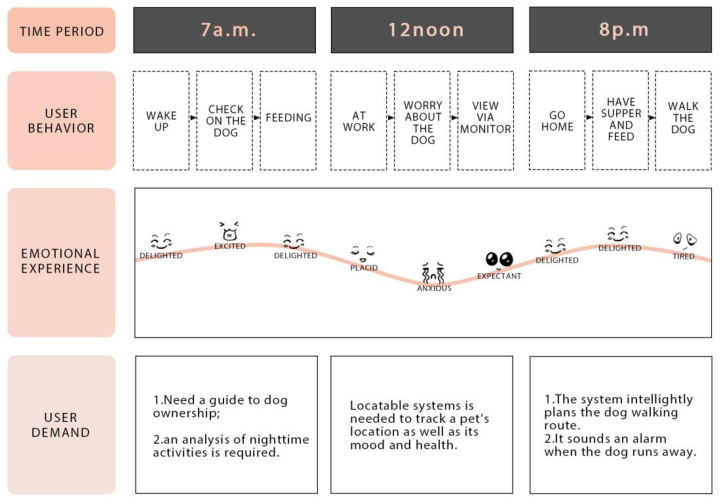
User Journey Map The user journey map of context-awareness is a crucial tool for understanding and describing users’ emotions, behaviors, and experiences during their interaction with a smart interactive system for pet dogs. As shown in Figure 1, the user journey map simulates the possible behaviors and emotional fluctuations of dog owners throughout a day to analyze pain points and design opportunities. Through the user journey map, it can be observed that users tend to feel more at ease and happy during the morning and evening when they are at home. However, during work hours, they experience more anxiety as they cannot monitor their pets’ condition at home anytime, which serves as a major focus of this design study.
Figure 1: User journey map (Drawn by Ding Xuan, 2024).
User Interview Changes in family size, structure, and lifestyle have all led to people forming different bonds with their pets. Pets play a significant role in a family, serving as friends, family members, partners, and even soulmates (Xu, 2021). To gain a clearer understanding of the needs and emotional connections dog
426 Xuan and Xin
owners have with their pets, this study selected five dog owners for semi- structured interviews. All participants were adults, including two males and three females. For specific interview results, please see Table 1.The specific interview questions are as follows: Q1: What is the most important functional factor you consider when using a smart interactive system?
Q2: What are your pet dog’s daily activities and hobbies? Q3: What additional functions should an ideal proactive smart interactive system possess?
Q4: What situation about your pet worries you the most?
Table 1. The interview results (Ding Xuan,Hu Xin, 2024).
Table available in the original PDF paper.
Question Result Theoretical Analysis Design Factor Using a faster data processor ensures quick pet location tracking and data transmission.
Users need to ensure that their pet dog’s behavioral state at home is safe in real-time.
Q1 Does it have a pet tracking function? Can the data be synchronized and sent to a mobile app?
Pet dogs are generally lively and active, preferring to be in a cool environment.
Q2 Playing with the owner, such as fetching balls or frisbees; swimming and bathing.
Incorporate tutorials and social features (friend function) into the mobile app.
Users need more scientific ways and tutorials for raising dogs, as well as social activities for dog owners.
Enhance the interactive behavior with pets by adding a video call function to meet the emotional connection needs between pets and owners. Q3 Add pet-friendly recipes and enable one-click purchase of ingredients in the mobile app;Incorporate a friend feature to share photos and videos of dogs with others.
An active interactive system needs to have emergency response measures in place for unexpected situations.
Q4 Working needs that involve business trips and relocation; lacking response measures for sudden acute illnesses in pet dogs.
Include emergency tutorials in the system or mobile app. Integrate a map system that provides information on nearby pet stores and veterinary hospitals that offer on-site services and are currently open.
THE DESIGN PRINCIPLES OF SMART INTERACTIVE SYSTEMS FOR PET DOGS UNDER THE CONTEXT-AWARE THEORY Active Interaction
Active interaction is the key feature of smart interactive systems for pet dogs. Active interaction refers to the bidirectional communication between intelligent products and users, where the products actively understand and
Design of a Smart Interactive System for Pet Dogs 427
respond to users’ intentions and needs, enabling interaction and dialogue to provide users with precise services. Smart products utilize real-time online interactive systems and sensors to conduct real-time measurements and adjustments of specific environments. Through comparisons of user data, they make active choices, judgments, and decisions. They respond to stimuli in the real environment with extreme speed, thereby actively triggering interactive scenarios. Then, the active computation interface and monitoring interface are displayed to ensure users’ awareness and supervision (Bian and Qin, 2024). Since pet dogs are not as capable as humans in learning complex operating systems, active interaction has high applicability in smart systems serving pets.
Personalized Service The system should be able to provide customized services based on the individual needs of pet dogs. Owners can connect the system to a mobile app and select personalized services in the app, such as daily routines, specific exercise plans, dietary recommendations, etc. The system can then tailor services specifically for each pet dog, enhancing the user experience for both owners and pets and increasing user retention.
User-Friendly Interaction Offering various interactive modes (such as voice control, gesture recognition, etc.) aims to fulfill the diverse needs of different user groups. In the pet dog smart interactive system, users may need to interact with the system in various scenarios, such as checking the pet dog’s health data, setting feeding plans, adjusting the angle of surveillance cameras, and so on. By designing intuitive and easy-to-understand interfaces and operation processes, users can effortlessly complete these tasks without complicated learning and memorization, reducing their cognitive load during operation and enhancing their user experience.
Real-Time Monitoring and Data Analysis The system should be capable of instantly monitoring the physical condition, behavioral patterns, and surrounding environment of pet dogs, providing accurate data support for contextual awareness. Utilizing data analysis techniques based on the monitored information, the system conducts in-depth analysis of the collected pet dog data to identify potential health issues or behavioral patterns, and then sends notifications to the pet owner’s mobile app. This ensures that the pet owner can receive the information in the first instance, enabling sufficient protection for pets even when they are alone and reducing the risk of emergency hazardous situations.
Data Security and Privacy Protection As the data processed by the pet dog smart interactive system becomes increasingly abundant and sensitive, including not only physiological parameters and behavioral data of pet dogs but also potentially involving personal information of users, ensuring the security, integrity, and
428 Xuan and Xin
confidentiality of the data plays a crucial role in protecting users’ rights and interests as well as maintaining the normal operation of the system.
Continuous Optimization and Iteration By actively collecting user feedback and suggestions, we continually optimize the system’s functionality and interface design to ensure that the design truly meets users’ needs and expectations. We keep track of the latest technological development trends, combining user feedback for product updates and iterations. After new product launches, we continue to collect user experience feedback, evaluate the effectiveness of improvement measures, ensuring that issues are effectively resolved and optimization is ongoing, thus enhancing the system’s technical level and user experience.
Design of a Smart Dog Collar Based on Context-Aware Theory Given the natural active characteristics of pet dogs and the ubiquity of pet owners frequently taking their pets outdoors, traditional home-based interactive systems can no longer meet the interactive needs of pet dogs during outdoor activities. Therefore, based on this significant characteristic, designing a smart interactive system that can be directly placed around the pet dog, ensuring that the pet dog can carry it with it, has become a scientific solution to enhance the pet care experience and achieve effective interaction. This solution can track the pet dog’s movement trajectory in real- time, provide immediate health monitoring and feedback, thus ensuring that the pet dog receives better care and attention during outdoor activities. After considering the scientificity and practicality, this study selects the smart collar for usability research. The following are the key design points for the design of this smart collar.
Continuous Optimization and Iteration By actively collecting user feedback and suggestions, we continually optimize the system’s functionality and interface design to ensure that the design truly meets users’ needs and expectations. We keep track of the latest technological development trends, combining user feedback for product updates and iterations. After new product launches, we continue to collect user experience feedback, evaluate the effectiveness of improvement measures, ensuring that issues are effectively resolved and optimization is ongoing, thus enhancing the system’s technical level and user experience.
Context Awareness and Prediction It is divided into real-time context monitoring and prediction of behavioral patterns. Real-time context monitoring requires the collar’s intelligent system to utilize built-in sensors and algorithms to immediately collect the pet dog’s physiological indicators, such as heart rate, body temperature, movement patterns, and environmental factors,such as weather, geographical location, etc. The prediction of behavioral patterns, on the other hand, utilizes machine learning and data mining techniques to analyze and mine the collected data
Design of a Smart Interactive System for Pet Dogs 429
to predict the pet dog’s behavioral patterns, such as walking, playing, resting, and so on.
Health Monitoring and Early Warning Based on the physiological data of the pet dog, regular health indicator analysis is conducted to assess the pet’s health status, such as heart rate and body temperature. Once any abnormalities in the health indicators are detected, the health warning system will be automatically activated. The smart collar will initiate the warning mechanism, notifying the pet owner through push notifications on the app, audible alerts, or other methods. If necessary, the emergency procedures will be displayed on the mobile app, allowing the pet owner to take timely action.
Location Tracking and Reminders Utilizing GPS positioning technology, the location of the pet dog is tracked in real-time, and its activity trajectory is displayed on the app. An electronic fence can be set on the app, and once the pet dog crosses the designated boundary, the smart collar should immediately issue a boundary crossing alert to notify the pet owner.
Behavior Recognition and Interaction By analyzing information such as the pet dog’s movement patterns and vocalizations, specific behaviors of the pet can be identified, such as excitement, anxiety, and uneasiness. Based on the identified behaviors, the smart collar can interact with the pet dog through voice prompts, flashing lights, and other methods. Pet owners can choose whether to enable the voice interaction function, and once enabled, the owner’s voice sent from the mobile phone will be transmitted through the speaker inside the collar. This can effectively soothe the pet dog’s emotions in necessary situations, and also adds entertainment and fun to the pet collar.
Safety and Reliability The collar should be designed with waterproof and dustproof capabilities to ensure its functionality during outdoor activities, guaranteeing normal operation in harsh environments. Battery life optimization requires low- power design and intelligent power management to extend the battery life of the collar, reducing the need for frequent charging. At the same time, data security protection should be implemented using data encryption and secure transmission technology to ensure the safety of the pet dog and owner’s private data, preventing data leakage and misuse.
Location Tracking and Reminders Based on user experience principles, an intuitive and user-friendly APP interface is designed to be concise and straightforward, enabling users to easily view their pet dog’s real-time status, historical data, and other information. Customized services are also provided, allowing users to personalize service content and interaction methods according to their own
430 Xuan and Xin
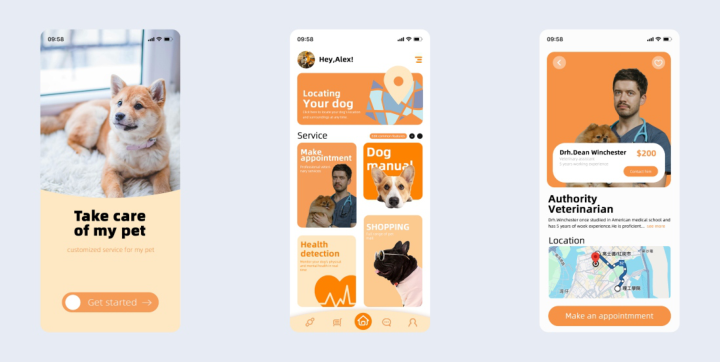
needs, such as setting reminders, adjusting monitoring parameters, and so on. Since almost all functions are integrated into the user’s mobile APP, the information presented on the APP interface needs to be clear and organized, quickly helping users understand task progress and the role of interface content, thus enhancing the fluency and usability of the interface. The final design outcome is presented in Figure 2.
Figure 2: App interface (Drawn by Ding Xuan, 2024).
Scalability and Compatibility It is presented through modular design and compatibility design. First, the modular design approach is adopted to facilitate the expansion and upgrade of future functionalities. For example, more types of sensors or modules can be added to achieve richer functionalities. Compatibility design, on the other hand, ensures that the smart collar can be compatible and interoperable with mainstream smartphones, smart homes, and other devices on the market, providing users with a richer smart lifestyle experience.
CONCLUSION
With the rapid development of artificial intelligence and the Internet of Things technology, the pet intelligent interaction system has become a hot topic in the modern pet care field. This research has conducted in-depth research and design on the intelligent interaction system for pet dogs under the perspective of context-aware technology. The core of the research lies in integrating context-aware technology into the smart collar, enabling it to monitor the pet dog’s physical condition, behavior patterns, and environmental information in a timely and accurate manner, thus providing personalized care suggestions and proactive interactive experiences.
Through a series of theoretical analyses and investigations, a pet dog intelligent interaction system based on context-aware theory has been
Design of a Smart Interactive System for Pet Dogs 431
designed. This system not only possesses basic functions such as real-time monitoring, health warning, and location tracking, but also can actively interact with the pet dog based on specific scenarios, such as through voice prompts, flashing lights, and other methods to enhance the emotional connection between the pet and its owner. In addition, the system also has the ability to self-learn and optimize, continuously improving the accuracy of context awareness and the intelligence level of interactions based on user feedback and usage data.
This research provides new ideas and methods for the development of pet intelligent interaction systems and lays a foundation for future research work. With the advancement of technology, in the near future, the pet intelligent interaction system based on context-aware technology will be able to serve pet dogs and their owners in a more intelligent and humane manner, making pet care simpler, easier, and more enjoyable.
REFERENCES
Bian Peng, Qin Yu. Research on Active Interaction Design in Smart Home Products [J]. Industrial Design, 2024(02): 104–107. Ding Fuhong, Wang Xuanzheng, Wu Xian. Research on the Design of Aging Friendly
Intelligent Wearable Travel Products Based on Situational Awareness [J]. DESIGN RESEARCH, 2024, 14(02):89–94+112. Endsley M R. Design and Evaluation for Situation Awareness Enhancement[J]. Proceedings of the Human Factors Society Annual Meeting, 1988, 32(2): 97–101. Gu Junzhong. Context aware computing [J]. Journal of East China Normal University (Natural Science), 2009(5):1-20, Inside Front Cover. DOI:10.3969/j.issn.1000–5641.2009.05.001. Kaltz W J, Ziegler J, Lohmann S. Context-aware Web Engineering: Modeling and Applications[J]. Revue d’intelligence artificielle, 2005, 19(3). Liu Wei, Yuan Xiugan. Theories and Applications of Situational Cognition in
Human-Computer Interaction[M]. Beijing: Science and technology of China press, 2005. Schilit B N, Adams N, Want R. Context-Aware Computing Applications[C]. Santa Cruz: First Workshop on Mobile Computing Systems and Applications, 1994. Xu Ruijing. Innovative Design of Pet Cleaning Products Based on the Concept of Emotional Symbiosis [J]. Packaging Engineering, 2021, 42(24): 362–367. DOI:10.19554/j.cnki.1001–3563.2021.24.046.
LISTED IN THE AHFE DIGITAL BOOKSTORE CATALOGUE
Explore the complete digital volume
Human Factors in Design, Engineering, and Computing
Read this individual research paper free through the original publisher, or explore the full digital proceedings book.
ISBN 978-1-964867-35-9
Explore this ISBN in the AHFE Bookstore ↗Listed in the July 2026 bookstore catalogue; search by ISBN to confirm current availability · Digital book purchase optional