Moritaro Inoue, Naoshi Uchihira (2022). Maritime Engine Room Resource Management Extended to Remote Members Onshore: Conceptual Model using Internet of Everything (IoE). In: The Human Side of Service Engineering. AHFE Open Access, vol. 62, pp. 117–125. https://doi.org/10.54941/ahfe1002549
Operation and management of ships is a typical service system including human factors. In recent years, the maritime industry has become increasingly concerned about human factors against maritime accidents, which have still remained high rate. The International Convention on Standards of Training, Certification and Watchkeeping for Seafarers, 1978/2010 (STCW convention) made that maritime resource management (MRM) is a requirement for seafarers' qualifications, including BRM (Bridge Resource Management) for the navigation department and ERM (Engine Room Resource Management) for the engine department. This paper focuses on ERM, which is a method to operate a ship safely by appropriately managing and effectively utilizing resources in the ship engine area. The STCW code lists the following requirements for ERM: (1) allocation, assignment and prioritization of resources (2) effective communication (3) assertiveness and leadership (4) obtaining and maintaining situational awareness (5) consideration of team experience.MRM has been developed based on Crew Resource Management (CRM), which has been developed in the aviation industry and has been one of the important issues in human factors research, by fitting the characteristics and target tasks of ships. At present, MRM capability is being developed through training-based methods. However, MRM does not depend solely on the abilities and skills of individuals, but can be demonstrated by organizations. In addition, as the equipment on ships becomes more complicated in response to environmental regulations and efficient operation, it is becoming more difficult for the personnel in the engine department to manage and control all the resources alone. In the future, it will be necessary to provide remote support from the members onshore, to make data visible efficiently by utilizing the Internet of Things (IoT), and to develop mechanisms and systems to support ERM in the actual field.In this paper, we propose a conceptual model of support system for ERM using human awareness and IoT sensors, and an ERM concept that extends to remote members onshore including engineering supervisors and maintenance personnel in shipbuilding companies. The proposed model uses not only an IoT system to collect sensor data from the main engine, generator, and other equipment on board the ship, but also the smart voice messaging system that allows the crew to share and store their operations and observations (human awareness). This model is classified as Internet of Everything (IoE) since it consists of IoT and human awareness. The smart voice messaging system had been developed for collaboration management in various services including maintenance by authors (Uchihira et al., Collaboration management by smart voice messaging for physical and adaptive intelligent services, PICMET 2013). The proposed ERM support system based on IoE is still conceptual model. We evaluated effectiveness of the proposed system by interviewing several ship managers. As a result, it was found that the system has the potential to support the resource management of equipment and personnel, which is the objective of MRM. Unique points of the proposed model include (1) ERM model extended to remote members onshore and (2) ERM support system utilizing both IoT sensor data and human awareness together.
Shipping by sea is still the most important mean of transportation in the world, and ships constantly undergo pressure to improve their efficiency and safety. The operation of a ship depends on the navigation and engine perfor- mance, also by the maintenance of the engine which is essential for the safe operations.
In recent years, more research and development of automatic ship opera- tion has been conducted (Anderson, 2020; Burmeister et al., 2014), while practical experiments using actual ships have been performed (Inoue and Mori, 2021). On the other hand, there are still many tasks in the engine room of large ships that can only be performed by humans (ship engine- ers). Frey and Osborne (2017) for example studied the likelihood of AI replacing the work of captains, mates, and pilots of water vessels, which is responsible for ship operation and maneuvering, showed a likelihood of 0.27, while ship engineers had a much lower likelihood of 0.041. Human
factors of ship engineers have a significant impact on the effective operation of a ship, and about 75-96% of marine accidents are still caused by human error (Hanzu-Pazara et al., 2008). Akino (2020) studied accident reports of ClassNK registered ships from 2006 to 2014, and found that 0.5-0.7% of the ship issues belonging to serious engine accidents that interfered with naviga- tion, and about 70% of these accidents were caused by human errors. MRM consists of Bridge Resource Management (BRM) for bridges and Engine- room Resource Management (ERM) for engine-rooms, each of which is specialized for a specific field of ship operation. In recent years, the sophisti- cation of the equipment used in ship operations made it difficult to maintain and manage the equipment alone, and it is becoming increasingly important to collaborate with shoreside managers and equipment manufacturers. The development of the satellite communication environment at sea has made it possible to transmit relatively large amounts of sensor data via the Internet, and maintenance using IoT is expected. This paper proposes a conceptual model of a support system using IoE for ERM, which includes IoT and digitization of human situation awareness and remote support by members onshore.
ENGINE ROOM RESOURCE MANAGEMENT Issues of Engine-Room Resource Management
The engine room of a ship is equipped with many components and equi- pments, not only the main engine for propulsion, but also a lot of auxiliary equipment, while the ship engineer has a wide range of duties to perform. The literature on equipment maintenance in the ship engine room is limited. The results of a survey conducted by Akino (2018) on experienced chief engi- neers involved in the operation of large merchant ships in Japan showed the following: (1) the tight operation schedule and the increase in paperwork and other administrative work did not allow sufficient time for equipment main- tenance, (2) the gap between supply and demand for seafarers has resulted in an increase in the number of members who were not accustomed to main- tenance and boarding operations, which increases a burden on managers, (3) increased workloads due to compliance with environmental regulations, and (4) difficulty in maintenance due to the sophistication of the equipment. This is because, even now, in many ships, the tasks performed by the crew are important for the operation of the ship, and these tasks are shared with the shore in the form of reports. It is very difficult to manage manpower resou- rces only in the field, and on-the-job training (OJT), which is becoming more and more important in crew education, and may become difficult due to the tight operation schedule. In addition, as the equipment becomes more soph- isticated and environmentally friendly, it is becoming more difficult for the crew on-site to maintain the equipment continuously, and cooperation with experts and equipment manufacturers onshore is required.
Requirements for Engine-Room Resource Management Due to the continuing high rate of maritime accidents caused by human errors, proper ERM was made a mandatory requirement along with BRM
Maritime Engine Room Resource Management Extended to Remote Members Onshore 119
by the 2010 Manila amendments of the International Convention on Stan- dards of Training, Certification and Watchkeeping for Seafarers (the STCW Convention), and its associated code. The ERM requirements are based on the Crew Resource Management developed in the aviation industry and have been developed according to the operational characteristics of naviga- tion and engine departments. The following items are specified in the ERM requirements (International Maritime Organization, 2010).
1. Allocation, assignment, and prioritization of resources 2. Effective communication 3. Assertiveness and leadership 4. Obtaining and maintaining situation awareness 5. Consideration of team experience These items are based on human factors, called non-technical skills (NTS), and organized in a way that is consistent with institutional operations. Flin et al. (2013) defined NTS as “the cognitive, social and personal resource skills that complement technical skills, and contribute to safe and efficient task performance (p.1)”, and it is thought that both technical skills and NTS are important for the practice of NTS. Jiang (2012) defined the pur- pose of ERM as “engine department personnel guaranteed that ships’ safe navigation, reduces and avoids the latent human error accident when has in the emergency case or engine room current management (p.35)”. Therefore, ERM can be decomposed into resource management in the following three phases:
1. Crisis resource management
Management to make effective use of resources and minimize damage in case of emergency or trouble. 2. Regular engine-room management Management of daily maintenance and inspection to prevent problems and ensure safe navigation on time. 3. Long-term life cycle management
Management to maintain hull and equipment from a long-term per- spective.
The implementation of ERM requires general mechanical knowledge, kno- wledge of the work of the engineer, and knowledge of the characteristics of the hull and equipment of each ship. A review paper of MRM (BRM and ERM) research by Praetorius et al. (2020) pointed out that MRM should not be implemented as an individual competency, but as a team, and compared to CRM in the aviation field, the support of MRM through uni- form training in the different environments and applications of each ship is difficult. It is concluded that while conventional training-based ERM support focuses on developing NTS capability of ERM, there are limits in practicing ERM in the actual field. A support system that includes functi- ons to support each component utilizing recent digital technologies will be promising.
120 Inoue and Uchihira
Table 1. ERM requirements and corresponding functions.
Table available in the original PDF paper.
ERM Requirements Conceptual System Model Functions
1 Allocation, assignment, and prioritization of resources
Evidence-based planning through information accumulation and visualization 2 Effective communication Face-to-face & non-face-to-face communication and asynchronous communication using ICT (including shore side) 3 Assertiveness and leadership Evidence-based instructions through information accumulation and visualization 4 Obtaining and maintaining situational awareness Experience management system
Integrated situation visualization and prediction of IoT data and human awareness 5 Consideration of team experience
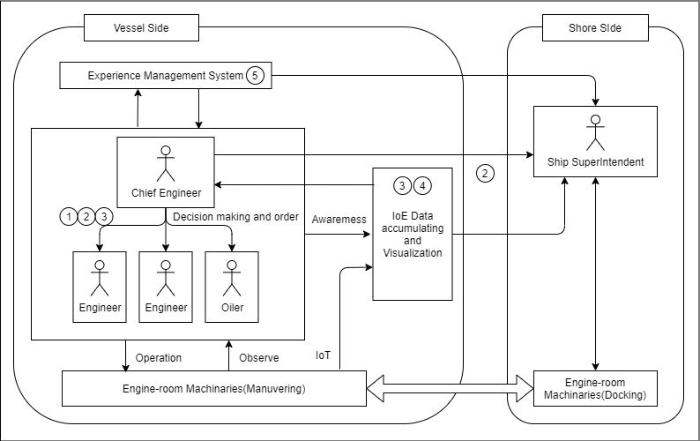
CONCEPTUAL ERM SUPPORT SYSTEM MODEL The purpose of ERM is to properly manage the resources of personnel, equi- pment, and information for efficient and safe ship operation. In addition to training, communication tools that support ERM in real-time, as well as visualization of work history and ship characteristics by understanding the movement of ships and equipment are considered to be important. In the actual operation and maintenance of ships, not only on-site repairs, but also the execution of planned maintenance plans, budget acquisition, and mana- gement are important. To understand and judge the condition of a ship, it is necessary to take into account several factors, such as the knowledge and experience of the engineer in the field, the operational status of the ship, and the condition of each piece of equipment. In this paper, we propose a new conceptual system model that combines human awareness and mechanical sensors in digital space for remote maintenance and resource management onboard and onshore (Figure 1). This model has functions corresponding to the five components of ERM (Table 1).
Functions of Conceptual ERM Support System Model The functions of the proposed system model are illustrated as follows.
Evidence-Based Planning Through Information Accumulation and Visualization In the actual field of ships, vibration, odor, the color of exhaust gas, etc., which do not appear in numerical values and figures, are also important. By sharing this information with the shore side by IoE (sensor data and digita- lized human awareness). Mechanical sensors can only detect the situation in the area where the sensor is installed. By linking the numerical data with the text data collected by engineers in the field in the form of flexible awareness of the parts that cannot be captured by the sensor, we can realize maintenance that is more in line with reality.
Maritime Engine Room Resource Management Extended to Remote Members Onshore 121
Figure 1: Conceptual ERM Support System Model. Numbers (1, 2, 3, 4, 5) correspond to ERM requirement in Table 1.
Face-to-Face Communication & Non-Face-to-Face and Asynchronous Communication Using ICT (Including Shore Side) Communication support is realized by introducing non-face-to-face and asy- nchronous communication using ICT including the shore side in addition to face-to-face communication. Asynchronous sharing is used for later confir- mation. The Smart Voice Messaging System (SVMS) (Uchihira et al., 2013), which has been developed for human healthcare service, is used for this purpose. SVMS can collect awareness and work contents and deliver them asynchronously, appropriately, and as needed. The quality of the work can be improved by tagging voice messages and passing them from the sender to the necessary receiver based on the relevant information task. The system enables a seamless exchange of information between the shore side and the field, from daily inspection and maintenance to emergency communication.
Evidence-Based Instructions Through Information Accumulation and Visualization As the system continuously collects data, it is possible to collect information on what kind of work, what kind of awareness, and what kind of values were obtained under what circumstances. By visualizing these data in a time series and for each target device, it is possible to clarify the characteristics of the hull and devices, and the trend of the work. Ships are different from other industrial products in that they show different tendencies depending on the quality of the equipment on board, the precision of the workmanship, and whether or not there have been problems in the past. To maintain a ship, it is necessary to perform maintenance from long-term operations, and this system supports this step.
122 Inoue and Uchihira
Figure 2: Relationship between Conceptual Support System Functions and ERM Phases.
Integrated Situation Visualization and Prediction of IoT Data and Human Awareness In the operation of a ship, the situation, and context in which the ship is pla- ced become important. For example, when the alarm for low or high lubricant level was sounded, it was not due to a decrease in lubricant itself, but due to the movement of the liquid level caused by the hull motion. By visualizing not only the numerical values of the sensors but also the situation and the state of the machine, which cannot be obtained by sensors, we can support the proper understanding and prediction of the state of the equipment.
Experience Management System By evaluating the amount of time spent on duty, the amount of witnessing and messages received, and the content of the messages, the amount of experience of each crew member can be visualized, and the tasks in which they have been involved can be narrowed down by task. Conventionally these tasks were left to the discretion of the chief engineer. In the proposed model, these tasks can be delegated correctly with the help of the system’s work history.
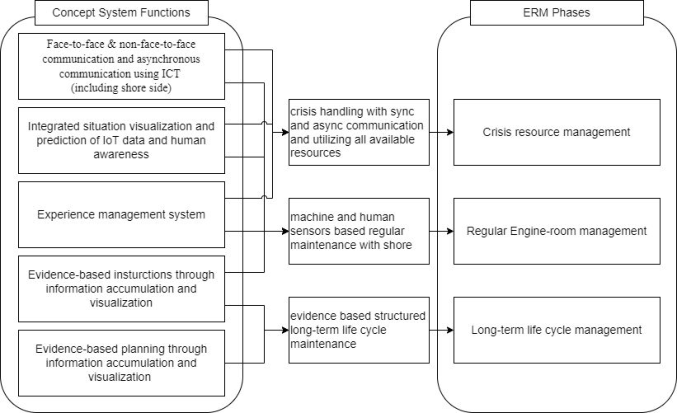
Relationship Between Functions and ERM Phases We explain the relationship between these functions and the ERM phases (Figure 2).
Crisis Resource Management During an emergency, it is necessary to understand the resources on board, the trouble, and the situation of the ship, and then to respond quickly with maximum efficiency. After collecting numerical data from mechanical sen- sors and abnormalities and notifications from digitalized human awareness,
Maritime Engine Room Resource Management Extended to Remote Members Onshore 123
and understanding the situation appropriately, the experience management system allows workers to work with consideration for their experience and competence. Operators can work on solving the problems through close com- munication between the management on the land side and the workers in the field.
Regular Engine-Room Management To operate a ship safely and on schedule, it is important to detect signs of trouble at an early stage and take appropriate measures, as well as to carry out essential daily inspections and maintenance. In addition, it is common for a small group of people to take turns to work on a ship, since a ship is in operation for more than one day. It is necessary to organize the team in consideration of the experience of each person, assign tasks according to their aptitude, and share the work performed and signs of trouble synchronously and asynchronously. In addition, it is thought that visualization by combining numerical values from machine sensors and digitalized human awareness is effective for trouble detection.
Long-Term Life Cycle Management It is estimated that the maintenance cost of a ship accounts for 25%-35% of the operating cost (Turan et al., 2009). Evidence-based maintenance and maintenance based on the characteristics and realities of the hull can reduce operating costs and prevent unexpected problems. It is necessary to create a maintenance plan based on the collected historical data and to perform main- tenance based on the characteristics of the hull and past troubles. In general, ship engineers rarely stay on the same ship for a long period of time, so it is important to take over the ship when the crew changes or when the ship moves into a dock. In the proposed model, the characteristics of a ship are expressed by the collected data, and the quality of maintenance is prevented from deteriorating due to crew changes.
RELATED WORK
Research on IT-based support systems in MRM has been conducted, alth- ough not as much as maintenance support in other fields such as aircraft and smart factories. Support systems for ships, such as navigation systems, engine monitoring systems, and remote control systems, are relatively inde- pendent and have a single function and a closed configuration (Liu et al., 2014). In the case of navigation equipment, NMEA0183 (National Marine Electronics Association, 2002) was developed and standardized as a method of communication between equipment, and attempts such as e-navigation using EGSIS(e.g., Burmeister et al., 2014; Patraiko, 2007) have been made relatively early. Tang and Shao (2017) proposed a data infrastructure that integrates EGSIS, AIS, alarm monitoring system, etc. as a Ship Integration System. Also, there have been problems with engine data, such as differe- nces in measurement points between ships and shaky notation, but the ISO 19848 (International Standard Organization, 2018) has made it possible to handle engine data based on a unified standard, and the use of engine data is
124 Inoue and Uchihira
advancing. The proposed model is unique in that it collects data on human awareness, understanding, and judgment (situation awareness) in addition to machine sensor data to support ERM in an integrated manner. Although there are many previous studies on remote maintenance (Wang et al., 2007), the remote maintenance of manufacturing equipment in a factory assumes that data on operating conditions can be collected under the same conditi- ons, analysis such as machine learning is possible, and maintenance experts have direct access to the target equipment. The proposed model is unique in that it supports maintenance from shore, considering the long-term life cycle of the ship in the constrained environment of a ship at sea.
CONCLUSION
In recent years, high-end satellite communication services such as Inmarsat FX have been expanding, and it is expected that remote maintenance using ship-to-land communication will become easier. In addition, as the equipment becomes more sophisticated, there will be many cases where the engineers in the field cannot make decisions by themselves, and it will be necessary to collaborate with managers and equipment manufacturers on land. It is highly possible that the current remote monitoring system, which relies only on sensor data, will not be able to fully support the actual ship operation and engine operations, which are affected by many factors. In addition, from the viewpoint of resource management, it is necessary to extend the ERM to the shore side, because there are more and more parts that cannot be handled only by the engineer in the field due to the sophistication of equipment and the high cost of repair. The proposed conceptual model is novel in that it can help in: (1) supports human factors in ERM by combining human awareness with IoT data, and (2) extends ERM to the shore side and proposes ERM that includes the entire life cycle. We are currently developing a system based on the concept proposed in this paper, and plan to install it on an actual ship for trial and evaluation.
REFERENCES
Akino, S. (2020). Introduction of Engine-room Resource Management Training Objectives and Training. Mar. Eng. 55, 344–348. (In Japanese). Akino, S. (2018). A Survey on the Actual Condition of Engine and Plant Management
in Large Oceangoing Merchant Vessels - Report 1: What Needs to be Improved to Realize the Automatic Ship Operation. Mar. Eng. 53, 565–569. (In Japanese). Anderson, M. (2020). Bon voyage for the autonomous ship Mayflower. IEEE Spectr.
57, 36–39. Burmeister, H.-C., Bruhn, W., Rødseth, Ø.J., Porathe, T. (2014). Autonomous unmanned merchant vessel and its contribution towards the e-Navigation imple- mentation: The MUNIN perspective. Int. J. E-Navig. Marit. Econ. 1, 1–13. Flin, R., O Connor, P., Crichton, M. (2013). Safety at the Sharp End: A Guide to
Non-technical Skills. Saf. Sharp End Guide Non-Tech. Ski. 1–317. Frey, C.B., Osborne, M.A. (2017). The future of employment: How susceptible are jobs to computerisation? Technol. Forecast. Soc. Change 114, 254–280.
Maritime Engine Room Resource Management Extended to Remote Members Onshore 125
Hanzu-Pazara, R., Barsan, E., Arsenie, P., Chiotoroiu, L., Raicu, G. (2008). Reducing of maritime accidents caused by human factors using simulators in training process. J. Marit. Res. 5, 3–18. Inoue, S., Mori, H. (2021). Development of Automated Ship Operation Technologies.
ClassNK Tech. J. 3, 59–66. International Maritime Organization (2010). STCW including 2010 Manila Amendments: STCW Convention and STCW Code: International Convention on Standards of Training: International Convention on Standards of Training, Certi- fication and Watchkeeping for Seafarers. International Standard Organization (2018). Ships and marine technology — Stan-
dard data for shipboard machinery and equipment. Jiang, D. (2012). Research of Engine Department Team Based on Engine Room Resource Management, in: Jin, D., Lin, S. (Eds.), Advances in Electronic Com- merce, Web Application and Communication: Volume 1, Advances in Intelligent and Soft Computing. Springer, Berlin, Heidelberg, pp. 35–40. Liu, S., Xing, B., Li, B., Gu, M. (2014). Ship information system: overview and
research trends. Int. J. Nav. Archit. Ocean Eng. 6, 670–684. National Marine Electronics Association (2002). NMEA0183-Standard for interfacing marine electronic devices: Version 3.01. Patraiko, D. (2007). The development of e-navigation. TransNav Int. J. Mar. Navig.
Saf. Od Sea Transp. 1. Praetorius, G., Hult, C., Österman, C. (2020). Maritime resource management: Current training approaches and potential improvements. TransNav 14, 573–584. Tang, Y., Shao, N. (2017). Design and research of integrated information platform
for smart ship, 2017 4th International Conference on Transportation Information and Safety (ICTIS), pp. 37–41. Turan, O., Ölçer, A.˙I., Lazakis, I., Rigo, P., Caprace, J.D. (2009). Maintenance- /repair and production-oriented life cycle cost/earning model for ship structural optimisation during conceptual design stage. Ships Offshore Struct. 4, 107–125. Uchihira, N., Choe, S., Hiraishi, K., Torii, K., Chino, T., Hirabayashi, Y., Sugihara,
T. (2013). Collaboration management by smart voice messaging for physical and adaptive intelligent services, 2013 Proceedings of PICMET ‘13, pp. 251–258. Wang, W., Tse, P.W., Lee, J. (2007). Remote machine maintenance system through Internet and mobile communication. Int. J. Adv. Manuf. Technol. 31, 783–789.
LISTED IN THE AHFE DIGITAL BOOKSTORE CATALOGUE
Explore the complete digital volume
The Human Side of Service Engineering
Read this individual research paper free through the original publisher, or explore the full digital proceedings book.
ISBN 978-1-958651-38-4
Explore this ISBN in the AHFE Bookstore ↗Listed in the July 2026 bookstore catalogue; search by ISBN to confirm current availability · Digital book purchase optional