Takaki Yasuda, Chiaki Oshiyama, Koki Ijuin, Naoshi Uchihira, Takuichi Nishimura (2024). A form of value co-creation in an innovation success team. In: The Human Side of Service Engineering. AHFE Open Access, vol. 143, pp. 83–90. https://doi.org/10.54941/ahfe1005086
Creating a new business in the manufacturing industry is more difficult than creating a new business in the retail industry or IT platform business due to the large amount of investment and the long time it takes to recover the investment. Moreover, the innovators of disruptive business ideas are often criticized as insane by many within the manufacturing company and cannot even begin to consider proof of concept. Under these circumstances, it is still very useful to refer to good examples of past innovations where ideas survived and were widely disseminated in society. In this study, the process is focused on which an unconventional idea gains support from within the company and potential customers and finally becomes the majority. From this process, it would be able to get the practical requirements of resource, mindset, motive, and interaction with others of human resources who promote innovation. This knowledge could have social and practical value and be aimed at establishing education and training services for spreading this value. Although there are many examples of analysis of innovators who create unique ideas, this research focuses on the people around innovators, especially those who play an important role in the unsung worlds. This report is a case study of a team that created a famous innovation and is based on data from individual interviews with multiple people around the innovator. From the analysis result about the complementary relationships and interactions between the innovator and nearest neighbors in this case, first, it was found out that incubation of that idea was developed effectively because several electronics-related organizations were integrated forcibly into one subsidiary. Second, after one year of consideration, an innovator came up with an idea that was different from common sense and that could only be won by their own company, and based on that vision, some of the employees enthusiastically provided services. Third it was also shown that commitment to the mobile phone-type demo device with a finish that is easy to imagine led to support within the company and immediate adoption by customers.
In the manufacturing industry, where mass production is the source of prof- its, creating new businesses tends to be conservative and hesitant because it requires a large amount of investment and takes a long time to recover. Some innovators develop maverick business ideas but are criticized by many within manufacturing companies as insane and cannot start proofs of con- cept. In this context, it is still helpful to refer to examples of past innovations where ideas survived and were widely diffused to the world.
For value co-creation, Constantin and Lusch (1994) define operant resources as resources on which an operation or act is performed to pro- duce an effect. Vargo and Lusch (2004) proposed “Service-Dominant Logic,” which is a way of thinking that reconsiders marketing activities from the perspective of “services,” which considers all activities rather than from the standpoint of marketing goods and services. It is said to be more of a mind- set than a theory. Hsieh and Hsieh (2015) investigated through the operant resources how customer co-creation affects the performance of high-tech ser- vice innovation, found high-tech companies can not only obtains feedback from customers, but also delivers messages to customers, and proposed they can employ these scales for monitoring the co-creation relationship.
Regarding the value of co-creation, there is a lot of literature on prod- uct or service planning with consumers in the context of marketing. Also, there is some literature about improvement activities between medical doc- tors, nurses, and patients, but a few about value co-creation of technological innovations between in-house persons, not with the customers.
Ramaswamy (2009:33) reported that Hindustan Computers Limited rec- ognized that “Becoming a co-creative organization is about changing the very nature of engagement and relationship between the institution of man- agement and its employees and between them and co-creators of value— customers, stakeholders, partners or other employees.”
METHOD
Research Object For this study, the Asahi Kasei Corporation’s “Electronic Compass (e-compass)” business was taken up as an interview subject. The e-compass is a “directional angle sensing device based on geomagnetic measurements” used in cell phone map applications. Research and development for this busi- ness began in 2001, their e-compass was adopted in cell phones in 2003, then in the first Android smartphone in 2008, and has maintained the largest market share in the world since its commercialization. It was awarded the Imperial Invention Prize by the Japan Institute of Invention and Innovation in 2012 and the Medal with Purple Ribbon of Japan in 2015 (Dr. Masaya Yamashita). This team is suitable for this study as a manufacturing innovation case.
Interview One-on-one individual semi-structured interviews were conducted with Dr. Yamashita and five of his closest associates. The purpose of the inter- view was to clarify the co-creation relationship among those initial members of the innovation team, and the interview was conducted with an awareness of recording the facts of the interactions at that time and an understanding of each person’s feelings.
The interviews’ results and handling mustn’t be to the detriment of the interviewees who agreed to cooperate with the research. Regardless of whether the person has a real name or wishes to remain anonymous, they will be separated from real individuals and treated as a model persona from the researcher’s interpretation. Interviewees’ statements were analyzed using Step Coding And Theorization (SCAT: Otani, 2007). Getting along with the SCAT procedure, textual data of the interviewee’s statements was treated as below: first, extracting the words of interest in the text; second, rephrasing the words in the text; third, looking for extra-textual concepts that explain rephasing; and fourth, extracting what they meant to say. Fifth, the final questions/is- sues found through this process are also described. Then, the storylines and theories that can be told from the interviewee’s words are described, and the points/issues that should be pursued further are summarized.
A Form of Value Co-Creation in an Innovation Success Team 85
RESULTS AND DISCUSSION
Explanation of This Case (Only the Very First Stage of the Innovation History) Since joining this company, Dr. Yamashita has been a developing leader in MRI (nuclear magnetic resonance imaging) diagnostic equipment first and LIB (lithium-ion battery) second. But in 2000, he was forced to choose between quitting Asahi Kasei and transferring to LIB’s joint venture com- pany to utilize his expertise or resetting his knowledge and returning to Asahi Kasei. (This might have been the first chasm of e-compass.) He ulti- mately decided to stay; his first boss in the corporate laboratory gave him a place to stay. Asahi Kasei planned to establish a holding company and sub- sidiaries from business units in 2003. So, his group would go to a subsidiary laboratory with integrated electronics departments.
Each manager scheduled to be merged had already started a meeting in person to plan a new business every month, so Dr. Yamashita immediately joined the “Electronics Device Meeting.” At that time, he recognized the need for a mobile phone navigation system and their direction for developing a susceptible magnetic sensor. But he thought it was nonsense because the geo- magnetic direction is thrown off by steel structures in urban areas and by a magnet inside the phone. Even if he told a few people about it after the meeting, they said, “It may be the case. But going in that direction would be no problem since it was still at the research stage.”. This was the first exclu- sion of critical opinions from a stranger, and that’s when co-creation was a hindrance.
Unable to let things go in the wrong direction, Dr. Yamashita conducted an experiment using a compass to measure direction around the city. How- ever, contrary to his expectations, the wandering from the north was ±20 degrees in 80% of the places, so it was found that there was no problem in determining the direction. After two months of contemplation, Dr. Yamashita logically thought that, on the contrary, a low-sensitivity magnetic sensor with a wide dynamic range is essential because it is not saturated in an environ- ment with motor magnets in mobile phones. But the more he said that the company’s existing sensors were sufficient, the more he was ridiculed. This was the second exclusion of unconventional opinion, and the other engineers didn’t accept his value proposition. Co-creation was hindered, and a second chasm threatened the idea of e-compass.
Dr. Yamashita borrowed someone else’s experimental equipment, and using his company’s magnetic sensor, he experimented to see if it was possible to measure a direction in one second of integration. He brilliantly demon- strated this by showing that rotating the orientation of the sensor causes the data to follow a cosine curve and showed this data at a September meeting. But they said, “Wow, good. But this is primitive. It would be even better if a high-sensitivity magnetic sensor were created. Providing the distance between the sensor and the motor magnet would be no problem.” This was the third exclusion of unconventional solutions, and co-creation was hindered again. A third chasm threatened the idea of e-compass. Dr. Yamashita said, “This
data did not convince engineers. Because they are experts, they are conser- vative and have various biases. They tend to accept the data but not change their best concepts.”
Although it was a volunteer research, Dr. Yamashita gave a poster pre- sentation at a company-wide presentation in November. People from other departments would look at him curiously, “That’s interesting. But what on earth are you doing?” He irritated the high-sensitivity magnetic sensor people. Positive value co-creation had not been produced yet with this uncon- ventional idea that he discovered alone, and it was the fourth chasm of e-compass.
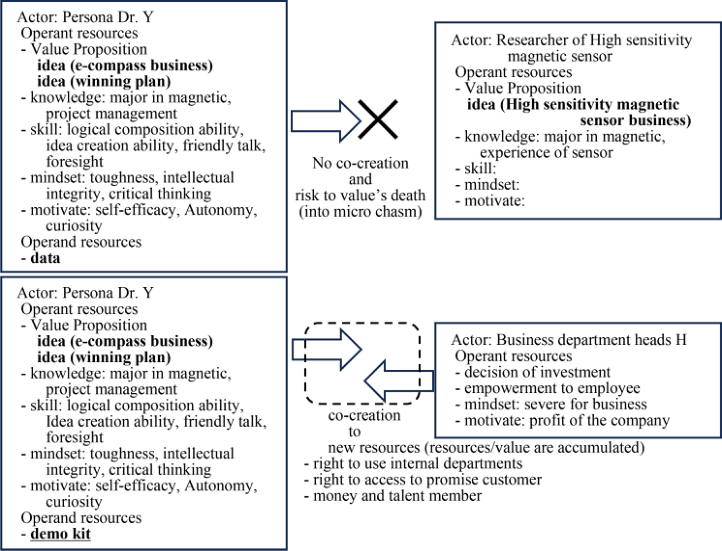
In January 2001, Dr. Yamashita was allowed to make the team, and one of the subordinates, E, liked electronic work. Dr. Yamashita asked him to build a demo cell phone with a direction sensor. It was completed in two months, and a demo was demonstrated at a meeting attended by business depart- ment heads H in March. H immediately ordered, “Do this theme just away.” Finally, it became an official theme, and the high-sensitivity magnetic sensor was discontinued in its place. Dr. Yamashita and subordinate E invested in each other’s operant resources and achieved value co-creation by making a demo machine. Also, Dr. Yamashita and Division Manager H invested in each other’s operant resources and earned value co-creation by swapping to better research themes. Finally, Dr. Yamashita jumped over several micro chasms in the ideation period to increase the value of resources added to the promising innovation idea.
Figure 1: Transaction of Persona Dr. Y to the others in voluntary research of 2000, 2001.
A Form of Value Co-Creation in an Innovation Success Team 87
As shown above, to survive an unconventional idea against many people’s criticism, other people who grow up value co-creation by mutually provid- ing operant resources is essential. If the innovator proposes the value of an unconventional idea, but the other person does not give operant resources, the other person does not understand the current value of the idea (Figure 1: upper). To keep this unconventional idea alive, supporters must not give up and continue to create and provide operant resources with logic, expres- sions, and stories to let the other offer his operant resources and contribute value co-creation (Figure 1: lower). Furthermore, after this researcher’s inter- pretation, it will be written as Persona Dr. Y instead of Dr. Yamashita in Figure 1.
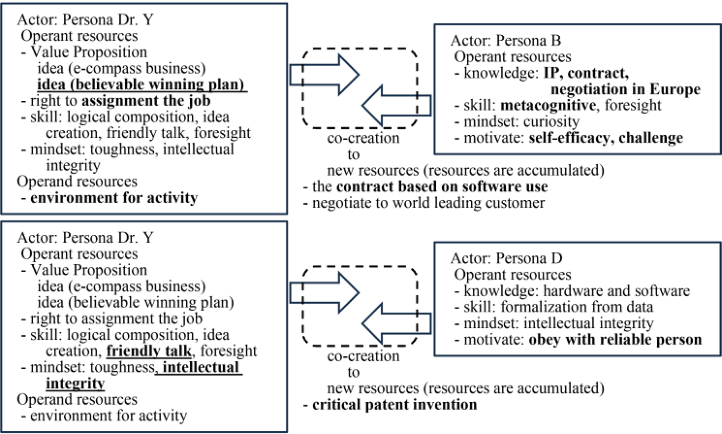
Figure 2: Transaction of Persona Dr. Y to the members in his team.
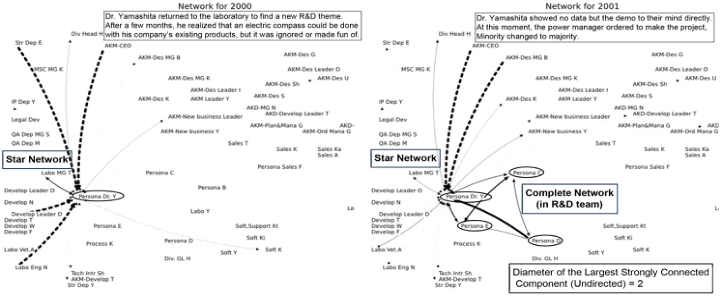
After establishing the team, Dr. Yamashita smoothly co-created and accu- mulated the value of the e-compass idea. Subordinate B was resonant and empathized with Dr. Yamashita’s winning story; subordinate D was resonant and empathized with Dr. Yamashita’s personality as an operant resource, so the valuable resource was different from each person (Figure 2) (Yasuda et al., 2024). Figure 3 shows the network around Dr. Yamashita for e-compass develop- ment. In 2000, Dr. Yamashita directly talked to persons in the company as voluntary research, so the network style was the star type from one person to 19 persons. In 2001, Dr. Yamashita and three subordinates constructed a complete network, which means everybody contributed to everybody’s task, and operant resource exchanging was accelerated at maximum in the team.
Figure 3: Network graph of e-compass R&D (before/after starting).
Table 1 shows the changes from 2000 to 2018, with stakeholders rep- resented as nodes and relationships between them described as edges. The number of people (nodes) with whom the interviewees were involved each year increased over the ten years after the project team was formed, and the initial members gradually disappeared after the division was transferred.
Table 1. Active nodes, active edges of network graph of e-compass R&D (2000–2018).
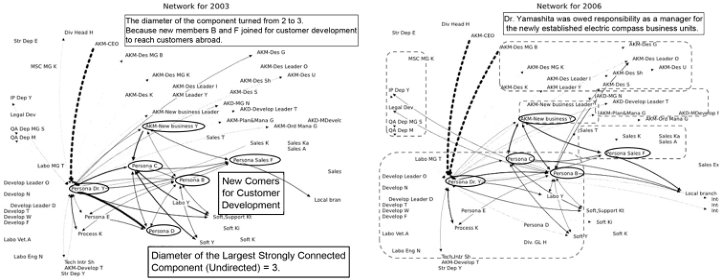
The number of positive edges (connections between two people) means the number of value co-creations. The value of the e-compass was increasing and spreading around the world. The network growth transition is shown in Figure 4.
Figure 4: Network expansion through hubs of e-compass R&D (2003, 2006).
A Form of Value Co-Creation in an Innovation Success Team 89
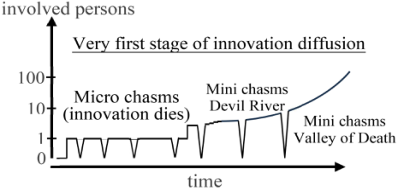
Contrary to snapshots of those figures, the time dependency of involved persons is shown in Figure 5. From nothing, Dr. Yamashita got the idea of a winning story on a new device. At first, as a maverick innovator, he found it hard to let others understand his idea. Against so many micro chasms, mav- erick innovators must be tough and think thoroughly. At first, he tested it alone, pondered it alone, and sought agreement from those around him, but for a while, no one took up his idea as it was unconventional. If he had given up or left things in the middle, he wouldn’t be able to achieve innovation. Service-dominant logic is helpful in understanding that it is essential for dif- fusion of innovation (Rogers, 2010) to create operant resources that the other party can receive and to gain empathy, then to co-creating. As the number of supporters, including his customers, increased, there were mini chasms such as the Devil’s River, the Valley of Death, and Darwin’s Sea, and then there was a chasm of whether the early majority purchased or not.
Figure 5: A model of micro chasms against innovation diffusion.
CONCLUSION
When a maverick innovator comes to an unconventional idea, he first investi- gates it alone, ponders it alone, and seeks agreement from those around him. But no one usually takes up his idea for a while because of unconventional. If he had given up or left things in the middle, he wouldn’t be able to achieve innovation. The perspective of service-dominant logic helps understand that creating and offering tailored operant resources is essential for the other to understand the idea’s value, empathize with the idea, and cooperate value co-creation in innovation.
ACKNOWLEDGMENT
Thanks to all the interviewee’s kindness: Dr. Masaya Yamashita, Mr. Seiichi Kato, Mr. Masanobu Sato, Mr. Koichi Hikita, Mrs. Yuko Matsunuma, and Mr. Norihiko Mikoshiba.
Note: The interviews were conducted based on the research plan “Hearing on Complementary Relationships in Innovation Teams,”which was approved by the ethics review of Japan Advanced Institute of Science and Technology (Person 04–026).
REFERENCES
Constantin, J. A., & Lusch, R. F. (1994). Understanding resource management: How to deploy your people, products, and processes for maximum productivity. Irwin Professional Pub. Hsieh, J. K., & Hsieh, Y. C. (2015). Dialogic co-creation and service innova-
tion performance in high-tech companies. Journal of Business Research, 68(11), 2266–2271. https://doi.org/10.1016/j.jbusres.2015.06.009 Otani, T. (2007). “SCAT” A Qualitative Data Analysis Method by Four-Step Coding: Easy Startable and Small Scale Data-Applicable Process of Theorization (in Japanese). Bulletin of the Graduate School of Education and Human Development (Educational Sciences), 54(2), 27–44. Ramaswamy, V. (2009). Leading the transformation to co-creation of value. Strategy
and Leadership, 37(2), 32–37. https://doi.org/10.1108/10878570910941208 Rogers, E. M. (2010). Diffusion of Innovations, 4th Edition. Simon and Schuster. Vargo, S. L., Lusch, R. F., Vargo Is Visiting Professor Of Marketing, S. L., Smith, R. H., Hunt, S., Laczniak, G., Malter, A., Morgan, F., & O’brien, M. (2004). A New Dominant Logic / 1 Evolving to a New Dominant Logic for Marketing. In Journal of Marketing (Vol. 68). Yasuda, T., Oshiyama, C., Ijuin, K., Uchihira, N., & Nishimura, T. (2024). What
kind of persons are “empathetic innovators” crucial to innovation? - From the case of the electronic compass device R&D team. In 2024 Portland International Conference on Management of Engineering and Technology (PICMET) (in Press). IEEE.
LISTED IN THE AHFE DIGITAL BOOKSTORE CATALOGUE
Explore the complete digital volume
The Human Side of Service Engineering
Read this individual research paper free through the original publisher, or explore the full digital proceedings book.
ISBN 978-1-964867-19-9
Explore this ISBN in the AHFE Bookstore ↗Listed in the July 2026 bookstore catalogue; search by ISBN to confirm current availability · Digital book purchase optional