Wataru Sato, Aoi Yamamoto, Naoki Koyama, Sayuri Kumagai, Koki Ijuin, Chiaki Oshiyama, Tsutomu Fujinami, Takuichi Nishimura (2023). Knowledge Structuring of Skilled Sports Trainers - For Correct Movement to Prevent Disability and Promote Progress. In: The Human Side of Service Engineering. AHFE Open Access, vol. 108, pp. 188–196. https://doi.org/10.54941/ahfe1003120
Japan has an aging population with a declining birthrate, and the social burden of nursing care is increasing. In this context, it is becoming increasingly important to make exercise a lifelong habit, and to prevent disability and promote progress through appropriate movement. To help achieve this, physical activity instructors, such as sports trainers, physical therapists, and sports coaches in various sports disciplines, monitor the client's posture, movement, and condition, including motor images, and provide voice and muscle and myofascial interventions to solve problems. However, because the knowledge of physical activity instructors is vast and tacit, the transfer of knowledge to other instructors with whom skilled instructors collaborate may not proceed smoothly, leading to poor performance, such as inconsistent instruction within the instructional team. In addition, face-to-face interventions are time-limited and require the client to physically visit the physical movement instructor. Therefore, although physical intervention is difficult, AI could improve the performance of the physical activity instructor team if even a portion of the verbal instruction could be implemented. In this study, we proposed a new data knowledge structuring method to improve the performance of the physical activity instructor team by comprehensively structuring the tacit knowledge they have about verbalization, allowing the AI to perform verbalization within the range that can be read from the images, and improving the knowledge based on the results. The results of the study showed that the AI can improve the knowledge by using the results of the wordings. As a result, a part of the knowledge that had not been told by skilled users was extracted, and the effectiveness of the proposed method was confirmed.
Due to the rapid aging of the population, the population of Japan will be less than 100 million by 2053, and the percentage of the elderly over 65 years old will exceed 40%. In this context, it is becoming increasingly important to make exercise a lifelong habit, and to prevent disability and promote
Knowledge Structuring of Skilled Sports Trainers - For Correct Movement 189
progress through proper movement. To help achieve this, physical activity instructors, such as sports trainers, physical therapists, and sports coaches in various sports disciplines, understand the client’s condition, including posture, movement, and motor image, and provide voice and muscle and myofascial interventions to solve the problem (Maruyama, 2004).
However, because the knowledge of physical movement instructors is vast and tacit, knowledge transfer from skilled instructors to other instructors with whom they collaborate may not proceed smoothly, leading to incon- sistent instruction within the instructional team and poor performance. In addition, face-to-face interventions are time-limited and require the client to physically visit the physical movement instructor. Therefore, although physi- cal intervention is difficult, AI could improve the performance of the physical activity instructor team if even a portion of the verbal instruction could be implemented.
Therefore, in this study, we propose a new data knowledge structuring method to improve the performance of the physical activity instructor team by comprehensively structuring the tacit knowledge they have about verbali- zation, allowing AI to perform verbalization within the range that can be read from the images, and then improving the knowledge based on the results. This method is called “meta-knowledge structuring”. We believe that this method will enable the physical activity instructor to become meta-cognizant of his or her own knowledge, and to efficiently transfer high-quality knowledge.
In this paper, we apply the proposed method to the structuring of kno- wledge used by skilled sports trainers for conditioning support. With the cooperation of skilled sports trainers, we construct work procedures and instructional knowledge for each of three types of basic body movements based on the proposed method, and construct a system based on these proce- dures and knowledge. Then, the practical feasibility of the proposed system in the field is examined. The purpose of this study is to clarify (1) whether the meta-cognition of skilled instructors enables efficient knowledge transfer, and (2) to what extent the proposed system can support the performance of the instructor team.
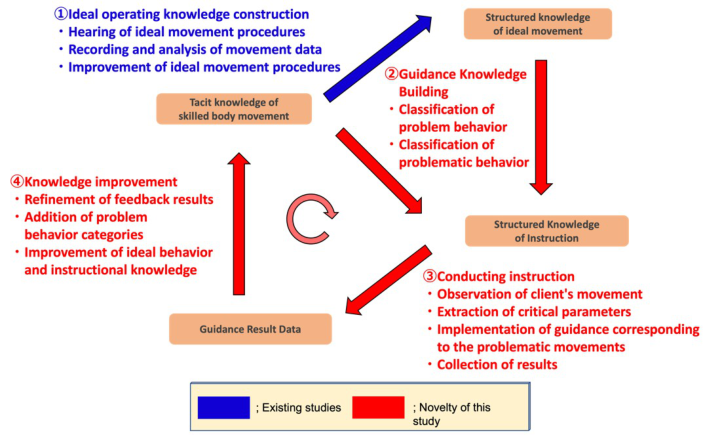
Proposal for a User Feedback Data Knowledge Structuring Method In this section, we propose a user feedback-based data knowledge structuring method for comprehensively extracting tacit knowledge of physical activity instructors. As shown in Figure 1, the proposed method consists of four steps: extracting the tacit knowledge of skilled instructors and continuously structuring the knowledge by repeatedly providing feedback to users. In the proposed method, step (1) has been proposed in an existing study (Yoshida, et al., 2022). Compared to previous studies, our method newly proposes (2) construction of instructional knowledge, (3) implementation of feedback, and (4) knowledge improvement by scrutinizing feedback results.
(1) Ideal Body Movement Knowledge Construction First, as in the previous study (Ijuin, et al., 2022), procedural knowledge is constructed by interviewing skilled persons about ideal body movements. In
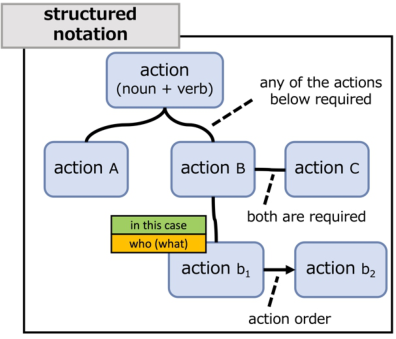
Figure 1: Schematic diagram of the proposed method.Figure 2: Structured notation of CHARM.
this study, the skilled person’s knowledge is structured using the structured notation shown in Figure 2. This method, called CHARM, describes that in order to achieve a node in the upper layer, a node in the lower layer is exe- cuted, and actions are basically described by nouns and verbs. In Figure 2, either (action A) or (actions B and C) (OR) must be performed to achi- eve the top-level action. In addition, both (action B) and (action C) require (AND). In addition, each action is assigned a condition (green) and a sub- ject (orange), which makes the procedure clear because the actions can be described concisely.
Next, motion data is recorded using physical movement measurement equipment, and this data is examined by a skilled person to improve procedu- ral knowledge. Motion data such as motion capture, floor reaction force, and
Knowledge Structuring of Skilled Sports Trainers - For Correct Movement 191
eye movement are recorded and analyzed to improve the knowledge structu- red by interviews. This is because there are cases in which there are differences between what a skilled person says and the actual movements. For example, even if a skilled person says, “Put the weight on the inside of the left foot,” the actual movement recorded by a floor reaction force meter may be more correct if the skilled person says, “Put the weight on the whole of the left foot. Thus, there are many cases in which the words uttered by the skilled person differ from the actual measured data. Therefore, when the client recei- ves the words and performs the movements himself, he may end up making a mistake. In order to accurately extract tacit knowledge, we analyze how the body should be moved by measuring the movements and improve the knowledge.
Furthermore, data fusion type structured knowledge is created by adding the measurement result data to the structured knowledge of work procedures using the link function of the knowledge construction system. The knowledge is further clarified by adding motion data such as motion capture and eye movement to the structured knowledge. This has already been demonstrated in previous research.
(2) Instructional Knowledge Construction Based on the experience of experienced trainers, movements with problems that differ from the ideal are taken up, and the conditions of these movements are created using numerical data. This allows the construction of instru- ctional knowledge such as “be conscious of raising the head” for specific conditions such as “when the trunk is tilted to the right by 10 degrees or more”. This will build up the knowledge of how to use language to correct movements that deviate from the ideal movement.
(3) Implementation of Instruction A feedback system using the structured knowledge of the instruction method is developed. The physical knowledge acquisition support here refers to con- tributing to the prevention of disability and promotion of improvement of the client by providing feedback on the skilled person’s knowledge of the physical movements. In the knowledge structuring of work procedures con- ducted in (1), data was recorded using various measurement devices in order to accurately describe knowledge. However, the feedback system proposed in this section is implemented using a simpler data recording method than (1). For example, a skeletal detection technique from images is used instead of a motion capture system, a thin insole-type foot pressure sensor is used instead of a floor reaction force meter, and a wearable eyeglass-type eyeglass measurement device is used instead of a large eyeglass measurement device. This makes it easier for clients to receive instruction from skilled personnel. The system also collects a record of the client’s posture and movements and the feedback provided by the AI.
(4) Knowledge Improvement In this step, the structured knowledge is improved. Specifically, we interview the instructor to determine whether the comments output from the feedback
system are appropriate, and improve the structured knowledge. Furthermore, the comments output from the improved system are interviewed to see if they are appropriate, and the structured knowledge and the system are improved.
Construction of a Physical Movement Acquisition Support System In this section, we implement the data knowledge structuring presented in section 3 and evaluate its usefulness. As an example, basic body movements are taken up. The author, Yamamoto, possesses tacit knowledge that can clearly grasp the physical condition of an athlete’s body based on three types of basic body movements (one-legged stance, squat, and lunge) performed by the athlete. Based on information such as the body’s wobble, leaning, and muscle tension during the basic body movements, the balance of the left and right muscles and the athlete’s characteristics can be extracted. The system provides accurate feedback based on the condition of the athlete to prevent injury and promote progress, and this support system has been accepted at the national team level. As an example, Yamamoto’s knowledge of physical movement is structured and a feedback system is constructed. Specifically, among the three basic body movements used by Yamamoto, we focused on the one-legged standing posture, which is used to identify the axis.
Table 1. Number of hearings held to date, dates, time required, and form of implementation.
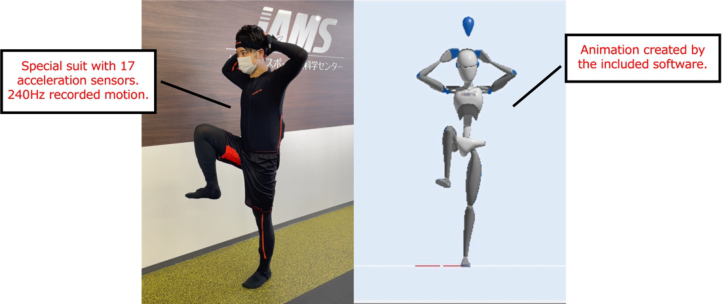
Figure 3: One-legged standing position performed by a skilled sports trainer.
Knowledge Structuring of Skilled Sports Trainers - For Correct Movement 193
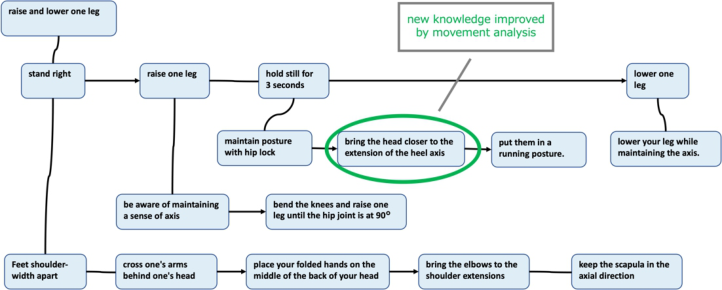
Figure 4: Structured knowledge of the procedure for raising and lowering one leg correctly.
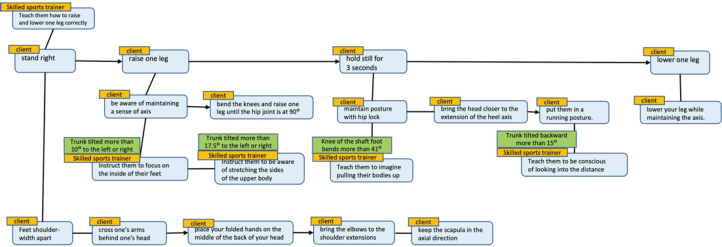
(2) Instructional Knowledge Construction The instructional knowledge was assigned by conducting interviews, and the skilled sports trainers structured the knowledge to teach the correct way to raise and lower one leg. Figure 5 shows a part of the instructional knowledge. The subject of the action (orange) gives feedback (light blue) according to the condition (green). In this study, as an example, only the tilt of the trunk was used as a condition, and the feedback knowledge was structured accordin- gly. This knowledge was constructed by interviewing skilled sports trainers and presenting them with diagrams in which the joint angles were changed by several degrees, and extracting feedback knowledge to explain the situ- ation and improve it. New instructional knowledge was structured through the interviews in this experiment, totaling 20 nodes, 4 of which contained conditions.
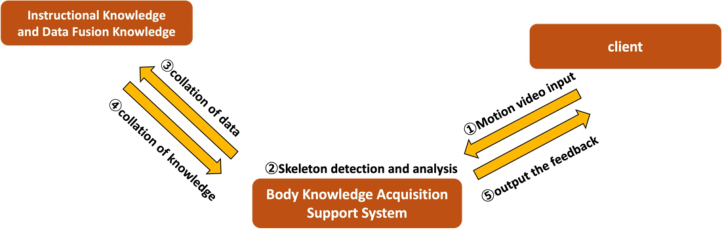
(3) Implementation of Instruction Figure 6 schematically illustrates the system proposed in this study. As shown in Figure 6, when a kleito inputs a video, the system performs skeletal dete- ction and analysis, and feedbacks the trainer’s knowledge by matching it with the instructional knowledge and data fusion type knowledge. KAPAO was
Figure 5: Structured knowledge to teach how to correctly raise and lower one leg.Figure 6: Schematic diagram of the proposed system.
used for skeletal detection; KAPAO simultaneously detects and fuses human pose objects and key point objects for posture estimation.
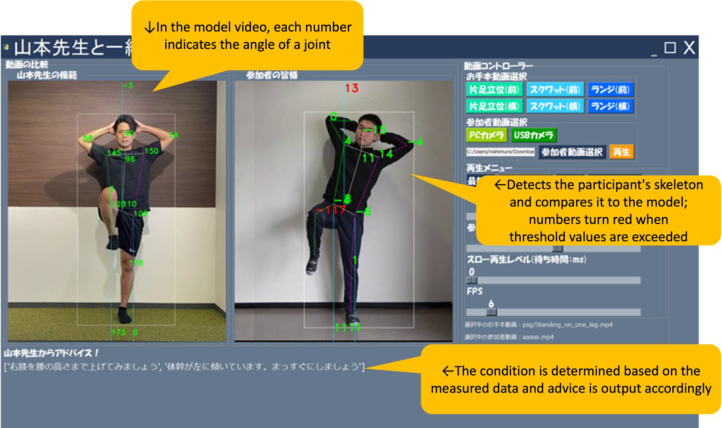
When using the system, a camera is placed in front of the client, and the client stands parallel to the camera. Figure 7 shows the user interface of the developed body movement support system. The left side of the screen shows a video of an ideal movement, and the right side shows a video of a movement performed by the client. The ideal side shows the actual joint angle (in degrees), and the participant side shows the joint angle dif- ference from the ideal (in degrees). The difference is obtained as “ideal - participant,” and a threshold value for the joint angle difference is set in the.csv file based on the knowledge of an experienced sports trainer, which is used to provide motion guidance when the difference exceeds a specific value. If the value is exceeded, the value on the participant’s side changes to red.
As an example, the participant’s torso tilt (the number above his head) is red, which means that the participant’s posture has exceeded the threshold
Figure 7: User interface for physical movement support systems.
Knowledge Structuring of Skilled Sports Trainers - For Correct Movement 195
value for the torso tilt. Three light blue vertical lines are marked in the figure, and the angle difference is indicated at the end where the lines move away from the person. This is a guideline for displaying the tilt of the trunk in relation to the vertical direction and the angles of the left and right hip joints.
(4) Knowledge Improvement Experiments were conducted on three male university students to verify the accuracy of the system. The proposed system shown in Figure 6 was used as the experimental equipment, and only one-leg standing movement was used as the target movement for a simple evaluation of the system.
The accuracy of the messages was verified by comparing the messages output from the feedback system with the messages actually stated by the trainers. Verification was based on the number of points of agreement in the “situation” and “improvement comments,” i.e., six items for three people of two types.
Based on these results, we improved the knowledge of guidance according to the tilt of the trunk, which means that a part of the structured knowledge with guidance knowledge created in the previous section has been impro- ved. By updating the system based on this structured knowledge, additional messages are output.
CONSIDERATION In this evaluation experiment, to assess the accuracy of the system, we com- pared the messages output by the system for the movements of three subjects with the actual messages given by the trainer. The results showed that only one of the six messages matched. The authors believe that there are two reasons for this result.
(1) Skilled sports trainers generate models from multiple perspectives and provide feedback according to the models. (2) Because the circulation of knowledge was not conducted and the degree of completion of structured knowledge was not high.
First, let us explain point (1). When we interviewed skilled sports trainers, they generated models based on multiple conditions and provided feedback according to the models. Improvement comments, specifically, “Let’s extend the upper body,” were also made based on the client’s physique, background, and sports competition history, in addition to conditions such as “flexion in the knee of the axis leg,” “right shoulder blade centration not maintained,” “left side trunk collapsed,” etc. The trainer also made comments on the cli- ent’s physical condition, such as “the right side of the body is not centered,” “the right side shoulder blade is not centered,” etc. In other words, feed- back is not provided based solely on trunk tilt information, as was done in this simple evaluation experiment. Therefore, one of the reasons for the low agreement rate in this evaluation experiment is thought to be that the system was verified using only trunk tilt information.
Next, we explain point (2). In this experiment, knowledge circulation was not conducted once, and the quality of the instructional knowledge was not
sufficient. This is thought to be the reason for the low agreement rate. The quality of the structured knowledge is normally enhanced by conducting this kind of knowledge circulation several hundred times. In fact, the knowledge circulation conducted in 5.5 showed improvement in two of the 22 nodes of the instructional knowledge. Therefore, one of the possible causes is that the knowledge circulation was not sufficient.
CONCLUSION
This paper proposes a user-feedback data knowledge structuring method for physical movement instructors. First, interviews were conducted with skilled trainers, and at the same time, motions were recorded using motion capture to structure ideal knowledge. Next, the conditions of typical problematic movements shown by skilled sports trainers were assigned as numerical data, and the words to improve them were assigned as instructional knowledge. We then developed a feedback system based on this structured knowledge, and improved the knowledge by examining the results. As a result, kno- wledge that the sports trainers had not told before was extracted, and the effectiveness of the system was confirmed.
On the other hand, it is not clear what percentage of the total know- ledge was extracted from the sports trainers. Future tasks are to improve the structured knowledge by collecting more data, and at the same time, to improve the system by comprehensively extracting the tacit knowledge of skilled trainers.
ACKNOWLEDGMENT
This work was supported by the New Energy and Industrial Technology Development Organization (NEDO) JPNP18002.
REFERENCES
Ijuin, K., Kobayakawa, M., Ino, N., Nishimura, T. (2022) “Methodology of Structuring Knowledge by Discussing Purpose of Each Action in Procedure-based Kno- wledge Graph: Structuiring Purpose-based Knouwledge Graph with Care-giving Experts”, Information Processing Society of Japan. Vol. 63, No. 1, pp. 104–115. Maruyama, H. (2004) “Trends in Rehabilitation of the Elderly”, Transactions of the
Society of Physical Therapy Science. Vol. 19, No. 3, pp. 163–167. Yoshida, H., Huziwara, Y., Kumagai, O., Shinkai, S., Hoshikawa, N., Tsutiya, Y. (2004) “Creation of a database for economic evaluation of long-term care pre- vention - Medical and long-term care benefit costs by level of independence of the elderly”, Welfare Indicators. Vol. 51, No. 5, pp. 1–8. Yoshida, Y., Ino, N., Nishino, T., Saito, T., Nishimura T. (2022) “Practice and
Analysis of Lnowledge-data Integration in Self-reliance Support for Elderly Using Remote Technology”, Information Processing Society of Japan. Vol. 63, No. 1, pp. 116–128.
LISTED IN THE AHFE DIGITAL BOOKSTORE CATALOGUE
Explore the complete digital volume
The Human Side of Service Engineering
Read this individual research paper free through the original publisher, or explore the full digital proceedings book.
ISBN 978-1-958651-84-1
Explore this ISBN in the AHFE Bookstore ↗Listed in the July 2026 bookstore catalogue; search by ISBN to confirm current availability · Digital book purchase optional