Chiaki Oshiyama, Takuichi Nishimura (2023). Development of an ontology that connects clinical psychology knowledge and Top Ontology. In: Emerging Technologies in Healthcare and Medicine. AHFE Open Access, vol. 116, pp. 239–245. https://doi.org/10.54941/ahfe1004377
In clinical psychology, various techniques are used to improve the mental state of subjects..In clinical psychology, there are areas for each technique, and problem-solving cases have been reported for each area. There are various approaches to solving the same problem. Some of these elements are common and some are different. However, because they have been reported separately, knowledge sharing beyond each domain has not been carried out. In recent years, ontologies related to clinical psychology have been developed. Clinical medicine ontology CONAND (Clinical Ontology in Anatomaical Structure and Disease) and The Behavior Change Intervention Ontology (BCIO) are ontologies related to medicine and behavioral change. These are very useful for searching clinical medicine and methods for behavior modification. However, it is not possible to retrieve the specific contents of actual problem solving in clinical psychology. In order to solve these problems, it is first necessary to extract knowledge from clinical psychology cases and clarify their relationships. So far, we have extracted and structured knowledge from several case studies and the practice of one psychotherapy technique, and by conducting workshops based on this knowledge, we have elaborated the structured knowledge and formalized tacit knowledge that can be verbalized. I have made knowledge and arranged it in the structure. By structuring the knowledge and actions taken to solve the problem in a goal-oriented manner, we clarified the relationship between the procedure to achieve the goal and the practice action to clear each stage. Through these activities, clinical psychologists were able to realize the meaning of actions in the activities and practice methods that they had unconsciously performed so far, and to acquire metacognition in practice. Next, we extracted important words from this knowledge and created an ontology based on them. By having this ontology scrutinized, we would like to connect it to existing ontologies related to clinical psychology, such as CONAND and BCIO. Our ultimate goal is to make it possible to retrieve structured knowledge that visualizes how problems were solved in cases from the system. There are various techniques in clinical psychology. At present, it largely depends on the ability and intuition of clinical psychologists to determine which technique is better for solving the problem. In the future, we would like to develop AI that can propose more appropriate methods by incorporating various information into this system.
There is a concept of “clinical knowledge” as knowledge that contributes to clinical practice required of experts in the fields of psychology and educa- tion (Nakamura, 1992). Nonaka et al. (1996) defined “tacit knowledge” as “subjective personal knowledge, and empirical physical knowledge, or clinical knowledge (practical knowledge)”. In addition, “theoretical knowl- edge, which is objective rational knowledge,”is cited as “explicit knowledge,” which is in opposition to this. According to Nonaka et al., “tacit knowledge” has two aspects: a technical aspect (know-how, etc.) and a cognitive aspect (mental model, thoughts, etc.) On the other hand, the cognitive side is the foundation that supports the technical side, but it is generally easier to con- vey the technical side, and the cognitive side is often overlooked. In clinical psychological treatment, experts use their own knowledge as “explicit knowl- edge”and “tacit knowledge”in the “actions”of treatment in order to provide problem-solving care.
Knowledge in Clinical Psychological Treatment In clinical psychological treatment, experts use their own knowledge as “explicit knowledge” and “tacit knowledge” in the “actions” of treatment in order to provide problem-solving care. In clinical practice, including the field of elderly dementia, experts in various fields (medicine, nursing, phar- macy, physical therapy, occupational therapy, nursing care, etc.) use their knowledge in a formal way to solve problems. In recent years, interdisci- plinary collaboration has been actively practiced in clinical settings. Whether or not this has an effect on the subject in a certain way has not yet been expressed in a fixed form. It is effective to clarify the procedure and purpose of the action (Oshiyama, 2019). By structuring clinical knowledge, including explicit knowledge and tacit knowledge, relationships between knowledge that were not visible until then become clear. It is useful for planning and reviewing clinical interventions (coping methods).
Problems of Clinical Protocol Mayer (1985)divides knowledge whose written content mainly explains con- cepts, facts, and mechanisms into declarative knowledge, and knowledge whose text explains operating methods and procedures as procedural knowl- edge. The former corresponds to scientific papers and editorial texts, and the latter corresponds to manual texts. The protocol for “cognitive behavioral therapy” expresses declarative knowledge and procedural knowledge, which are the “knowledge” used in clinical practice using “cognitive behavioral therapy.” Generally, clinical knowledge is published in books or disclosed in the form of case studies. From them, the clinician learns knowledge “for- mally.” However, there are cases where the care procedure changes according to the change of the care recipient that occurs in front of us. Therefore, it is difficult to provide care corresponding to various contexts only by referring to the protocol. Furthermore, some of the knowledge and know-how used in
Development of an Ontology That Connects Clinical Psychology Knowledge 241
actual care situations is “tacit” and unique to individual professionals. If the “formal” and “tacit” knowledge of such clinicians is comprehensively shared in a format that is easy to understand and reuse, it is thought that the training of new staff and the accuracy and speed of care will improve.
Application of Knowledge Expression Method We focused on knowledge-based methods that link various types of infor- mation and connect them semantically. Intervention procedures expressed in the protocol and actions aimed at problem solving by clinicians are expressed in a certain way using the “goal-oriented knowledge structuring incorporat- ing procedures” proposed by Ijuin et al. (2022). By doing so, we visualized the structure. Researchers with experience in structuring and research assis- tants structured and described knowledge about common behaviors based on protocols for care. This is a method called “knowledge expression” that enables individuals to acquire specific knowledge. In addition, We aimed that by extracting the “tacit knowledge” possessed by experienced psychologists from the supervision and placing it in an appropriate position, we are able to describe actions that include “tacit knowledge” for care. We aim to improve interpretation, understanding and inference of knowledge for humans and machines by adapting clinical explicit knowledge and “tacit knowledge” to various contexts.
Oshiyama, in “Objective-oriented knowledge structuring of pro- cesses aimed at expanding psychological support capabilities by AI” [oshiyama2019], extracts actions in cases of psychological support as knowl- edge and structures them in a goal-oriented manner to We have described the process of achieving support goals. As a result, the purpose and relation- ship of actions performed in support became clear. In addition, Oshiyama et al., “Visualization of nursery teacher’s tacit knowledge using knowledge structuring ∼For efficient acquisition of childcare skills” [oshiyama], gave a specific example of a goal for nursery teachers and asked, “What do you need to do to achieve it? Do you want to do it?”, the knowledge obtained by conducting a workshop in which the answer is found is struc- tured in a goal-oriented manner, and the difference between the viewpoints of experienced and new nursery teachers was clarified. In Ijuin et al. (2022), in order to build a system that can acquire and share expert knowledge (purpose of action, etc.), which is not sufficiently included in manual knowl- edge sharing, the purpose of action in the work procedure is expressed. By structuring and making proposals, we were able to reflect on multiple tasks based on objectives and deepen common understanding. In addition, Ijuin et al. advocated the usefulness of the process of externalizing tacit knowledge, such as the acquisition of specific knowledge that had not been sufficiently verbalized, and followed the method of knowledge expression targeting nursing care sites. We report that we have adopted a method of acquiring and building knowledge directly from caregivers in the field. Subsequently, Oshiyama et al. (2023) proposed to share more useful clini- cal knowledge by connecting concrete knowledge of clinical cases to meta classification by ontology. From the above, it is thought that structuring
242 Oshiyama and Nishimura
knowledge makes actions including procedures for problem solving easier to understand, brings various awareness to supporters, and deepens common understanding.
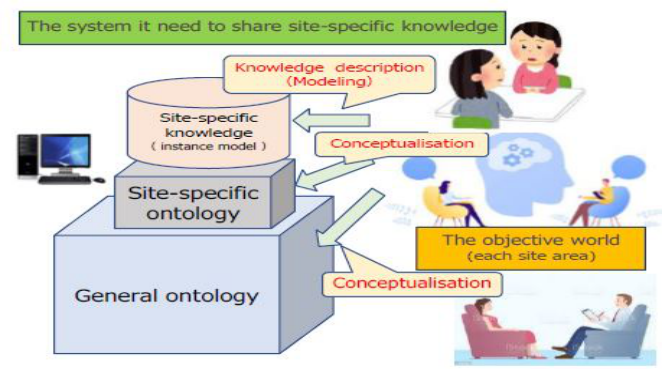
Intermediate Ontology In Oshiyama et al., “Visualization of nursery teacher’s tacit knowledge using knowledge structuring ∼For efficient acquisition of childcare skills” (Oshiyama et al., 2023), we proposed constructing an ontology to structure the knowledge of nursery teachers and connect the created knowledge with higher-level ontology. This is because the definition of vocabulary becomes clearer and it becomes possible to express without blurring. It is also thought that the accuracy of the search system will improve. This time, we will report on the creation of an “intermediate ontology”that connects structured clinical knowledge to a higher-level ontology.
Figure 1: Image connected by intermediate ontology of human systems integration.
METHODS
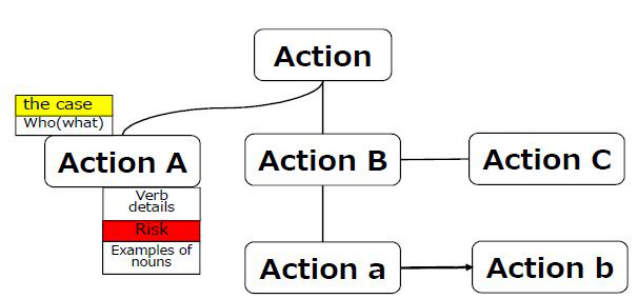
Knowledge Structuring Method We used a goal-oriented knowledge structuring method that incorporates procedures with the aim of describing the actions to be performed along with their rationale. By connecting the steps of actions described in each layer with the relationship of purpose, we visualized the relationship between each step (see Figure 2). Nishimura’s goal-oriented knowledge structuring (Nishimura et al., 2013) is a method in which the action that is the goal that one ulti- mately wants to achieve is listed at the top, and the actions to be taken to achieve it are listed below. Basically, the goal is to achieve the above action. By placing the actions necessary to do so below and connecting them with lines, the relationship between each action is expressed in a goal-oriented manner.
Development of an Ontology That Connects Clinical Psychology Knowledge 243
Figure 2: Expression method of Nishimura’s goal-oriented knowledge structuring [2013]. Actions connected by a horizontal line indicate that by performing both, the action that is placed one above and connected is achieved. If there are branches, it means that the above action can be achieved by performing either action. In addition, when the horizontal line is an arrow (→), it represents the order of actions, and by this, the procedure can be described.
Creating an Intermediate Ontology Words (nouns) were extracted from the structured knowledge and defined as an ontology.
CONSIDERATION AND CONCLISION Result of Knowledge Structuring
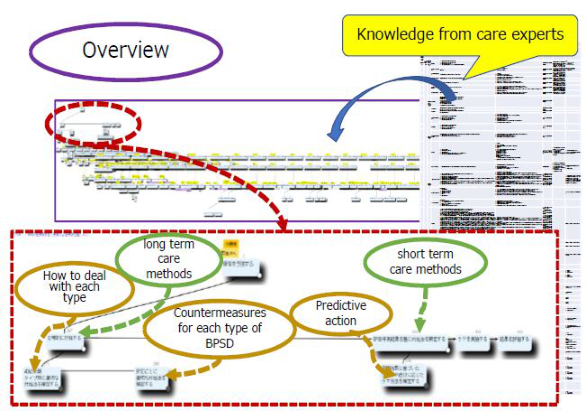
Figure 3: Example of structured clinical knowledge results.
244 Oshiyama and Nishimura
We extracted and structured consciousness from data collected by clinical experts (see Figure 3). For structuring, we used kNeXaR (Iino et al., 2018), a system that supports knowledge structuring, to make structured data com- puter readable. Long-term care methods (care knowledge based on dementia classification method 4DAS and coping knowledge based on BPSD type) and short-term care (care knowledge based on BPSD extracted from predictive AI) are incorporated from Excel tables. It is structured in a purpose-oriented manner.
Creating an Intermediate Ontology From the Knowledge Structuring
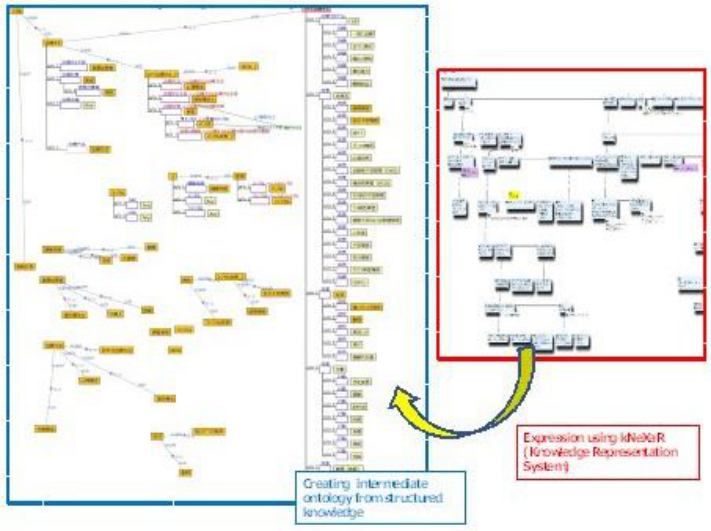
Figure 4: Creating an intermediate ontology from the knowledge structuring.
Each anecdotal knowledge statement has its own wording and each one is specific. There are some parts that cannot be described using ontology alone. It is necessary to present a problem-solving method based on knowledge structuring (visualization) of cases. First, we visualize clinical problem- solving methods based on certain rules. Visualization provides a clear path to problem solving. To make the unique clinical knowledge created search- able, we extract words from the created structured knowledge and create an intermediate ontology from it. This allows us to organize clinically relevant ontologies. Intermediate ontologies can be connected to existing higher- level ontologies. Examples of higher-level ontologies include those related to healthcare and behavior change, such as his CONAND (Clinical Ontology in Anatomy and Disease) (T. Imai et al., 2009) and Behavior Change Interven- tion Ontology (BCIO) (Michie S et al., 2019). These are extremely useful in
Development of an Ontology That Connects Clinical Psychology Knowledge 245
clinical medicine and in the search for behavior change methods. This links the visualized problem-solving instance and the higher-level ontology and makes it searchable.
ACKNOWLEDGMENT
This work was supported by JSPS KAKENHI Grant-in Aid for Transforma- tive Resarch Areas (B).
REFERENCES
Chiaki Oshiyama, Takuichi Nishimura. (2021). Goal-oriented knowledge structuring of processes aimed at expanding psychological support capabilities ∼Through the case study of music therapy. Collection of abstracts from the 9th Service Society National Conference. pp. 1–14 (in Japanese). Ikujiro Nonaka, Takahiro Takeuchi. (1996). Knowledge creation company. Toyokeizai Inc. pp. 88–90 (in Japanese). Koki Ijuin, Maiko Kobayakawa, Nami Iino, Takuichi Nishimura. (2022). Proposal
of a method to express and structure the purpose of actions in work procedures - goal-oriented knowledge structuring in nursing care settings. IPSJ Transactions on Journal. (Web) 63(1) (in Japanese). Mayer, R. E. (1985). Structural analysis of science prose : can we increase problemsolving performance? In B. K. Britton & J. B. Black (Eds.), Understanding expository text. New Jersey: Lawrence Erlbaum Associates. pp. 65–87, 1985. Nami Iino, Satoshi Nishimura, Takuichi Nishimura, Mio Suzuki, Kenichiro Fukuda,
Hideaki Takeda. (2018) Diagrammatic representation of action process based on guitar playing ontology, Japanese Society for Artificial Intelligence research group materials Vol. 45, No. 5, pp. 1–4 (in Japanese). Nishimura, S. et al. (2013). CHARM as Activity Model to Share Knowledge and Transmit Orocedual Knowledge and its Application to Nursing Guide- lines Integretion. Journal of Advanced Computational Intelligence and Intelligent Informatics, (17) 2, 208–220. Michie S, Carey RN, Johnston M, Rothman AJ, de Bruin M, Kelly MP, Connell
LE. (2018) From Theory-Inspired to Theory-Based Interventions: A Protocol for Developing and Testing a Methodology for Linking Behaviour Change Techniques to Theoretical Mechanisms of Action. Ann Behav Med. May 18;52(6): 501–512. Doi: 10.1007/s12160-016-9816-6. PMID: 27401001; PMCID: PMC6367898. Oshiyama, C., Ishiwatari, I. & Nishimura, T. (2023).: Visualization of nursery teacher’s tacit knowledge using knowledge structuring∼for efficient acquisition of childcare skills∼The Human Side of Service Engineering. AHFE Open Access, 108. DOI: 10.54941/ahfe1003121. T. Imai, H. Kou, J. Zhou, K. Kozaki, R. Mizoguchi, K. Ohe. (2009) Japan
Medical Ontology Development Project for Advanced linical Information Sys- tems. Proc. Of 10th. International HL7 Interoperability Conference (IHIC2009). pp. 42–46. Yujiro Nakamura. (1992). What is Clinical? Iwanami Press. pp. 12–13 (in Japanese).
LISTED IN THE AHFE DIGITAL BOOKSTORE CATALOGUE
Explore the complete digital volume
Emerging Technologies in Healthcare and Medicine
Read this individual research paper free through the original publisher, or explore the full digital proceedings book.
ISBN 978-1-958651-92-6
Explore this ISBN in the AHFE Bookstore ↗Listed in the July 2026 bookstore catalogue; search by ISBN to confirm current availability · Digital book purchase optional