Leonard Walletzký, Zuzana Schwarzová, Janka Marschalková, Klára Kubíčková (2024). Role of T-shape in IT academic research. In: The Human Side of Service Engineering. AHFE Open Access, vol. 143, pp. 98–107. https://doi.org/10.54941/ahfe1005088
The T-shaped model of education, which combines a broad understanding of various IT domains with deep expertise in a specific area, is a valuable approach for preparing students to contribute effectively to multidisciplinary teams. However, the role of T-shaped experts in academic research deserves more attention. This abstract explores how T-shaped expertise can enhance interdisciplinary collaboration, foster innovation, and advance IT academic research.The T-shaped model enables researchers to bridge disciplinary boundaries and collaborate across diverse fields within IT academia. Interdisciplinary collaboration, a key aspect of the T-shaped approach, allows researchers to integrate their strengths to address complex problems, leading to innovative solutions and transformative discoveries. It also promotes a holistic understanding of IT phenomena and uncovers new research opportunities at the intersection of technology, society, and the environment.Effective communication and collaboration skills are emphasised in the T-shaped approach, facilitating interdisciplinary research endeavours. By fostering a culture of open dialogue and knowledge sharing, interdisciplinary teams can leverage the collective intelligence of their members and maximise the impact of their research outcomes.This abstract also presents the methodology of managing, maintaining, and developing a team of T-shaped members, using the Laboratory of Service Systems at the Faculty of Informatics, Masaryk University, Brno, Czech Republic, as an example. The laboratory’s wide-ranging aims include Smart Service systems, such as Smart Cities, the application of Open Data, data quality investigation, analytical work in the domain of Smart services, and methodological expertise in the domain of Smart Cities. The lab members collaborate in synergy, work on various types of projects, grow through these experiences, and contribute to the lab’s diverse tasks. Their T-shaped knowledge is crucial for achieving this synergy. The paper also discusses the successful collaboration of the lab with external partners, such as companies and public institutions, and how it benefits both the academic and the practical aspects of the research. Best practices will be presented in the paper.
In the ever-evolving service sector, the demand for well-rounded experts is escalating. While the business aspects of service design are extensively docu- mented, the research domain remains relatively uncharted. This paper seeks to bridge that gap by examining the role of T-shaped researchers within the IT faculty’s research groups and laboratories. The T-shaped model, charac- terised by a deep understanding of a specific discipline complemented by a
broad knowledge across multiple areas, is widely endorsed as the optimal knowledge structure for fostering innovation.
However, some scholars propose alternative structures, such as the π- shaped model, which incorporates two areas of deep expertise (Saukkonen and Kreus, 2022) The significance of a well-structured knowledge base in service research cannot be overstated. It is essential for grasping the essence of complex problems, discerning the intricate interconnections between var- ious contexts, and devising truly groundbreaking solutions. The T- shaped framework facilitates such comprehensive understanding and is increasingly recognized as vital for advancing IT disciplines, particularly in applications related to artificial intelligence and augmented reality (Spohrer et al., 2022; Demirkan and Spohrer, 2015) This paper explores the impact of T-shaped researchers in IT research groups and laboratories. Given the challenging nature of IT, which demands both specialized and interdisciplinary acumen, the study underscores the necessity of a unique knowledge structure. By exploring the T-shaped paradigm and its alternatives, the paper contributes to a deeper comprehension of how knowledge architecture can influence innovation and service design in the digital age.
KNOWLEDGE ARCHITECTURES Different Shapes
In contemporary educational models, we observe various approaches that illustrate the multidisciplinary paradigm. The most prevalent are:
I-shape: This is a common model in university or higher education. It rep- resents individuals who are experts in a single domain, possessing deep knowledge of one system. I-Shaped individuals are specialists in their field, offering a high level of expertise. However, they may lack a broader perspective and collaborative skills.
Dash shape: This model is designed for multidisciplinary work. Individu- als with this educational model are not experts in any single domain but are well-equipped to interconnect various domains. This type of education is well-suited for I-shaped individuals who need to expand their ability to communicate and be a valuable part of multidisciplinary teams.
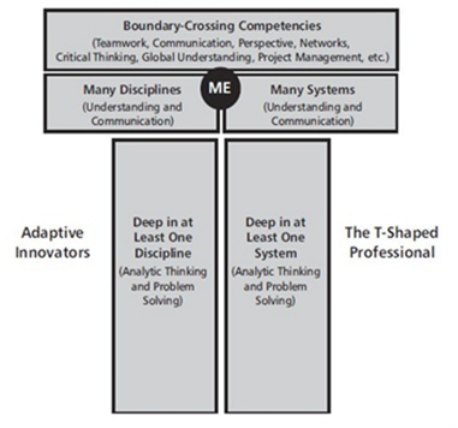
T-shape: The letter ‘T’ is a paradigm that signifies that every professional has achieved a certain level of depth in a system or field of expertise (the stem of the T) and some level of breadth across many systems or disciplines (the top of the T) (Spohrer et al., 2022).
π-shape: This is a relatively new concept that expands upon the idea of T-shaped professionals. It signifies that an individual’s expertise spans not just one, but two deep domains. For instance, a n-shaped professional could possess expert-level knowledge in UX design and data mining. These experts are quite rare, yet their value and contribution to discovering inno- vative solutions can be significantly impactful. Logically, the demand for such experts is expected to increase in the future.
Figure 1: T-shaped knowledge architecture (Spohrer et al., 2022).
T-Shape The role of T-shaped education and knowledge profile has been already proved by many authors. Also, some authors already investigated the signif- icant role of T-shaped experts for the research (Freud et al., n.d.) The main design of the T-shaped knowledge has been also already unified (Fig. 1).
But still, there seems to be a significant gap in the research – and it is the importance of T-shaped experts for academic research, the transfer of innovation and the collaboration with the business entities.
It should be clear that having the T-shaped expert in the team of the research lab could help with the overlaps to the other disciplines, mostly with the communication with the external partners or experts and getting the new perspectives to the solutions or their usage in the real life.
The main question also is how the researchers (mostly PhD candidates and Junior researchers) are evaluating their knowledge profile – do they find themselves as T-shaped experts? Do they evaluate it as an advantage for their research?
And finally the key question – does the T-shaped knowledge structure mean the advantage for the research?
CASE STUDY For our initial case study, we have chosen the environment of the Faculty of Informatics of Masaryk University (FI MUNI). The research map of the faculty shows that we are covering a wide array of topics related to computer science. With respect to the ACM CCS classification, many laboratories are addressing more than one topic. Based on this, we can formulate a hypothesis that a T-shaped combination of knowledge and skills should be a natural
Role of T-Shape in IT Academic Research 101
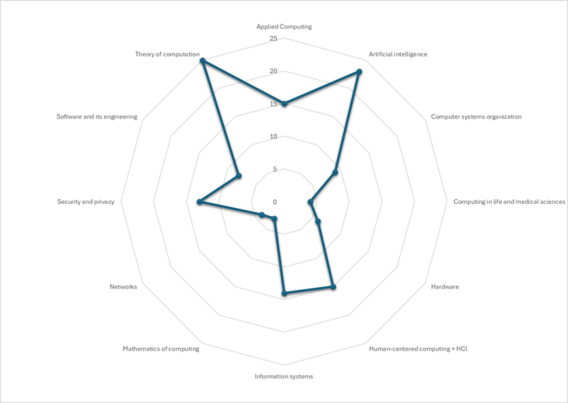
part of most scientists, PhD researchers, and candidates. The following figure (Fig. 2) illustrates the structure of research at the Faculty of Informatics.
The logic of the graph is derived from the number of research areas that are the focus of all FI MUNI laboratories. Each topic is counted as many times as any of its subtopics is mentioned as a relevant subtopic for the lab. From this figure, we can observe a strong emphasis on the Theory of Com- putation and Artificial Intelligence. However, less attention is given to typical T-shaped domains, such as Computing in Life and Medical Sciences or Com- puter Systems Organizations. Therefore, we can anticipate a continued strong I-shaped orientation.
Figure 2: Research map of FI MUNI, authors’ elaboration.
Types of Research Groups at FI MUNI Scientific research at FI is organized rather informally, within flexible research groups which can quickly respond to current challenges and trends in the scientific world. Currently, there are seven distinct research groups focusing on a wide range of relevant topics (Research Groups, 2024)
Formal Methods and Theory - distributed systems, algorithm design, dis- crete mathematics, computational complexity, graph theory, logic and systems biology
Artificial Intelligence - artificial intelligence, machine learning, natural language processing, and knowledge discovery
Security and Embedded Systems - cryptography, quantum information processing, digital systems design, and cybersecurity
Data Management - big data indexing, searching, multimedia processing, and electronic document management
Large Scale Distributed Systems and Networks - high-performance com- puting, big data processing, high-speed networking, and planning with scheduling
Enterprise Systems and Services - service systems, software architectures.
T-Shaped Teaching at FI MUNI Faculty of Informatics, Masaryk University, has one specialization of a study program that is explicitly focused on creating T-shaped professionals - Ser- vice Development Management. Its curricula reflects the contemporary shift towards an economy that is service-oriented rather than product-oriented. With IT challenges growing in complexity, mere technological expertise has become insufficient for effective problem-solving. This specialization empha- sizes a multidisciplinary approach, equipping students not only with essential IT skills but also with a comprehensive understanding of complex issues. Students will delve into areas such as marketing, management, finance, and law, alongside developing crucial communication competencies (FI MU Study Catalogue, 2023/2024 n.d.).
Laboratory of Service Systems (SeSLab), part of the Enterprise Systems and Services research group, is connected to the T-shaped specialization through the principles of Service Science, Service Design and System Thinking. The laboratory’s aim is to explore the possibilities of services provision and their IT support, which is similarly provisioned as a service, so that they bring maximal value to their users. Their primary research domain is Smart City, as a complex service environment, and studying the role and value of ser- vices and IT systems in various contexts of such environment. Furthermore, they work on the topics of smart services analysis, open data and its qual- ity, and smart cities methodologies research. SeSLab embraces the T-shaped approach and fosters multidisciplinary research. In all the different topics, they aim to apply a complex approach, based on the 4 Diamonds-of-Context model. It’s a specific model which helps to analyze and model the connec- tions between different contexts (Stanicek, 2009; Walletzky, Carrubbo, and Ge, 2019; Dragoicea et al., 2020) The model allows the inclusion of non- technical aspects into the model examples (human factors, social dimensions, etc.). This approach leads to a definition of new solutions that are better accepted by the cities, their residents, and other stakeholders because they bring more added value that all the involved parties clearly understand. The laboratory currently has twenty- five members and offers an environment where the Bachelor, Master and Doctoral students can work together in synergy. It is being managed using an agile methodology that was modi- fied specially for that laboratory by one of the former members (Svoboda, 2021) Members can apply their skills to a wide range of tasks, e.g. analytical, theoretical, programming, service design, service management, and service marketing (Laboratory of Service Systems, 2024; Webpages of the Labora- tory of Service Systems, n.d.) Especially for this practical collaboration, the T-shaped knowledge is a must when the students (and their tutors) should understand the needs and requirements and share the point of view with the representatives of municipalities.
Role of T-Shape in IT Academic Research 103
METHODOLOGY
The data for our case study were gathered by an on-line anonymous sur- vey that was sent to the leaders of all the research groups and laboratories affiliated with the Faculty of Informatics, Masaryk University, for them to share it with the researchers or students in their group. The question- naire consisted of combined closed and open questions, the open questions serving to provide examples and reasoning related to the closed questions. All the questions were elective, excluding the opening question that col- lected the respondents’ familiarity with the term T-shaped. The survey consisted of three main areas. First was the characterization of the respondent and their knowledge architecture, gaining insights into their competencies and research type. The second area focused on the proactivity of respon- dents regarding their self-education in other domains than their primary domain, studying the accompanying challenges and examples. The third part examined the general perception of T-shaped learning in an academic environment.
RESULTS AND ANALYSIS The survey has gained 24 respondents from 7 different research groups and laboratories. Due to the electiveness of the survey’s questions, the number of respondents for each question varies. For all the closed questions and for the open questions that weren’t asking for examples, the respondent quantity stayed in the range of 21 to 24 respondents, with the majority of the ques- tions being answered by all of the respondents. For the three open questions focusing on examples provided by the respondents, the number of answers dropped to 15–20 answers.
The introductory query tested the respondents’ familiarity with the T- shaped knowledge architecture, asking whether they have heard the term T-shaped before – it showed that the majority, 74% of respondents, have already been familiar with this concept. After the first question, a short description of the T-shaped knowledge architecture was presented, accompanied by the T-shaped model image.
The first main part of survey questions was focused on the respondents, their research, and their competencies in the primary and secondary skills domains. Firstly, the respondents were asked to characterize their research on a scale based on its applicability, and then based on its interdisci- plinary character. The gathered data shows that none of the respondents are working on solely theoretical research, and that more than half of the respondents are leaning towards applied research. Approximately 25% of participants chose the middle option of a scale, indicating that their research most likely falls in the middle and combines the theory and application in equal parts. The second characterization showed that more than 60% of respondents consider their research positively interdisciplinary, with only minimum answers choosing the option of research focused on using only one discipline.
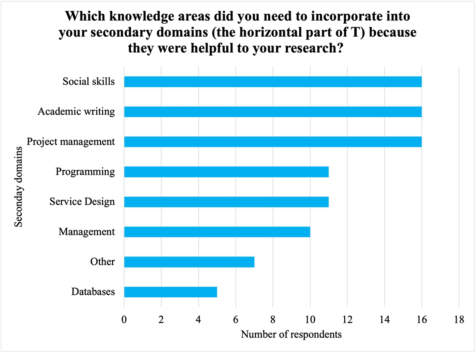
Figure 3: Secondary research domains, authors’ elaboration.
The next questions focus on the assessment of respondents’ primary domain skills (the vertical part of T) and the skills from secondary domains (the horizontal part of the T) that were needed to help their research. The answers for the primary domain skills were various, corresponding to the different focuses of research groups and laboratories, and furthermore to various research focuses of the individuals, e.g. visualization, human- computer interaction, software engineering, smart city, bioimage analysis, live-stream spectatorship, cybersecurity, or service science. For the secondary skill domains question (Fig. 3), the respondents were presented with a set of most likely skills to choose from, with an option to add their own. The three leading skills in the collected answers are academic writing - they need to be able to provide their research’s result to the scientific community in a suitable way, social skills - to gain potential collaborators at conferences or network- ing events, and project management - for leading their research teams or students. The other skills added by respondents included for example student supervision, psychology, biology, and UX design.
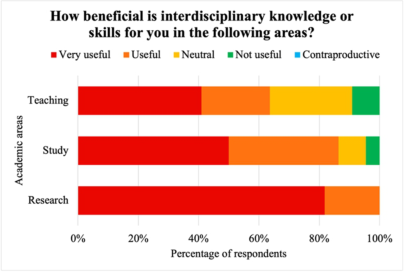
The first part of the survey was concluded by analyzing whether the researchers benefit from their T-shaped knowledge in the three domains typical for academic environment: teaching, studying and research (Fig. 4). Interdisciplinary knowledge has been marked mostly useful in all three aca- demic areas. In the research area, 100% of the respondents consider it useful, the majority of them even very useful. The situation is similar in the study area, the percentage of researchers declaring usefulness is slightly lower, approximately 85%. Interdisciplinary knowledge got the lowest usefulness score in the area of teaching, reaching only a bit more than 60%, combined with multiple neutral votes. The neutral votes can be interpreted as the votes from researchers that are not engaging in teaching courses or seminars at the university. The respondents were also prompted to provide some examples of cases when the interdisciplinary knowledge has been useful for them in one of the three areas. For all the three areas the answers have included effective communication with other interested parties, be it students, teammates, or
Role of T-Shape in IT Academic Research 105
fellow researchers. Specifically mentioned for research was the example of conferences and sharing knowledge from various domains, and the necessity of understanding the different domains in order to use them and improve your research. Regarding teaching examples, the respondents have highlighted the need to not only understand the subject they are teaching, but also the skills to present the knowledge or explain it in different ways to help communi- cation with students. For the study area, we have the skill of management applied on team projects.
Figure 4: Usefulness of interdisciplinary knowledge, authors’ elaboration.
The second part of the questionnaire was focused on self-education related to the T-shaped knowledge architecture. More than 75% of the respondents stated they do actively seek out opportunities to learn about subjects outside of their primary domain of study or research. The rest of the respondents placed lack of time as the reason for not doing so. The main challenges that the researchers are facing when broadening their secondary skills encom- pass likewise the lack of time, combined with the problematic availability of resources, such as language barrier with a domain specific terminology or the unsureness of a starting point to gain a sufficient introduction into the new domain. Multiple respondents emphasize the need to have a persisting mindset in order to brace these challenges. The following open question inves- tigated the examples of how the researchers seek out the opportunities for broadening their secondary domain skills. The respondents presented a com- bination of engaging in discussions with skilled people either at networking events, conferences or in the workplace, self-learning through papers, jour- nals, books, online learning platforms, or attending various learning events, such as conferences, workshops, lectures, or university courses.
The final part of the questionnaire, focused on the general perception of T-shaped knowledge and interdisciplinary approach in the academic context, consisted of two main questions. The first question linked the usage growth of AI and machine learning with the need for an interdisciplinary approach. More than 75% of respondents agreed that interdisciplinary approach will gain increased significance. Moreover, one of the respondents believed that this would happen regardless of the influence of AI and machine learning.
The second question (Fig. 5) focused on T-shaped learning at different aca- demic levels. All the respondents at more than 80% agreed or were at least neutral on supporting the interdisciplinary learning opportunities at the level of Master’s and Doctor’s studies, and in academic research in general. The case of supporting T-shape at the Bachelor’s level was different, with only approximately 50% in agreement, the rest neutral or even in a disagreement, suggesting that the Bachelor’s studies should be focused more on gaining an expertise only in one domain, and leaving the interdisciplinary learning for later academic activity.
CONCLUSION
The T-shaped knowledge architecture is widely recognized among researchers, with a majority being familiar with the concept. This architecture, which emphasizes both depth and breadth of knowledge, is indicative of a research community that values versatility and adaptability. The survey’s findings reveal a clear preference for applied research, with a significant number of respondents also valuing a balance between theoretical and practical applica- tions. This trend reflects the evolving nature of research, which increasingly seeks to address real-world problems and offer tangible solutions.
Interdisciplinary research is becoming increasingly important, as evidenced by the 60% of respondents who consider their work to be cross-disciplinary. This approach is not only prevalent but also diverse, with primary domain skills varying widely among respondents. However, certain secondary skills such as academic writing, social skills, and project management are consis- tently identified as vital for research success. These skills facilitate effective communication, collaboration, and leadership within the research commu- nity, underscoring the importance of a well- rounded skill set in academia.
The pursuit of interdisciplinary knowledge is strong, with over 75% of respondents actively seeking learning opportunities outside their primary field of study. This eagerness to expand one’s skill set, however, is met with challenges like time constraints and resource availability. Despite these obsta- cles, researchers employ a range of strategies to enhance their knowledge, including networking, self-study, and participation in educational events. The growing relevance of AI and machine learning further amplifies the need for an interdisciplinary approach, a sentiment echoed by the vast majority of respondents. While there is robust support for interdisciplinary learning at advanced academic levels, the division of opinion regarding its place in under- graduate education suggests a more traditional view of early specialization. Overall, the survey highlights a strong inclination towards interdisciplinary learning and its perceived value in equipping researchers to tackle future challenges.
REFERENCES
Demirkan, Haluk and James C. Spohrer (2015) “T-Shaped Innovators: Identifying the Right Talent to Support Service Innovation”. In: Research-Technology Management 58, pp. 12–15.
Role of T-Shape in IT Academic Research 107
Dragoicea, M. et al. (2020) “Service Design for Resilience: A Multi-Contextual Modeling Perspective”. In: IEEE Access 8, pp. 185526–185543. issn: 2169–3536. doi: 10.1109/ACCESS.2020.3029320. FI MU Study Catalogue 2023/2024 (n.d.) [Online; accessed 2024-04-08]. url:
https://www.fi.muni.cz/catalogue-current/?program=nmgr rsss cz&lang=en. Freud, Louis E. et al. (n.d.) “T-shaped Professional: The Past, Present & Future of MyT-Me Developmental Planning”. In: vol. 2024. AHFE doi: 10.54941/ahfe2024. Laboratory of Service Systems (2024) [Online; accessed 2024-03-21]. url: https://www.fi.muni.cz/research/laboratories/seslab.html. Research Groups (2024) [Online; accessed 2024-03-21]. url: https://www.fi.muni.
cz/research/laboratories/. Saukkonen, Juha and Pia Kreus (2022) “T-shaped Capabilities of the next Generation: Prospecting for an Improved Model”. In: European Conference on Knowl- edge Management. url: https://api.semanticscholar.org/CorpusID:251857022. Spohrer, J. et al. (2022) Service in the AI Era: Science, Logic, and Archi-
tecture Perspectives. Business Expert Press. isbn: 978-1-63742-303-5. url: https://books.google.cz/books?id=w9ALzwEACAAJ. Stanicek, Zdenko (2009) SSME*: Service Systems, Modeling, Execution, Education, Evaluation. ZSCC: 0000010 Published: Study material of SSME study field at the Faculty of Informatics, Masaryk University, Brno. Svoboda, Filip (2021) “Adapting Agile for Research Laboratory [online]”. PhD
thesis. url: https://is.muni.cz/th/yzi59/. Walletzky, L L Carrubbo, and M Ge (2019) “Exploring complex service design: Understanding the Diamonds of Context”. In: ed. by E Gummesson, C Mele, and F Polese. ZSCC: 0000004. Webpages of the Laboratory of Service Systems (n.d.) [Online; accessed 2024-04-08].
Read this individual research paper free through the original publisher, or explore the full digital proceedings book.
ISBN 978-1-964867-19-9
Explore this ISBN in the AHFE Bookstore ↗Listed in the July 2026 bookstore catalogue; search by ISBN to confirm current availability · Digital book purchase optional