Markus Warg (2025). Shaping Digital Transformation beyond Circularity. In: The Human Side of Service Engineering. AHFE Open Access, vol. 182, pp. 114–123. https://doi.org/10.54941/ahfe1006412
Motivation and PurposeWhile recognizing circular economy and the intuitive appeal that reusing parts of discarded products has for sustainability, Vargo emphasizes in his paper "Beyond Circularity" (Vargo, 2021) that this model adheres and perpetuates a model of economy that is at the root of unsustainability: the make-buy-destroy-rebuy model of goods. As alternative mental and economic model, he presents Service-Dominant (S-D) Logic conceptualizing economic activity in terms of service-for-service exchange with service defined as applying one´s resources for the value of another. And thus, promoting an economic model in which value is provided through service and suggesting that it can be provided independently from material goods. This shift towards providing service instead of embedding it into material goods (e.g. CDs for music or videos) is accelerated by digitalization and the associated opportunity to improve sustainability beyond the circular economy as part of digital transformations. The question of "how to shape digital transformation beyond circularity" is where this research starts. Initially the understanding of the properties and mechanisms of digital transformations is summarized. Afterwards the key dimensions and value constellations of service and service provision are outlined drawing on the theoretical lens of Service-Dominant Logic, Service Science and Service Dominant Architecture (Normann & Ramirez, 1993; Spohrer, Maglio, Vargo, & Warg, 2022). Finally, the service perspectives are conceptually integrated and recommendations for “shaping digital transformation beyond circularity” are derived.Methodology and Approach A conceptual paper with theory synthesis as research design is picked to achieve conceptual integration across multiple theories and concepts (Gilson & Goldberg, 2015; Jaakkola, 2020; Lukka & Vinnari, 2014, 2016; MacInnis, 2011). To outline, structure and understand the fragmented field of digital transformation, its nature, mechanism and its effects, literature reviews are applied as domain theory. Based on the reviews of Vial (Vial, 2019), Nadkarni (Nadkarni & Prügl, 2021), and Hanelt (Hanelt, Bohnsack, Marz, & Antunes Marante, 2021), the core elements of digital transformation are elaborated. For carving out the key dimensions and value constellations of service, service provision, value cocreation and service innovations Service-Dominant Logic, Service Science and Service Dominant Architecture are chosen as method theories. Through conceptual integration of the different perspectives, theoretical knowledge and implications for the practical implementation of "shaping the digital transformation beyond circularity" are built up.Findings In digital transformations, organizations operate in complex value constellations and diverse relationships. This research offers a concept for promoting digital service provision instead of embedding it in material goods and thus for “shaping digital transformation beyond the circular economy”. The key findings are that the success of less natural resource-based, human-centered and sustainable digital transformations depends on fundamental changes in mindsets, economic models and processes. The focus of technology-driven transformations is not on the digital mapping of existing linear processes, but on the mobilization of actors on the path to creating their own value in complex relational value constellations. The core task of management is therefore the reconfiguration of outputs, roles, rules and relationships.
WHY SHAPING DIGITAL TRANSFORMATION BEYOND CIRCULARITY?
The call to action of the “UN High-level Political Forum” at the end of 2023, was that “bold and transformative actions on the Sustainable Development Goals (SDGs) must be prioritized and brought to scale”. Before the status of SDG implementation was assessed and it was stated that “only 15 per cent of the SDG targets are on track”. Transformative action should be pursued through science, technology and innovation (STI). Achievements in enabling technology to act as accelerators of the SDGs, and STI need to be at the front and centre of the SDG action plans (United Nations, 2023, 2024).
Shaping Digital Transformation Beyond Circularity 115
In his opinion paper “Beyond Circularity - A Service dominant (S-D) Logic Perspective” (Vargo, 2021), Vargo promotes S-D Logic as mental and economic model for providing value through service and depicting that it can be provided independently from material goods. While recognizing circular economy (circularity) and the intuitive appeal that reusing parts of discarded products has for sustainability, Vargo emphasizes that circularity is part of a model of economy that is at the root of unsustainability: the make-buy-destroy-rebuy model of goods.
The promoted shift towards providing service instead of embedding it into material goods (e.g. CDs for music or videos) can be empowered through digitalization and digital transformation. Digital as a service (aaS) models are on the rise and succeed in reducing the consumption of natural resources in whole or in part in many more areas than the predominantly well-known entertainment as a service areas such as netflix or spotify.
In the course of the digital transformation, collaboration models have to be redesigned in order to promote sustainability in the course of increasing service for service exchange and fewer embedded material goods (Normann & Ramirez, 1993). Examples for models based on evolving service provision and the replacement of material goods by service are Rolls Royce, Miele or relayr. Rolls Royce combined manufacturing and services by selling maintenance with the “power by the hour” offering (Prasad & George, 2009). Miele offers a pay per use model for commercial dishwashers in which customers pay for each wash cycle (Kühn, 2024). Relayr offers subscription- based equipment-as-a-service models in which entire machines, industrial plants and systems including maintenance, spare parts and installation are made available (Evcenko et al., 2023; Kett et al., 2023; Relayr, 2024). The resulting question of “how to shape digital transformation beyond circularity” is where this research starts.
METHODOLOGY AND APPROACH A conceptual paper with theory synthesis as research design is picked to achieve conceptual integration across multiple theories and concepts (Gilson & Goldberg, 2015; Jaakkola, 2020; Lukka & Vinnari, 2014, 2016; MacInnis, 2011). To outline, structure and understand the fragmented field of digital transformation, its nature, mechanism and its effects, literature reviews are applied as domain theory. Based on the building blocks, frameworks and maps of the in total 679 reviews of Vial (2019), Nadkarni & Prügl (2021), and Hanelt et al. (2021), the core elements of digital transformation are demonstrated. For carving out the key dimensions and value constellations of service, service provision, value cocreation and service innovations Service-Dominant Logic, Service Science and Service Dominant Architecture are chosen as method theories. Through theory synthesis as conceptual integration of the different perspectives, theoretical knowledge and implications for the practical implementation of “shaping the digital transformation beyond circularity” are built up.
116 Warg
DIGITAL TRANSFORMATION - A LITERATURE REVIEW This section oversees digital transformation and derives its core elements from the perspectives of the three literature reviews of Vial (2019), Nadkarni and Prügl (2021) and Hanelt, Bohnsack, Marz and Antunes (Hanelt et al., 2021). After a general description of the phenomenon of digital transformation the observable properties, mechanisms and core elements are described.
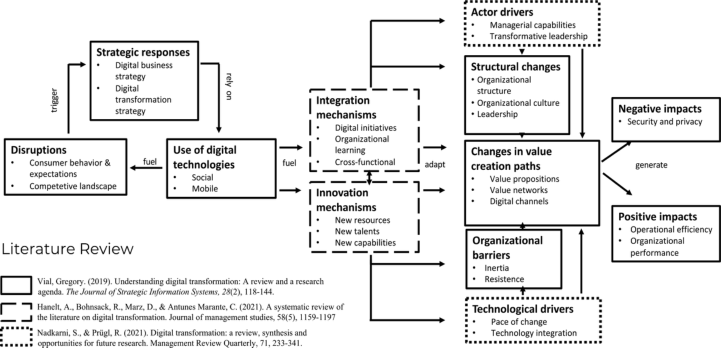
Digital transformation is defined by Vial (2019) “as a process where digital technologies create disruptions triggering strategic responses from organizations that seek to alter their value creation paths while managing the structural changes and organizational barriers that affect the positive and negative outcomes of this process.” Based on the review of 282 works, Vial derived a framework of eight building blocks of the digital transformation process. The framework demonstrates the relationships of the eight overarching building blocks by describing digital transformation as a change process initiated by digital technologies. By fueling disruptions in actor (e.g. consumer) behavior the application of digital technologies triggers strategic responses of organizations, e.g. as digital business strategies. Organizations adapt by adopting and using digital technologies to alter the value propositions and value creation paths they have previously relied upon to remain competitive. To that end, organizations need to implement structural changes and to overcome barriers like organizational inertia or resistance. These changes in the value creation paths are designed to generate positive impacts, although they can also be associated with undesirable outcomes (Vial, 2019).
Nadkarni and Prügl (2021) reviewed 118 studies published between 2001 and 2019. Digital transformation is understood as a comprehensive change in business models and processes driven by the adoption of digital technologies. It involves the integration of digital technologies into all areas of a business. The paper identifies two main dimensions of digital transformation: technology and actor. In the dimension technology issues such as technology integration, pace of change, distributed value creation and customer interface are highlighted. Within the dimension actor themes like transformative leadership, organizational capabilities, culture or work environment are explored. Transformational leadership is characterized as proactive and fosters the application of innovative processes and the integration of digital technologies within organizational structures (Alos-Simo et al., 2017; Nadkarni & Prügl, 2021).
Based on 279 reviews Hanelt, Bohnsack, Marz and Marante (Hanelt et al., 2021) emphasize the interplay between digital technologies, organizational structures, and external business ecosystems. Digital transformation is understood as a shift in how organizations adapt to new digital environments. At the core of this adaptation are organizational designs that enable continuous adaptation and participation in ecosystems. These ecosystems emphasize the importance of strategic partnerships and external collaborations. The core mechanisms - linking input and output variables (Hedström & Swedberg, 1998) - of digital transformation identified in the
Shaping Digital Transformation Beyond Circularity 117
review are innovation and integration (Hanelt et al., 2021). Innovation mechanisms involve the application of new resources, processes, and capabilities. Key activities include attracting new talents, establishing digital mindsets, and leveraging digital capabilities such as online informational capabilities, big data analytics, and digital platforms. Integration mechanisms focus on the process of aligning new digital technologies with existing organizational structures. This includes the development of digital transformation strategies or digital initiatives, enhancing organizational learning and cross-functional cooperation (Hanelt et al., 2021).
Figure 1 integrates the core mechanisms of the three literature reviews. Based on the eight building blocks of (Vial, 2019), the each two core mechanisms of (Nadkarni & Prügl, 2021) - technology and actor - and of (Hanelt et al., 2021) - integration and innovation - are integrated.
Figure 1: Literature review synthesis (Hanelt et al., 2021; Nadkarni & Prügl, 2021; Vial, 2019).
A SERVICE LENS ON DIGITAL TRANSFORMATION Since industrialization economic activity is usually understood in terms of tangible goods production and consumption, often captured in the concept of a supply chain. Characterized by a linear one-way model in which a producer obtains materials from a supplier and creates value in the form of material products for consumers. The mental and economic model for this has developed and institutionalized since the industrial revolution. Vargo and Lusch referred to this as Goods-Dominant (G-D) Logic (Vargo & Lusch, 2004, 2008). Despite the impact of the circular economy on sustainability - by reducing the use of raw materials through reuse - the circular economy continues to adhere to this Goods-Dominant model (Vargo, 2021).
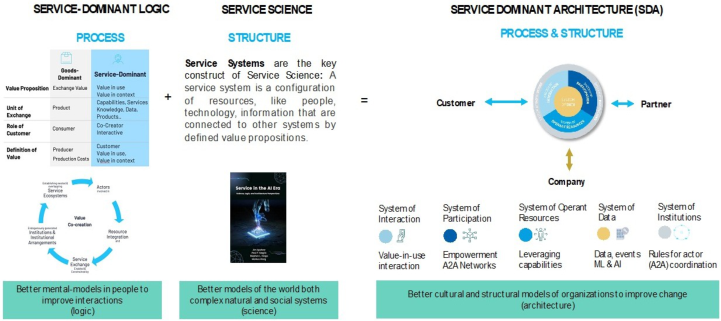
Service-Dominant (S-D) Logic as alternative mental and economic model is focused on service provision. Goods are viewed as carrier of services and as service provision vehicles. S-D Logic argues that exchange is better
118 Warg
understood in terms of service-for-service than in terms of goods-for-goods. Actors (e.g., organizations, humans) applying resources, such as knowledge or technologies, for the benefit of others in exchange for others providing service for them (Vargo & Lusch, 2004). Value is seen in terms of benefit for the beneficiary. Accordingly, the beneficiary (e.g. the customer) is always involved, the venue and the primary resource integrator of value creation. In this way actors engage in the process of service for service exchange and thus shape institutional arrangements to coordinate behavior as well as cultural beliefs (Scott, 2014). In the context of service ecosystems understood as “relatively self-contained, self-adjusting systems of resource- integrating actors”institutions and institutional arrangements connect actors and coordinate mutual value creation through service exchange (Vargo & Lusch, 2016; Vargo & Lusch, 2018). As’ad et al. (2024) identified three types of dynamics of behavior patterns within service ecosystems: (1) reproduction (stabilizing existing behavior pattern), (2) reconfiguration (changing existing pattern) and (3) transition (disrupting and shifting behavioral pattern).
The consideration of value cocreation as dynamic process sometimes lacks the structural characteristics of dynamic systems. That is, that each instance of resource integration changes the nature of the system and thus the context of the value creation constellation and the network (Richard Normann & Rafael Ramirez, 1993; Reynoso et al., 2018; Vargo & Lusch, 2011). In the context of social systems as evolving entities Giddens (Giddens, 1984) introduced the term “duality of structure” for describing the dynamic and reciprocity of social structures and actions. The structural properties of networked social systems are both the medium and the outcome of the practices and actions they recursively organize.
Service Science closes this gap. Key constructs in Service Science include service systems and Service-Dominant Logic. The service systems concept of service science is similar to the service ecosystem concept of Service- Dominant Logic. Service system entities as responsible actors are seen as dynamic value co-creation configurations of resources (Spohrer et al., 2008; Vargo & Lusch, 2016). All connected internally and externally and thus networked to other service systems by value propositions. Service systems contain at least one operant resource. As open and dynamic systems they are capable of improving the state of another system or structures of systems through sharing or applying resources; and of improving their own states by integrating external resources (Kieliszewski et al., 2018; Spohrer et al., 2007). Adaptation from the perspective of Service Science can be judged as the improvement of a service system or a service (eco) system as assessed by the abilities and capacities of the system to adapt to an environment (Spohrer & Maglio, 2010). Accordingly Adner (Adner, 2017) characterized ecosystems as structures of interconnected partners (responsible actors, service system entities) that need to interact in order to materialize a value proposition. The positions of the actors within the structure specify where in the flow of value cocreation the actors are located. The dynamic of the service ecosystem (structure) emerges from the interactions of the service systems which cannot be reduced to individual parts but unfolds by self-adjustments of the service systems.
Shaping Digital Transformation Beyond Circularity 119
As architecture Service Dominant Architecture (SDA) is about better cultural and structural models of e.g. organizations to improve change. SDA provides a transcending perspective and organizing logic on enterprise architecture by reimagining the organization in the terms of Service- Dominant Logic and Service Science. As a construction plan of five design pattern SDA facilitates processual and structural properties for transforming value constellations in value cocreation constellations in the process of service exchange. Technically implemented as systems the SDA design pattern (as structure) support five specific roles: (1) sense-and-respond cocreation interactions with actors (System of Interaction); (2) frictionless onboarding and participation of human or technological actors (System of Participation); (3) rapid integration of the companies operant resources (System of Operant Resources); (4) improved insights from data (System of Data); and (5) actor coordination by institutions as rules and norms (System of Institutions) (Spohrer et al., 2022; Warg & Engel, 2016). Implemented by responsible actors e.g. as digital service platform the five systems become service systems facilitating the collaborative creation, building and application of value propositions (Warg & Engel, 2016; Zolnowski & Warg, 2017). Regardless of whether from the perspective of an actor in the process of value cocreation (Service-Dominant Logic) or the perspective of a structure of service systems (Service Science) SDA fosters resource integration and resource density and thus facilitates service innovation as new combinations of resources that are beneficial (Arthur, 2009; Lusch & Nambisan, 2015). From a practical perspective SDA has already been implemented in a large number of cross- domain examples (e.g. health, mobility, (Warg, 2025)) and longitudinal case studies (Warg Markus et al., 2016; Weiß, 2019).
Figure 2: A service lens.
THEORY SYNTHESIS The conceptual integration of the “literature review” and the “service perspectives” is elaborated on the dimensions of technology, relationship of
120 Warg
actors, venue of value creation, approach for societal wellbeing and the role of the organizations. Table 1 provides a summary.
Table 1: Theory synthesis.
Table available in the original PDF paper.
Product -> output Product renders services ->
Technology as “carrier for services” and
input
input value cocreation Value chain, transactional,
Value constellation,
Relational actor constellations. Human-
linear
relational, actor as service provider and consumer
and technical actors connected by shared institutional arrangements and mutual value creation through service exchange. Producer of
Beneficiary/value in use of
Value is cocreated by many actors
technology technology/exchange value/firm alsways including the beneficiary (Axiom 2: S-D Logic) Beyond Circularity/digital
Digital transformation to “as a service”
service provision instead of embedding services in products
models and thus continuously reducing material goods. Circularity where material goods are still indispensable. Circularity/ reusing
Enabling resource
Reinvent value constellations. Transition
integration, reconfiguring roles and rules
discarded products Change in value creation paths
of institutional arrangements and behavior patterns for facilitating value by service provision instead of embedding value in material goods.
1. The role of technology within digital transformation should not to be interpreted as a finished output but as “resource that renders services” (Gummesson, 1995; Penrose, 1959). Technology thus is a carrier of service provision and serving as input for the value cocreating processes of actors like employee or customers in the context of digital transformation. 2. The relationship of (human and technical) actors is relational. Value in the process of digital transformation and integrating new technologies is created by many actors and each actor is service provider and consumer within a network of actors. 3. The venue of value creation is the beneficiary. Value is realized as value in use in the process of integrating and applying new technologies and the services they render. The beneficiary is always (inter-) active as resource integrator and co-creator. 4. Circularity and beyond circularity approaches are necessary for improving societal wellbeing. This means not only to use digitalization and digital transformation to map old processes with new technologies. Instead, new technologies and new forms of cooperation (e.g. service platforms) open up the opportunity to design and institutionalize new processes and value creation constellations like “as a service models” for continuously reducing the embedding of material goods. As well as to continue to use the circular economy where material goods are still indispensable. 5. The role of the organization is to reinvent value constellations in the process of shaping digital transformations. At the core this means to create action situations and behavior patterns that enable and foster the integration and application of technology and the services it renders. This is about the design of behavior patterns where human (employees,
Shaping Digital Transformation Beyond Circularity 121
groups) and technological actors engage in service exchange to solve problems and to build value creation constellations to more sustainable outcomes e.g. “as a service models”. In this process of shaping digital transformation, organizations reproduce, change or disrupt existing institutional arrangements as coordination mechanisms for actors. Existing institutional arrangements are stabilized by reproducing existing behavior patterns; they are changed by reconfiguring patterns of behavior, or they are disrupted by transitioning to new behavior patterns necessary for reinventing value constellations.
PRACTICAL IMPLICATIONS The work sheds light on how far digital transformations go further than the mere implementation of technology. It will certainly be an upheaval that will most likely lead to new roles and relationships between customers, co-producers and organizations.
OUTLOOK FOR FURTHER RESEARCH This paper is to be considered as a starting point for research focused on shaping digital transformations beyond circularity. We have set out of scope of highly relevant dimensions like the role of technology, the relationship of actors or the key strategic tasks for organizations. This should be included in upcoming studies.
CONCLUSION
The paper contributes to theory building and practical implications in the context of shaping digital transformations beyond the circular economy. More specifically, it elaborates how value can be provided by service provision instead of embedding it into material goods. This way the use of natural resources can be fully or partially reduced in the course of digital transformations.
Transitioning existing value chains and shifting towards service provision requires organizations with a Service-Dominant mindset and the willingness and managerial capabilities to reinvent value constellations. This is not about translating existing processes to new technologies on a one-to-one basis. Rather, new technologies are to be interpreted and used as carriers of services that fundamentally change the value creation constellations. In this process the behaviour patterns and roles of stakeholders have to be transitioned and customers and co-producers have to be mobilized to engage in service exchange. Taking the transition of roles and relationships as key strategic task in the course of digital transformation, enables organizations to establish service based value constellations (e.g. as service platforms) and to replace the use of natural resources through digital service provision.
122 Warg
REFERENCES
Adner, R. (2017). Ecosystem as Structure: An Actionable Construct for Strategy. Journal of Management, 43(1), 39–58. https://doi.org/10.1177/ 0149206316678451 Alos-Simo, L., Verdu-Jover, A. J., & Gomez-Gras, J.-M. (2017). How transformational leadership facilitates e-business adoption. Industrial Management & Data Systems, 117(2), 382–397. Arthur, W. B. (2009). The nature of technology: What it is and how it evolves. Simon and Schuster. As’ ad, N., Patrício, L., Koskela-Huotari, K., & Edvardsson, B. (2024). Understanding service ecosystem dynamics: A typology. Journal of Service Management, 35(6), 159–184. Evcenko, D., Kett, H., & Falkner, J. (2023). Equipment-as-a-Service–Necessary
Changes for Service-Based Business Models. Human Systems Engineering and Design (IHSED 2023): Future Trends and Applications, 112(112). Giddens, A. (1984). The constitution of society: Outline of the theory of structuration. Univ of California Press. Gilson, L. L., & Goldberg, C. B. (2015). Editors’ comment: So, what is a conceptual paper? In: SAGE Publications Sage CA: Los Angeles, CA. Gummesson, E. (1995). Relationship marketing: Its role in the service economy.
Understanding services management, 244, 68. Hanelt, A., Bohnsack, R., Marz, D., & Antunes Marante, C. (2021). A systematic review of the literature on digital transformation: Insights and implications for strategy and organizational change. Journal of management studies, 58(5), 1159–1197. Hedström, P., & Swedberg, R. (1998). Social mechanisms: An introductory essay.
Social mechanisms: An analytical approach to social theory, 1–31. Jaakkola, E. (2020). Designing conceptual articles: Four approaches. AMS Review, 1–9. Kett, H., Evcenko, D., & Falkner, J. (2023). Equipment-as-a-Service (EaaS).
Fraunhofer Verlag. Kieliszewski, C. A., Spohrer, J. C., Lyons, K., Patrício, L., & Sawatani, Y. (2018).
Handbook of Service Science (Vol. 2). Springer. Kühn, A. (2024). Digitalisierung von Geschäftsmodellen – Pay-per-Use- Geschäftsmodell für gewerbliche Geschirrspülmaschinen. Fraunhofer IEM. https://www.iem.fraunhofer.de/de/referenzen/pay-per-use-geschaeftsmodell- gewerbliche-geschirrspuelmaschinen.html?t Lukka, K., & Vinnari, E. (2014). Domain theory and method theory in management accounting research. Accounting, Auditing & Accountability Journal, 27(8), 1308–1338. https://doi.org/10.1108/AAAJ-03-2013-1265 Lukka, K., & Vinnari, E. (2016). Domain theory and method theory revisited: A reply
to Lowe, De Loo and Nama. Accounting, Auditing & Accountability Journal, 29(2), 317–322. Lusch, R. F., & Nambisan, S. (2015). Service Innovation: A Service-Dominant Logic Perspective. MIS Quarterly, 39(1), 155-175. MacInnis, D. J. (2011). A framework for conceptual contributions in marketing.
Journal of Marketing, 75(4), 136–154. Nadkarni, S., & Prügl, R. (2021). Digital transformation: A review, synthesis and opportunities for future research. Management Review Quarterly, 71, 233–341. Normann, R., & Ramirez, R. (1993). Designing Interactive Strategy, Harvard
Business Review. In.
Shaping Digital Transformation Beyond Circularity 123
Normann, R., & Ramirez, R. (1993). From value chain to value constellation: Designing interactive strategy. Harvard business review, 71(4), 65–77. Penrose, E. T. (1959). The theory of the growth ofthe firm. New York: Sharpe. Prasad, V. N., & George, S. S. (2009). Rolls-Royce: A Manufacturer at Your Service.
ecch the case for learning. Relayr. (2024). Equipment as a service ermöglichen. In R.-A. M. R. company (Ed.). Reynoso, J., Barile, S., Saviano, M., & Spohrer, J. (2018). Service systems, networks and ecosystems: Connecting the dots concisely from a systems perspective. Handbook of Service-Dominant Logic; Vargo, SL, Lusch, RF, Eds. Scott, W. R. (2014). Institutions and organizations: Ideas. Interests, and Identities. Spohrer, J., Anderson, L., Pass, N., & Ager, T. (2008). Service science and service-
dominant logic. Otago Forum. Spohrer, J., & Maglio, P. (Eds.). (2010). Toward a Science of Service Systems: Value and Symbols. Spohrer, J., Maglio, P., Bailey, J., & Gruhl, D. (2007). Steps toward a science of service
systems. Computer, 40(1), 71–77. Spohrer, J., Maglio, P. P., Vargo, S. L., & Warg, M. (2022). Service in the AI era: Science, logic, and architecture perspectives. Business Expert Press. United Nations. (2023). The United Nations High-level Political Forum, under
the auspices of the General Assembly (SDG Summit) - Informal Summary. https://hlpf.un.org/sites/default/files/ United Nations. (2024). SDG Indicators; Global Indicator framework for the SDG and targets of the 2030 Agenda for Sustainable Development. UN. Vargo, S., & Lusch, R. (2016). Institutions and axioms: an extension and update
of service-dominant logic. Journal of the Academy of Marketing Science, 44(1), 5–23. Vargo, S. L. (2021). Beyond circularity—A Service-dominant (SD) logic perspective.
Circular Economy and Sustainability, 1(1), 257–260. Vargo, S. L., & Lusch, R. F. (2004). Evolving to a New Dominant Logic for Marketing. Journal of Marketing, 68(January), 1–17. Vargo, S. L., & Lusch, R. F. (2008). Service-dominant logic: Continuing the evolution
[10.1007/s11747-007-0069-6]. Journal of the Academy of Marketing Science, 36(1), 1–10. http://www.springerlink.com/content/n1r06pg5l66w7441/ Vargo, S. L., & Lusch, R. F. (2011). It’s all B2B... and beyond: Toward a systems perspective of the market. Industrial Marketing Management, 40(2), 181–187. Vargo, S. L., & Lusch, R. F. (2018). The SAGE handbook of service-dominant logic.
SAGE Publications Limited. Vial, G. (2019). Understanding digital transformation: A review and a research agenda. The Journal of Strategic Information Systems, 28(2), 118–144. Warg, M. (2025). Use Cases Service Dominant Architecture (SDA). https://www.ifsd.hamburg/USE-CASES-SDA/ Warg, M., & Engel, R. (2016). Service-Dominierte Architektur (SDA): Kernkomponente digitaler Transformation. Zeitschrift für Versicherungswesen, 2016(12), 391–395. Warg Markus, Weiß Peter, Engel Ronald, & Zolnowski, A. (2016). Service Dominant
Architecture based on SD logic for Mastering Digital Transformation: The Case of an Insurance Company. Tiziana Russo-Spenaand Cristina Mele, 807. Weiß, P. W., Markus; Zolnowski, Andreas. (2019). Building Systems of Engagement to overcome the challenges of digital transformation Naples Forum on Service, Ischia. Zolnowski, A., & Warg, M. (2017). Let’s Get Digital: Digitizing the Insurance
Business with Service Platforms. Cutter Business Technology Journal, 30(9), 19–24.
LISTED IN THE AHFE DIGITAL BOOKSTORE CATALOGUE
Explore the complete digital volume
The Human Side of Service Engineering
Read this individual research paper free through the original publisher, or explore the full digital proceedings book.
ISBN 978-1-964867-58-8
Explore this ISBN in the AHFE Bookstore ↗Listed in the July 2026 bookstore catalogue; search by ISBN to confirm current availability · Digital book purchase optional