Christoph Glauser, Peter Kropf, Ricco Kämpfer, Loris Schmid (2025). Early Digital Market Insights on Autonomous Vehicles (AVs). In: The Human Side of Service Engineering. AHFE Open Access, vol. 182, pp. 124–139. https://doi.org/10.54941/ahfe1006413
Autonomous vehicles (AVs) represent a transformative innovation poised to redefine the public transportation sector. Early developments and tests of Robotaxis and AV shuttles have demonstrated promising potential for integration with public transport systems, offering opportunities to enhance urban mobility and address last-mile connectivity even with the ambition to reduce overall traffic. At the same time the human factors of passenger fears, technology scepticism, first accidents, bad weather conditions or early weak sensors etc. have shown some of the risks that might challenge a fast market introduction of AVs (McKinsey & Company, 2025). However, the AV market remains nascent, with challenges in obtaining reliable market overviews due to fragmented data and varying regional developments. This study explores these different dimensions through a multidisciplinary approach, providing insights into digital market trends, producer behaviour, and the interplay between traditional vehicle manufacturers, software support or platform providers. By leveraging existing literature and existing empirical data, the study aims to offer a nuanced overview for a better understanding of the multiple interconnected AV landscape.
Autonomous vehicles provide an attractive, flexible, partly or fully automated solution to move people from A to B also mentioned as “door to door” services. First tests started in the early 2000s on industrial or educational campuses, city centres, or suburban neighbourhoods, touristic hotspots, connecting such areas with main mass transit systems, greatly improving public transportation. In urban areas Robotaxis were the first AVs to hit the roads in North America and in Asia. Many vehicle manufacturing, software and operation companies as well as public transport organisations (PTOs) especially in Europe are involved in the development of a variety of new autonomous shuttle models and platforms in projects like AVENUE (Fournier et al., 2024), SHOW (Fang et al., 2024) or ULTIMO (Arwolo et al., 2024). However it is rather difficult to provide a valid and reliable market
Early Digital Market Insights on Autonomous Vehicles (AVs) 125
overview. The paper faces the challenge to provide such a first overview and an updated collection on the AV supply side and to compare them with the digital demand side by analyzing all relevant internet channels to get an insight on “supply & demand” for AVs and AV shuttles in Europe, in North America and in Asia.
There are multiple objectives for this paper: It first collects the most relevant players on the market for AV shuttles and robotaxis in the United States, in Asia and in Europe for AV vehicles, for software and operation layers and for automotive brands. It secondly also investigates the traditional vehicle producers as on how far they already implement latest AV software in their own vehicles. Thirdly it compares the collection with active searches on the digital market platforms in order to mirror the active supply with active demand by generic users and potential future passengers or customers say “passengers”. Fourth this qualitative (list) and quantitative (generic validated search demand) analytical and systematic approach, allows for the first time some exceptional early market insights for a yet very fragmented and emerging market. Until today only some randomly collected data has been made available by the producers often from the tech industry and by the classical automotive industry.
LITERATURE REVIEW
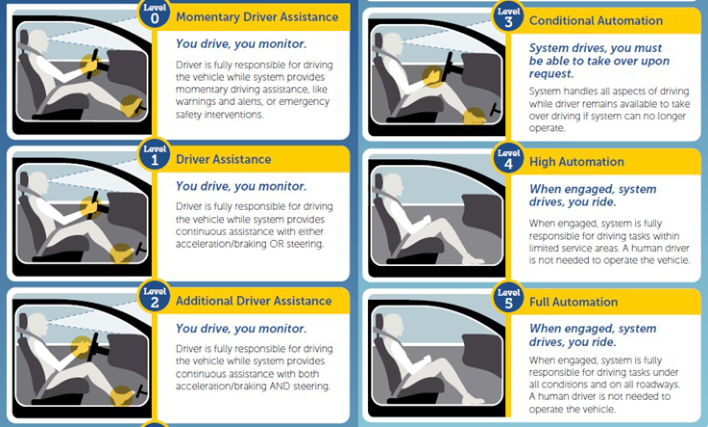
Autonomous Vehicle Technologies and Capabilities The Society of Automotive Engineers (SAE) defines five levels of driving automation, ranging from Level 0 (no automation) to Level 5 (full automation). The transition from Level 2, involving partial automation requiring human supervision (security drivers), to Level 3 (L3), where conditional automation allows the system to monitor the driving environment, marks a critical milestone in AV development (SAE, 2019). Honda’s launch of the first Level 3 self-driving car exemplifies progress in this domain, demonstrating the integration of advanced sensor and software systems (Uno, 2021). Since then many traditional car producers and newcomers deriving from the big tech industry follow the example of Honda. Most original equipment manufacturers (OEMs) go for L2+ instead of L3 because the added value of L3 seems small and the handover of control from the driver to the AV system is complex.
Advancements in hardware technologies, such as LiDAR and RADAR, and breakthroughs in software like machine learning and artificial intelligence, are pivotal in enhancing AV capabilities. Nowadays, the LiDAR companies leading the industry are Hesai, Robosense, Aeva, Ouster, Luminar, Innoviz and others, driving recent innovations. Additionally, efforts by companies such as Tesla, Waymo, and Cruise highlighted the early competitive landscape in autonomous systems, pushing the boundaries of performance and reliability. However, the unexpected “full stop” of Cruise in October 2023 after an accident has shown still existing weaknesses on the management, technological, sensors- and operational readiness level. Findings from Swiss Re also emphasize the transformative potential of AV technologies in reshaping urban and inter-urban mobility (Puttaiah et al., 2021). However
the latest data show an astonishingly strong growth of the active demand for AV’s during the last few months on most of the digital channels.
Figure 1: Levels of driving automation (SAE, 2019).
Market Readiness and Regional Trends AV’s technical and vehicle system readiness is not the only precondition for scale. The readiness for autonomous vehicle adoption varies significantly across
different regions, influenced by regulatory frameworks, government support, infrastructure, and industry collaboration according to Dentons Global Guide to Autonomous Vehicles (Dentons, 2023). Countries like UK, Germany, Switzerland or France have created their own legal frameworks for allowing level 4 AV’s, which is not yet the case in other EU countries. In the U.S. the legal frameworks are also rather fragmented. Within the U.S., California takes a leading position. China is supporting L2+, L3 and Robotaxis with considerable public fundings and a part of its national mobility strategy is clearly to become a global leader on this sector.
Europe’s AV readiness is shaped by a complex regulatory environment and existing strong public transportation networks. The European Union has established regulatory frameworks to support AV deployment, including the General Safety Regulation and initiatives under Horizon Europe (CCAM), which have allocated €159 million to research and development. Countries like Germany, France, and the Netherlands take a lead in AV policy development and testing. Germany implemented its dedicated AV legislation in 2021, the “Autonome-Fahrzeuge-Genehmigungs-und-Betriebs- Verordnung” (AFGBV) came into effect in 2022, to allow Level 4 AVs on public roads. The UK, through its regulatory sandbox approach, has
Early Digital Market Insights on Autonomous Vehicles (AVs) 127
positioned itself as an innovation hub for AV technology, with government- backed initiatives like the £66 million Commercializing Connected and Automated Mobility (CAM) program. In contrast, countries such as Hungary and Poland are emerging as regional AV testing hubs, leveraging government- backed research initiatives.
The United States presents highly diverse AV regulatory circumstances, where federal guidelines set the foundation, but state-level regulations play a crucial role in AV deployment. States such as California, Arizona, and Texas are at the forefront, providing regulatory flexibility and fostering industry- led AV initiatives. The Department of Transportation (USDOT) and National Highway Traffic Safety Administration (NHTSA) have issued guidelines to support AV testing and deployment while ensuring safety and public trust. The U.S. is home to leading AV companies, including Waymo, Tesla, Cruise, and Aurora, which are advancing AV technologies through commercial pilot programs. While Robotaxi services have been introduced in select cities, regulatory concerns regarding safety, liability, and cybersecurity continue to pose barriers to full-scale adoption.
In Asia, particularly China, is leading the global AV race due to strong government backing, extensive infrastructure investment, and a thriving technology ecosystem. China has established AV-friendly regulations, creating designated AV testing zones in major cities such as Beijing, Shanghai, and Guangzhou. The country has invested over $5 billion in AV research and infrastructure, positioning companies like Baidu Apollo, WeRide, and Pony.ai at the forefront of robotaxi development. China’s regulatory environment actively supports commercial AV deployment - especially for L2 and L3 robotaxis - with over 32,000 km of public roads designated for AV testing. Beyond China, Japan and South Korea are making significant strides in AV adoption. Japan’s SIP-adus program, with a budget of $300 million, supports the deployment of Level 3 AVs, while South Korea’s K-City AV testbed and smart city initiatives aim to integrate AVs into urban transportation networks. However, regional challenges such as data security concerns, infrastructure gaps, and public acceptance remain key factors influencing the pace of AV deployment.
Integrating AVs with public transport systems is a pivotal European strategy for enhancing urban mobility. The World Economic Forum (Mezghani and Zhao, 2024), as one of the rare strategic articles on this topic, clearly emphasizes the benefits of a synergistic AV-PT model, which can address first/last-mile connectivity and replace underperforming bus routes in low-density areas. Such integration leverages unified data platforms for seamless communication, consolidated fare systems, and coordinated service planning to optimize network efficiency and to reduce congestion.
Societal and Economic Implications Autonomous vehicles have significant implications for equity and sustainability. While AVs promise improved and even more secure easy affordable mobility for underserved populations, such as people without driver’s license, the elderly and disabled, high ownership costs could
exacerbate social disparities. Shared mobility models, as advocated by Future Agenda (IEA, 2020), offer a pathway to mitigate these issues by promoting cost-effective and inclusive access. The question on how profitable the investments into mobility services will be in the future is a topic, which is intensively discussed by all stakeholders. Infrastructure readiness is another critical factor limiting the scalability of AVs. High-quality roads, HD maps, advanced communication networks like G6, and EV charging stations are prerequisites for successful AV-deployment in the case of both, public and privately owned vehicles. Countries like Singapore or the Netherlands lead in infrastructure provision, while nations with less developed road networks still face much greater challenges (IEA, 2020; Duvall et al., 2019). In the case of Mobility as a Service (MaaS), these prerequisites are not a problem as PTOs do not have to be charged at available charging stations and some have an already existing infrastructure which can be used for their limited service area. Furthermore, Litman suggests that AV deployment could increase Vehicle Miles Travelled (VMT), raising concerns about congestion and urban sprawl without effective land use and transportation policies (Litman, 2024). The reduction of the traffic frequencies by AVs in compared to private mobility still remains a topic for an open discussion.
METHODOLOGY
This study applies a mixed-method approach, combining desk research, quantitative data analysis from digital platforms and qualitative insights from existing data bases and literature. As opposed to estimations or summarized often vague financial predictions from governments and suppliers this study gathers data from existing systematically collected information from the AV suppliers during the last few years and mirrors them with other sources, such as validated keyword analytics and search metrics for Effective Share Of Voice (ESOV) reflecting digital market demand by active internet users, who might well become customers. This method allows independent neutral measurements and research of the active demand at a very early stage of the emerging AV market. The data base collected with this new method delivers an unbiased picture, where no other recoverable market data are yet available for elaborating the potential of such new mobility vehicles, technologies and their planned applications. Here only the Swiss Re’s market readiness framework provides some early empirical evidence for market trends and consumer preferences. Regional comparisons focus on North America, Europe and Asia to identify distinct challenges and opportunities (Puttaiah et al., 2021).
Analysis of MaaS Value Chain To make the demand for AVs quantifiable in a holistic and cross-market manner, a comprehensive input set of existing providers and technologies is required. As part of this study, an analysis of the AV MaaS (Mobility-as- a-Service) value chain is used, which fundamentally differs from traditional value chains. Essentially, five different layers can be identified:
Early Digital Market Insights on Autonomous Vehicles (AVs) 129
Layer 1 – Automated Driving System The Automated Driving System (ADS) encompasses the software and hardware required to achieve SAE Level 4 autonomy (see Fig. 1). The hardware stack includes aspects such as hardware development, production, testing, automotive approval, and safety compliance. The software stack focuses on self-driving software development and covers activities such as testing & simulation, Operational Design Domain (ODD) management, Self- Driving System (SDS) licensing, mapping, sensor data processing, end-to-end integration, and safety compliance.
Layer 2 – Automated Driving (AD) Vehicle AD Vehicles are considered Level 4-ready vehicle platforms. This layer focuses on development and design, including tasks such as platform & system architecture, regulatory compliance, safety concepts, homologation, logistics, and production. Additionally, ADS & AD Vehicle Operations Functions describe all functions and interfaces required for AD MaaS-specific tasks performed by the AD Fleet Control Center and Remote Operator. These include remote vehicle control, cabin and rider monitoring, operator & emergency calls, and remote ADS control/assistance.
Layer 3 – Fleet Operations Fleet Operations cover operational activities for AV fleets. Tasks include maintenance, service and repair, financing, concessions, charging, training, cleaning, and parts supply. Moreover, AD Fleet Control Center tasks include the execution of ADS & AD Vehicle Operations Functions (e.g., cabin and rider monitoring or remote ADS assistance) within a fleet management tool/user interface. It also includes typical fleet management tasks such as mission management, health monitoring, and maintenance & charging scheduling of the AV fleet.
Layer 4 – Mobility Platform The Mobility Platform is the rider-facing frontend. It serves as the point of sale and the primary communication and interaction channel with the user. Tasks include booking, pricing, payment, vehicle assignment, and dynamic routing (fleet intelligence features). Rider experience aspects such as music and entertainment may also be covered by mobility platforms.
Layer 5 – Enabler Enablers primarily include cloud infrastructure and data centers for processing and storing large volumes of AV data. Furthermore, particularly in China, V2X (Vehicle-to-Everything) is a key pillar in pilot zones, enabling faster AV deployment and collaborative decision-making. It should be noted that cloud infrastructure can also be assigned to Layer 1.
To conduct the quantitative analysis and determine digital market trends for AVs, an initial qualitative market and competitive analysis of providers and solutions in the first four layers - particularly focusing on Layers 1 and 2 - is required. This study first identifies all market players in Europe,
North America, and China that offer AD MaaS solutions. The basis for this analysis is primarily the P3 AD Market Insights, a global market and competitive analysis of autonomous driving based on the described layer logic (P3 automotive GmbH, 2024).
The next step involves identifying keywords for each provider that succinctly describe the product or solution. In the case of ADS providers, this includes the specific name of the ADS stack. A similar approach applies to vehicle manufacturers, whose AD-specific platforms usually have distinct names. These keywords are derived partly from P3 AD Market Insights, other non-public market and competitive analyses conducted by the authors, and desk research. It is important not to rely solely on generic keywords. Through this approach, the study generates a comprehensive dataset for quantitative measurement and provides a robust methodology for measuring active market demand variability and evaluating trends on the user side over an extended period.
Digital Market Measurement The analysis of digital demand in the Autonomous Vehicle (AV) market utilizes a new sophisticated methodology and technology that relies on API and search data to measure user behaviour directly at the interface of all relevant digital platforms. This approach enables an in-depth understanding of online searches, as Total Audience of Search (TAS), capturing the frequency and trends of specific keywords while distinguishing between different digital channels and regions. By focusing solely on active search demand by the online community, the methodology avoids the limitations of secondary media information effects or survey’s and polls, providing a unique valid and reliable perspective on digital demand.
The data collection process is built on a multi-channel approach, extracting information from over 14,103 global platforms, including search engines (e.g., Google, Bing, Yahoo, Baidu), social media networks (e.g., Facebook, Twitter, TikTok), and e-commerce platforms (e.g., Amazon, Ebay, Alibaba). These sources are systematically monitored and parametrized by criteria such as keyword frequency, search trends, country representation, language, technology and platform type. Continuous adjustments to APIs ensure the integrity of data even when technical changes occur, with cross-validation and reliability testing the approach processes confirmed data not only on AVs across channels and countries.
Search data will be gathered for two key timeframes - December 2024 and February 2025 - to allow for a trend comparison. The methodology is designed to segment data geographically by country domains where possible, ensuring accurate regional insights. When domain-specific segmentation is unavailable, internet average user statistics, such as those provided by ITU, are used to align data with the appropriate population. This ensures that the analysis reflects the behaviour of active internet users in each region, enhancing its reliability and relevance.
The search behaviour of the online population is constantly evolving, driven by shifts in technology, platforms, and consumer interests. On average,
Early Digital Market Insights on Autonomous Vehicles (AVs) 131
up to 40% of universal searches now occur on social media and e-commerce platforms, with newer options frequently emerging as older ones decline in usage. This dynamic environment underscores the importance of using a cross-channel approach, which systematically aggregates and compares data from multiple platforms to capture a comprehensive picture of digital demand. This methodology has proven effective in various contexts, from analyzing election campaigns (Glauser et al., 2021) to studying the adoption of new technologies during the COVID-19 pandemic (Kurpicz-Briki et al., 2023). The data collected is analyzed through a process that averages search frequencies across all available channels for each country, providing a holistic view of user behaviour. The multi-channel nature of this approach reduces biases associated with individual platforms, ensuring that the results reflect broader trends. Validation is further enhanced by cross-referencing search data with the total number of active internet users per country, ensuring the reliability of findings. This method provides particularly valuable insights for the AV market, enabling the identification of regional trends, emerging consumer interests, and shifts in digital demand. By capturing keyword-based search behaviour over time, the analysis offers a nuanced understanding of how public interest in AV technologies evolves. The results inform manufacturers, policymakers, and market analysts, helping them to navigate through the complexities of this transformative sector.
Ethically, the methodology adheres to strict standards of anonymity, using only publicly available and fully anonymized search queries. The results focus on content-related and channel-specific insights, ensuring privacy while offering reliable and actionable data. While some regional biases may remain due to language differences or domain-specific constraints, the methodology’s robust cross-validation processes aim to mitigate these limitations.
ANALYSIS AND DISCUSSION Market Size and Growth
The global AV market is projected to grow significantly, driven by advancements in technology, private and public investments and supportive policies. However, regional disparities persist, with Asia leading in production and North America excelling in infrastructure readiness and Europe following the strategy to roll out, test and scale up via PTOs.
The adoption of autonomous vehicles (AVs) represents a transformative shift in transportation, driven by advancements in artificial intelligence, sensor technologies, and public investment. Governments worldwide are allocating substantial funding to facilitate AV research, infrastructure, and private or public deployment. This section presents a detailed analysis of public investment trends, AV deployment by sector, and the projected market dynamics across North America, Europe, and Asia.
Public Investment in AV Technology Public funding plays a pivotal role in accelerating AV development. Governments support the AV industry through direct grants, regulatory
initiatives, and infrastructure development to foster innovation and large- scale deployment.
Table 1: Public investment in AV technology.
Table available in the original PDF paper.
Region Funding Key Public Investment $200 million in AV pilot programs North America Department of
Transportation (USDOT)
with the Intelligent Transportation Systems (ITS) program aiming to enhance AV safety and reduce congestion National Science
> $100 million for AI & AV
Foundation (NSF)
technology research California > $3 billion in AV infrastructure and supports leading AV companies such as Waymo and Cruise Europe Horizon Europe €159 million to Cooperative,
Connected, and Automated Mobility (CCAM) European Defense
€1.1 billion toward AV-enabled
Fund (EDF)
logistics and defense applications Germany > €500 million for AV pilot projects by 2027 Asia China $5 billion in AV research since 2018,
with 32,000 km of public roads designated for AV testing Japan $300 million for SIP-adus program to developing Level 3 AV technologies South Korea $15 million for K-City testbed
outlining a roadmap for AV deployment by 2030
Despite the large sums invested in AD technology research and AV deployment, it should be noted that early investments in pilots at the European or national level have so far failed to create a sustainable project landscape. Instead, the early landscape of autonomous mobility projects is characterized by a generation of isolated solutions pilots and individual initiatives that lack long-term viability and coordination. These projects, often located in rural or touristic areas, are marked by temporary funding, poorly defined consortium structures, and unrealistic goals. Compounding this issue is the fact that learning curves are not centrally coordinated, making it difficult to access, evaluate, and compare project results. Furthermore, many projects suffer from a lack of comprehensive planning, as they are funded and implemented without sufficient consideration for long-term sustainability. With the Horizon Europe project ULTIMO, the EU tries to address the topic more systematically.1
1Within the framework of Horizon Europe, ULTIMO is co-funded by the European Union and the State Secretariat for Education, Research and Innovation in Switzerland (SERI).
Early Digital Market Insights on Autonomous Vehicles (AVs) 133
Projected Market Size of AV Technology by Use Case Sector Autonomous vehicles are being deployed across various transportation sectors, including robotaxis, autonomous shuttles, AV buses, and private autonomous vehicles.
Table 2: Projected market size of AV technology by use case sector.
Table available in the original PDF paper.
Use Case Region Projected Market Size Robotaxis North America Companies such as Waymo operate commercial robotaxi services already in San Francisco, Phoenix, and Austin, with the market projected to reach $50 billion by 2030. Europe Limited trials in London and Germany
indicate slower adoption, with the projected market estimated at $15 billion. Asia China dominates the robotaxi sector,
North America Public investments exceeding $100
with Baidu Apollo, WeRide, and Pony.ai leading operations in Beijing and Shanghai. The Chinese market is expected to exceed $80 billion. Autonomous shuttles million have supported shuttle services at airports and university campuses, with a projected market of $10 billion. Europe Germany, France, and the UK are leading
shuttle trials, contributing to an estimated market of $12 billion. Asia Asia continues to heavily invest in autonomous shared mobility, particularly in China, where the projected market is expected to reach $15 billion. AV buses North America USDOT has allocated over $1 billion for
AV bus trials, with deployments in cities such as Las Vegas and Phoenix. The U.S. market is projected to grow to $8 billion by 2030. Europe UK and Germany, have introduced AV buses, although scalability remains a challenge, resulting in a projected market size of $9 billion. Asia China, Japan, and South Korea have
significantly invested in bus automation, with a projected market of $20 billion. Consumer AVs North America Tesla’s Full Self-Driving (FSD) system leads private AV trials, with the market anticipated to surpass $100 billion by 2030.
Continued
Table 2: Continued Use Case Region Projected Market Size
Table available in the original PDF paper.
Europe Leading manufacturers such as Mercedes, BMW, and Volkswagen are testing still on Level 2–3 AVs, contributing to a projected market of $40 billion. Asia Companies such as Nio, Xpeng, Toyota,
and Honda are advancing private AV technology, with the regional market projected to reach $120 billion.
Since entry barriers are rather high, public investment in private AV technology is expanding across different regions, with varying strategic priorities. China is leading in robotaxi and shuttle markets, the U. S. with Tesla and China with systems from Huawei, Xpeng, Xiaomi are at ready for private AV development. Europe is emphasizing AV buses and public transit integration basically via existing PTOs. The AV market is expected to witness significant growth, surpassing $500 billion globally by 2035. This section provides a comprehensive analysis of AV investment, deployment, and market trends, highlighting the regional variations that shape the future of autonomous mobility.
The numbers illustrate that significant investments in autonomous driving have already been made by both private companies and public government entities. However, as previously mentioned, this has not led to a sustainable landscape of autonomous mobility yet, as isolated solutions were promoted instead of centralized model regions. Additionally, the global market is characterized by significant consolidation, causing some promising AD MaaS companies (e.g., Cruise, Argo AI, drive.ai) to disappear entirely from the market. For this reason, many of the reported numbers regarding market size and growth should be viewed with caution, as the market for AD solutions has not yet been consolidated.
In the meantime China has developed an extensive AV landscape, with companies receiving significant government support and gradually scaling (an estimated fleet size of over 1,000 vehicles in operation). On the other hand the U.S. market is growing relatively slowly in terms of fleet numbers (an estimate of 500–700 vehicles are in operation today). In contrast, fleet sizes all over Europe remain below 50 vehicles.
Due to the overall slow scaling process and complex challenges in Europe (e.g., use cases, financing, and regulations), the authors do not expect significant market growth or expansion in Europe in the coming years.
Producer Dynamics Traditional automakers are increasingly integrating AV capabilities, such as Advanced Driver-Assistance Systems (ADAS), into their vehicles. New entrants, such as Waymo and Tesla, challenge established players with innovative business models and technological prowess.
Traditional OEMs have primarily excelled in the production of highly complex vehicle systems, with a strong focus on hardware and the
Early Digital Market Insights on Autonomous Vehicles (AVs) 135
physical quality of their vehicles. However, as the industry shifts from hardware-centric vehicles to rather software-defined vehicles, the software is becoming a fundamental element—particularly to meet evolving new customer demands and expectations.
A clear example of this transformation can be seen in China, where vehicles are increasingly designed from a software-first and passenger-centric perspective, with the physical structure following later. Since traditional OEMs face significant challenges in transforming into software-driven companies, the AV industry - spanning private vehicles, MaaS, and Logic as a Service (LaaS) - has seen a growing number of close collaborations between OEMs, technology firms, and ADS providers. These partnerships aim to accelerate time to market and better anticipate or address future customer needs. As a result, a significant portion of the value creation is no longer retained by OEMs or traditional suppliers but instead shifts to emerging market players; many of whom did not even exist a few years ago.
Consumer Preferences Digital demand analysis reveals that consumer interest peaks around affordability, safety, and usability. E-commerce trends indicate a preference for lower-level automation features and services in the short term, with growing interest in Level 3 and above for the future. First experiences from Pilots show, that passengers who are given the possibility to drive with an AV are very enthusiastic about it, even if they had a critical attitude towards AVs beforehand.
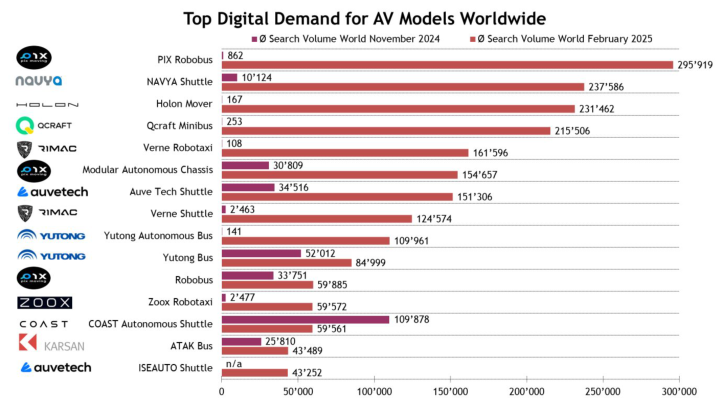
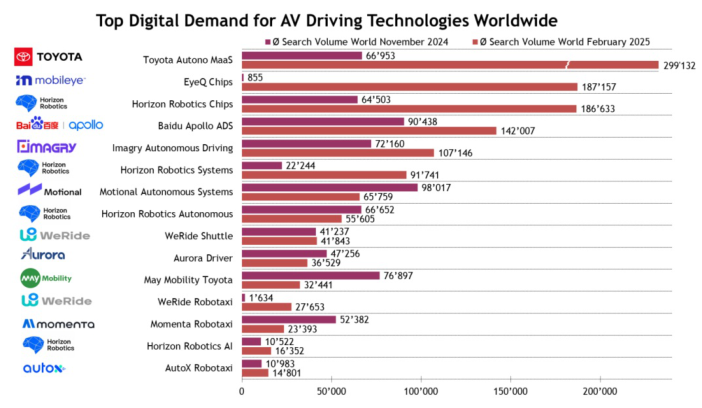
Figure 2: Top digital demand for AV models worldwide.Figure 3: Top digital demand for AV driving technologies worldwide.
Digital Demand AV Models First, significant trends on the worldwide Top Five digital market demand for AV models (measured between December 2024 and February 2025) show measured top ranks for: PIX Robobus, Navya shuttle, Holon Mover, Qcraft Minibus and Vere Robotaxi. All demand trends in this sample of the Top 15 vehicles are positive except the one for COAST Autonomous Shuttles, which was almost diminishing from average 109’878 active searches in December 24 to 59’561 in Ferbuary 2025. The exhaustive list of all relevant AV models and the active demand trends covers 24 AV models.
Digital Demand AV Driving Technologies Secondly the digital market research shows how also the AV driving technology trends are increasing too, but still considerably less than the vehicle models from Figure 2. The digital active search metrics show that the demand for Toyota Autono MaaS, EyeQ Chips from Mobileye, Baidu Apollo ADS, Imagry Autonomous Driving and Horizon Robotics Systems, close to Motional Autonomous Systems are market demand leaders. Even if these Technologies are enablers for the AV market, their demand and active user interest is significantly lower than the demand for the AV models. The full list covers 31 of the most important driving technologies and their providers.
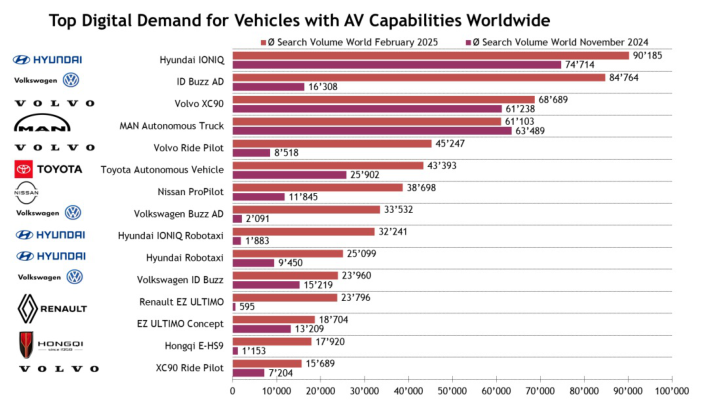
Digital Demand Vehicles With AV Capabilities Many of the well-known classical car manufacturers and brands started to engage in various AV Capabilities this study wanted to shed some light on them too. The top five lead here for active demand on all digital channels between December 2024 and February 2025 is: Hyundai IONIQ, Volkswagen ID Buzz AD, Volvo XC90, (MAN Autonomous Truck), Volvo Ride Pilot and Toyota Autonomous Vehicle. It is expected that these top
Early Digital Market Insights on Autonomous Vehicles (AVs) 137
brands will play a pivotal role in the future of AV mobility. The exhaustive list covers 28 Vehicles and Brands with AV capabilities.
Figure 4: Top digital demand for vehicles with AV capabilities worldwide.
The analysis of digital demand for autonomous vehicles (AVs) through keyword-based monitoring provides a wealth of insights into consumer preferences, industry trends, and emerging patterns in the AV market. By examining search frequencies, trends, and platform-specific behaviours, the following key aspects can be extracted: Popular Features and Attributes
The increasing frequency and context of keywords reveal which of the AV features are of growing interest for the users. This can help stakeholders prioritize feature development and marketing strategies on a) Regional Preferences: Data segmented by geographic regions provides insights into how demand differs across markets. For instance, keywords like “robotaxis in Singapore” or “autonomous trucks in the U.S.” can highlight local interest and readiness for AV adoption. b) Consumer Concerns: Frequent searches for terms such as “self-driving car accidents” or “autonomous vehicle regulations” indicate areas of consumer concern. Understanding these anxieties or interests allows companies to address and reflect them in communication strategies, public relations, and product development, c) Temporary Trends: Tracking keywords over time reveals shifting consumer priorities for models, technologies and AV applications. These trends help to predict future shifts in the market at an early stage d) Competitive Landscape: Analyzing search behavior for brand-specific keywords likes “Tesla autonomous driving,” or “Cruise AV testing” provides insight into how companies are perceived in the market. This helps in benchmarking competitors and understanding brand positioning e) Platform-Specific
Insights: Collecting and analysing data from different mobility platforms reveal diverse consumer behaviours. For example, searches on Google may indicate general curiosity, while high engagement on e-commerce platforms like Amazon might rather reflect readiness to purchase f) Emerging Technologies: Keywords linked to innovative concepts, such as “LiDAR technology,” “V2X communication,” or “AI in autonomous driving,” signal interest in underlying technologies. This can identify areas ripe for investment or collaboration g) Consumer Demographics: Although the data is anonymized, platform usage patterns often align with specific demographic groups. For example, younger audiences might generate higher search volumes on TikTok for AV-related hashtags, while professional platforms like LinkedIn may reflect corporate interest in AV solutions etc. h) Policy and Regulation Trends: Keywords like “autonomous vehicle laws” or “regulation for self-driving cars” indicate the level of awareness and interest in governance, regulatory and compliance, which are critical for AV deployment.
CONCLUSION
This study provides a comprehensive overview of the already often predicted fast growing AV market, emphasizing the importance of digital market trends and regional dynamics. The authors have been surprised by the exponential growth on the demand especially for AV models during the last few months in 2024/2025. As opposed to the models, the operating technologies and the integration of AV capabilities in classical cars, show still a significantly lower active demand than predicted by the stakeholders. While technological innovations drive feasibility, regulatory clarity and consumer trust remain critical topics. Regional disparities highlight the need for tailored strategies to address unique market challenges. The keywords at stake can only be measured within a predefined scope. As addressing technological, regulatory, and consumer-related barriers, stakeholders can accelerate AV adoption by ensuring equitable and sustainable developments and roll out at a larger scale. Future research will focus on long term effects to track evolving trends of supply & demand and their impact on the global AV ecosystem.
REFERENCES
Arowolo, W., Larsson, M. and Nicolaï, I. (2024) ‘Governance of shared automated electric vehicle in the urban transport system: Insight from a willingness- to-use survey and Norwegian cultural context’, Transportation Research Interdisciplinary Perspectives, 24, 101040. Dentons (2023) Global guide to autonomous vehicles. Available at: Dentons-Global-
Guide-to-Autonomous-Vehicles-2023.pdf Duvall, T., Hannon, E. and Katseff, J. (2019) ‘A new look at autonomousvehicle infrastructure’, McKinsey & Company. Available at: https:// www.mckinsey.com/industries/travel-logistics-and-infrastructure/our-insights/ a-new-look-at-autonomous-vehicle-infrastructure European Commission (2019) General Safety Regulation. Available at: https://eur-
lex.europa.eu/eli/reg/2019/2144/oj
Early Digital Market Insights on Autonomous Vehicles (AVs) 139
Fang, K., Azizan, S. A. and Huang, H. (2024) ‘GIS-based intelligent planning approach of child-friendly pedestrian pathway to promote a child-friendly city’, Scientific Reports, 14(1), 8139. Fournier, G., Boos, A., Konstantas, D. and Attias, D. (2024) Automated vehicles as a
game changer for sustainable mobility: Learnings and solutions. Springer Nature, p. 509. Glauser, C., Schmid, L. and Savoy, J. (2021) ‘UMUSE: User monitoring of the US Presidential Election’, in Proceedings of the Sixth International Congress on Information and Communication Technology: ICICT 2021, London, Volume 1. Singapore: Springer Singapore, pp. 483–492. IEA (2020) Global EV Outlook 2020. International Energy Agency. Available at:
https://www.iea.org/reports/global-ev-outlook-2020 Kurpicz-Briki, M., Glauser, C. and Schmid, L. (2023) ‘Internet search behavior in times of COVID-19 lockdown and opening’, in Encyclopedia of Data Science and Machine Learning. IGI Global, pp. 488–502. Litman, T. (2024) Autonomous vehicle implementation predictions: Implications
for transport planning. Victoria Transport Policy Institute. Available at: https:// vtpi.org/avip.pdf Mezghani, M. and Zhao, J. (2024) ‘How autonomous vehicles can be integrated with public transport systems for urban mobility’, World Economic Forum. Available at: https://www.weforum.org/stories/2024/10/how-will-autonomous- vehicles-shape-urban-mobility/ Puttaiah, M. H., Raverkar, A. K., Atzei, M. and Avramakis, E. (2021) ‘Autonomous mobility – How demand and supply are moving closer to equilibrium’, Swiss Re Institute. Available at: https://www.swissre.com/institute/ research/topics-and-risk-dialogues/digital-business-model-and-cyber-risk/ autonomous-mobility-demand-and-supply-moving-closer.html SAE (Society of Automotive Engineers) (2019) SAE updates J3016 automated driving
graphic. Available at: https://www.sae.org Swiss Re Institute (2021) Autonomous mobility – How demand and supply are moving closer to equilibrium. Swiss Re. Available at: https://www.swissre.com Uno, T. (2021) ‘Honda launches world’s first level-3 self-driving car’, Japan-
Forward.com. Available at: https://japan-forward.com/honda-launches-worlds- first-level-3-self-driving-car/ Vijayenthiran, V. (2021) ‘Self-driving technology company Argo AI makes lidar breakthrough’, MotorAuthority.com. Available at: https:// www.motorauthority.com
LISTED IN THE AHFE DIGITAL BOOKSTORE CATALOGUE
Explore the complete digital volume
The Human Side of Service Engineering
Read this individual research paper free through the original publisher, or explore the full digital proceedings book.
ISBN 978-1-964867-58-8
Explore this ISBN in the AHFE Bookstore ↗Listed in the July 2026 bookstore catalogue; search by ISBN to confirm current availability · Digital book purchase optional