Yuri Misnikov, Victoria Samoilava (2025). Designing a New Generation of AI-aided e-Participation Public Services. In: The Human Side of Service Engineering. AHFE Open Access, vol. 182, pp. 147–157. https://doi.org/10.54941/ahfe1006415
The liberal conception of democracy differentiates between (a) its institutions, such as free elections, political competition parties, freedom of speech that underline the western political system; and (b) regulative ideals that justify and let this system work. When the same institutions are justified differently depending on the underlying regulative ideals, the relationship between them becomes problematic, invoking often such notions as ‘democratic deficit’ and ‘democratic crisis’. These in turn point at the presence of political polarization, lack of meaningful civic participation in politics, and eventually the undermined democratic legitimacy. The aim of liberal democracy is to find an institution that can aggregate individual preferences into collective choice as fairly and efficiently as possible ensuring that different persons are equal and have the same weight in the political community. The aggregation is typically done by using the majoritarian principles of voting to make decisions or pluralistically, when disparate society’s groups influence decisions according to their interest in passing or rejecting such decisions, for example, through position voting. However, neither the majoritarian nor position voting does not envisage changing the initial political preferences so they could account for the views of other persons before the vote. Conversely, a deliberative concept of democracy is based on an open and uncoerced discussion – a form of e-participation public service – that is capable to transform initial preferences and thus accommodate other views. We argue that Artificial Intelligence (AI) can support a new type of e-participation services by using the algorithms specifically designed to alternate voting and discussion through the intertwined AI and human test actions and eventually aggregate political preferences in a more conciliatory manner. We propose that such preferences are semantically revealed with the help of AI through the Habermasian validity claims to normative rightness that serve as the discursively constructed argumentation vehicles. This logic could help better exploit AI benefits to overcome the ills of the social choice theory used in the liberal democratic model to count votes, improve user’s experience of interacting with technology and eventually make political decisions more democratic.
e-Participation, Deliberation and Public Sector Management e-Participation – or online participation – can be discussed from two main perspectives. One is a democratic practice of civic engagement for participatory decision-making that rests on public debate (deliberation). As originally proposed by Ann Macintosh, the main direction of e-participation is to connect (a) citizens with one another, and (b) with their elected representatives through public deliberation within the government’s broader strategy of integrating digital technology in its operations and thereby to facilitate citizen engagement (Macintosh, 2006). The emphasis on deliberation is quite remarkable given that public debate as a form of civic participation is often overlooked in e-participation definitions and the real- world practices on the part of the public sector management community that represents another perspective. It is primarily interested in government administrative performance rather than in democratic efficacy of citizens’ political participation. From the managerial point of view, e-participation is a government electronic (online) service under the conceptual domain of the New Public Management (NPM) paradigm aiming to help public sector organizations perform like business entities focused on efficiency, cost-effectiveness and service-orientation thanks to new digital innovations (Mergel & Desouza, 2013; Mergel et al., 2019; Diefenbach, 2009).
However, the existing services that facilitate citizens’ interaction with government administrative bodies to make decision-making more participatory do not prioritize public debate. The latter is replaced with such more passive, top-down and one-way e-services from government to citizens as online consultations and crowdsourcing, when citizens simply submit their comments through electronic channels directly to the government without discussing them publicly before submission. For example, the United Nations e-Government Reports that monitor the availability of various e- services across the globe, including e-participation, do not distinguish online discussion as a stand-alone government service even though some half the world’s countries have their national or local e-participation portals (UN DESA, 2024, p. 61). Consequently, the publication by governments of how citizens’ voices are included in their policy decision-making through comment-based electronic consultation services, increasingly with the help of Artificial Intelligence (AI), (e.g., using ChatGPT), is considered sufficient when it comes to democratic participation in politics between elections (Mariani et al., 2024, p. 37).
Use of Artificial Intelligence for Deliberative Argumentation One of the most notable examples of the use of AI in the field of deliberation has been undertaken in the ‘argument and computation’ domain focusing on argumentation in deliberative bodies both online and offline (Budzynska & Reed, 2011). From the computational perspective, arguments should be intentionally constructed; that is, to contain not only the explicit logic and factual evidence but also to include implicit inferences in the form of the dialogically organized series of persuasion sessions among discourse
Designing a New Generation of AI-Aided e-Participation Public Services 149
participants. These can be examined analytically by using such argument mapping software tools as OVA (Online Visualisation of Argument) and Arvina dialogue system examining large-scale deliberation and politically complex decision-making. On the other hand, such software can also help create arguments (Snaith et al., 2010). Yet, these complex systems are designed for experts and are unlikely to be used by lay citizens in real-life deliberative discussions.
LIBERAL, REPUBLICAN AND DELIBERATIVE DEMOCRATIC TRADITIONS Although the conceptual meaning and practical realization of democracy may vary substantially, it is commonly agreed that there are two main traditions in democratic theory: the liberal (Anglo-Saxon) tradition and the republican one (French or Continental) (Bellamy, 2008; Mouffe, 2000). A newer, deliberative, model of democracy draws on the public sphere concept as advanced by Jurgen Habermas in his discourse ethics theory (Habermas, 1989, 1992a, 1992b, 1996, 1998, 2006).
Liberal Model Theoretically, the modern liberal tradition is viewed primarily as a heritage of the American sociology of democracy – a pluralist type of ‘micro-democracy’ focused on the ‘ordinary man’ in terms of individual rights, personal autonomy, political freedoms embedded in political perceptions, preferences, judgments, worldviews, opinions. It has long presumed a clear distinction between (a) its key institutions (free elections, political competition, freedom of speech, independent media, etc.) and (b) the regulative ideals that justify and let these institutions work in practice (Miller, 1992). From a liberal view, democratic politics is mainly about the socialization process while politics is left to political elites. Citizens are seen primarily as voters, not independent actors, agency. They are private, self-interested individuals who vote accordingly to their personal preferences. As John Dryzek (Dryzek, 1990, p. 119) puts it, “Liberal democratic theory generally interprets politics and policy-making in terms of the pursuit of essentially private interests by voters, entrepreneurial politicians, and other political actors” through “public channels”. The main requirement here is to change political elites democratically via voting in regular and fair elections when they fail voters’ expectations. This requirement is considered sufficient for democracy to function (Marina, 1979; Lucacs, 1979; Berelson et al., 1954).
Voting outcomes generate the aggregated political will which affects public administration that should act in accordance with this will. Therefore, the task of making decisions and formulating policies does not envisage engaging members of the public in debates between elections, as the state does not ‘know’ how to handle it and integrate into administrative normative process. Thus, the liberal model does not fully accept the communicative power generated by citizens’ self-legislation during public debate and consequently does not institutionalize inclusive processes of opinion- and will-formation. The lack of such opportunities prompt active citizens to engage instead
150 Misnikov and Samoilava
in political mobilization and protest action to compensate for the lack of participatory efficacy of liberal democracy.
Republican Tradition The republican (participatory) model conceptualizes differently the role of citizens and the law governing democratic political processes. It reflects a more diverse European political experience that combines modern critical social theory and the ‘classical’ Greek democratic thought to underline the society’s collective democratic experiences in the form of such social qualities as equality, participation, morality, ethics, consensual values, common public goods. It places political participation at the core of civic ethics and cultures. Politics as an ethical act tries to answer ethical questions and creates the medium to form “quasi-natural solidarity communities” (Habermas, 1998, p. 240). Such communities are created through deliberation forming free association of equal citizens who realize their mutual interdependence communicatively. In addition to the vertically centralized state administrative power and decentralized market self-interest of the liberal model, citizens’ horizontal solidarity in the republican tradition emerges as the additional source of social integration. These autonomous civic solidarities are fully independent from the state in their collective political will-formation in the public sphere. Therefore, for the republican conception the political public life (and civil society as its base) acquires strategic significance. The autonomy of the citizenry’s communicative practice is not a positive (pre-political) right guaranteed upon birth as in liberal democracy. Yet, the republican democratic model guarantees the very possibility of participating in a common communicative practice “through which the citizens can first make themselves into what they want to be – political responsible subjects of a community of free and equal citizens” (Habermas, 1998, p. 241). Habermas does not insist on consensus-making contrary to the widely believed assumption. Instead, he advances mutual understanding while respecting existing differences in opinion that always exist in a healthy democratic society. From this perspective, he credits the republican model for its focus on communicatively uniting citizens as democratic actors who pursue collective goals through ethical discourses of self-understanding by clarifying “which traditions they wish to cultivate, how they should treat each other, minorities, and marginal groups, in what sort of society they want to live” (Habermas, 1998, p. 244).
However, political discourses should not be reduced to achieving collective ethical self-understanding only. Disparate conditions of cultural and social pluralism may hide diverging interests and values that do not necessarily represent the entire political community whose members may conflict with one another, with little prospect of consensual resolution. At some point such conflicts may need non-discursive, the state-sanctioned power-based compromises outside ethical discourses. The fairness of these compromise should be measured, governed and justified normatively (i.e., to be part of the existing justice system). Today there are no institutionalized mechanisms neither allowing citizens to form intersubjective solidarity groups legitimately
Designing a New Generation of AI-Aided e-Participation Public Services 151
in the attempt to understand one another as political collective actors communicatively nor applying instruments of the counterbalancing non- discursive compromises in case of unsolvable through deliberation conflicts (so called non-deliberative disagreement) (Mutz, 2006).
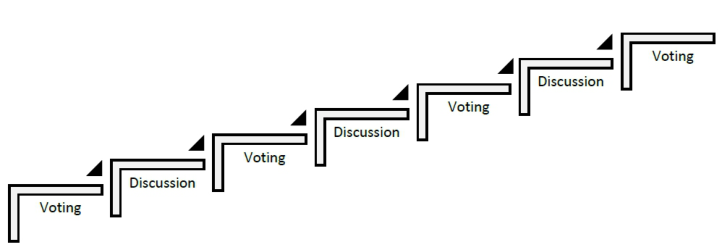
Deliberative Model – A Discourse Theory of Democracy The concept of deliberative politics goes beyond the republican ethical self- clarification idea and is based on the endless variability of communication forms between individuals, social and ethnic groups, cultures. Deliberative politics is strongly dialogical that, if institutionalized, accommodates instrumental, procedure- and rule-based deliberative politics (Cohen, 1996, 1998). Consequently, the institutionalized opinion- and will-formation acquires legitimacy. The discourse theory of democracy integrates together the advantages of both liberal and republican models into the concept of an ideal procedure for deliberation and decision-making. According to this proceduralist view, practical reason withdraws from universal human rights or from the concrete ethical life of a specific community into the rules of discourse and forms of argumentation that borrow their normative content from the validity-basis of communicative action to reach understanding. It is highly important for Habermas that this structure of democratic process paves the way to different normative conceptualizations of state and society (Habermas, 1998, p. 246). He assumes that argumentation is not unique and can be decoupled from specific ethical contexts of disparate political communities to become a more universal communicative (linguistic) practice of reaching understanding through making claims to the validity of shared truths. We argue that the acts of (a) initial claim-making and (b) subsequent claim-validation serve as the forms of reasoned argumentation. The understanding achieved through such claim-based argumentation can be institutionalized in both government structures and broader society alike. A possible course of such institutionalization is proposed by David Miller (Miller, 1992) to include deliberation inside the already institutionalized process of voting and the rules of vote count. Specifically, he suggests alternating discussion and voting as a means of conflict resolution between different political preferences that cannot be resolved by voting alone. The repeated sessions of deliberation and vote counts last until the participants’ positions become closer to one another. That would also help eliminate the liberal democracy’s problem of majoritarian voting and strategic manipulation during the voting. It’s impossible, for example, through the majority voting to reach fair compromises and find the ‘objectively correct’ answer among many conflicting political preferences due to the very impossibility of having the ‘right’ answer in principle (Miller, 1992, p. 55). This fundamental problem of liberal democracy can be overcome with the help of the epistemically informed deliberation that encourages the transformation of initial political preferences before the final vote takes place. Such a transformation can be measured through the process of claim making and validation. The entire
152 Misnikov and Samoilava
procedure is imagined as an algorithmic ladder to aggregate opinion, with the steps representing voting and deliberation (Figure 1).
Figure 1: The process of opinion aggregation based on alternating discussion and voting.
Eventually, voting ceases to be the sole democratic procedure to solve political problems of decision-making if and when complemented by discussion, which can be initiated as many times as needed to reduce political polarization to the acceptable to all extent.
VALIDITY CLAIMS AS DISCURSIVE ARGUMENTATION Claims to Normative Rightness
Public debate is realized discursively by making three types of basic claims to validity. Type 1 claims the validity of objective (propositional) truths, i.e. when the speaker refers to the totality of objects or existing states of affairs in the objective world. Type 2 claims the validity of intersubjective normative rightness (i.e., shared values), i.e. when the speaker refers to the totality of shared interpersonal relationships of social groups. Type 3 claims the validity of individual experiences (subjective truthfulness and sincerity), i.e. when the speaker refers to the totality of personal worlds (Habermas, 1984, pp. 313– 314, 1987, p. 52). All these validity claims serve as the discursive vehicles via which participants connect their personal real-world practices with broader worldview perspectives discursively in the public sphere as a common communication space reserved exclusively for citizens’ lifeworld in Habermas’ terminology (Misnikov, 2012, 2013). We are interested only in identifying Type 2 claims that are always disputable and seek reciprocal reaction through the act of claim validation from other participants to either support the claim or reject it. The claim validation acts build intersubjective solidarities, coordinate social actions, achieve mutual understanding (not necessarily consensus). Linguistically it can be expressed in the endless variations of words and sentences, whereas semantically it can be usually reduced to shorter validity claim statements. From the boarder perspective, such claims serve as a collectively implemented public reasoning and dialogical recognition in everyday communicative practice, especially online.
Designing a New Generation of AI-Aided e-Participation Public Services 153
Validation of claims to normative rightness is done usually through agreements and disagreements that are mutually interdependent. They should not be viewed in isolation as stand-alone utterances separated from the claims already made earlier. Agreeing and disagreeing leads to the formation of at least two issue-based virtual intersubjective solidarity communities, with one being “For” something and another “Against” something. There are many different solidarities exist in any political community.
The analytical and empirical benefit of claim-making lies not only in revealing the issues that participants identify themselves as problematic during the debate, but also in the possibility to measure the extent of their support (or the lack of it) to such issues (Misnikov, 2013, p.141). Otherwise speaking, the claim-based method can gauge the discursively formed opinions and their respective solidarities empirically.
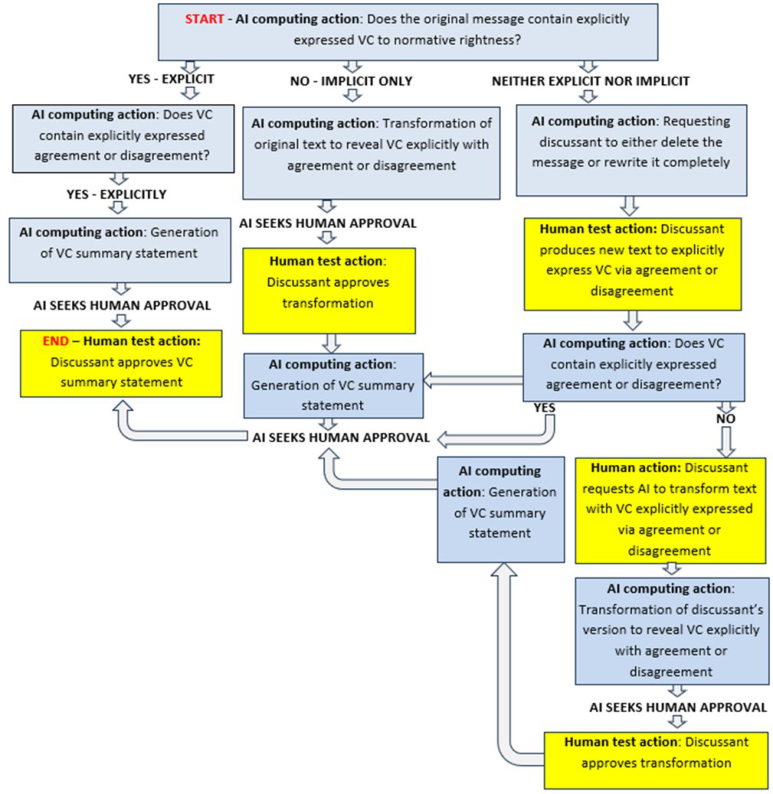
Use of AI for Improving Deliberative Argumentation and User Experience Algorithmically, the logic of training and using artificial neural networks could be deconstructed into a series of the AI actions, on the one hand, and the Human test actions (Figure 2).
One of the most useful outcomes of AI use could be to provide automated summaries of original messages and further transform them into the validity claim statements; that is, to perform a semantic aggregation of the endless linguistic variation of the original textual content contained in posted message to uncover the presence or absence of validity claims to normative rightness. These summaries would be checked by the author of the post as a human test action to confirm the aggregation correctness; if the summarized content is not sufficiently accurate, there is a possibility to correct it again as many times as needed and then confirm as final. The next AI action generates a brief claim statement based on the message’s summary. Again, the author of the message could edit it in person or ask AI to do it instead until satisfied with the wording and intended meaning. Additionally, AI might make a cross-claim analysis comparing different claim-based intersubjective solidarities and thus gauge how closer or farther the discussants have become to one another collectively. There could be a range of other indicators, such as, the number of validated positions through agreement and disagreement in general and in relation to each claim.
The key objective of the repeated discussion-voting rounds would be to limit the initial range of preferences and find an acceptable solution easier and quicker (Miller, 1992). Neutrality of AI may also help overcome the lack of trust between political opponents. Discussants can turn to, for example, a specialized AI-based chatbot or a general-use applications like ChatGPT to seek aid in situations when they exhaust their arguments and ideas for new claims. The artificial neural networks trained on Large Language Models (LLM) seem capable of generating such arguments for discussants drawing on other contexts and experiences.
154 Misnikov and Samoilava
Figure 2: An algorithmic example of AI and human test actions to identify validity claims.
CONCLUSION
It is generally agreed that digital technologies are not only changing many traditional perceptions about social, economic and political conditions but are also transforming the very nature of these conditions. However, opinions differ regarding the perceived direction of such transformation and whether technology can help support democratization. Perhaps pessimism prevails today precisely due to the dominant focus on technical affordances and benefits of digital technology rather than on such political problems as democratic deficit and discontents in today’s liberal democracy (Coleman, 2017). To overcome this pessimism, we suggest reversing the logic of the traditional technology-first approach with the help of the controlled AI action. In this case, the technical features and affordances of digital
Designing a New Generation of AI-Aided e-Participation Public Services 155
media and medium that determine to a large extent the experiences of social interaction can be better exploited to diminish such technological determinism. Moreover, in doing so we also propose turning around the entire paradigm of deliberative argumentation by releasing the untapped potential of validity claims as discourse drivers that discussants can apply intuitively, naturally, casually. We believe that when it comes to the use of uncontrollable AI-generated outcomes, discourse participants need an opportunity to verify such outcomes through the human test action. Technically and psychologically, the prospect of long rounds of discussion and voting might be too demanding and time consuming for lay people and thus difficult to implement such practices in the real-world setting, be it online or offline. Our idea is that a controllable AI technology designed in the form of a new generation of e-participation public service can help support the debate in the event its discussants start lacking new claims and arguments to gradually become more conciliatory than combative, more friendly than hostile. The outcome of the AI-aided deliberation would be a semantically generalized collective judgement on conflicting preferences and problematic issues. Achieving such semantic clarity can be the main benefit of applying AI algorithms, which would help clarify and correct their own wording by making the intended meaning sharper. Eventually, the use of AI as described above may decrease the number of dissatisfied citizens who become more tolerable to others’ opinions during a meaningful debate and reduce political polarization with the help of a new smart e-participation public service.
REFERENCES
Atton, C. 2004. An alternative Internet: radical media, politics and creativity.
Edinburgh: Edinburgh University Press. Bellamy, C. (2000). “Modelling electronic democracy: Towards democratic discourses for an information age”, in: J. HOFF, I. HORROCKS, and P. TOPS, eds. Democratic governance and new technology: technology mediated innovations in political practice in Western Europe. New York: Routledge, pp. 34–55. Berelson, B. Lazarsfeld, P. and W. Mcphee. (1954). Voting: A study of opinion formation in a presidential campaign (midway reprinted, 1st edition). Chicago: University of Chicago Press. Budzynska, K. Reed, C. (2011). Speech Acts of Argumentation: Inference Anchors
and Peripheral Cues in Dialogue. Computational Models of Natural Argument: Papers from the 2011 AAAI Workshop, (WS-11-10), https://www.aaai.org/ocs/ index.php/WS/AAAIW11/paper/viewFile/3940/4244). Castells, M. 2001. The Internet galaxy: reflections on the Internet, business and society. Oxford and New York: Oxford University Press. Cohen, J. (1996). “Procedure and substance in deliberative democracy”, in:
S. Benhabib, ed. Democracy and difference: contesting the boundaries of the political. Princeton, NJ: Princeton University Press, pp. 95–119. Cohen, J. (1998). “Democracy and liberty”, in: J. Elster, ed. Deliberative democracy.
Cambridge: Cambridge University Press, pp. 185–231. Coleman, S. (2017). Can The Internet Strengthen Democracy? Wiley. Dahl, R. (1989). Democracy and its critics. Yale University Press.
156 Misnikov and Samoilava
Diefenbach, T. (2009). New Public Management in public sector organizations: The dark sides of managerialistic ‘enlightenment’. Public Administration, 87: 892–909. Dryzek, J. S. (1990). Discursive democracy: politics, policy, and political science.
Cambridge: Cambridge University Press. Habermas, J. (1984). The theory of communicative action. Reason and the rationalization of society (volume 1). Boston: Beacon. Habermas, J. (1987). The philosophical discourse of modernity. Polity Press,
Cambridge. Habermas, J. (1989). The structural transformation of the public sphere: an inquiry into a category of bourgeois society. Cambridge: Polity Press. Habermas, J. (1992a). Moral consciousness and communicative action. Cambridge:
Polity Press. Habermas J. (1992b). Concluding remarks. In: Calhoun C. (ed) Habermas and the public sphere, pp. 462–479. The MIT Press, Cambridge. Habermas, J. (1996). Between facts and norms: Contributions to a discourse theory
of law and democracy. Cambridge: Polity Press. Habermas, J. (1998). The inclusion of the other: Studies in political theory.
Cambridge: Polity Press. Habermas, J. (2006). Political communication in media society: Does democracy still enjoy an epistemic dimension? The impact of normative theory on empirical research. Communication theory, 16(4), pp. 411–426. Held, D. (2006). Models of democracy (3rd edition). Cambridge: Polity Press Jones, S. G. ed. (1998). CyberSociety 2.0: Revisiting computer-mediated communication and community. Thousand Oaks, London, New Delhi: Sage. Lucacs, J. A. (1979). “The monstrosity of government”, in: K. S. Templeton, ed. The
politicization of society. Indianapolis: LibertyPress, pp. 391–408. Macintosh, A. (2006). “eParticipation in policy-making. The research and the challenges, exploiting the knowledge economy: Issues, applications, case studies”, in: P. Cunningham & M. Cunningham, eds. eParticipation in policy-making: The research and the challenges. Amsterdam: IOS Press. Mariani, I., Mortati, M., Rizzo, F. and Deserti, A. (2024). “The Theoretical
Background of Design Thinking for Public Sector Innovation”, in: I. Mariani, M. Mortati, F. Rizzo, & A. Deserti (Eds.), Design Thinking as a Strategic Approach to E-Participation: From Current Barriers to Opportunities (pp. 57–74). Springer Nature. Marina, W. (1979). “Egalitarianism and empire”, i: K. S. Templeton, ed. The politicization of society. Indianapolis: LibertyPress, pp. 127–166. Mergel, I. Desouza, K. C. (2013), Implementing Open Innovation in the Public Sector:
The Case of Challenge.gov. Public Admin Rev, 73: 882–890. Mergel, Ines, Edelmann, Noella & Haug Nathalie, Defining digital transformation: Results from expert interviews, Government Information Quarterly, Volume 36, Issue 4, 2019. Miller, D. (1992). Deliberative democracy and social choice. Political studies, XL
(Special issue Prospects for democracy), pp. 54–67. Misnikov, Y. (2013). You Say ‘Yes’, I Say ‘No’: Capturing and Measuring Public Opinion through Citizens’ Conversation Online (on the Russian-Language LiveJornal Blogging Platform’. In ePart 2013 proceedings. Volume 8075 of the Lecture Notes in Computer Science series, Springer.
Designing a New Generation of AI-Aided e-Participation Public Services 157
Misnikov, Y. (2012). How to read and treat online public discussions among ordinary citizens beyond political mobilisation: Empirical evidence from the Russian-language online forums. Digital Icons: Studies in Russian, Eurasian and Central European New Media, 7: 1–37 (2012), http://www.digitalicons.org/ issue07/yuri-misnikov. Mouffe, C. (2000). The Democratic paradox. London: Verso. Mutz, D. (2006). Hearing the other side: deliberative versus participatory democracy? Cambridge: Cambridge University Press. Oakeshott, M. (1979). “The masses in representative democracy”, in: K. S. Templeton, ed. The politicization of society. Indianapolis: LibertyPress. Snaith, M. Lawrence, J. and Reed C. (2010). “Mixed Initiative Argument in Public
Deliberation”, in: De Cindio, F., Macintosh, A., Peraboni, C. (eds.) From e-participation to Online Deliberation, Proceedings of the Fourth International Conference on Online Deliberation, OD 2010, pp. 2–13. University of Leeds and Universita Degli Studi Di Milano. UN DESA (2024). E-Government Survey 2024: Accelerating Digital Transformation for Sustainable Development. With the addendum on Artificial Intelligence. New York. available at https://publicadministration.un.org/egovkb/en-us/Reports/UN- E-Government-Survey-2024.
LISTED IN THE AHFE DIGITAL BOOKSTORE CATALOGUE
Explore the complete digital volume
The Human Side of Service Engineering
Read this individual research paper free through the original publisher, or explore the full digital proceedings book.
ISBN 978-1-964867-58-8
Explore this ISBN in the AHFE Bookstore ↗Listed in the July 2026 bookstore catalogue; search by ISBN to confirm current availability · Digital book purchase optional