Yuqing Zhang, Shengfeng Qin, Chenyu Ge (2025). Leveraging Digital Twins and Generative AI to Alleviate Loneliness Among Elderly Adults Living Alone Through Smart Flowerpot Design. In: Human Factors and Systems Interaction. AHFE Open Access, vol. 192, pp. 99–107. https://doi.org/10.54941/ahfe1006632
Loneliness and Social Isolation from elder people present a critical factor in different diseases of aging, necessitating tailored intervention for individuals to effectively engaging with interventions and interacting to their stakeholders. A great deal of research efforts has been made to tackle the challenging issues related to loneliness and social isolations of elder people, mainly focusing on develop various personal and group interventions such as social robots, group/community activity interventions, serious games, and Chatbots. The key barrier to have long-term impacts from these interventions is to make interventions adaptable to individual’s personal needs, scenarios/environments and contexts. To overcome the barrier, how to design adaptable interventions and implement interventions adaptably to meet a person’s needs is a great research question. This research aims to address this research question by (1) applying adaptable design principles into smart intervention design of a smart flowerpot or pet plant, enabled by generative AI and reconfigurable design, (2) applying digital twin technology to create a user’s personal replica with only needed information to support personalized intervention adaption. The objective is to create a smart service system/platform based on Digital Twins and Generative AI to effectively design and deliver smart interventions, for and with elderly individuals and their stakeholders in a smart service ecosystem way. The smart flowerpot is purposely designed to make it like a normal pot flower like most families having them at home, its visitor/user can trim, water, move and care it. The home users typically visit their home flowerpots regularly if not daily. And if a flowerpot becomes very attractive to its users, it can become a pet plant befriending with its users. Some reports already indicates that pet plant can be a useful means for companying elder people at home and make flowerpot-based intervention easier to adapt. On the other hand, to turn an ordinary home flowerpot into a smart flowerpot, we design a special structure for a flowerpot, which not only support a normal flower plant to grew but also can smartly interact with its users/visitors/cares. Within the structure, we equip some IoT sensors to sense a visitor presence, and then connect to the visitor’s personal digital twin to gain better understanding of the visitor’s needs, and finally feed the user’s needs into generative AI and reconfigurable designed elements to provide personalised interventions such as coloured light, display patterns, background music and chats generated by generative AI, etc. This paper presents our research processes, methods and evaluations via a smart flowerpot design, development and testing. The qualitative evaluation shows that our proposed adaptable intervention design and implementation system enabled by digital twin and generative AI technologies has a great potential of bettering understanding of a user’s needs, user engagement with interventions and user experience. Thus, this research has the potential to herald a new era in healthcare for the aging population, fostering smooth smart service and improved quality of life for older adults.
With the intensification of global aging, the issues of loneliness and social isolation among the elderly are becoming increasingly prominent. Loneliness not only affects the mental health of older adults but is also closely associated with various aging-related diseases, such as depression, cardiovascular disease, and cognitive decline (Teguo et al., 2016). In response to these challenges, recent studies, including “Mitigating Social Isolation and Loneliness Through Smart Technology for Aging-in-Place” (Durak, 2024), have explored the role of smart technology in alleviating loneliness and enhancing social engagement among older adults. As research in this field continues to expand, developing effective strategies to mitigate elderly loneliness remains a crucial area of study.
The primary challenge in addressing loneliness and social isolation among elderly adults is the development of interventions that can adapt to the unique personal needs, environments, and contexts of individuals. Current interventions often lack the flexibility required to provide personalized and sustained support. For example, while social robots can provide
companionship, they may not adapt to the changing emotional states or preferences of the user over time (Blanco et al., 2024). Loneliness and social isolation are prevalent among elderly adults, with significant implications for their physical and mental health. Research has shown that these conditions are associated with increased risks of depression, cognitive decline, and mortality (Cacioppo & Cacioppo, 2018). The COVID-19 pandemic has further exacerbated these issues, as many elderly individuals were forced to isolate themselves to avoid health risks.
Various interventions have been developed to address loneliness and social isolation, including social robots, group activities, serious games, and chatbots. While these interventions have shown some success, they often lack the adaptability required to meet the diverse needs of elderly individuals. For example, social robots like PARO have been used to provide companionship, but they are limited in their ability to adapt to the changing emotional states of users (Shibata & Wada, 2011).
Digital twin (DT) technology involves creating a virtual replica of a physical entity, enabling real-time monitoring and analysis. This technology has been widely used in industries such as manufacturing and healthcare to optimize processes and improve outcomes (Grieves, 2014). Generative AI, on the other hand, involves the use of algorithms to generate new content, such as text, images, and music. The integration of these technologies offers new possibilities for personalized interventions, particularly in the context of elderly care.
DT is being applied in healthcare on a growing scale to enable real-time monitoring, predictive diagnosis, and tailored care plans (Venkatesh et al., 2023). In elderly care, DT is capable of simulating an individual’s daily activities, detecting anomalies in behavior, and adjusting care interventions accordingly (Lazarev & Kalininskaya, 2024). With IoT sensors embedded in intelligent environments and wearables, DT and AI-enabled intervention systems can better support independent living in older adults by minimizing the dangers of social isolation and promoting adaptive care practices.
Moreover, generative AI has been used increasingly to enable improved human-AI interaction through dynamic, emotionally intelligent dialogue. Research indicates that conversational agents based on AI improve engagement and mental well-being in older adults through companionship and cognitive stimulation (Shimizu et al., 2024). The AI models have also been proved to reduce caregiver stress by automating tailored interventions in healthcare, thus streamlining care processes without neglecting personalized care (Khan et al., 2024). One study recently tested AI-driven photo-based dialogues, where older adults engaged meaningfully with AI agents capable of scanning photos and offering conversational prompts. Findings suggest that older adults respond positively to AI that simulates humans, further proving that AI-driven social interventions have the potential to enhance emotional well-being (Shimizu et al., 2024).
However, the challenges of making the DT and AI-enabled interventions acceptable by the older users are twofold. First, the intervention service interfaces need as natural as possible for delivering useful functions. And the second is to have good means to address personal data and privacy concerns.
Leveraging Digital Twin and Generative AI to Alleviate Loneliness 101
To meet these challenges, we propose a smart flowerpot solution situated in a home environment to provide useful interventions to the user via natural interactions and serve as an information hub connecting with the user’s personal digital twin to facilitate various interventions among, the user, the flowerpot, the user’s caregivers, and the community support services. In this paper, we first review users pain points in their daily life when living along, existing interventions and their limitations. Then we conduct a conceptual design of the smart flowerpot and its qualitative evaluation via a Focus group. And finally, we discuss its potential future work.
RELATED WORK
Recent advancements in machine learning and AI have significantly impacted healthcare, particularly predictive analytics, patient monitoring, and elderly care. Hospital readmissions have been increasingly being predicted through machine learning models based on EHR and wearable sensor data analysis, improving earlier intervention and reducing healthcare costs (Shickel et al., 2018). AI-driven systems, for instance, CarePredict, leverage wearable sensors to monitor daily activities and detect behavior anomalies, such as falls and abnormal patterns of change in movements, thus enhancing patient safety and detection of deteriorating health at an earlier point (CarePredict, 2023). AI chatbots, for example, Medisafe, deliver personalized reminders on medications and education to facilitate drug adherence, addressing one of the largest challenges in elderly care (Medisafe, 2022).
At the same time, intelligent healthcare devices have been on the increase in elderly care systems. Intelligent pill dispensers, for instance, such as Hero, apply machine learning to learn users’ drug regimens and remind users in real time, encouraging compliance and minimizing the likelihood of human errors (Hero Health, 2023). Social robots, too, such as ElliQ, with NLP abilities, interact with older adults daily and assist in maintaining social connections, basically easing feelings of loneliness and isolation (Intuition Robotics, 2023). Beyond social interaction, conversational agents based on AI, such as Woebot, provide cognitive behavior therapy (CBT) to patients with depression and anxiety, demonstrating the potential of AI in mental care interventions (Fitzpatrick et al., 2017).
AI-driven computer vision technologies have also enhanced fall detection and monitoring in real time. Intelligent home cameras’ video streams are now processed by deep learning algorithms to detect falls with high accuracy, reducing emergency response times significantly (Aziz et al., 2021). Similarly, wearable devices such as the Apple Watch feature AI-driven fall detection features, automatically initiating emergency calls when sudden falls occur (Apple, 2023). Outside of personal monitoring, AI systems such as IBM Watson Health scan large EHR data collections to recommend customized treatment plans, optimizing medical decision-making and outcomes (IBM, 2023). Moreover, predictive analytics solutions have been applied to identify high-risk patients, enabling healthcare professionals to implement preventive interventions in advance (Rajkomar et al., 2019).
AI voice assistants have also been effective tools in elderly care. Intelligent devices such as Amazon’s Alexa and Google Home enable older adults to
carry out daily tasks, remind them of appointments, and change intelligent home settings using voice commands, hence enhancing accessibility and convenience (Amazon, 2023). AI systems such as SafelyYou also utilize computer vision to continuously detect and prevent falls, offering a proactive solution to elderly safety in home and institutional care (SafelyYou, 2023).
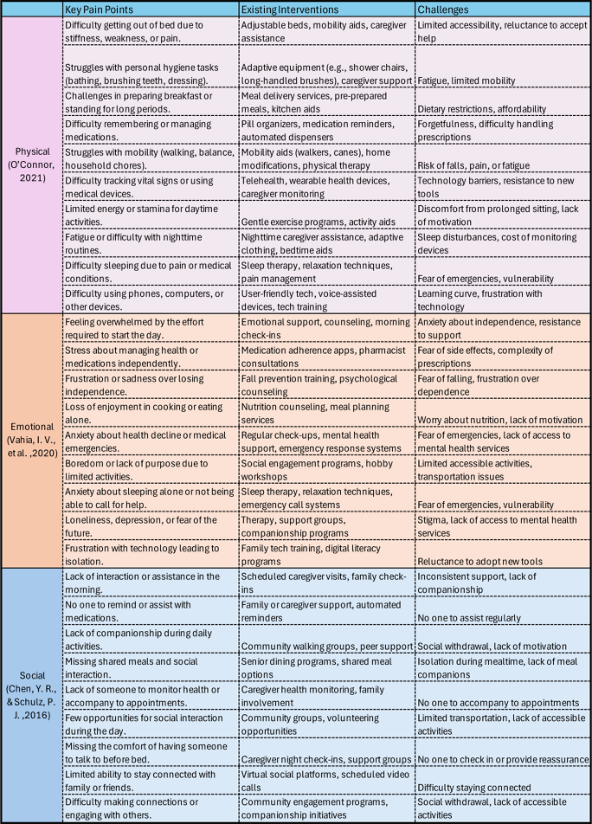
Despite all these technological advances, several challenges remain in the adoption and utilization of AI-driven healthcare solutions. Issues of data security and privacy are some of the major concerns, as AI systems require constant data collection and processing, which creates issues of consent and confidentiality. Additionally, technological illiteracy concerns with elderly patients have also been a hindrance to adoption, as elderly patients struggle to navigate AI-enabled systems. The cost of intelligent devices, as well as compatibility issues with existing healthcare infrastructures, also limit accessibility and scalability. More importantly, current research is unable to provide personalized services with natural interactions. The key pain points, existing interventions and their challenges are summarized in Figure 1.
Figure 1: Common pain points, existing interventions and challenges.
Leveraging Digital Twin and Generative AI to Alleviate Loneliness 103
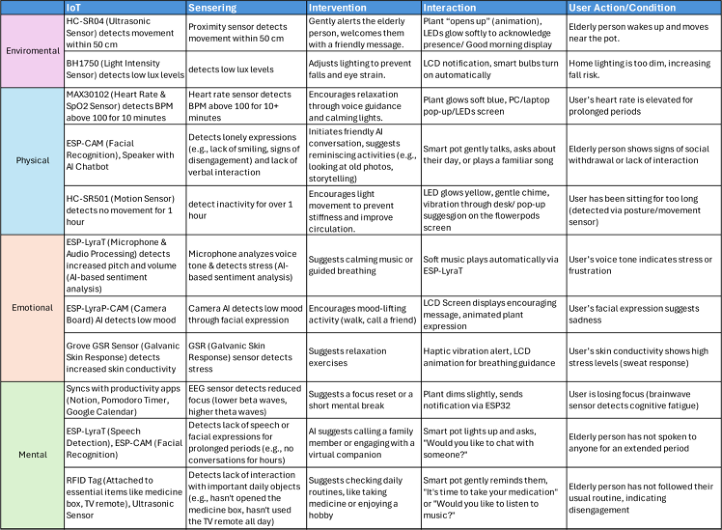
SMART FLOWERPOT CONCEPTIAL DESIGN The integration of artificial intelligence (AI) into everyday objects has paved the way for innovative solutions in elderly care, with the smart flowerpot emerging as a holistic system that combines emotion detection, health monitoring, social interaction, and plant care assistance. This design leverages AI-driven analytics, IoT sensors, and an intuitive user interface to enhance the well-being of elderly users. A key feature of the smart flowerpot is its ability to detect emotions through IoT and DT, which analyze the context. AI models process these inputs to infer emotional states, prompting the flowerpot to respond with calming LED lights, soothing sounds, or gentle movements. Additionally, health monitoring is facilitated through sensors that measure heart rate, temperature, and air quality, with AI algorithms analyzing these data points to detect anomalies (see Figure 2). In the event of irregularities, timely alerts are sent to caregivers, enabling early intervention and improved safety.
Figure 2: Functions of the smart flowerpot.
Beyond health monitoring, the smart flowerpot functions as a medication reminder, synchronizing with a mobile application to provide subtle visual or auditory cues, ensuring adherence to medication schedules. Social interaction is further enhanced through an integrated voice assistant, enabling natural conversations and facilitating message exchange with family members, who can send photos, text, or voice notes. These messages can either be displayed on a screen or read aloud, fostering a sense of connection and reducing social
isolation. In addition to its role in human interaction, the smart flowerpot assists in plant care by monitoring soil moisture, light, and temperature levels, offering personalized care recommendations to encourage user engagement and a sense of responsibility.
Designed for intuitive and accessible interaction, the smart flowerpot enables users to engage through voice commands, LED signals, and gentle vibrations. Accessibility features, such as large manual buttons, voice feedback for visually impaired users, and a simplified setup process, ensure ease of use, particularly for older adults with cognitive or physical limitations. To foster emotional engagement, personalization options allow users to name their flowerpot and select from various AI-generated personalities, while growth feedback features provide notifications on plant development, reinforcing a sense of achievement and companionship.
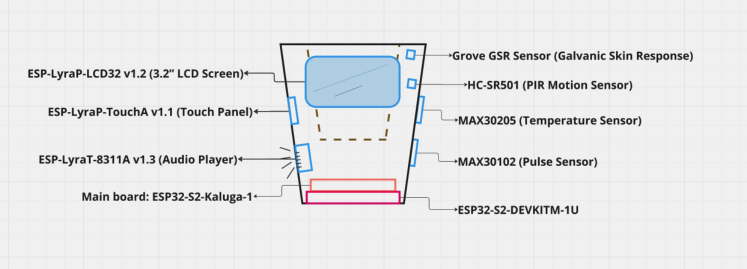
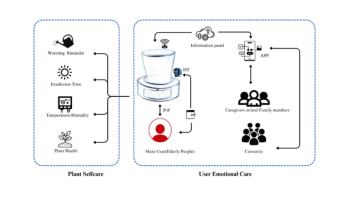
The hardware components of the smart flowerpot include sensors for soil moisture, temperature, heart rate, and emotion along with actuators that enable dynamic responses such as adjusting lighting, playing sounds, or initiating gentle movement (see Figure 3 and Figure 4). AI algorithms process real-time data to optimize emotion recognition, health monitoring, and plant care recommendations, while cloud-based infrastructure ensures secure data storage, remote monitoring, and seamless caregiver communication. Figure 3 indicates some IoT sensors design for support the above functions realization. Figure 4 shows the system framework.
Figure 3: Sketch of the smart flowerpot structure.Figure 4: Framework of the smart flowerpot system.
Leveraging Digital Twin and Generative AI to Alleviate Loneliness 105
QUALITATIVE EVALUATION A qualitative evaluation of our conceptual design was conducted with a Focus group in a controlled laboratory setting to assess the initial functionality of the smart flowerpot, ensuring that its design, structure, embedded sensors, and interactive features operated as intended. This focus group studied involved researchers and developers testing core components, including emotion detection, health monitoring, and social interaction capabilities. The primary objective was to verify system responsiveness, sensor accuracy, and AI-driven interactions before engaging end users in a more iterative, user- centred design process. Preliminary findings confirmed that the integrated sensors effectively captured environmental and physiological data, with heart rate, and soil moisture measurements aligning with expected outputs. The emotion detection system responded to distinct facial expressions and voice modulations and biological data, activating corresponding interventions such as LED adjustments and audio feedback. However, inconsistencies in detecting subtle emotional states highlighted the need for further refinement in AI processing. Additionally, leveraging DT technology to better understand user context and implementing GAI for personalized interactions require deeper exploration to enhance adaptability and responsiveness. Further research is needed to optimize these technologies, ensuring a more intuitive and context-aware user experience.
Despite the overall success of the conceptual design validation, areas for improvement emerged. The accuracy of emotion recognition requires optimization to minimize misclassification, and the responsiveness of the voice assistant needs enhancement for smoother interactions. Adjustments to sensor calibration are also identified to ensure long- term stability. Additionally, while the design effectively concealed embedded technology, further refinements in material selection and form factor have been suggested to enhance aesthetic appeal and usability.
These insights provide a foundation for the next phase, which will adopt a user-centred and co-design approach with elderly participants to refine interaction models, personalize AI responses, and ensure the system aligns with real-world user needs. By integrating direct user feedback, future iterations will enhance accessibility, engagement, and ethical considerations, ultimately improving the smart flowerpot’s effectiveness as a supportive tool for elderly well-being.
DISCUSSION
The qualitative evaluation of the smart flowerpot prototype revealed that the system has significant potential to enhance user understanding, engagement, and experience. Participants reported feeling more connected and engaged with the flowerpot, and appreciated the personalized interventions. Many participants believe that the flowerpot can provide a sense of companionship and reduce feelings of loneliness. Some participants suggest additional features, such as the ability to customize the flowerpot’s appearance or integrate it with other smart home devices.
While the results are promising, there are some limitations to the study. The sample size was relatively small, and further research is needed to evaluate the effectiveness of the smart flowerpot via its further developed functional prototypes in terms of alleviating loneliness and social isolation.
This paper presents the conceptual design of a smart flowerpot, and its development framework for evaluating its effectiveness and usability. Our future work is to apply user-centred design processes and methods to further develop functional prototypes for evaluation and feedback in an iterative improvement process. The functional prototypes of the user digital twins and AI tools will be integrated into our future research work.
ACKNOWLEDGMENT
The author extends sincere appreciation to a colleague for their constructive feedback and insightful discussions during the preparation of this paper. Additionally, the author acknowledges the use of OpenAI’s ChatGPT-4o for language enhancement, grammar correction, and content suggestion. All AI- assisted content were critically reviewed, manually verified, and incorporated only when aligned with the author’s academic standards and the paper’s scholarly objectives.
REFERENCES
Arrieta, A. B., et al. (2020). Explainable artificial intelligence (XAI): Concepts, taxonomies, opportunities, and challenges toward responsible AI. Information Fusion. arXiv:1910.10045v2. Blanco, A., Pérez, G., & Condón, A. (2024). AI-enhanced social robots for older
adults care: Evaluating the efficacy of ChatGPT-powered storytelling in the EBO platform. IEEE International Conference on Robot and Human Interactive Communication, Pasadena, CA. Cacioppo, J. T., & Cacioppo, S. (2018). The growing problem of loneliness. The Lancet, Volume 391, No. 10119. Crista, V., Martinho, D., & Marreiros, G. (2024). A multi-agent system approach
with generative AI for improved elderly daily living. Portuguese Conference on Artificial Intelligence, Volume 14967, pp. 128–140. Fitzpatrick, K. K., et al. (2017). Delivering cognitive behavioral therapy to young adults with symptoms of depression and anxiety using a fully automated conversational agent (Woebot): A randomized controlled trial. JMIR Mental Health, Volume 4, No. 2. Goodfellow, I., Pouget-Abadie, J., Mirza, M., Xu, B., Warde-Farley, D., Ozair, S.,...
& Bengio, Y. (2014). Generative adversarial nets. Advances in Neural Information Processing Systems, Volume 2, pp. 2672–2680. International Conference on Neural Information Processing Systems, Montreal, QC. Grieves, M. (2014). Digital twin: Manufacturing excellence through virtual factory replication. White Paper, pp. 1–7 Holt-Lunstad, J., Smith, T. B., Baker, M., Harris, T., & Stephenson, D. (2015).
Loneliness and social isolation as risk factors for mortality: A meta-analytic review. Perspectives on Psychological Science, Volume 10, No. 2.
Leveraging Digital Twin and Generative AI to Alleviate Loneliness 107
Khan, M. A., Din, I., Khan, N. A., Hassan, S., & Almogren, A. S. (2024). Adaptive generative AI for elderly-assisted living environments: A proactive approach.7th International Conference on Internet Applications. 7th International Conference on Internet Applications, Protocols, and Services (NETAPPS), Kedah Darul Aman, MY. Killough, A., Barja, A., & Gurocak, H. (2024). Smart flowerpot as an IoT device
for automatic plant care. International Conference on Automation, Robotics and Applications, Helsinki, FI. Lazar, A., et al. (2021). Designing for older adults: Principles and creative human factors approaches. PP. 296. Lazarev, A. V., & Kalininskaya, A. A. (2024). The digital health care and digital twins
as its components: A systematic review. Problemy Sotsial’noi Gigieny. Volume 32, No. 3. Li, Y., Luo, J., Liu, Z., Wu, D., & Zhang, C. (2023). A personalized and smart flowerpot enabled by 3D printing and cloud technology for ornamental horticulture. Volume 23, No. 13. Mitzner, T. L., Boron, J. B., Fausset, C. B., Adams, A. E., Charness, N., Czaja,
S. J.,... & Sharit, J. (2010). Older adults talk technology: Technology usage and attitudes. Computers in Human Behavior, Volume 26, No. 6. Rajkomar, A., et al. (2019). Machine learning in medicine. New England Journal of Medicine. Volume 380, No. 14. Serdyuk, K., & Klymenko, S. (2024). Development and implementation of an
autonomous smart flowerpot. International Scientific Conference on Information Technologies. Kyiv, UA. Shibata, T., & Wada, K. (2011). Robot therapy: A new approach for mental healthcare of the elderly – A mini-review. Gerontology, Volume 57, No. 4. Shickel, B., et al. (2018). Deep EHR: A survey of recent advances in deep learning
techniques for electronic health record analysis. IEEE Journal of Biomedical and Health Informatics. Volume 57, No. 5. Shimizu, K., Ami, B., Dongeun, C., Iwamoto, M., Kusaka, N., Siriaraya, P., & Kuwahara, N. (2024). Exploring photo-based dialogue between elderly individuals and generative AI agents.International Journal of Advanced Computer Science and Applications, Volume 15, No. 7.
LISTED IN THE AHFE DIGITAL BOOKSTORE CATALOGUE
Explore the complete digital volume
Human Factors and Systems Interaction
Read this individual research paper free through the original publisher, or explore the full digital proceedings book.
ISBN 978-1-964867-68-7
Explore this ISBN in the AHFE Bookstore ↗Listed in the July 2026 bookstore catalogue; search by ISBN to confirm current availability · Digital book purchase optional